rand/
mnemosyne

rand/mnemosyneConnectors
Mnemosyne is a agentic memory and orchestration system designed to provide Claude Code with persistent semantic memory across sessions.
86
Mnemosyne is a agentic memory and orchestration system designed to provide Claude Code with persistent semantic memory across sessions.

MCP server for persistent Julia sessions — fast iteration without startup/compilation overhead
Bridge Claude Code/Codex sessions to a Feishu (Lark) bot

A Model Context Protocol server that executes commands in the current iTerm session - useful for REPL and CLI assistance
Correction-first persistent memory for AI agents. MCP server + SDK + CLI. Compounds across sessions.
A headless browser for AI agents that fetches modern web pages, runs JavaScript, manages sessions, and returns token-efficient Markdown.
Stop babysitting local AI agents. Just notifications, approve, and resume your Codex,Pi,Grok, or Claude code sessions anywhere. 0-Intrusion mobile control bridge via Telegram/微信/飞书. No hooks, no skills, no MCP.

Self-correcting learning engine for Claude Code — persistent identity, behavioral pattern tracking, and cross-session memory

Persistent session memory for AI coding agents — local-first, with on-device inference, associative recall, and drift detection. Works with Claude Code, Cursor, and Codex.

MCP server providing kanban-based task management memory for complex multi-session workflows with AI agents
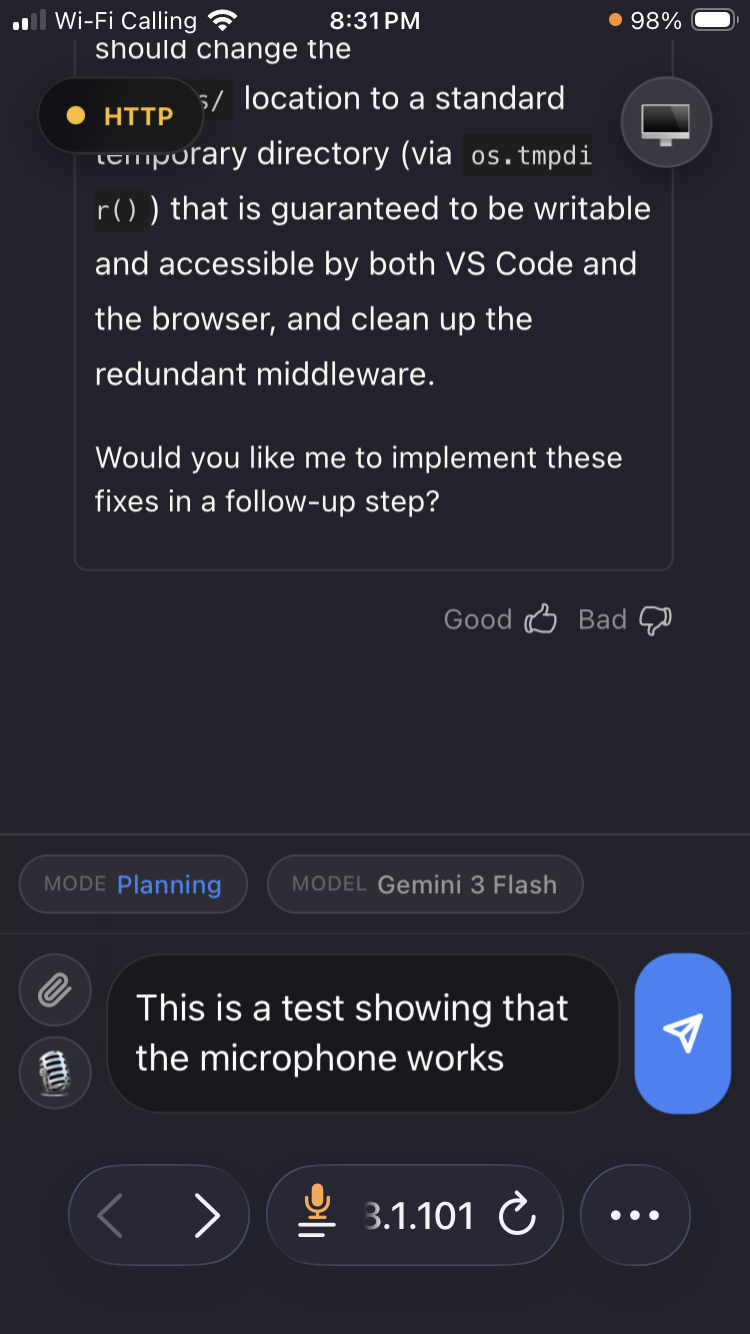
Mobile companion for Google's Antigravity IDE. Mirror AI sessions on your phone, send messages, stop generation, automate via 9 MCP tools or OpenAPI.
MCP server for Linux desktop GUI automation on KDE Plasma 6 Wayland -- 30 tools for virtual and live sessions

HTTP bridge powering OpenClaw's AI agents via Claude Code CLI — manages persistent sessions, auto-resume, extended thinking, and provides a real-time React dashboard with per-agent cost tracking. Exposes an OpenAI-compatible API.

Turn your team's AI coding sessions, GitHub code, and docs into one shared, searchable memory — a self-hosted git truth store you query right from your editor over MCP.
Synapse is a local-first personal memory operating system designed for AI agents. It provides durable, typed, and highly reliable long-term memory using only local SQLite — giving agents the ability to remember, update, and reason over facts across sessions with full user control.

Stop re-explaining your data to your AI every session. The individual-analyst context layer, delivered over MCP (Claude Code / Cursor / Codex).

Fixes prompt cache regression in Claude Code that causes up to 20x cost increase on resumed sessions
Local-first 3-in-1 AI memory layer & MCP server for Claude Code, Codex, Grok, Gemini, VS Code and Cursor. Fuses session history, codebase indexing & concept graphs in SQLite. Enables zero-cloud, privacy-first context & instant recall, supports multi-agent swarms.

Persistent, branch-aware workflow state memory MCP server for AI coding assistants. Tracks tasks, accepted decisions, and active blockers to prevent session context bloat and speed up development.
The Cursor10x MCP is a persistent multi-dimensional memory system for Cursor that enhances AI assistants with conversation context, project history, and code relationships across sessions.

Persistent memory graph for AI agents. Facts, decisions, entities, and relationships that survive across sessions, tools, and providers. MCP server — works with Claude, Cursor, ChatGPT, and any MCP client.

MCP-native code retrieval for AI agents — 84-88% fewer read tokens, BM25F + semantic search, AST chunks, session dedup
An agentic memory database that cuts session tokens by 82–99%. One portable SQLite file — your agent's memory, anywhere.

First open-source OpenEvidence MCP server: browser-session medical research tools for Codex, Claude Code, and MCP clients