

koala73/worldmonitorConnectors
Real-time global intelligence dashboard. AI-powered news aggregation, geopolitical monitoring, and infrastructure tracking in a unified situational awareness interface
86k
MARM Memory is a local-first memory layer and MCP server for coding agents. It stores sessions, notes, project history, and concept links in SQLite, then serves them back through HTTP or STDIO so your agent can recall context instead of starting over. It also indexes repositories into a code graph, so agents can look up symbols, trace paths, and follow project structure. The bundled console lets you inspect memories, graphs, and indexed projects, and the server supports shared multi-agent setups as well as private local use.

Builders who want their agent to remember past sessions, index codebases, and share context across Claude Code, Codex, Cursor, Gemini CLI, or other MCP clients.
You can keep project context, code structure, and prior decisions available across chats instead of re-explaining everything.
Stores conversations, notes, notebooks, summaries, and semantic memories in a local SQLite-backed store.
Indexes repositories, tracks symbols, follows code paths, and keeps project structure available for recall.
Extracts people, decisions, errors, and ideas from stored memories and links them back to code when possible.
Serves the same tools over HTTP and STDIO so different clients can connect locally or through a shared server.
Provides `swarm`, `swarm-max`, and `trusted` profiles for shared or high-throughput agent use.
Offers a local UI to browse memories, knowledge graphs, and indexed projects.
Includes the `marm-init` skill to help agents set up MARM from chat.
pip install marm-mcp-server
marm-memory init --g-claude --g-codex --g-gemini
pip install marm-mcp-server
pip install marm-mcp-server
marm-memory start
# Stuck on client setup? Open a Q&A thread: https://github.com/Lyellr88/marm-memory/discussions
# most agents use this --transport command
"agent" mcp add --transport http marm-memory http://localhost:8001/mcp
codex mcp add marm-memory --url http://localhost:8001/mcp
pip install marm-mcp-server
python -m marm_mcp_server.server_stdio
# most agents use this --transport command
"agent" mcp add --transport stdio marm-memory-stdio marm-mcp-stdio
codex mcp add marm-memory-stdio -- marm-mcp-stdio
# --swarm: write queue on, 200 RPM - recommended for multi-agent shared servers
docker run -d --name marm-mcp-server \
  -p 127.0.0.1:8001:8001 \
  -e SERVER_HOST=0.0.0.0 \
  -e MARM_API_KEY=your-generated-key \
  -v ~/.marm:/home/marm/.marm \
  lyellr88/marm-mcp-server:latest --swarm
marm_graph_index(repo_path="/workspace/marm-memory")









Contributions welcome! Browse open issues to contribute, or join the MARM Discord to share workflows, get setup help, and connect with other builders.
pip install marm-mcp-server
marm-memory init --g-claude --g-codex --g-gemini
Also available: --g-qwen and --g-kiro. Run without flags to install into your current project folder instead of home
"Use the marm-init skill to set up MARM."
Manual setup
Prefer to wire it up yourself:
Replace "agent" with your client’s CLI command (for example, claude, gemini, or qwen). For Codex, use codex mcp add marm-memory --url http://localhost:8001/mcp instead.
| If you are... | Start the server | Connect your MCP client |
|---|---|---|
| Solo developer / researcher | marm-memory start | "agent" mcp add --transport http marm-memory http://localhost:8001/mcp |
| Private local STDIO user | marm-mcp-stdio | "agent" mcp add --transport stdio marm-memory-stdio marm-mcp-stdio |
| Multiple agents sharing memory | marm-memory start --profile swarm | "agent" mcp add --transport http marm-memory http://localhost:8001/mcp |
| Private high-throughput swarm | marm-memory start --profile swarm-max | "agent" mcp add --transport http marm-memory http://localhost:8001/mcp |
| Trusted private lab/server | marm-memory start --profile trusted | "agent" mcp add --transport http marm-memory http://localhost:8001/mcp |
Your AI forgets everything. MARM Memory doesn't.
marm-memory gives your agents a private, shared memory for the context that normally gets lost between chats: decisions, research, fixes, notes, and project history. Switch from Claude Code to Codex or Gemini without losing the context already gathered.
It brings three things together:
All 14 tools work over HTTP and STDIO. Your agents share the same local memory across sessions instead of starting from scratch each time. The bundled Console App provides a browsable view of Memories, the Knowledge Graph, and Indexed Projects, including progress for graph builds and repository indexing. Indexing a repository creates its independent Code Graph, which you can explore from Knowledge Graph → Code Explorer even before storing any memories.
| Layer | What it does | Why it matters |
|---|---|---|
| Memory model | Sessions, structured logs, notebooks, summaries, and semantic memories | Keeps project history searchable instead of trapped in one chat |
| Scale layer | SQLite WAL mode, connection pooling, serialized write queue, and HTTP rate-limit presets | Lets one server support solo use, multi-agent work, and swarm-style bursts |
| Intelligence layer | FTS filter, semantic re-rank, bounded semantic fallback, auto-classification, write-time consolidation, and compaction candidates | Keeps recall useful as memory grows instead of letting duplicates pile up |
| Code graph layer | Repo indexing, symbol lookup, call tracing, architecture overview, and change-impact analysis | Gives agents project structure without rereading the whole codebase |
| Concept graph layer | Entity and relationship extraction from stored memories, with links back into the code graph | Connects decisions, errors, tools, and people across sessions instead of leaving them as flat text |
| Token layer | Lightweight 7-tool core surface (14 total with bundled graph tools), semantic re-rank before retrieval, and write-time deduplication | Reduces tokens sent to the model on every recall and cost stays predictable as memory scales |
| Deployment layer | Pip, Docker, STDIO, HTTP, and managed swarm, swarm-max, and trusted profiles | Lets you run private local memory or shared multi-agent memory with the same MCP surface |
See Performance & Scaling Benchmarks for retrieval latency, concurrency, and write-cost numbers, and Architecture & Internals for the mechanisms behind each layer.
marm-memory is the local runtime manager installed with the Python package. These are the normal operational commands; use marm-memory <command> --help for flags and command-specific examples.
Daily runtime work
marm-memory fast-start-http                # start HTTP, Console, and open the browser
marm-memory start                          # start or reuse the managed HTTP runtime
marm-memory start --profile swarm          # shared multi-agent preset
marm-memory stop                           # stop the managed runtime safely
marm-memory restart                        # restart the managed runtime
marm-memory status                         # inspect runtime, database, queue, and graph status
marm-memory logs --follow                  # follow bounded runtime logs
marm-memory console                        # start or reuse the bundled local Console
Transports and setup
marm-memory http                           # run HTTP in the foreground
marm-memory stdio                          # run the strict local MCP STDIO transport
marm-memory init                           # install the MARM skill into detected agents (project scan)
marm-memory init --g-claude                # install the skill into the home-folder claude directory
marm-memory doctor                         # diagnose the local install
marm-memory key init                       # create or reuse ~/.marm/.env without displaying the key
marm-memory key path                       # print the managed key-file path
marm-memory key reveal                     # explicitly display the managed key
marm-memory console --import-key           # open an authenticated local Console session
marm-memory upgrade --check                # compare the installed package with PyPI
marm-memory uninstall                      # preview package removal; always preserves ~/.marm
Knowledge, projects, and maintenance
marm-memory knowledge status               # Indexers, models, and how far behind automatic indexing is
marm-memory knowledge build --all          # Rebuild the whole concept graph (new memories index themselves)
marm-memory knowledge auto off             # Stop indexing memories automatically (on, off, status)
marm-memory projects list                  # List all tracked workspaces
marm-memory projects index <path>          # Add a repo to the code graph (kept current after that)
marm-memory projects status                # Inspect target repo graph readiness
marm-memory projects auto off              # Stop re-indexing repos automatically (on, off, status)
marm-memory maintenance status             # Check internal database optimization state
marm-memory maintenance embeddings migrate # Upgrade old 384-dim vectors to 512-dim
marm-memory maintenance chunks rechunk     # Recalibrate long memory text splits
Docker commands are documented separately below because they require explicit data mounts, network exposure, and key-handling choices.
MARM is tuned for fast recall first, even as memory grows and long memories are chunked behind the scenes.
These measurements use the fastembed-backed jinaai/jina-embeddings-v2-small-en encoder and a throwaway local SQLite database. Every timed path calls the shipped MARMMemory code, not a benchmark-local reimplementation. Sections 1-4 are timings from a single run of scripts/benchmarking/performance/bench_hotpath.py on local hardware; absolute milliseconds vary by machine, so treat the scaling shape as the signal. Section 5 is a separate accuracy benchmark (run_eval.py) measuring retrieval rather than speed, and its latest row is a controlled before and after, explained there.
End-to-end recall_similar latency (includes query encoding).
| Session Size ($N$) | Min Latency | Median Latency | p95 Latency |
|---|---|---|---|
| N = 100 | 7.4 ms | 7.9 ms | 9.4 ms |
| N = 250 | 11.9 ms | 13.5 ms | 15.4 ms |
| N = 500 | 10.9 ms | 11.8 ms | 13.4 ms |
| N = 1,000 | 13.3 ms | 13.5 ms | 15.6 ms |
| N = 2,000 | 17.5 ms | 18.2 ms | 19.6 ms |
| N = 4,000 | 23.8 ms | 25.9 ms | 30.9 ms |
Run-to-run variance at small $N$ is larger than the gap between adjacent sizes, which is why N = 250 reads slower than N = 500 here. Treat the trend from N = 1,000 upward as the real signal.
893ms3.8ms, p95 4.3ms151.5ms vs 176.0ms serial (gather/serial = 0.86). Do not read that as parallelism: repeated runs of this same benchmark land anywhere from 0.63 to 0.86, so the ratio is not stable enough to claim a speedup. The path is serialized around shared encoder and SQLite work by design, and any apparent gain is measurement noise.6.5ms, p95 7.6ms58.1ms, p95 106.5ms9.0x median cost so recall stays fast and the store stays cleaner over time. Consolidation is off by default.Why recall stays flat as memory grows: Instead of scanning every vector, production recall uses an FTS keyword pre-filter to narrow the candidate pool, then re-ranks using a blended semantic + BM25 + temporal score. Both benchmark columns represent authentic asynchronous code paths timed with precomputed vectors to isolate retrieval speed from raw encoding overhead. Tests alternate execution to ensure completely unbiased cache conditions.
| Session Size ($N$) | Full Semantic Scan | Production Hybrid | Speedup | FTS candidates |
|---|---|---|---|---|
| N = 100 | 3.3 ms | 6.6 ms | 0.5x | 85 / 200 |
| N = 500 | 16.3 ms | 11.6 ms | 1.4x | 200 / 200 |
| N = 1,000 | 31.1 ms | 14.7 ms | 2.1x | 200 / 200 |
| N = 2,000 | 63.5 ms | 19.0 ms | 3.3x | 200 / 200 |
| N = 4,000 | 127.2 ms | 29.1 ms | 4.4x | 200 / 200 |
| N = 10,000 | 316.7 ms | 53.8 ms | 5.9x | 200 / 200 |
The full scan grows roughly linearly with $N$ while hybrid recall grows far more slowly, so the advantage still widens with session size. At very small $N$ the pre-filter is not worth its overhead and hybrid is slower.
All 10 LoCoMo conversations are ingested through marm_log_entry (5,882 memories), then top-5 marm_smart_recall results are scored against 1,977 evidence-annotated questions. No answer-generation model or LLM judge is involved, so this measures whether the right memory is retrieved, not whether an agent answers correctly with it.
| Configuration | Any evidence hit | All evidence hit | Mean evidence recall |
|---|---|---|---|
| MiniLM baseline | 37.5% | 29.5% | not published |
| Jina v2 Small (v2.29.0) | 53.0% | 43.4% | 47.6% |
| v2.33.1 through v2.44.3 | 62.9 - 63.5% | 53.1 - 53.5% | 57.4 - 57.9% |
| v2.44.4 (log lane fix) | 69.1 - 69.6% | 58.2 - 58.6% | 63.0 - 63.5% |
The last row is a controlled comparison, same build and data with the log lane as the only variable. That lane previously substring-matched the whole query against log topics and summaries, so a natural-language question never matched and it scored 0.0% on all 1,977 questions. It now tokenizes the query and reaches 53.3% on its own. Ranges rather than single figures because the semantic lane varies about half a point between runs, so a sub-point difference is not a result.
Multi-hop remains the weakest category at 44.9%, and single-hop evidence recall is 36.6% against a 66.2% any-hit rate, so the lane often surfaces some of a question's evidence rather than all of it. Reproduce with run_eval.py.
MARM targets a specific niche: local-first memory for MCP-connected coding agents, not general personalization memory or a full agent runtime. Here's how it differs architecturally from established names in AI agent memory:
| MARM | Mem0 | Letta (MemGPT) | Zep / Graphiti | agentmemory | |
|---|---|---|---|---|---|
| Type | Memory engine, MCP-native | Memory layer API | Full agent runtime | Temporal knowledge graph | Memory engine, MCP-native |
| Required infrastructure | No separate data service (embedded SQLite) | Vector DB (Qdrant/pgvector) | Postgres + vector DB | Neo4j | Separate iii-engine runtime |
| Deployment | Local-first by default; Docker for shared/remote | Cloud API or self-hosted | Self-hosted or cloud | Cloud or self-hosted | Local-first |
| Retrieval model | Hybrid: FTS5 BM25 exact lane + semantic rerank | Vector + graph + key-value | Vector archival store + agent-managed core memory | Temporal knowledge graph (fact validity windows) | BM25 + vector + graph (RRF fusion) |
| Write capture | Explicit tool calls from the connected agent | Explicit add() calls (some integrations auto-extract) | Agent self-edits its own memory | Explicit API calls | Hook-based, automatic (no explicit calls needed) |
| Code structure awareness | Bundled code graph + concept graph, fused with memory | Not built in | Not built in | Not built in | Not built in (pairs with a separate project) |
| Framework lock-in | None (any MCP client) | None | High (must run within Letta) | None | None (any MCP client) |
Disclaimers & Accuracy: Competitor landscapes evolve rapidly. The matrix above reflects core architectural traits as of Q3 2026, based on public documentation and READMEs, not internal testing of each system. If any data point regarding an alternative framework has changed or is misrepresented, please open an issue or submit a Pull Request to update the table. We actively welcome corrections from peer maintainers.
Manual pip install
pip install marm-mcp-server
Swarm / multi-agent note: The write queue is enabled by default to serialize memory writes through one worker. For shared HTTP deployments, use marm-memory start --profile swarm (200 RPM) or --profile swarm-max (600 RPM). --profile trusted disables rate limiting entirely for private deployments. STDIO is still best for private single-agent/local use. See Swarm & multi-agent presets for the full table.
"agent" refers to claude, gemini, grok, qwen, or any MCP client. Codex uses --url instead of --transport to add MCP tools.
pip install marm-mcp-server
marm-memory start
# Stuck on client setup? Open a Q&A thread: https://github.com/Lyellr88/marm-memory/discussions
# most agents use this --transport command
"agent" mcp add --transport http marm-memory http://localhost:8001/mcp
codex mcp add marm-memory --url http://localhost:8001/mcp
Default pip/local startup is zero-config: MARM binds to localhost and does not require a key unless you expose it with SERVER_HOST=0.0.0.0.
pip install marm-mcp-server
python -m marm_mcp_server.server_stdio
# most agents use this --transport command
"agent" mcp add --transport stdio marm-memory-stdio marm-mcp-stdio
codex mcp add marm-memory-stdio -- marm-mcp-stdio
Replace marm-mcp-stdio with python -m marm_mcp_server.server_stdio if using a virtualenv or a path-based setup. Works with Claude Code, Cursor, VS Code, Qwen, and Gemini CLI. STDIO stays a single local process with no port and no API key, and exposes the same 14 tools as HTTP.
Use HTTP when multiple agents need to share one live MARM server. STDIO is still best for private single-agent use because each client owns its own local process.
# HTTP shared server, normal multi-agent use
marm-memory start --profile swarm

# HTTP shared server, heavier private swarm
marm-memory start --profile swarm-max

# HTTP trusted private lab/server, rate limiting disabled
marm-memory start --profile trusted

# STDIO remains keyless/private and does not use swarm flags
marm-mcp-stdio
Docker HTTP requires an API key because it exposes MARM as a network server; STDIO stays local to the client process and does not need one.
If you installed MARM through pip, the product CLI can safely preview or run the same setup. It uses a loopback port by default, preserves ~/.marm, stores the generated key in ~/.marm/.env rather than shell history, and refuses to replace an existing container.
marm-memory docker command                 # preview the exact HTTP command
marm-memory docker run                     # create the managed HTTP container
marm-memory docker stdio-command           # print a Docker STDIO client command
marm-memory docker status
marm-memory docker logs --follow
marm-memory docker stop

# Optional: mount repositories read-only for code indexing.
marm-memory docker run --repo /absolute/path/to/repository

# Optional: preview or explicitly write a Compose configuration.
marm-memory docker compose
marm-memory docker compose --yes
The HTTP run, command, and compose commands accept the same operational flags:
| Flag | Purpose |
|---|---|
--data-dir <absolute path> | Persistent host directory mounted at /home/marm/.marm. Defaults to ~/.marm; this holds memory, indexes, logs, and the managed key file. |
--env-file <path> | Explicit Docker env file. It must already contain MARM_API_KEY; without this flag, MARM uses ~/.marm/.env and creates a key there only when docker run or docker compose --yes needs one. |
--port <number> | Host HTTP port. Default: 8001. |
--expose-network | Bind the host port to 0.0.0.0 instead of loopback. This is deliberate network exposure; configure a firewall and TLS proxy. |
--profile standard|swarm|swarm-max|trusted | Select the same write-queue and rate-limit preset as native HTTP startup. |
--rate-limit-rpm <number> | Override the selected profile's HTTP rate limit. 0 disables rate limiting. |
--repo <absolute path> | Repeatable read-only repository mount for code indexing. MARM reports each corresponding /workspace/repo-N path to index inside the container. |
--tag <tag> | Official image tag. Default: latest. |
--pull | Pull the selected image before creating a new HTTP container. |
--name <name> | Managed container name. MARM refuses to replace an existing container with that name. |
--memory <limit> / --cpus <limit> | Optional Docker resource limits. |
--dry-run | docker run only: print the planned command without creating a container or key file. docker command is always a preview. |
For example:
# Shared local server with a custom data path and two repositories for indexing.
marm-memory docker command \
  --profile swarm \
  --data-dir /srv/marm-data \
  --repo /srv/projects/api \
  --repo /srv/projects/web

# Execute the reviewed command, pulling the image first.
marm-memory docker run --profile swarm --data-dir /srv/marm-data --pull
Docker STDIO is separate from Docker HTTP: marm-memory docker stdio-command uses docker run -i --rm, has no port and no bearer key, but still
Sign in to join the discussion.
No comments yet. Be the first to say what this is good for.
Real-time global intelligence dashboard. AI-powered news aggregation, geopolitical monitoring, and infrastructure tracking in a unified situational awareness interface
High-performance code intelligence MCP server. Indexes codebases into a persistent knowledge graph — average repo in milliseconds. 158 languages, sub-ms queries, 99% fewer tokens. Single static binary, zero dependencies.
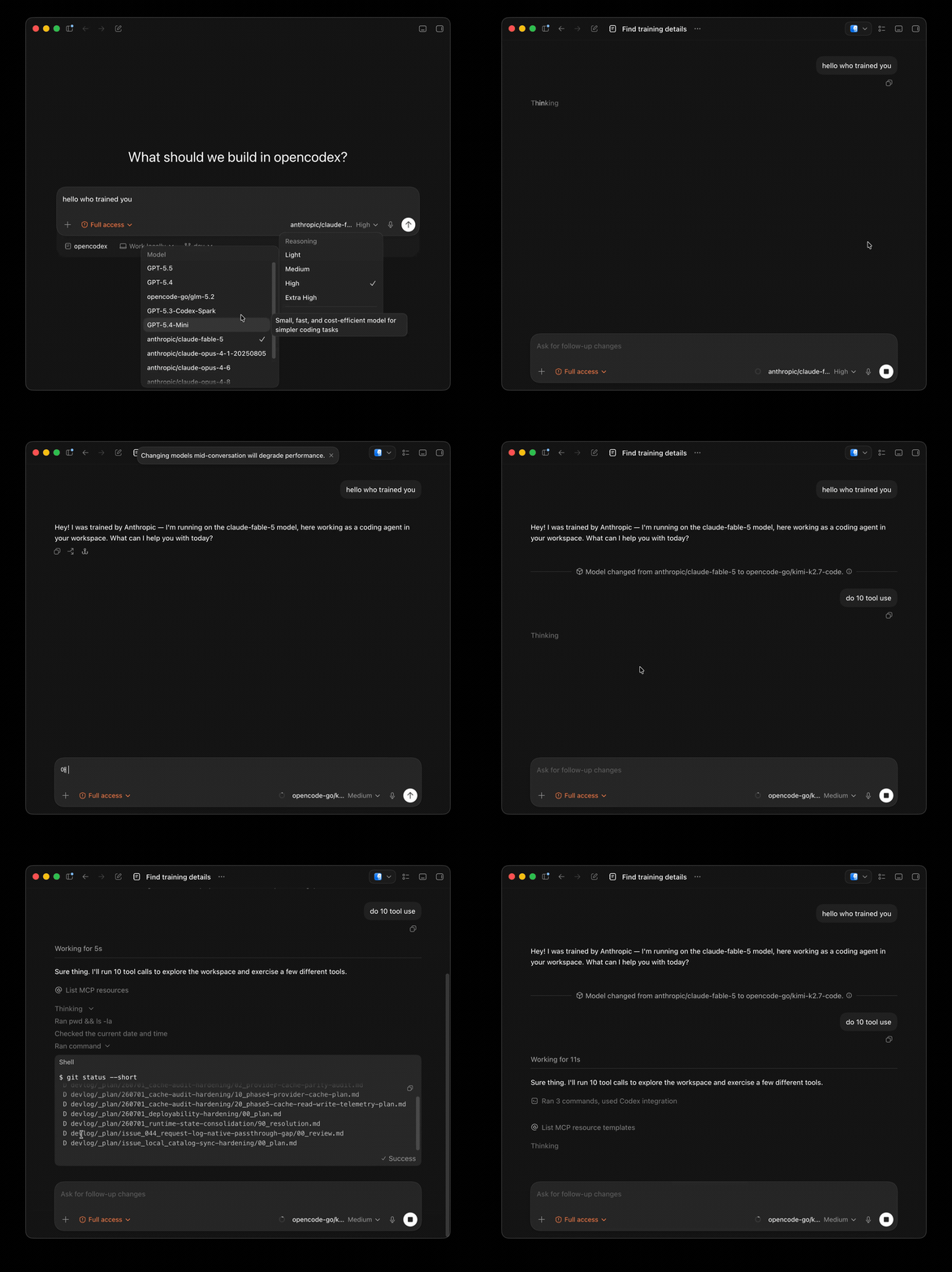
Universal provider proxy for OpenAI Codex & Claude Code — use any LLM (Claude, Gemini, Grok, DeepSeek, Ollama…) with Codex CLI, App, SDK, and Claude Code

Git-native persistent memory for AI coding agents. Implements Google OKF v0.2 with sub-300µs in-memory BM25 search, embedded MCP server, and progressive disclosure. Slashes token bloat by 80% with zero external databases or dependencies. Built in pure Go.

Local-first code intelligence graph for MCP and CLI. Builds a persistent map of your codebase so AI coding tools read only what matters, with benchmarked context reductions on reviews and large-repo workflows.

Stop your AI from making things up — it proposes, deterministic tools decide, every claim checked against ground truth with evidence. Grounded facts and context survive resets. Reverse engineering is the proving ground. MCP server + CLI.