
koala73/worldmonitorConnectors
Real-time global intelligence dashboard. AI-powered news aggregation, geopolitical monitoring, and infrastructure tracking in a unified situational awareness interface
86k
This repo connects Claude Code and Codex to Feishu/Lark so you can chat with an agent in a group thread. It includes provider adapters, slash commands, approval cards, persistence, and runtime config so sessions keep working across restarts.
Builders who want to run coding agents inside Feishu group chat.
You can start, pause, resume, and approve agent work from Feishu without leaving the conversation.
Switch between Claude and Codex per config or per session.
Keeps chat state on disk and resumes conversations after restarts.
Turns tool calls into approval cards in Feishu before the agent acts.
Supports commands like `/new`, `/resume`, `/cd`, `/provider`, and `/config set`.
Queues incoming chat while the agent is working and lets `!` interrupt the current turn.
Lets you change selected settings from chat without restarting the service.
npm install -g agent-feishu-channel
afc init
# Creates ~/.agent-feishu-channel/config.toml from template
vim ~/.agent-feishu-channel/config.toml
afc
afc [options]            Start the service
afc init                 Create config template at ~/.agent-feishu-channel/config.toml

Options:
  -c, --config <path>    Path to config.toml (overrides default location)
  -v, --version          Show version number
  -h, --help             Show help

Claude and Codex, natively in Feishu / Lark.
A full coding-agent workflow — right inside your Feishu group chat.




English | 中文
Migrating from
claude-feishu-channel? The project was renamed to reflect multi-provider support (Claude + Codex). Runpnpm remove claude-feishu-channel && pnpm add agent-feishu-channel(or the npm equivalent). Command is nowafcinstead ofcfc. On first run, the state directory at~/.claude-feishu-channel/will be auto-renamed to~/.agent-feishu-channel/— session history is preserved. Config keys are unchanged.
! prefix interrupts/config set to tune behavior without restartnpm install -g agent-feishu-channel
afc init
# Creates ~/.agent-feishu-channel/config.toml from template
Edit the config with your Feishu credentials:
vim ~/.agent-feishu-channel/config.toml
To discover your Feishu open_id on first run, temporarily set
allowed_open_ids = [] and unauthorized_behavior = "reject", then send the
bot a message. It will reply with your open_id; add that value to
allowed_open_ids and switch back to "ignore" for normal use.
afc
The bot connects to Feishu via WebSocket and starts listening for messages.
afc [options]            Start the service
afc init                 Create config template at ~/.agent-feishu-channel/config.toml

Options:
  -c, --config <path>    Path to config.toml (overrides default location)
  -v, --version          Show version number
  -h, --help             Show help
claude binary in $PATH when using the Claude providercodex binary in $PATH plus @openai/codex-sdk when using the Codex provider| Command | Description |
|---|---|
/new | Start a new session (clear context) |
/stop | Interrupt current generation |
/status | Show session state, model, reasoning effort, token usage |
/cost | Show token usage totals (input / output / total) for this session |
/context | Show context window usage and mitigation status |
/compact | Reset the current session to free context (idle-only) |
/sessions | List all known sessions |
/projects | List all configured project aliases |
/resume <id> | Resume a previous session |
/cd <path> | Change working directory (with confirm card) |
/project <alias> | Switch to a configured project alias |
/provider <claude|codex> | Switch the current session provider |
/mode <mode> | Set permission mode: default, acceptEdits, plan, bypassPermissions |
/model <name> | Switch the current provider model |
/effort <level> | Switch the current provider reasoning effort |
/config show | Display current configuration |
/config set <key> <value> | Change a config value at runtime |
/config set <key> <value> --persist | Change and write back to config.toml |
/memory | Show current provider memory files (CLAUDE.md for Claude, AGENTS.md for Codex) |
/memory add <text> | Append <text> as a bullet to the current provider's project memory file |
/help | Show available commands |
Special inputs:
| Input | Effect |
|---|---|
!<text> | Interrupt current turn + run <text> as new turn |
| Plain text | Queue as next turn (or start immediately if idle) |
See config.example.toml for all options with comments.
| Section | Keys | Description |
|---|---|---|
[feishu] | app_id, app_secret, encrypt_key, verification_token | Feishu bot credentials |
[access] | allowed_open_ids, unauthorized_behavior | Who can talk to the bot |
[agent] | default_provider, default_cwd, default_permission_mode, permission_timeout_seconds, permission_warn_before_seconds | Shared defaults and legacy fallbacks |
[claude] | default_permission_mode, default_model, default_effort, permission_timeout_seconds, permission_warn_before_seconds, cli_path | Claude provider defaults |
[codex] | default_permission_mode, default_model, default_effort, cli_path | Codex provider defaults |
[render] | inline_max_bytes, hide_thinking, show_turn_stats | Card rendering options |
[persistence] | state_file, log_dir, session_ttl_days | State and log paths |
[logging] | level | Log level: trace, debug, info, warn, error |
[projects] | <alias> = "<path>" | Project aliases for /project command |
[[mcp]] (array) | name, type (stdio/sse), command/args/env or url | Custom MCP servers exposed to the active provider |
These keys can be changed via /config set without restart:
render.hide_thinking, render.show_turn_stats, render.inline_max_bytes,
logging.level, agent.default_provider, agent.default_cwd,
agent.default_permission_mode, agent.permission_timeout_seconds,
agent.permission_warn_before_seconds, claude.default_model,
claude.default_effort, claude.default_permission_mode,
claude.permission_timeout_seconds, claude.permission_warn_before_seconds,
codex.default_model, codex.default_effort, codex.default_permission_mode
Existing Claude-only configs continue to load. Legacy [claude] values are used as shared fallbacks when [agent] is absent or only partially present, and Codex receives safe defaults (gpt-5.5, high effort, shared permission mode). Users can move to the new layout gradually with /config set ... --persist; no one-time manual migration is required.
Feishu WebSocket
      │
      ▼
FeishuGateway (event decryption, dedup, access control)
      │
      ├─ onMessage ──▶ parseInput (router)
      │                    │
      │                    ├─ /command ──▶ CommandDispatcher
      │                    │
      │                    └─ plain text ──▶ ClaudeSession.submit
      │                                        │
      │                                        ▼
      │                           provider queryFn (Claude or Codex)
      │                                        │
      │                                        ├─ tool_use ──▶ PermissionBroker ──▶ Feishu card
      │                                        ├─ thinking ──▶ Feishu card (streaming)
      │                                        └─ text ──▶ Feishu answer card
      │
      └─ onCardAction ──▶ PermissionBroker.resolveByCard
                          QuestionBroker.resolveByCard
                          CommandDispatcher.resolveCdConfirm
Key components:
FeishuGateway — receives WebSocket events, verifies signatures, deduplicates, enforces access controlClaudeSession — shared session state machine (idle → generating → idle) with message queue, drives the selected provider runtimeClaudeSessionManager — chat_id → ClaudeSession map with persistence, provider selection, and crash recoveryFeishuPermissionBroker — posts permission cards, tracks pending approvals, handles timeoutsCommandDispatcher — handles slash commands (/new, /cd, /config set, etc.)The bot now applies staged mitigation before it hits Claude's 50MB hard request limit:
warn — notify that the session is getting largehard reset fallback — keep the backend-driven Request too large / max 50MB reset-and-retry path as the last fallbackUse /context to inspect current window usage and see the mitigation order reflected in user-facing output.
# Clone and install
git clone https://github.com/Blackman99/agent-feishu-channel.git
cd agent-feishu-channel
pnpm install

# Run in dev mode
pnpm dev

# Run tests
pnpm test

# Type check
pnpm typecheck

# Build
pnpm build
| Variable | Description |
|---|---|
AGENT_FEISHU_CONFIG | Override config file path (default: ~/.agent-feishu-channel/config.toml) |
CLAUDE_FEISHU_CONFIG | Legacy alias for AGENT_FEISHU_CONFIG (still honored) |
ANTHROPIC_BASE_URL | Custom API endpoint for Claude SDK |
ANTHROPIC_AUTH_TOKEN | Auth token for custom endpoint |
acceptEdits escalation is still a provider-specific downgrade on Codex: setPermissionMode() is a safe no-op in the current adapter.MIT
Sign in to join the discussion.
No comments yet. Be the first to say what this is good for.
Real-time global intelligence dashboard. AI-powered news aggregation, geopolitical monitoring, and infrastructure tracking in a unified situational awareness interface
High-performance code intelligence MCP server. Indexes codebases into a persistent knowledge graph — average repo in milliseconds. 158 languages, sub-ms queries, 99% fewer tokens. Single static binary, zero dependencies.
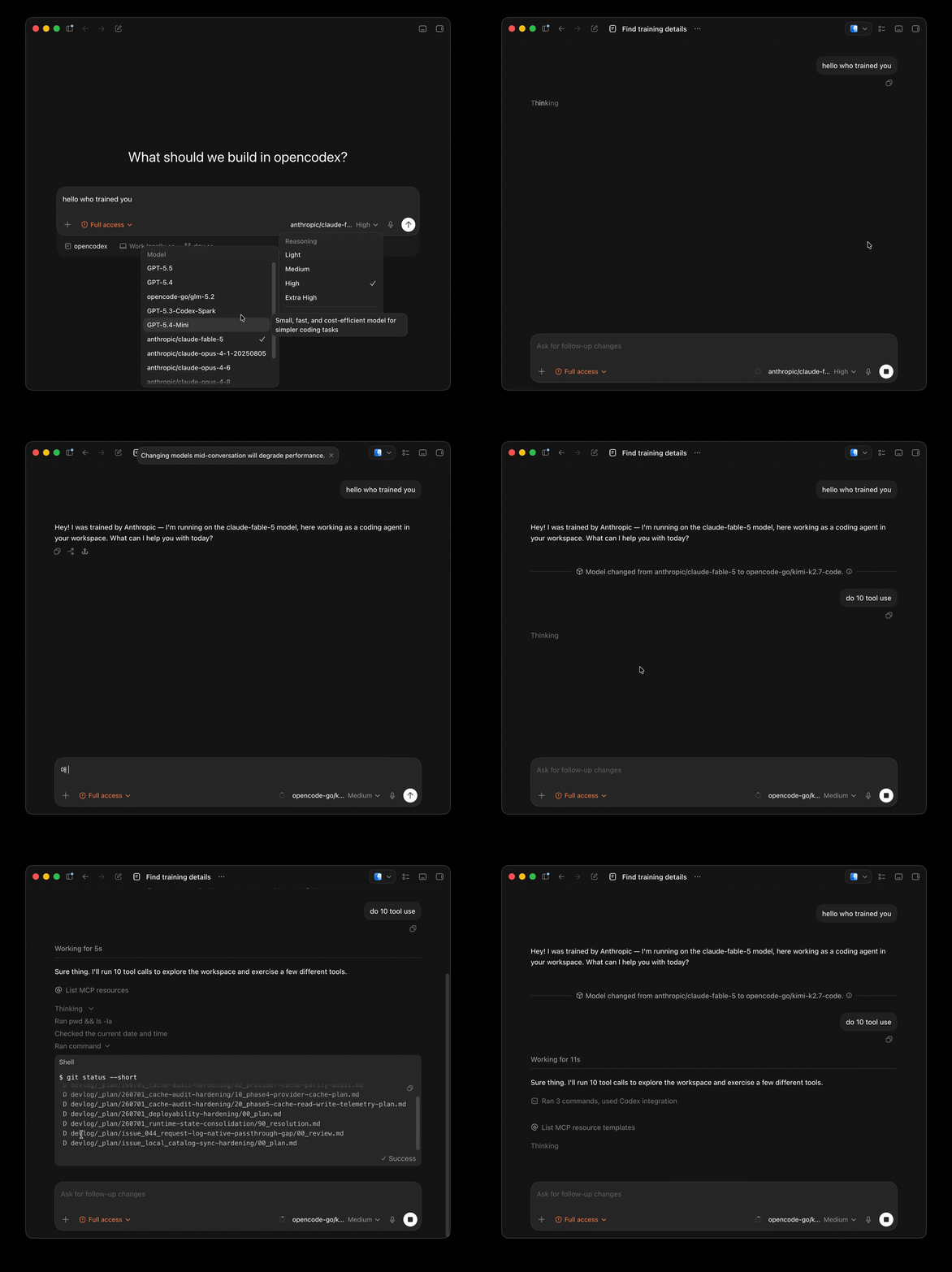
Universal provider proxy for OpenAI Codex & Claude Code — use any LLM (Claude, Gemini, Grok, DeepSeek, Ollama…) with Codex CLI, App, SDK, and Claude Code

Git-native persistent memory for AI coding agents. Implements Google OKF v0.2 with sub-300µs in-memory BM25 search, embedded MCP server, and progressive disclosure. Slashes token bloat by 80% with zero external databases or dependencies. Built in pure Go.

Local-first code intelligence graph for MCP and CLI. Builds a persistent map of your codebase so AI coding tools read only what matters, with benchmarked context reductions on reviews and large-repo workflows.

Stop your AI from making things up — it proposes, deterministic tools decide, every claim checked against ground truth with evidence. Grounded facts and context survive resets. Reverse engineering is the proving ground. MCP server + CLI.