
koala73/worldmonitorConnectors
Real-time global intelligence dashboard. AI-powered news aggregation, geopolitical monitoring, and infrastructure tracking in a unified situational awareness interface
86k
Mnemosyne adds persistent semantic memory to Claude Code and pairs it with a multi-agent orchestration system. It uses local storage, vector search, and graph links to recover context, while the orchestration layer manages reviewer, executor, optimizer, and orchestrator roles. The repo also includes Claude Code integrations such as MCP configuration, hooks, commands, and an integrated context editor. You can use it to keep project memory across sessions and coordinate longer agent-led workflows with less re-explaining.
Builders who use Claude Code and want their agent to keep project memory across sessions.
You can resume agent-led work with remembered context instead of rebuilding it every session.
Stores memories with project-aware namespaces, semantic search, FTS5, graph links, and typed memory kinds like insight, architecture, decision, task, and reference.
Runs orchestrator, optimizer, reviewer, and executor actors with dependency-aware scheduling, quality gates, and deadlock resolution.
Ships Claude-specific config, commands, hooks, skills, and MCP setup so the memory system plugs into Claude Code workflows.
Provides `mnemosyne edit` and `mnemosyne-ics` for editing context files with templates, panels, vim mode, and semantic highlighting.
Includes a dashboard and HTTP/SSE API for live agent status, event history, and cross-instance coordination.
# Remove binary and MCP config (preserves data)
./scripts/install/uninstall.sh

# Remove everything including data
./scripts/install/uninstall.sh --purge
# Store with automatic namespace detection
mnemosyne remember --content "User prefers concise code reviews" --importance 8

# Store with explicit namespace
mnemosyne remember "Database uses LibSQL with vector search" \
  --namespace "project:mnemosyne" \
  --type architecture \
  --importance 9
# Semantic search
mnemosyne recall --query "code review preferences"

# Search with namespace filter
mnemosyne recall "database" --namespace "project:mnemosyne"

# Limit results
mnemosyne recall "architecture decisions" --limit 5
# Consolidate duplicate memories
mnemosyne evolve consolidate

# Recalibrate importance scores
mnemosyne evolve importance

# Archive old/low-value memories
mnemosyne evolve archive
# Run orchestration workflow
mnemosyne orchestrate --session-id dev-001 --work-items plan.json
High-performance agentic memory system for Claude Code's multi-agent orchestration
Mnemosyne provides persistent semantic memory with sub-millisecond retrieval, built in Rust with LibSQL vector search and PyO3 Python bindings.
mnemosyne peer invite/joinmnemosyne graphIntegrated context editor accessible via mnemosyne edit or /ics slash command
#file, @symbol, ?hole with color-coded highlightingUsage:
# From Claude Code session
/ics context.md
/ics --template feature new-feature.md
/ics --panel memory --template api auth.md

# Command-line
mnemosyne edit context.md
mnemosyne edit --template architecture decision.md
mnemosyne ics --readonly --panel diagnostics review.md
See docs/guides/ICS_INTEGRATION.md for complete guide.
:3000): Automatic REST API with owner/client mode for multiple instancesSee docs/DASHBOARD.md for complete documentation.
Production-ready gRPC server for remote access to mnemosyne's memory system
Usage:
# Start RPC server on default port (50051)
mnemosyne-rpc

# Custom configuration
mnemosyne-rpc --host 0.0.0.0 --port 9090 --enable-llm

# With custom database
mnemosyne-rpc --db-path /path/to/mnemosyne.db
Client Example (Python):
import grpc
from mnemosyne.v1 import memory_pb2, memory_pb2_grpc

# Connect and store a memory
channel = grpc.insecure_channel('localhost:50051')
stub = memory_pb2_grpc.MemoryServiceStub(channel)

response = stub.StoreMemory(memory_pb2.StoreMemoryRequest(
    content="Important architectural decision",
    namespace=memory_pb2.Namespace(
        project=memory_pb2.ProjectNamespace(name="my-project")
    ),
    importance=9,
    tags=["architecture", "decision"]
))
print(f"Stored memory: {response.memory_id}")
See src/rpc/README.md for complete API documentation, deployment guides, and client examples.
Automated Installation (Recommended):
# Clone repository
git clone https://github.com/yourusername/mnemosyne.git
cd mnemosyne

# Run installation script
./scripts/install/install.sh

# Installation will:
# - Build release binary
# - Install to ~/.local/bin
# - Initialize database
# - Configure MCP server
# - Optionally set up API keys
# - Detect and optionally install Nerd Fonts for icon support
Icon System: Mnemosyne uses Nerd Font icons (Font Awesome) for a polished CLI experience with automatic fallback to ASCII. For best results, install JetBrainsMono Nerd Font. See docs/ICONS.md for details.
Manual Installation:
# Prerequisites: Rust 1.75+, Python 3.10-3.14, uv
cargo build --release

# Copy binary to PATH
cp target/release/mnemosyne ~/.local/bin/

# Initialize database
mnemosyne init

# Configure secrets (optional for LLM enrichment)
mnemosyne secrets set --provider anthropic --key sk-ant-...
Uninstallation:
# Remove binary and MCP config (preserves data)
./scripts/install/uninstall.sh

# Remove everything including data
./scripts/install/uninstall.sh --purge
Store memories:
# Store with automatic namespace detection
mnemosyne remember --content "User prefers concise code reviews" --importance 8

# Store with explicit namespace
mnemosyne remember "Database uses LibSQL with vector search" \
  --namespace "project:mnemosyne" \
  --type architecture \
  --importance 9
Search memories:
# Semantic search
mnemosyne recall --query "code review preferences"

# Search with namespace filter
mnemosyne recall "database" --namespace "project:mnemosyne"

# Limit results
mnemosyne recall "architecture decisions" --limit 5
Evolution operations:
# Consolidate duplicate memories
mnemosyne evolve consolidate

# Recalibrate importance scores
mnemosyne evolve importance

# Archive old/low-value memories
mnemosyne evolve archive
Interactive Collaborative Space (Standalone):
# Launch standalone ICS context editor
mnemosyne-ics

# Create from template
mnemosyne-ics --template feature

# Open existing file
mnemosyne-ics path/to/context.md

# Read-only mode (view memory dumps)
mnemosyne-ics --read-only path/to/dump.md

# Features:
# - Full terminal ownership (no conflicts)
# - Template system (api, architecture, bugfix, feature, refactor)
# - Storage backend integration
# - Semantic highlighting (3-tier system)
# - Vim mode with modal editing
Real-time Monitoring Dashboard:
# API server starts automatically with first MCP instance (owner mode)
# Launch monitoring dashboard (connects to http://localhost:3000 by default)
mnemosyne-dash

# Custom configuration
mnemosyne-dash --api http://localhost:3000 --refresh 500

# Features:
# - Clean 4-panel layout (System Overview, Activity Stream, Agent Details, Operations)
# - Smart event filtering (heartbeats hidden by default, 8 categories)
# - Event correlation (links start→complete with durations)
# - Real-time SSE updates with zero latency
# - Full keyboard control (0-3 panel toggles, c to clear, q to quit)
# - Automatic slow operation and failure detection
# - 124+ tests, production-ready monitoring

# See docs/DASHBOARD.md for keyboard shortcuts and advanced usage
TUI Wrapper Mode (Deprecated in v2.1.0):
⚠️ Deprecated: Use mnemosyne-ics + mnemosyne-dash instead
See docs/guides/migration.md for migration guide

# Launch TUI with command palette, ICS editor, and agent dashboard
mnemosyne tui

# Start with ICS panel visible
mnemosyne tui --with-ics

# Features:
# - Helix-style command palette (Ctrl+P)
# - ICS editor with markdown highlighting (Ctrl+E)
# - Real-time agent dashboard (Ctrl+D)
# - Context-aware help overlay (?)
# - Pattern highlighting: #file.rs @symbol ?hole
Orchestration (Python agents):
# Run orchestration workflow
mnemosyne orchestrate --session-id dev-001 --work-items plan.json
┌─────────────────────────────────────────────────────┐
│           Multi-Agent Orchestration                  │
│                                                      │
│  ┌──────────────┐    ┌──────────────┐              │
│  │ Orchestrator │◄──►│  Optimizer   │              │
│  │  (Ractor)    │    │  (Ractor)    │              │
│  └──────┬───────┘    └──────┬───────┘              │
│         │                   │                        │
│         │              Skill Discovery               │
│         ▼                   ▼                        │
│  ┌──────────────┐    ┌──────────────┐              │
│  │   Executor   │◄──►│   Reviewer   │              │
│  │  (Ractor)    │    │  (Ractor)    │              │
│  │  + Sub-agents│    │ Quality Gates│              │
│  └──────────────┘    └──────────────┘              │
└─────────────────────────────────────────────────────┘
                         │
                         ▼
┌─────────────────────────────────────────────────────┐
│       Storage + Evolution + Evaluation               │
│                                                      │
│  LibSQL  ◄──►  Consolidation  ◄──►  Evaluation     │
│  Vector       (Deduplication)     (Learning Weights)│
└─────────────────────────────────────────────────────┘
Actor Responsibilities:
# Store memory
mnemosyne remember [OPTIONS] <CONTENT>
  --namespace <NS>      Namespace (auto-detected from git/CLAUDE.md)
  --importance <1-10>   Importance score (default: 5)
  --type <TYPE>         Memory type (insight|architecture|decision|task|reference)
  --tags <TAGS>         Comma-separated tags
  --links <IDS>         Link to existing memory IDs

# Search memories
mnemosyne recall [OPTIONS] <QUERY>
  --namespace <NS>      Filter by namespace
  --limit <N>           Max results (default: 10)
  --min-importance <N>  Minimum importance score

# Generate embeddings
mnemosyne embed <TEXT>
  --model <MODEL>       Embedding model (local|remote)
# Run evolution jobs
mnemosyne evolve <OPERATION>
  consolidate           Detect and merge duplicate memories
  importance            Recalibrate importance scores
  archive               Archive low-value memories
  links                 Update link decay scores
# Run orchestration workflow
mnemosyne orchestrate [OPTIONS]
  --session-id <ID>     Session identifier
  --work-items <FILE>   Work items JSON file
# Launch standalone ICS context editor
mnemosyne-ics [OPTIONS] [FILE]
  --template <TEMPLATE>  Use template (api|architecture|bugfix|feature|refactor)
  --read-only            Open in read-only mode
  --vim-mode             Enable vim keybindings (default: on)
  --theme <THEME>        Color theme (dark|light)

# Features:
# • Full terminal ownership (no conflicts with Claude Code)
# • Template system for common contexts
# • 3-tier semantic highlighting (<5ms→<200ms→2s+)
# • Storage backend integration
# • Vim modal editing
# • Pattern syntax: #file.rs @symbol ?hole
# Launch real-time monitoring dashboard
mnemosyne-dash [OPTIONS]
  --api-url <URL>       API server URL (default: http://localhost:3000)
  --refresh-rate <MS>   Update interval (default: 100ms)

# API server starts automatically with first MCP instance
# No manual startup required

# Features:
# • Live agent activity via SSE across all MCP instances
# • Color-coded agent states
# • System statistics (memory, CPU, context)
# • Event log with scrollback
# • Auto-reconnect on disconnect
# MCP server automatically starts HTTP API on first instance (owner mode)
# Subsequent instances connect as clients and forward events via HTTP
mnemosyne serve

# Owner mode (first instance):
# • Binds port 3000 (or 3001-3010 if 3000 unavailable)
# • Starts API server with SSE event streaming
# • Broadcasts events locally

# Client mode (subsequent instances):
# • Detects existing API server via health check
# • Forwards events via POST /events/emit
# • No port conflicts - seamless multi-instance support

# Endpoints:
# GET  /health                Health check (used for auto-detection)
# GET  /events                SSE event stream (real-time)
# POST /events/emit           Event forwarding (client mode)
# GET  /state/agents          List agent states
# GET  /state/context-files   Context files across instances

# Features:
# • Automatic owner/client mode detection
# • Zero-configuration multi-instance support
# • Event forwarding via HTTP POST (100ms timeout, fire-and-forget)
# • REST API with Axum + Server-Sent Events (SSE)
# • CORS support for web clients
⚠️ Deprecated in v2.1.0: Use mnemosyne-ics + mnemosyne-dash instead
See docs/guides/migration.md for migration guide

# Launch enhanced TUI wrapper mode
mnemosyne tui [OPTIONS]
  --with-ics            Start with ICS panel visible
  --no-dashboard        Disable agent dashboard

# TUI Features:
# • Command Palette (Ctrl+P): Helix-style fuzzy command selector
# • ICS Editor (Ctrl+E): Integrated Context Studio with highlighting
# • Agent Dashboard (Ctrl+D): Real-time agent status and work queue
# • Help Overlay (?): Context-aware keyboard shortcuts
# • Status Bar: Dynamic action hints based on current mode

# Keyboard Shortcuts:
# General Navigation:
#   Ctrl+P          Open command palette
#   Ctrl+E          Toggle ICS panel
#   Ctrl+D          Toggle dashboard
#   Ctrl+Q          Quit application
#   ?               Show help overlay

# ICS Mode:
#   Ctrl+Enter      Submit refined context to Claude
#   Ctrl+S          Save edited document
#   Pattern syntax:
#     #file.rs      File reference (blue, bold)
#     @symbol       Symbol reference (green, bold)
#     ?interface    Typed hole (yellow, bold)
# Initialize database
mnemosyne init [PATH]

# Manage secrets
mnemosyne secrets set --provider <PROVIDER> --key <KEY>
mnemosyne secrets list

# Database info
mnemosyne info
# Database
export DATABASE_URL="sqlite:///path/to/mnemosyne.db"

# API Keys (for LLM enrichment)
export ANTHROPIC_API_KEY="sk-ant-..."
export VOYAGE_API_KEY="pa-..."   # For remote embeddings

# Logging
export RUST_LOG="info"           # debug|info|warn|error
SearchConfig {
    semantic_weight: 0.7,  // 70% semantic similarity
    fts_weight: 0.2,       // 20% keyword match
    graph_weight: 0.1,     // 10% link connectivity
}
ConnectionMode::Local(path)              // Local SQLite file
ConnectionMode::LocalReadOnly(path)      // Read-only database
ConnectionMode::Remote { url, token }    // Remote LibSQL/Turso
ConnectionMode::EmbeddedReplica { ... }  // Local replica with sync
# Unit tests
cargo test --lib

# Integration tests
cargo test --test integration_ics --features test-utils

# E2E tests
bash tests/e2e/human_workflow_1_new_project.sh
bash tests/e2e/agentic_workflow_1_orchestrator.sh
bash tests/e2e/recovery_1_graceful_degradation.sh

# All E2E tests
find tests/e2e -name '*.sh' -executable -exec {} \;

# With coverage
cargo tarpaulin --lib --out Html
If you see zsh: killed mnemosyne when trying to run the binary:
Quick Fix:
xattr -d com.apple.provenance ~/.cargo/bin/mnemosyne
codesign --force --sign - ~/.cargo/bin/mnemosyne
Root Cause: macOS Gatekeeper invalidates code signatures when binaries are relocated (e.g., by cargo install). The binary in target/release/ works fine, but the installed copy in ~/.cargo/bin/ gets killed by taskgated.
Permanent Fix: Always use the install script, which handles re-signing automatically:
./scripts/install/install.sh
Quick rebuild during development:
./scripts/build-and-install.sh
For more troubleshooting help, see TROUBLESHOOTING.md.
Storage Operations (PyO3 vs subprocess):
Memory:
Scalability:
bd import -i .beads/issues.jsonlcargo clippy and cargo fmt before PRsDevelopment Workflow:
# Setup
git checkout -b feature/my-feature
bd import -i .beads/issues.jsonl

# Development cycle
cargo build --lib
cargo test --lib
cargo clippy

# E2E testing
bash tests/e2e/relevant_test.sh

# Commit
git add . && git commit -m "Descriptive message"

# Before PR
cargo fmt
cargo clippy --all-targets
cargo test --all

# Export Beads state
bd export -o .beads/issues.jsonl
See LICENSE file for details.
Current Version: 2.3.1
v2.4.0 Release (2025-11-23) - Distributed Coordination:
v2.3.1 Release (2025-11-09) - Dashboard Crash Fix:
partial_cmp().unwrap() patternsv2.3.0 Release (2025-11-08) - Dashboard Redesign & CLI Operations Tracking:
docs/DASHBOARD.md (300+ lines) with architecture, features, troubleshootingv2.2.0 Release (2025-11-08) - gRPC Remote Access:
rpc feature, no impact on default buildsv2.1.2 Release (2025-11-06) - Clean Build & Repository Cleanup:
v2.1.1 Release (2025-11-06) - Python Bridge Architecture & Production Hardening:
Completed (v2.1.0):
mnemosyne-ics) with template system:3000) with SSE event streamingmnemosyne-dash)Known Issues (v2.3.1):
Roadmap (post-v2.3.1):
For detailed technical documentation, see ARCHITECTURE.md. For troubleshooting, see TROUBLESHOOTING.md. For MCP server integration, see MCP_SERVER.md. For development progress, see TODO_TRACKING.md.
Sign in to join the discussion.
No comments yet. Be the first to say what this is good for.
Real-time global intelligence dashboard. AI-powered news aggregation, geopolitical monitoring, and infrastructure tracking in a unified situational awareness interface
High-performance code intelligence MCP server. Indexes codebases into a persistent knowledge graph — average repo in milliseconds. 158 languages, sub-ms queries, 99% fewer tokens. Single static binary, zero dependencies.
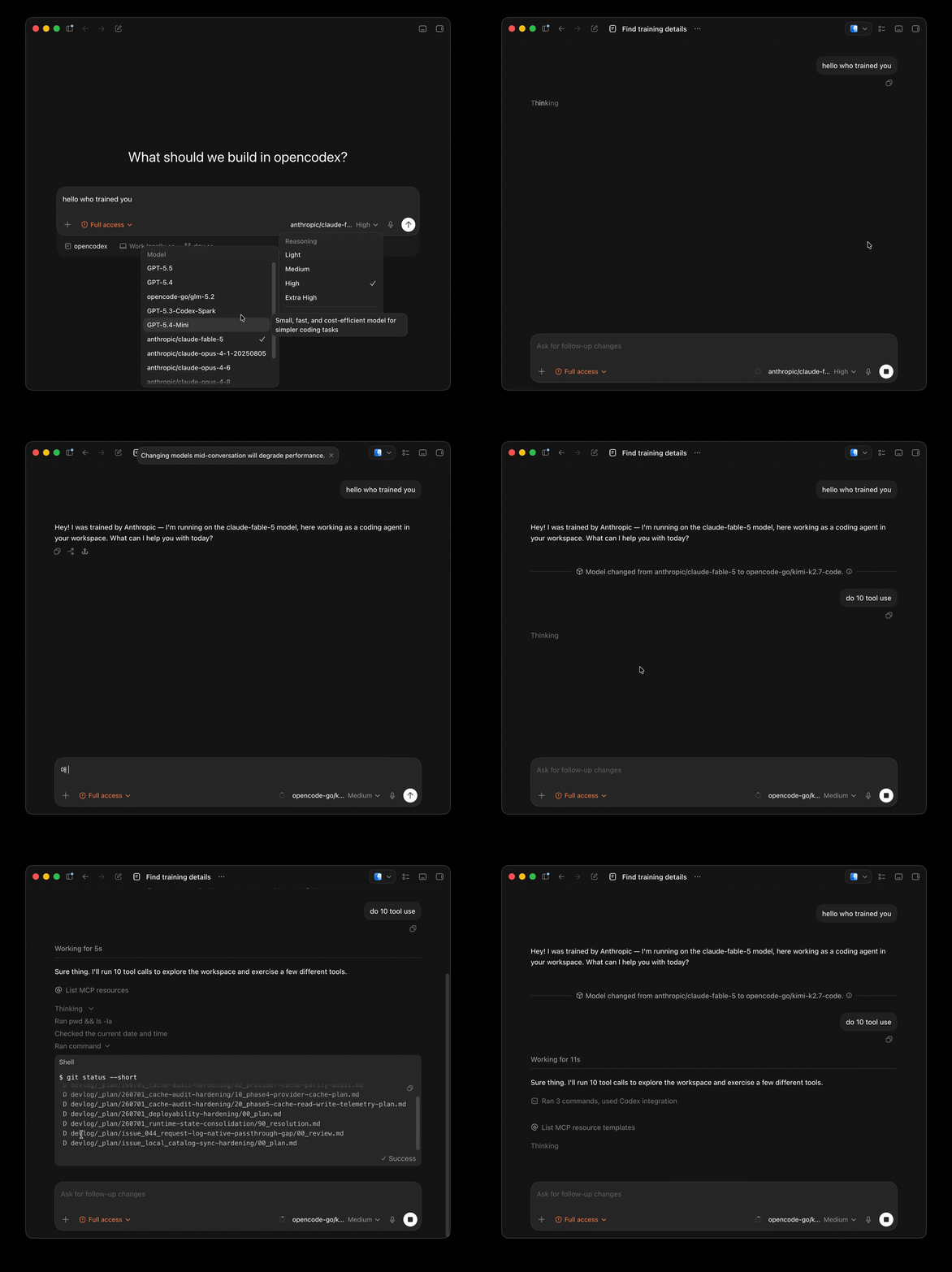
Universal provider proxy for OpenAI Codex & Claude Code — use any LLM (Claude, Gemini, Grok, DeepSeek, Ollama…) with Codex CLI, App, SDK, and Claude Code

Git-native persistent memory for AI coding agents. Implements Google OKF v0.2 with sub-300µs in-memory BM25 search, embedded MCP server, and progressive disclosure. Slashes token bloat by 80% with zero external databases or dependencies. Built in pure Go.

Local-first code intelligence graph for MCP and CLI. Builds a persistent map of your codebase so AI coding tools read only what matters, with benchmarked context reductions on reviews and large-repo workflows.

Stop your AI from making things up — it proposes, deterministic tools decide, every claim checked against ground truth with evidence. Grounded facts and context survive resets. Reverse engineering is the proving ground. MCP server + CLI.