
koala73/worldmonitorConnectors
Real-time global intelligence dashboard. AI-powered news aggregation, geopolitical monitoring, and infrastructure tracking in a unified situational awareness interface
86k
browser39 gives agents a single local binary for web browsing, JavaScript execution, form filling, and session persistence. It exposes the browser through MCP, CLI commands, JSONL files, and a Rust library, so builders can plug it into different agents and tools.

Builders who want their agent to fetch real web pages, keep login state, and return only the part they need.
You can give an agent reliable web access without opening a full browser stack or re-reading whole pages.
Returns content sections first, then lets the agent re-fetch a targeted selector instead of sending the whole page.
Runs JavaScript with DOM traversal, events, storage, timers, and form interaction through V8.
Saves cookies, localStorage, and history to an encrypted session file so logins survive restarts.
Works through stdio MCP, HTTP MCP, CLI fetch/search commands, and JSONL watch or batch files.
Lets agents manage search settings, cookies, storage, headers, and auth profiles while masking secrets in output.
Provides `BrowserService` and related types for embedding browser39 directly in Rust, plus Python, TypeScript, and Rust examples.
npm install @aquintanar/browser39
cargo install browser39
curl -fsSL https://raw.githubusercontent.com/alejandroqh/marketplace/main/h39.sh | bash
browser39 fetch https://example.com
# Example Domain
This domain is for use in documentation examples without needing permission.

[Learn more](https://iana.org/domains/example)
browser39 search "rust async traits"
A headless browser for AI agents that fetches modern web pages, runs JavaScript, manages sessions, and returns token-efficient Markdown.
| browser39 | Playwright / Puppeteer | Raw HTTP (requests, ureq) | |
|---|---|---|---|
| External browser | None (single binary) | Requires Chrome/Chromium | None |
| Binary size | ~52MB | ~280MB with browser | N/A (library) |
| Platforms | macOS, Linux, Windows | macOS, Linux, Windows | Any |
| JavaScript | Yes (V8 via deno_core) | Yes (full V8) | No |
| HTML to Markdown | Built-in, token-optimized | No (raw HTML or screenshots) | DIY |
| Token preselection | Content sections, agent picks what to read | No | No |
| Cookies & sessions | Automatic, persisted, encrypted | Manual | Manual |
| DOM queries | CSS selectors + full JS DOM API | Full DOM API | No |
| Forms | fill + submit | Full interaction | Manual POST |
| Auth & secrets | Profiles, redaction, opaque handles | Manual | Manual |
| Transports | MCP (stdio + HTTP), JSONL, CLI | Library API | Library API |
Real test: extracting the "Optical communications" section from Artemis II on Wikipedia (full page: ~14,600 tokens).
| Raw HTTP | WebFetch (Claude Code built-in) | Mistral Web Search | browser39 | |
|---|---|---|---|---|
| How it works | Fetch full page, truncate to ~1,000 tokens | Send full page (~14,600 tokens) to intermediate model with extraction prompt | Cloud API: search + page processing by Mistral model | Fetch → content selectors list → targeted section fetch |
| Tokens consumed | ~1,000 (truncated) | ~14,600 (processed by intermediate model) | Cloud processed, not disclosed | 196 |
| Found the section? | No. Section is at token ~6,320, truncated away | Yes, but returns a lossy summary | Depends on search ranking | Yes. Exact original content |
| Content quality | Nav menus, infobox, article intro | Paraphrased, no links, no references | Summary with citations | Lossless markdown with links and citations |
| Session state | None | None | None | Cookies, history, follow-up queries free |
| Data processing | Local | Processed remotely | Processed remotely | Local |
| Cost per call | Free | Bundled | $30 / 1,000 calls | Free |
| Retries needed | Pagination to find it | None, but no control over output | May not find specific section | None. Agent sees structure first |
browser39 returns the exact section in 196 tokens at zero cost. The raw approach misses it entirely, WebFetch burns 75x more tokens through an intermediate model, and cloud tools like Mistral's charge $0.03 per call.
npm install @aquintanar/browser39
Or via Cargo:
cargo install browser39
Installs the binary and auto-configures it for every MCP client detected: Claude Code, Claude Desktop, Codex, OpenCode, OpenClaw.
curl -fsSL https://raw.githubusercontent.com/alejandroqh/marketplace/main/h39.sh | bash
Pre-built binaries available on the releases page.
Add to your MCP client config:
{
  "mcpServers": {
    "browser39": {
      "command": "browser39",
      "args": ["mcp"]
    }
  }
}
29 tools available instantly: browser39_fetch, browser39_click, browser39_links, browser39_dom_query, browser39_fill, browser39_submit, browser39_search, cookies, storage, history, config management, and more.
browser39 fetch https://example.com
# Example Domain
This domain is for use in documentation examples without needing permission.

[Learn more](https://iana.org/domains/example)
Search the web using the configured search engine:
browser39 search "rust async traits"
Add --output json for structured results suitable for piping into other tools.
Long-running subprocess that any language can talk to via JSONL files:
touch commands.jsonl
browser39 watch commands.jsonl --output results.jsonl
# From your agent (Python, Node, Rust, shell, anything):
echo '{"id":"1","action":"fetch","v":1,"seq":1,"url":"https://example.com"}' >> commands.jsonl
Drop-in web_search and visit_website tool examples: Python | TypeScript | Rust
See docs/install-cli.md for the full integration guide.
Embed browser39 directly in a Rust application — no subprocess, no IPC.
[dependencies]
browser39 = "1.8"
tokio = { version = "1", features = ["full"] }
anyhow = "1"
use std::collections::HashMap;

use browser39::{BrowserService, Config, HttpMethod, InMemoryStore, SessionStore};

#[tokio::main]
async fn main() -> anyhow::Result<()> {
    let store: Box<dyn SessionStore> = Box::new(InMemoryStore);
    let mut service = BrowserService::new(Config::default(), store).await?;

    let options = service.default_fetch_options();
    let page = service
        .fetch(
            "https://example.com",
            &HttpMethod::Get,
            &HashMap::new(),
            None,
            None,
            &options,
        )
        .await?;

    println!("{}", page.markdown);
    Ok(())
}
The crate root re-exports the common types: BrowserService, Config, PersistenceMode, FetchOptions, HttpMethod, SessionStore, InMemoryStore, create_session_store. Lower-level modules (browser39::core, browser39::cli, browser39::mcp) are also public if you need direct access to the HTML→Markdown engine, JSONL runner, or MCP server.
browser39 minimizes token usage when feeding web content to LLMs:
selector.selector: "#Astronauts" returns the full section until the next same-level heading, not just the heading text.[text][N] instead of inline URLs, with full URLs in the links array.V8 (via deno_core) runs JavaScript against a full DOM environment:
parentElement, children, firstChild, lastChild, nextSibling, previousSibling, closest(), matches(), contains()getElementById, getElementsByClassName, getElementsByTagName, getElementsByNamecreateElement, createTextNode, appendChild, removeChild, insertBefore, setAttribute, removeAttribute, textContent/innerHTML settersaddEventListener, removeEventListener, dispatchEvent, new Event/CustomEvent/MouseEvent/KeyboardEvent/InputEventlocalStorage, document.cookie, console.log (captured), setTimeout, atob/btoa, getComputedStyle, MutationObserverelement.value get/set, element.click(), form.submit(){"action": "dom_query", "script": "document.querySelectorAll('a').length"}
{"action": "dom_query", "script": "document.getElementById('content').closest('section').textContent"}
{"action": "dom_query", "script": "document.querySelector('h1').setAttribute('class', 'modified')"}
Cookies, localStorage, and browsing history are persisted to disk by default (~/.local/share/browser39/session.enc, AES-256-GCM encrypted). An agent can log in once and stay authenticated across restarts.
Disable with --no-persist or config:
[session]
persistence = "memory"
Fill fields by CSS selector and submit. browser39 handles enctype, builds the HTTP request, and returns the response page:
{"action": "fill", "fields": [{"selector": "#user", "value": "agent"}, {"selector": "#pass", "value": "secret", "sensitive": true}]}
{"action": "submit", "selector": "form#login"}
Auth profiles keep credentials out of the LLM conversation. The agent references a profile name and never sees the token:
[auth.github]
header = "Authorization"
value_env = "GITHUB_TOKEN"
value_prefix = "Bearer "
domains = ["api.github.com"]
{"action": "fetch", "url": "https://api.github.com/repos", "auth_profile": "github"}
Agents can manage browser39's configuration directly through MCP tools: change the search engine, store credentials, manage auth profiles, cookies, storage, and headers. Sensitive values are stored securely on disk but never returned via MCP; config_show masks them with ••••••.
> browser39_config_set key="search.engine" value="https://www.google.com/search?q={}"
Set search.engine = https://www.google.com/search?q={}

> browser39_config_auth_set name="github" header="Authorization" value="Bearer ghp_..." domains=["api.github.com"]
Auth profile 'github' saved

> browser39_config_show section="auth"
{"auth": {"github": {"header": "Authorization", "value": "••••••", ...}}}
10 config tools: config_show, config_set, config_auth_set/delete, config_cookie_set/delete, config_storage_set/delete, config_header_set/delete.
| Transport | Command | Use case |
|---|---|---|
| MCP (stdio) | browser39 mcp | Local MCP clients |
| MCP (HTTP) | browser39 mcp --transport sse --port 8039 | Remote agents, cloud deployments |
| JSONL watch | browser39 watch commands.jsonl | Any language, long-running agent IPC |
| JSONL batch | browser39 batch commands.jsonl | One-shot scripted operations |
| CLI fetch | browser39 fetch <url> | Quick page retrieval, shell scripts |
| CLI search | browser39 search <query> | Quick web search from shell scripts |
| Rust library | cargo add browser39 | Embed in Rust apps, no subprocess |
browser39 --config path/to/config.toml fetch https://example.com
Precedence: --config flag > BROWSER39_CONFIG env > ~/.config/browser39/config.toml
See docs/config.md for the full reference.
| Doc | Description |
|---|---|
| install-cli.md | CLI integration guide with Rust, Python, TypeScript examples |
| jsonl-protocol.md | Full JSONL protocol specification |
| config.md | Configuration reference |
cargo build              # Build
cargo run                # Run
cargo test               # Run all tests
cargo clippy             # Lint
cargo fmt                # Format
Apache-2.0
Sign in to join the discussion.
No comments yet. Be the first to say what this is good for.
Real-time global intelligence dashboard. AI-powered news aggregation, geopolitical monitoring, and infrastructure tracking in a unified situational awareness interface
High-performance code intelligence MCP server. Indexes codebases into a persistent knowledge graph — average repo in milliseconds. 158 languages, sub-ms queries, 99% fewer tokens. Single static binary, zero dependencies.
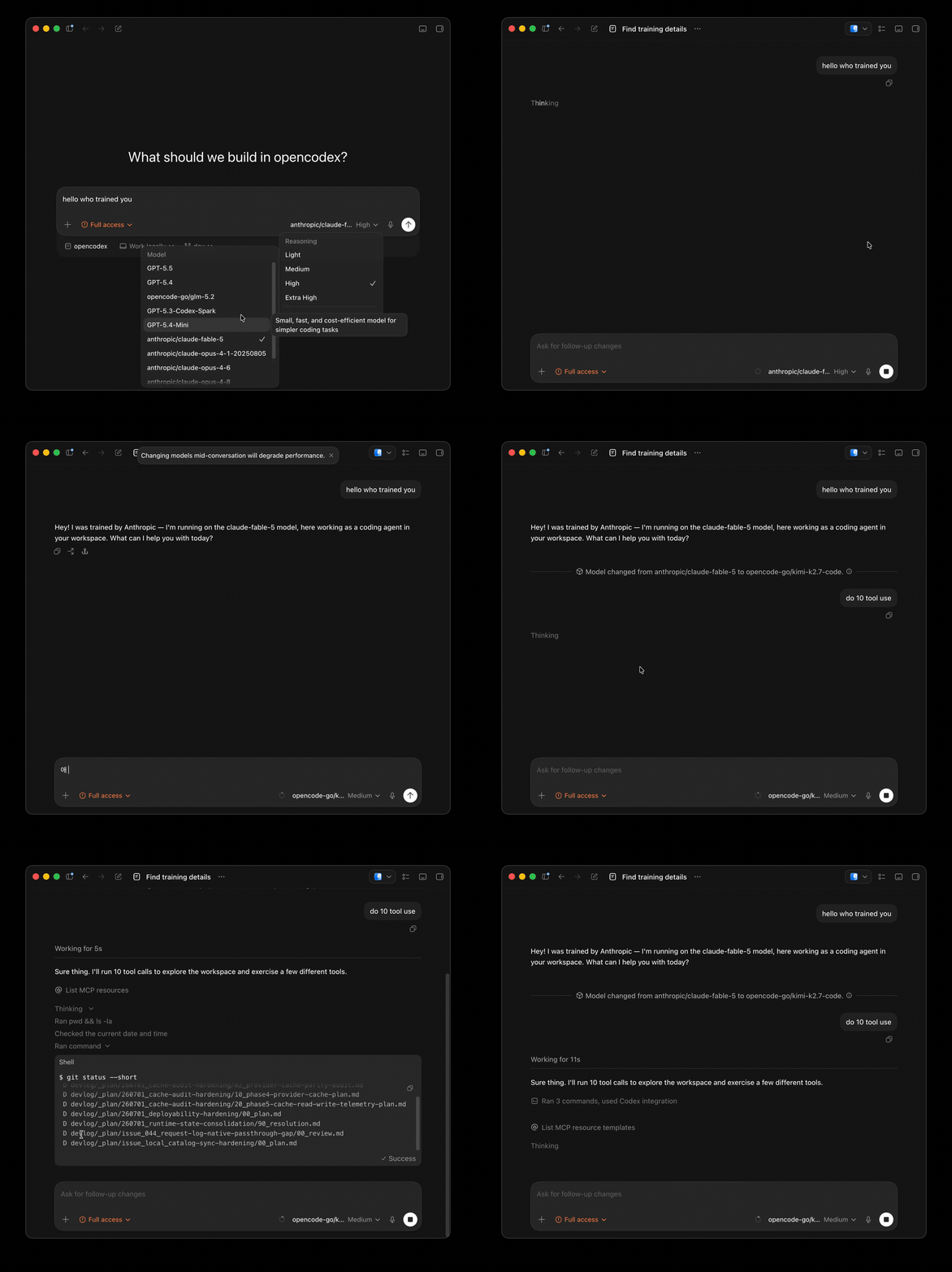
Universal provider proxy for OpenAI Codex & Claude Code — use any LLM (Claude, Gemini, Grok, DeepSeek, Ollama…) with Codex CLI, App, SDK, and Claude Code

Git-native persistent memory for AI coding agents. Implements Google OKF v0.2 with sub-300µs in-memory BM25 search, embedded MCP server, and progressive disclosure. Slashes token bloat by 80% with zero external databases or dependencies. Built in pure Go.

Local-first code intelligence graph for MCP and CLI. Builds a persistent map of your codebase so AI coding tools read only what matters, with benchmarked context reductions on reviews and large-repo workflows.

Stop your AI from making things up — it proposes, deterministic tools decide, every claim checked against ground truth with evidence. Grounded facts and context survive resets. Reverse engineering is the proving ground. MCP server + CLI.