
koala73/worldmonitorConnectors
Real-time global intelligence dashboard. AI-powered news aggregation, geopolitical monitoring, and infrastructure tracking in a unified situational awareness interface
86k
This project gives an agent a kanban board it can use as working memory for multi-session tasks. It stores boards and tasks in SQLite, exposes MCP tools for creating and moving tasks, and provides prompts for starting or resuming work. A separate web UI lets you inspect and edit the board by hand.
Builders who want their agent to track plans, tasks, and progress across sessions.
You can resume agent work from a board instead of re-explaining the project each time.
Creates boards, adds tasks, moves tasks, deletes tasks, and reads full board or task details through MCP tools.
Moves tasks between columns while respecting column capacity and work-in-progress limits.
Uses an embedded database for board state and task history.
Provides a browser interface to watch progress and edit tasks manually.
Includes prompts for creating a board and for resuming work on an existing project.
npm ci --prefix shared/db
npm ci --prefix mcp-server
npm run build --prefix shared/db
npm run build --prefix mcp-server
docker build -t mcp/mcp-kanban .
An MCP tool set providing kanban-based task management state for AI-driven development. This is similar to other task management MCP tools, with the additional structure, rules and visibility of a kanban-based task management system.
The main idea is to direct the AI agent to document and save its work as tasks in a kanban board, both in the planning session and in execution sessions.
Use the MCP prompts to start a project or to make progress on a project. Alternatively, ask the LLM assistant to record its plan by creating a kanban board. To make progress in a follow-up session, ask the assistant to locate a specific kanban board and resume work on it.
Clone this repo, then run:
npm ci --prefix shared/db
npm ci --prefix mcp-server
npm run build --prefix shared/db
npm run build --prefix mcp-server
Then add the MCP server configuration to the MCP client (e.g. Claude Desktop):
"mcpServers": {
    "kanban-mcp": {
        "command": "node",
        "args": [
            "/path/to/repo/mcp-server/dist/server.js"
        ],
        "env": {
            "MCP_KANBAN_DB_FOLDER_PATH": "/path/to/db"
        }
    }
}
Replace /path/to/repo with the location of the cloned repo.
Replace /path/to/db with a folder that will contain the DB files. This can be any folder with read/write access. It will be created if it doesn't exist.
Build the Docker image:
docker build -t mcp/mcp-kanban .
Then add the MCP server configuration to the MCP client (e.g. Claude Desktop):
"mcpServers": {
    "kanban-mcp": {
        "command": "docker",
        "args": [
            "run",
            "--rm",
            "-i",
            "-v",
            "/path/to/db:/mcp",
            "mcp/mcp-kanban"
        ]
    }
}
Replace /path/to/db with a folder that will contain the DB files. This can be any folder with read/write access. It will be created if it doesn't exist.
Build the web-ui and web-server:
npm ci --prefix shared/db
npm run build --prefix shared/db

npm ci --prefix web-ui
npm ci --prefix web-server
npm run build --prefix web-ui
npm run build --prefix web-server
Run the web-server:
MCP_KANBAN_DB_FOLDER_PATH=/path/to/db npm run start --prefix web-server
Open the browser at http://localhost:8221
create-kanban-board
name (string): The name of the boardprojectGoal (string): The goal of the project.add-task-to-board
boardId (string): The ID of the board to add the task totitle (string): The title of the taskcontent (string): The content of the task in markdown formatmove-task
taskId (string): The ID of the task to movetargetColumnId (string): The ID of the column to move the task toreason (string, optional): The reason for moving the taskdelete-task
taskId (string): The ID of the task to deleteget-board-info
boardId (string): The ID of the board to get info forget-task-info
taskId (string): The ID of the task to get info forlist-boards
create-kanban-based-project
description (string): The description of the projectmake-progress-on-a-project
description (string): The description of the projectSign in to join the discussion.
No comments yet. Be the first to say what this is good for.
Real-time global intelligence dashboard. AI-powered news aggregation, geopolitical monitoring, and infrastructure tracking in a unified situational awareness interface
High-performance code intelligence MCP server. Indexes codebases into a persistent knowledge graph — average repo in milliseconds. 158 languages, sub-ms queries, 99% fewer tokens. Single static binary, zero dependencies.
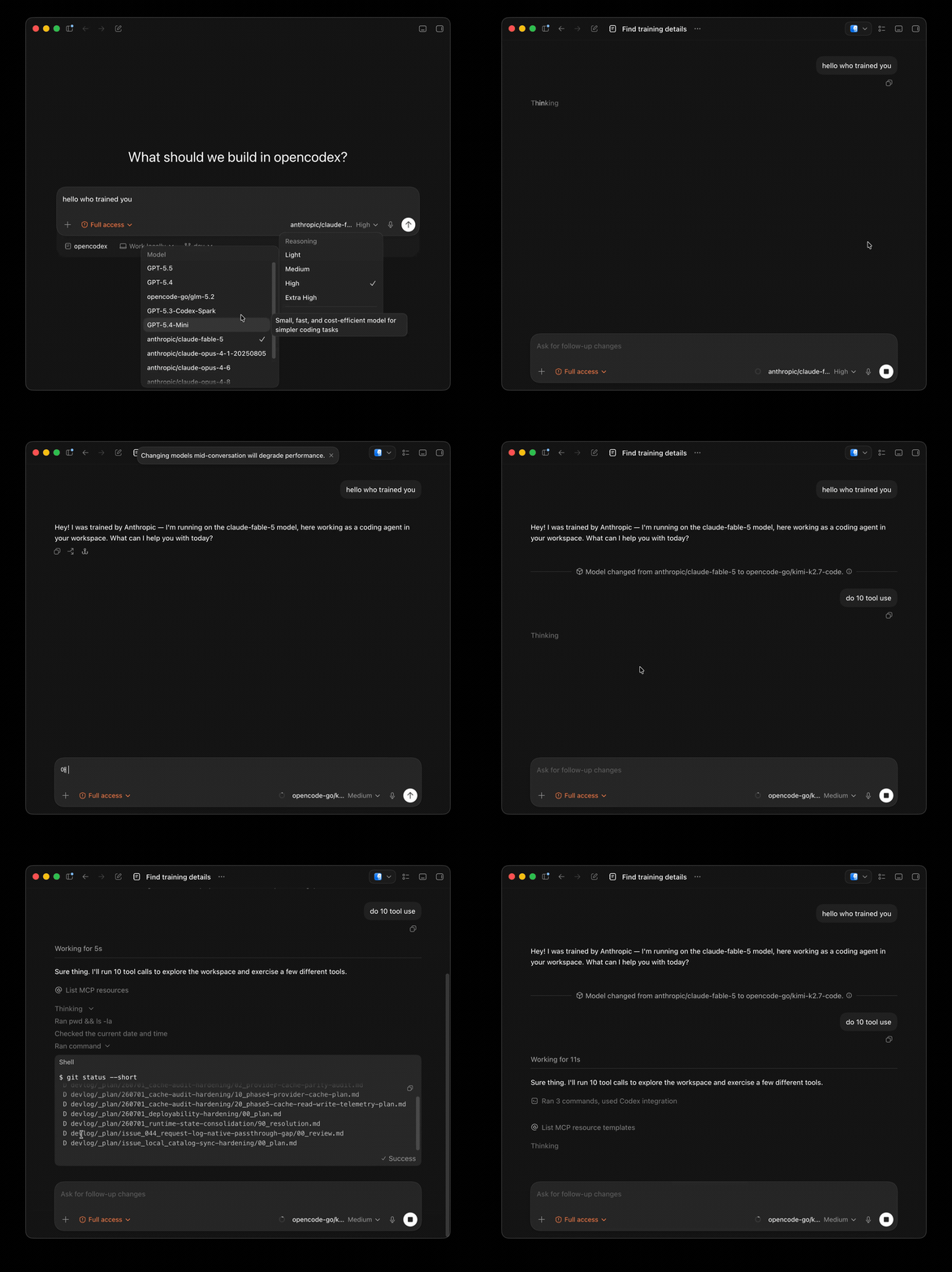
Universal provider proxy for OpenAI Codex & Claude Code — use any LLM (Claude, Gemini, Grok, DeepSeek, Ollama…) with Codex CLI, App, SDK, and Claude Code

Git-native persistent memory for AI coding agents. Implements Google OKF v0.2 with sub-300µs in-memory BM25 search, embedded MCP server, and progressive disclosure. Slashes token bloat by 80% with zero external databases or dependencies. Built in pure Go.

Local-first code intelligence graph for MCP and CLI. Builds a persistent map of your codebase so AI coding tools read only what matters, with benchmarked context reductions on reviews and large-repo workflows.

Stop your AI from making things up — it proposes, deterministic tools decide, every claim checked against ground truth with evidence. Grounded facts and context survive resets. Reverse engineering is the proving ground. MCP server + CLI.