infinri/
Writ

infinri/WritHarnesses
Governance runtime for Claude Code. Enforces workflow gates at tool time, delivers the engineering rules relevant to the work, and preserves decision provenance across sessions.
197
Governance runtime for Claude Code. Enforces workflow gates at tool time, delivers the engineering rules relevant to the work, and preserves decision provenance across sessions.
YAO = Yielding AI Outcomes. A rigorous engineering, evaluation, governance, and portability system for reusable agent skills.

Governed, provenance-sealed creative rendering for Databricks — a Streamlit App + Unity Catalog ai_render() function that turns any governed source (Sample Lakehouse, UC, Genie, or BYO data) into infographics, reports, decks, video briefings, music, and podcasts.

Build tested agent skills and govern their lifecycle through a user-defined marketplace: evidence, discovery, updates, rollback, quarantine, and 17-platform distribution.

Governance standard and reference toolset for LLM-maintained knowledge corpora

Governance gateway for AI agents — bounded, auditable, session-aware control with MCP proxy, shell proxy & HTTP API. Works with Cursor, Claude Code, Codex, and any MCP-compatible agent.

Govern consequential AI agent actions in Docker with deterministic policy, human approval, and signed Decision Dossiers.
Know what to fix next — local .pm governance skill pack for AI coding agents (Spec Kit–inspired).

A disciplined methodology for AI-assisted software development. Covers architectural constraints, validation hooks, session governance, and PAG (Pattern Abstract Grammar) for structured AI collaboration. Copy claude-setup/ into your project to start.

One governed graph for AI agents — GraphQL + MCP over your databases, files, APIs, and code

SkillsVote: Lifecycle Governance of Agent Skills from Collection, Recommendation to Evolution

Governance framework for AI coding agents. It runs them through a five-step workflow (plan, build, review, test, ship) where no step counts as done without evidence. Drop-in rules and guardrails for Claude Code, Codex, Cursor, Copilot, and Antigravity, via AGENTS.md.
Remote approvals, policy checks, and execution evidence for unattended AI agents.

AI-driven quality & governance MCP Server for dbt projects. Audit coverage, profile data, detect schema drift, and auto-generate documentation — all through natural language with your AI assistant.
AI-powered company knowledge MCP. Unified place for internal policies, values, documentation, and governance. Agents can search, cite, and answer questions using real company docs.

A human-governed AI coding workflow that distills ephemeral session context into persistent project memory—making work traceable, reviewable, and resumable.

A collection of structured AI agent skills that enable Claude Code, Cursor, GitHub Copilot, and other AI coding assistants to create, operate, debug, and govern Harness CI/CD workflows through natural language.

GenBI (Generative BI) for AI agents, an open-source, governed text-to-SQL through an open context layer that turns natural-language questions into trusted dashboards, charts, and SQL across 20+ data sources, such as BigQuery, Snowflake, PostgreSQL, ClickHouse, Amazon Redshift, Databricks and more.
Open-source governed, local-first memory control plane for AI agents and teams. arXiv:2608.08253

📚 Two books on harness engineering — the design philosophies behind Claude Code & Codex: constraints, query loops, context governance, multi-agent verification. harness-books.agentway.dev

Local-first, evidence-controlled academic writing workflows for AI agents, with bounded revision, clean-room review, and release governance.

Caura (formerly MemClaw) — governed shared memory for AI agent fleets. Multi-agent, multi-tenant, MCP-native. Trust tiers, keystone policies, audit trails, knowledge graph, self-improving retrieval. Apache 2.0.
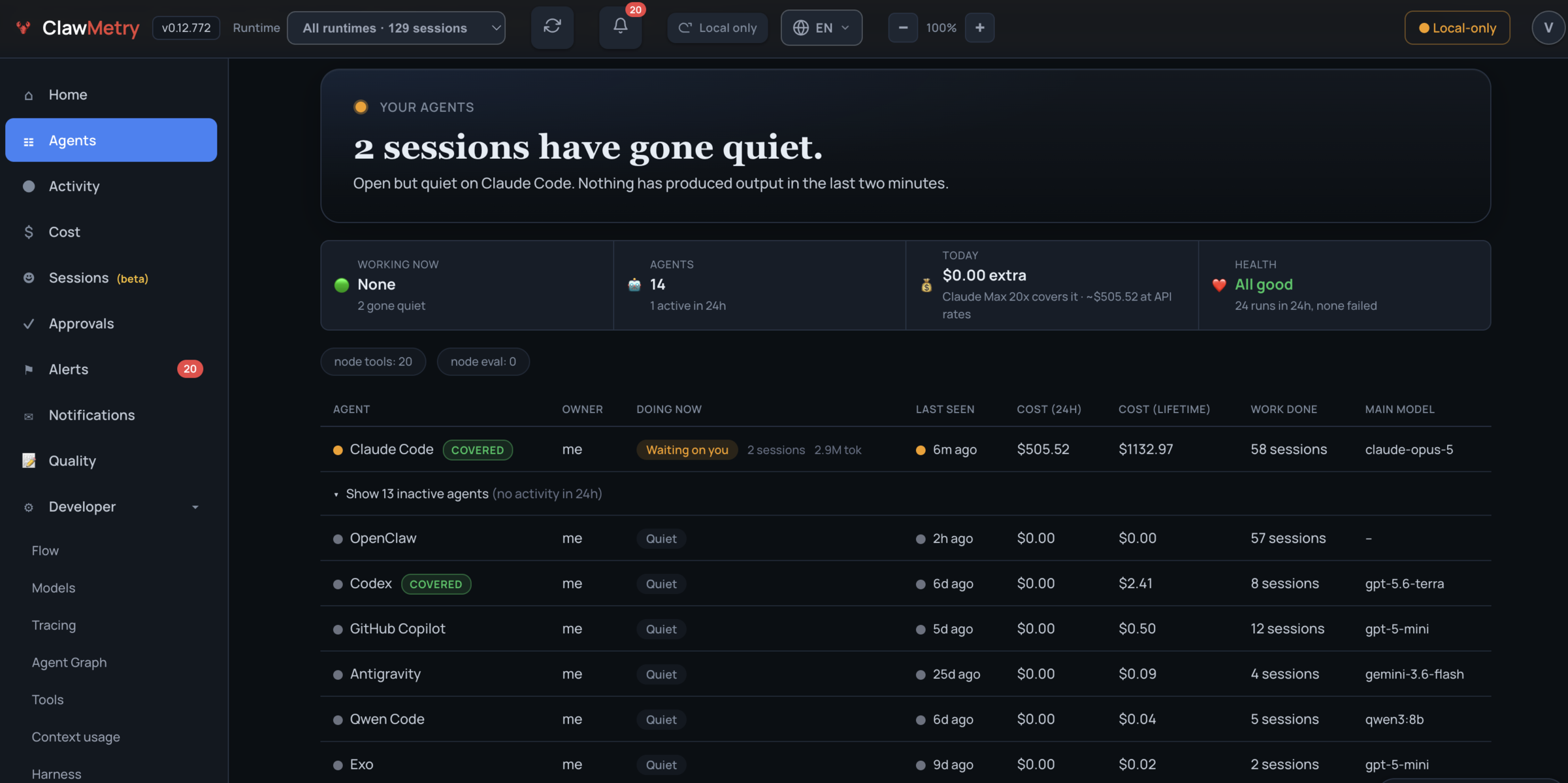
See your agent think. Zero-config observability & governance for 30 AI agent runtimes: Claude Code, OpenAI Codex, Hermes, OpenClaw & 26 more. Live token costs, sessions, tool calls, crons.

Forge Orchestrator: Multi-AI task orchestration. File locking, knowledge capture, drift detection. Rust.