
affaan-m/
ECC

affaan-m/ECCHarnesses
The agent harness performance optimization system. Skills, instincts, memory, security, and research-first development for Claude Code, Codex, Opencode, Cursor and beyond.
258k
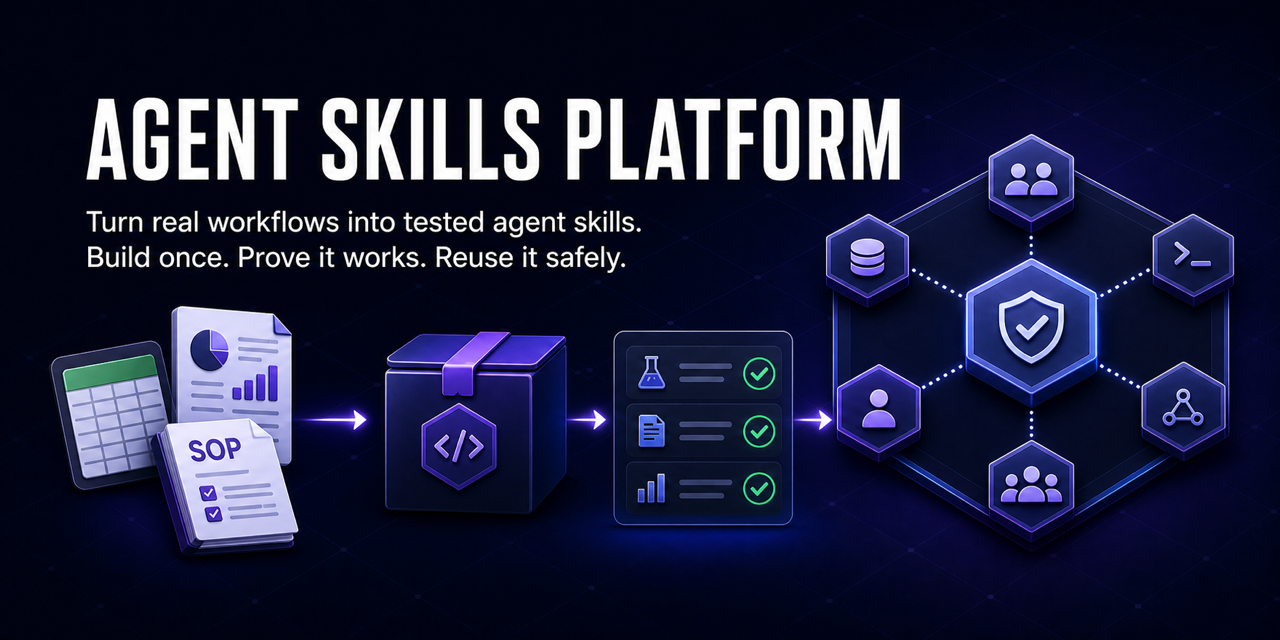
Agent Skills Platform turns a workflow plus evidence into an installable skill package. It adds instructions, scripts, evals, security checks, and a representative run, then publishes that skill through a governed marketplace with versioning, discovery, rollback, and quarantine.
Builders who want Claude Code, Codex, Cursor, or other agent tools to reuse approved workflows instead of redoing them from scratch.
You can turn a recurring workflow into a verified skill and share it through a controlled marketplace instead of distributing prompts by hand.
Builds a reusable skill from prompts, reports, spreadsheets, screenshots, transcripts, links, or scripts.
Runs validation, security checks, evals, and a representative run before release.
Supports admission, approval, release, distribution, updates, rollback, and quarantine for team skills.
Packages skills for installation across supported agent platforms and editors.
Keeps raw evidence, draft patterns, and validated changes separate from the executable skill.
/agent-skills-platform

Turn my monthly revenue-variance review into a reusable internal skill.
I attached past reports and the source spreadsheets. The decision is whether to
escalate a material variance. It must not modify source data.
/agent-skills-platform

Turn my monthly revenue-variance review into a reusable internal skill.
I attached past reports and the source spreadsheets. The decision is whether to
escalate a material variance. It must not modify source data.
SME supplies examples and approves the result
        ↓
Creator builds and verifies a skill
        ↓
Marketplace operator governs and publishes it
        ↓
Colleagues install an approved version and use itTurn a real workflow into a tested, installable agent skill—then publish it safely to your team.





Website · Installation · Worker runbook · Team marketplace · Product scope
Agent Skills Platform turns the way people already work into tested, installable agent skills. Give it a prompt plus the evidence behind the work—spreadsheets, reports, emails, screenshots, transcripts, links, or scripts—and it builds a reusable workflow that a person can inspect, an organization can review, and a team can safely reuse.
/agent-skills-platform

Turn my monthly revenue-variance review into a reusable internal skill.
I attached past reports and the source spreadsheets. The decision is whether to
escalate a material variance. It must not modify source data.
The result is not just a prompt: it is an installable skill package with instructions, functional scripts when needed, evals, security checks, a representative-run record, and a correction path for real-world learning.
After release, a skill can retain maintenance evidence without turning every log
into runtime prompt context: classified run evidence is captured in raw/, recurring
findings become evidence-linked draft patterns in wiki/, and only a separately
validated change may update the executable skill. This is a governed maintenance
record, not autonomous self-modification.
Choose the path that matches what you need today.
First question: is this skill just for you, or will teammates install or reuse the skill itself?
Teammates receiving a report or queue does not require a marketplace. Use the team path only when teammates will install or reuse the skill.
Open the AI agent you already use, attach examples of the work, and paste this:
/agent-skills-platform

Turn my monthly revenue-variance review into a reusable internal skill.
I attached past reports and the source spreadsheets. The decision is whether to
escalate a material variance. It must not modify source data.
The creator asks for the business decisions only you can authorize, builds and tests the skill, and shows a representative result. When it is correct, say: “Publish this to the Finance marketplace.”
When the workflow uses an API, database, MCP, codebase, or structured file, Semantic
Recon runs automatically before implementation and creates a pinned data contract.
Use ./install.sh --without-semantic-recon only for a deliberately local,
source-free installation.
Do not use Git, edit registry files, or run marketplace commands. If the creator is not installed in your agent, send this section to your marketplace operator.
Use the governed team marketplace guide to admit, approve, release, distribute, update, quarantine, and roll back tested skills.
Read the product scope, organizational acceptance protocol, and technical implementation guide.
SME supplies examples and approves the result
        ↓
Creator builds and verifies a skill
        ↓
Marketplace operator governs and publishes it
        ↓
Colleagues install an approved version and use it
The SME owns business meaning. The marketplace operator owns distribution and policy. See roles and handoffs.
The repository includes a live, read-only weather briefing example with a source-linked result and verification evidence. Start with the verification record, then inspect the skill package.
| Need | Read |
|---|---|
| Install on a supported AI tool | Installation |
| Create, correct, and hand off a first skill | Worker runbook |
| Run a governed internal marketplace | Team marketplace |
| Understand scope and product boundaries | Product scope |
| Review architecture, validation, and technical controls | Technical overview |
| Contribute | Contributing |
An Agent Skill is a reusable workflow package that guides an agent from a recognized situation to a verified outcome. It can use retrieved knowledge, MCP tools, APIs, deterministic scripts, and agent judgment, but it is not itself a RAG system, MCP server, or agent runtime.
RAG supplies knowledge. MCP supplies capabilities. The harness supplies execution. A skill organizes them into a governed path toward a verified outcome.
Reason where interpretation is necessary. Execute and verify with deterministic controls where reproducibility matters. External models, APIs, and changing data may vary rather than promising identical outputs.
Humans establish meaning. The factory does not expect you to know the correct prompt or semantic contract; it asks one bounded question at a time. The flow is:
Every skill is checked as one connected system. The skill graph links its
instructions, scripts, evaluations, and expected outputs. Two structural
requirements confirm that every expected result is tested and every predictable
multi-step workflow has one reliable entry point. Four checks—specification,
pipeline, security, and evaluation schema—run in parallel. Finally, a
representative run proves that the skill produces a useful result. The graph also
enforces every_expected_is_reachable and deterministic_multistep_has_orchestrator.
See CONTRIBUTING.md and CODE_OF_CONDUCT.md. Contributions require the contributor assignment.
MIT. See LICENSE. Copyright © 2026 Francy J G Lisboa, also known as Charuto. See ownership.
Sign in to join the discussion.
No comments yet. Be the first to say what this is good for.
The agent harness performance optimization system. Skills, instincts, memory, security, and research-first development for Claude Code, Codex, Opencode, Cursor and beyond.
from vibe coding to agentic engineering - practice makes claude perfect
🌊 The original agent meta-harness. Deploy intelligent multi-player swarms, coordinate autonomous workflows, and build conversational AI systems. Features adaptive memory, self-learning intelligence, RAG integration, and native Claude Code / Codex / Hermes and many more Integrated
Practical patterns, starters & CLI tools for loop engineering with AI coding agents. Design systems that prompt and orchestrate agents (inspired by Addy Osmani and Boris Cherny). Includes loop-audit, loop-init, loop-cost.

Git. Ship. Done - Core

The most RAM efficient harness