
affaan-m/
ECC

affaan-m/ECCHarnesses
The agent harness performance optimization system. Skills, instincts, memory, security, and research-first development for Claude Code, Codex, Opencode, Cursor and beyond.
258k
Cambium defines how an agent-maintained knowledge corpus should be governed: what rules apply, who may change shared state, what evidence is required, and how interrupted work resumes. It centers a normative kernel, one selected profile, and adopter-owned runtime state, then uses deterministic tools to validate structure, queues, receipts, and host projections. It also exposes an MCP server and generated host configs so builders can connect Claude Code, Codex, and similar agents to the same governed workflow. The repo is not the corpus itself; it is the control layer around the corpus.
Builders who want their agent to manage a knowledge corpus with shared rules, evidence, and resumable tasks.
You can run long-lived agent work with clear rules, verifiable state, and a safe resume path instead of guesswork.
Defines a normative kernel, one selected profile, and adopter-owned runtime state as the effective governance stack.
Ships tools for initializing state, compiling queues, checking status, updating tasks, and recording receipts.
Requires audit receipts, terminal proof, and other checks before work can close.
Renders host configs and an MCP interface for supported agent hosts from one canonical server definition.
Separates machine-resolvable read sets from curated cards for route-specific guidance.
Includes candidate profile creation, validation, and adoption commands for bringing a corpus under Cambium governance.
effective governance
  = Cambium kernel
  + exactly one selected profile
  + adopter-owned runtime state
.cambium/
├── <canonical current state>
├── <bound operational inputs>
├── <evidence and history>
├── <recovery state>
├── <transient workspace>
└── <derived projections>
python3 Tools/scaffold_profile.py . --profile-id my-profile
python3 Tools/scaffold_profile.py . --profile-id my-profile --apply
python3 Tools/profile_onboarding_status.py . --profile-id my-profile --json
python3 Tools/check_profile.py profiles/my-profile
python3 Tools/apply_profile_adoption.py . --plan <plan>.yaml \
  --upstream-root <local-cambium-repository> --upstream-ref <git-ref>
python3 Tools/apply_profile_adoption.py . --plan <plan>.yaml \
  --upstream-root <local-cambium-repository> --upstream-ref <git-ref> --apply
python3 Tools/check_queue.py . --resume-status
English | 简体中文
Cambium is a governance standard and reference toolset for knowledge repositories maintained with LLM agents.
It helps an operator answer five practical questions:
Cambium is not a knowledge base, a RAG engine, an agent scheduler, or a default domain policy. It governs work; it does not supply the corpus or decide its meaning.
effective governance
  = Cambium kernel
  + exactly one selected profile
  + adopter-owned runtime state
The diagram shows how these layers connect to runtime routes, deterministic tools, and agent execution contexts.
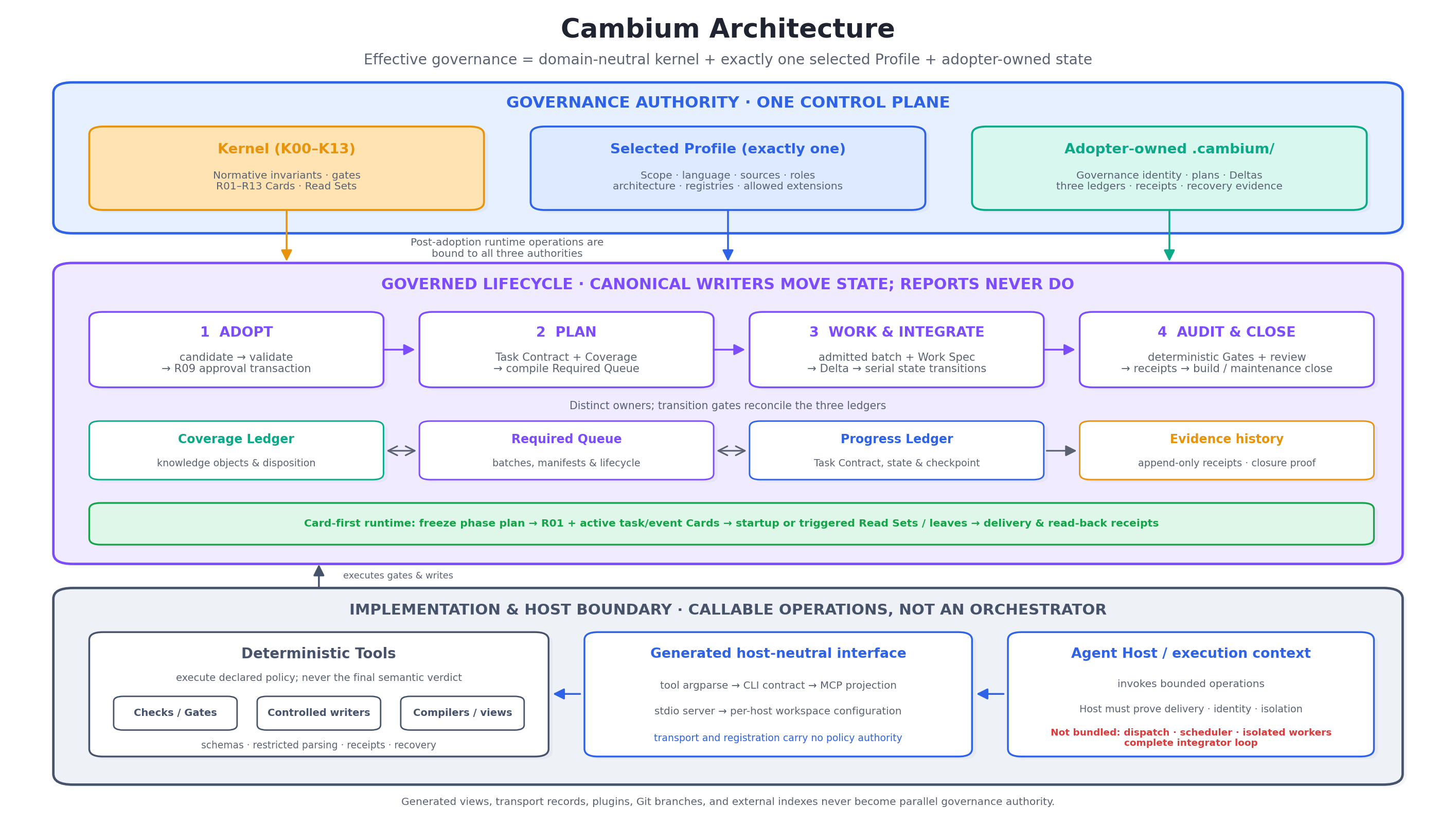
| Layer | What it owns |
|---|---|
kernel/ | Cross-domain governance semantics, invariants, state meanings, and extension points |
Card/ | Curated, non-authoritative flight checklists for an already selected task route or phase |
Read Set/ | Machine-resolvable declarations of what canonical material an already selected route or phase must load |
| Selected profile | One repository's scope, language, architecture, sources, priorities, roles, scans, and allowed extensions |
.cambium/ | The adopter's current governance identity, task state, Queue, plans, deltas, receipts, and recovery evidence |
Tools/ | Stable public commands and Area/Domain implementations for deterministic checks, controlled writes, schemas, and generated projections |
The kernel is normative. A profile can fill or tighten an extension point, but cannot disable a kernel rule. Tools execute declared rules; they do not make the final semantic judgment.
Cards are short, curated checklists, not routes or a second copy of the standard. Read Sets own the static loading boundary. When a Card is insufficient or disputed, its read-back hook resolves through the paired Read Set to the canonical owner.
This repository is intentionally uninstantiated. It contains one candidate Profile template and non-authoritative examples, but selects no adopter profile and creates no fabricated task state.
Cambium currently provides:
The generated MCP surface exposes both leaf calls and the bounded Runner. The Runner is not a scheduler or governance engine: it derives one identity-bound next action from current runtime state, invokes only registered capabilities, reads the result back, and stops at every semantic boundary. Each underlying Tool still decides whether its operation is valid and whether its evidence counts. For every active typed path, the transport retains the admitted file or parent-directory descriptor through subprocess consumption; an unsupported platform fails server initialization instead of claiming this assurance.
Cambium does not currently bundle:
These boundaries are intentional. A host may add capabilities, but it must not claim evidence for a capability it cannot prove. See ROADMAP.md for the delivery order.
Long-running work uses three state objects with different owners:
| State object | What it answers |
|---|---|
| Coverage Ledger | Which knowledge objects exist, what disposition they have, and which batch currently owns unfinished work? |
| Required Queue | Which batches exist, what are their manifests and dependencies, and what lifecycle state is each batch in? |
| Progress Ledger | What is the task contract, whole-task state, checkpoint, Standards identity, and accepted Queue fingerprint? |
They must agree, but they are not interchangeable task lists.
The adopter-owned namespace contains six lifecycle classes:
.cambium/
├── <canonical current state>
├── <bound operational inputs>
├── <evidence and history>
├── <recovery state>
├── <transient workspace>
└── <derived projections>
Do not edit canonical state by hand. Use the owning writer so revisions, hashes, receipts, and recovery evidence move together. Tools/execution/task_runtime/runtime_paths.py is the single machine owner of the current physical path spellings and object classifications; this README does not maintain a second directory contract.
Adoption creates and approves one profile for one repository. Copying a template or example does not select it.
Run the authoring workflow from a Cambium source checkout after the Agent-driven Host preparation. With terminal access and installation authorization, the Agent prepares and verifies the required toolchain; users do not choose dependency versions or fill in local paths. The user supplies and confirms repository decisions, without manually copying template files or writing TOML.
python3 Tools/scaffold_profile.py . --profile-id my-profile
python3 Tools/scaffold_profile.py . --profile-id my-profile --apply
The first command is a dry run. The second creates profiles/my-profile/profile.toml with the confirmed identity and empty slots, copies only the declared supporting files, and refuses to overwrite an existing candidate. It makes no policy choice and performs no adoption.
The assisting agent uses profiles/interview.yaml to discuss the repository's needs and Tools/profile_candidate.py to read, preview, edit, and render the candidate. User answers live once in profile.toml; independently referenced policy bodies retain their own owner. profiles/README.md describes the exact workflow and snapshot preconditions.
The Kernel owns slot meaning and legal values through K00/19 and domain-owned contracts. Tools own TOML encoding—including the root version, slots packaging, and draft-validation entry point—plus file layout, evaluation, and presentation. Existing domain YAML contracts remain sole owners where other consumers need them; their CUE projections are generated and checked, not parallel handwritten rules.
python3 Tools/profile_onboarding_status.py . --profile-id my-profile --json
python3 Tools/check_profile.py profiles/my-profile
Unanswered draft fields remain unanswered: omission is not agreement to disable an option or inherit a default. Existing legal defaults still apply where the completed contract permits them, but do not prove user confirmation. Mechanical validity, user confirmation, and adoption are separate; a rendered view or successful check never selects the Profile.
Prepare a plan from Tools/schemas/profile_adoption_plan.template.yaml, then dry-run and apply it:
python3 Tools/apply_profile_adoption.py . --plan <plan>.yaml \
  --upstream-root <local-cambium-repository> --upstream-ref <git-ref>
python3 Tools/apply_profile_adoption.py . --plan <plan>.yaml \
  --upstream-root <local-cambium-repository> --upstream-ref <git-ref> --apply
The transaction resolves the upstream ref to its full Git commit SHA and records that SHA as the sole Standards identity in upstream_revision_id. It binds the selected Profile and resulting adopter-owned contracts/evidence, and restores the previous control plane if any step fails. It never restamps or rewrites the adopter's upstream Card bytes. Adoption remains an explicit CLI maintenance operation: its external upstream repository input is never exposed as an unrestricted MCP argument.
An empty corpus follows the same adoption contract. First perform bounded founding work to create real canonical owners and the residual-scan witness — one page may serve as both owner and witness when that is semantically natural, but pages are never merged only to save files. Then a second R09 revision configures the Corpus Planning slot before large-scale work begins. The candidate and adoption boundary is documented in profiles/README.md.
Always check for existing runtime state before writing:
python3 Tools/check_queue.py . --resume-status
If .cambium/state/ exists, this command reports the recorded task, locks, holds, in-flight batches, recovery state, and exact next_action. Do not initialize over it.
Bounded work does not need persistent state. For long-running, resumable, or multi-batch work, first copy and complete the single Task Plan:
cp Tools/schemas/task_plan.template.yaml \
  .cambium/deltas/task-plans/TP-001.yaml

python3 Tools/init_state.py . \
  --plan .cambium/deltas/task-plans/TP-001.yaml

python3 Tools/init_state.py . \
  --plan .cambium/deltas/task-plans/TP-001.yaml --apply

# Run the exact compile_queue command printed by init_state.py; it already carries the Queue revision and SHA bound to the published Task Plan.
python3 Tools/compile_queue.py . --apply --actor-role integrator \
  --expected-queue-revision REVISION \
  --expected-sha256 SHA256

python3 Tools/check_queue.py .
python3 Tools/render_queue.py .
init_state.py has no parallel flags for task identity, objective, scope, Standards, Profile, completion model, or concurrency. Those confirmed values have one owner: the Task Plan. The command atomically publishes the empty Queue, complete Task Contract, planning-only Coverage, and the Receipt retained by Progress; compile_queue.py remains the sole Queue materializer.
After the Queue exists, shared state changes go through a controlled writer:
register_amendment.py and apply_amendment.py handle approved operational replans such as bounded scope/disposition changes and batch cancellation;apply_contract_amendment.py handles the two supported Task Contract fields: policy_exceptions and amendment_authority;adopt_standards.py moves an active task to an approved Standards/Profile revision without rewriting its lifecycle history;apply_delta.py, update_queue.py, and update_task.py own batch and task progression.Writers are dry runs unless --apply is present. Shared-state writes are integrator-only and require current revisions or hashes where the tool asks for them. Exact commands, schemas, and recovery procedures are in Tools/README.md.
Cambium renders registration and corpus binding for Claude Code, Codex, Kimi Code, and dsh from one canonical server definition:
python3 Tools/render_host_configs.py . \
  --projection-target carried-runtime \
  --output-dir /absolute/path/to/corpus/.host-config-staging \
  --distribution-root /absolute/path/to/corpus \
  --workspace-root /absolute/path/to/corpus

python3 Tools/render_host_configs.py . \
  --projection-target carried-runtime \
  --output-dir /absolute/path/to/corpus/.host-config-staging \
  --distribution-root /absolute/path/to/corpus \
  --workspace-root /absolute/path/to/corpus \
  --check
Run this from the adopted corpus root after its carried interface has been generated. Bound products land in .host-config-staging/; install the selected product through the host's own mechanism. Tools/compiled/host-configs/ remains the source-distribution template set and is only regenerated or checked by Cambium maintenance.
| Host | Install the generated configuration at |
|---|---|
| Claude Code | <corpus>/.mcp.json |
| Codex | <corpus>/.codex/config.toml |
| Kimi Code | <corpus>/.kimi-code/mcp.json |
| dsh | the operator profile for registration and <corpus>/.env for binding |
Registration answers “where is the server?” Corpus binding answers “which repository does this session govern?” They are separate capabilities.
Installing a host configuration is not Cambium adoption. It does not approve a profile, create task state, or migrate Standards. The MCP server exposes the generated CLI projection and passes tool verdicts through; it does not create a second policy engine.
Card delivery also has a strict evidence boundary. A server can prove what it sent, but not by itself what a host placed in the model context or what an agent read. Machine-enforced Assignment delivery remains an in-progress roadmap capability; until its gate is complete, do not turn transport metadata into a claim of cognition or independent execution.
2 is a hold, not success and not an ordinary failure.SHA-256 bindings detect drift and inconsistent history inside the adopter's local trust domain. They are not signatures. Without a protected runner or external attestation, Cambium does not authenticate actor labels, reviewer labels, operating-system identities, or workspace isolation. A party that can rewrite the repository, tools, and evidence can construct a new internally consistent history. The MCP transport rejects unsafe arguments and static path aliases inside this local trust domain. For every caller-visible typed path, it also prevents a post-admission name or parent replacement from redirecting the child tool: the exact admitted object is retained and consumed. This is not protected whole-workspace execution. A concurrently privileged process can still attack fixed or derived internal paths that are not part of the public call surface, rewrite repository code and evidence together, or interfere outside the filesystem capability boundary; those wider guarantees require an isolated workspace or external trust anchor.
| Path | Purpose |
|---|---|
kernel/ | Normative common governance rules and Kernel-owned machine contracts |
Card/ | Curated, non-authoritative action checklists |
Read Set/ | Canonical static loading declarations and generated navigation |
profiles/ | Candidate template, interview, adoption guidance, and non-authoritative examples |
Tools/ | Stable Tools/<tool>.py public commands, Tool contracts, schemas, and operating guidance |
Tools/governance/, Tools/knowledge/, Tools/execution/, Tools/platform/ | Implementations grouped by the machine-checked Area/Domain hierarchy |
Tools/TOOL_CATALOG.md | Generated Tool hierarchy, interface, and dependency navigation |
Tools/compiled/ | Generated CLI, MCP, metadata, host, and Tool-catalog projections |
assets/readme/ | Public diagrams embedded by the root READMEs |
ROADMAP.md | Status-based implementation roadmap |
CONTRIBUTING.md | Issue ownership, defect promotion, and pull-request contract |
Kernel module numbers are stable identities, not a contiguous display sequence. A number is not reused after its module moves or retires; the active reading order is the one listed by each Standard entry page's Module Index.
Examples show answer shape; they are not defaults and must not be selected in place of an adopter-owned profile.
Cambium uses path-based licensing:
Tools/, .github/, Makefile, and distribution-boundary.yaml uses Apache-2.0;kernel/, curated Card/ and Read Set/ material, profiles, README and contributing documentation, the roadmap, and diagrams under assets/readme/ use CC BY 4.0.See LICENSE.md, ATTRIBUTION.md, and LICENSES/ for the authoritative terms and notices.
Adopter-generated profiles, state, receipts, and evidence do not acquire a Cambium license merely because Cambium tools manage them.
Sign in to join the discussion.
No comments yet. Be the first to say what this is good for.
The agent harness performance optimization system. Skills, instincts, memory, security, and research-first development for Claude Code, Codex, Opencode, Cursor and beyond.
from vibe coding to agentic engineering - practice makes claude perfect
🌊 The original agent meta-harness. Deploy intelligent multi-player swarms, coordinate autonomous workflows, and build conversational AI systems. Features adaptive memory, self-learning intelligence, RAG integration, and native Claude Code / Codex / Hermes and many more Integrated
Practical patterns, starters & CLI tools for loop engineering with AI coding agents. Design systems that prompt and orchestrate agents (inspired by Addy Osmani and Boris Cherny). Includes loop-audit, loop-init, loop-cost.

Git. Ship. Done - Core

The most RAM efficient harness