nvk/
llm-wiki

nvk/llm-wikiPlugins
LLM-compiled knowledge bases for any AI agent. Parallel multi-agent research, thesis-driven investigation, source ingestion, wiki compilation, querying, and artifact generation.
1.3k
LLM-compiled knowledge bases for any AI agent. Parallel multi-agent research, thesis-driven investigation, source ingestion, wiki compilation, querying, and artifact generation.
Harness engineering applied to knowledge production: a self-evolving multi-agent newsroom that turns your documents into a cross-linked markdown wiki. A "reground" loop pulls published pages back in before they go stale — writer ≠ reviewer, local-first, a structured alternative to RAG.

Turn your architecture into a living, queryable knowledge graph - and render it as beautiful auto-laid-out Excalidraw diagrams. An MCP server for Cursor, Claude Code & Windsurf. Offline, no API keys.
Evidence-first reading for AI agents — turn articles, books and PDFs into traceable claims, evidence, source locations and knowledge maps.

AI Agent Skills for Chinese Knowledge Workers: iMandalArt, FIRE, planning, and publishing workflows for Claude Code, Codex, and LLM agents.
A personal context store for AI agents and assistants—reuse your existing coding agent CLI (Codex/Claude/OpenCode) with built‑in Skills/tools and a desktop GUI to capture, search, and reuse project knowledge across agents and repos.

A Git-native knowledge layer for your team — and a set of tool suite that keeps it alive.
Local-first AI knowledge layer. Extract architecture, query from any AI tool via MCP. Private by architecture.

Persistent project knowledge graph for coding agents. MCP server with semantic search, in-process embeddings, and web explorer.
Turn any codebase, with its docs, SQL schemas, configs, and PDFs, into a queryable knowledge graph. A /graphify skill for Claude Code, Cursor, Codex, and Gemini CLI: local deterministic AST parsing, every edge explained, no vector store.
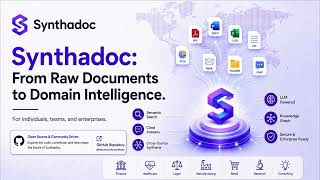
Synthadoc: An open-source LLM knowledge compilation engine that turns raw documents into structured, local-first wikis. A transparent, human-readable alternative to traditional RAG, which can be self-managed and self-improved without the use of any tools.

MCP Documentation Server - Bridge the AI Knowledge Gap. ✨ Features: Document management • Gemini integration • AI-powered semantic search • File uploads • Smart chunking • Multilingual support • Zero-setup 🎯 Perfect for: New frameworks • API docs • Internal guides

A Model Context Protocol (MCP) server that implements the Zettelkasten knowledge management methodology, allowing you to create, link, explore and synthesize atomic notes through Claude and other MCP-compatible clients.

A fast codebase indexer and knowledge wiki for AI agents.

Up to 71.5x fewer tokens per session on Claude Code with Obsidian + Graphify. Persistent memory, codebase knowledge graphs, and chat import pipeline. 🇧🇷 PT-BR included.

Markdown and OFM SDK w/ MCP server that transforms your Obsidian vault into an intelligent knowledge system

Persistent memory for AI coding agents: automatic capture, explainable recall, knowledge consolidation, privacy controls, and portable offline storage. One Python file, zero dependencies.
Capture first. Organize later. A local-first Markdown app that turns scattered records into clear notes with AI.
Agent-driven research knowledge base. Agents collect, search, and synthesize web research into a persistent, searchable wiki.

LLM-powered knowledge base from your Claude Code, Codex CLI, Copilot, Cursor & Gemini sessions. Karpathy's LLM Wiki pattern — implemented and shipped.

Caura (formerly MemClaw) — governed shared memory for AI agent fleets. Multi-agent, multi-tenant, MCP-native. Trust tiers, keystone policies, audit trails, knowledge graph, self-improving retrieval. Apache 2.0.

Automatically create new skills based on past agent traces

Frappe Agent Skills gives AI coding assistants structured Frappe knowledge for DocTypes, APIs, Desk customization, frontend apps, reports, testing, and production patterns.

A complete starter kit for an Obsidian + Claude Code personal knowledge management system.