
koala73/worldmonitorConnectors
Real-time global intelligence dashboard. AI-powered news aggregation, geopolitical monitoring, and infrastructure tracking in a unified situational awareness interface
86k
This repository provides an MCP server that manages documents, chunks them for retrieval, and exposes search and document tools to agents. It also starts a web dashboard on port 3080 and exposes the same actions through a REST API, so builders can use it from MCP clients or simple HTTP calls.

Builders who want their agent to search, upload, and manage project docs from one local knowledge base.
You can give your agent a shared document store with semantic search instead of re-explaining context every session.
Add, list, fetch, and delete documents with metadata and stored content.
Processes `.txt`, `.md`, and `.pdf` files from the uploads folder into the knowledge base.
Combines full-text and vector search across all documents or within one document.
Returns neighboring chunks so the agent can see the surrounding section, not just the match.
Uses Google Gemini for optional AI-powered document analysis when `GEMINI_API_KEY` is set.
Provides a browser UI for browsing, searching, uploading, and deleting documents.
Includes `skills/documentation-server/SKILL.md` with REST API examples for agents.
curl -s http://127.0.0.1:3080/api/config
curl -s http://127.0.0.1:3080/api/documents
curl -s -X POST http://127.0.0.1:3080/api/search-all \
  -H "Content-Type: application/json" \
-d '{"query": "your search", "limit": 5}'npx skills add https://github.com/andrea9293/mcp-documentation-server --skill documentation-server






Local-first document management and semantic search for AI coding agents. No external databases, no cloud APIs, no vendor lock-in.
Unlike other MCP servers that are CLI-only, this one ships with a full web dashboard — browse, search, upload, and manage your knowledge base from your browser. Every MCP tool is also exposed as a REST API, giving AI agents a lean, schema-free interface.
.txt, .md, .pdf support{
"mcpServers": {
"documentation": {
"command": "npx",
"args": ["-y", "@andrea9293/mcp-documentation-server"]
}
}
}
Open your browser at http://localhost:3080 — the web UI starts automatically.
Every MCP tool is also accessible via the REST API on http://127.0.0.1:3080/api/. This is the recommended way to interact from AI agents (Claude Code, OpenCode, Gemini CLI, Cursor) because it avoids loading MCP tool schemas into the conversation context — only the response JSON enters.
curl -s http://127.0.0.1:3080/api/config
curl -s http://127.0.0.1:3080/api/documents
curl -s -X POST http://127.0.0.1:3080/api/search-all \
  -H "Content-Type: application/json" \
  -d '{"query": "your search", "limit": 5}'
A ready-to-use skill is included at skills/documentation-server/SKILL.md — it teaches your agent every endpoint with examples. Install it:
npx skills add https://github.com/andrea9293/mcp-documentation-server --skill documentation-server
add_document or place .txt / .md / .pdf files in the uploads folder and call process_uploads.search_all_documents, or within a single document with search_documents.get_context_window to fetch neighboring chunks and give the LLM broader context.The web interface starts automatically on port 3080 when the MCP server launches. From the web UI you can:
GEMINI_API_KEY is set){
"mcpServers": {
"documentation": {
"command": "npx",
"args": ["-y", "@andrea9293/mcp-documentation-server"]
}
}
}
{
  "mcpServers": {
    "documentation": {
      "command": "npx",
      "args": ["-y", "@andrea9293/mcp-documentation-server"],
      "env": {
        "MCP_BASE_DIR": "/path/to/workspace",
        "GEMINI_API_KEY": "your-api-key-here",
        "MCP_EMBEDDING_MODEL": "Xenova/all-MiniLM-L6-v2",
        "START_WEB_UI": "true",
        "WEB_HOST": "127.0.0.1",
        "WEB_PORT": "3080"
      }
    }
  }
}
All environment variables are optional. Without GEMINI_API_KEY, only the local embedding-based search tools are available.
The server registers the following tools (all validated with Zod schemas):
| Tool | Description |
|---|---|
add_document | Add a document (title, content, optional metadata) |
list_documents | List all documents with metadata and content preview |
get_document | Retrieve the full content of a document by ID |
delete_document | Remove a document, its chunks, database entries, and associated files |
| Tool | Description |
|---|---|
process_uploads | Process all files in the uploads folder (chunking + embeddings) |
get_uploads_path | Returns the absolute path to the uploads folder |
list_uploads_files | Lists files in the uploads folder with size and format info |
get_ui_url | Returns the Web UI URL (e.g. http://localhost:3080) — useful to open the dashboard or to locate the uploads folder from the browser |
| Tool | Description |
|---|---|
search_documents | Semantic vector search within a specific document |
search_all_documents | Hybrid (full-text + vector) cross-document search |
get_context_window | Returns a window of chunks around a given chunk index |
search_documents_with_ai | 🤖 AI-powered search using Gemini (requires GEMINI_API_KEY) |
Configure via environment variables or a .env file in the project root:
| Variable | Default | Description |
|---|---|---|
MCP_BASE_DIR | ~/.mcp-documentation-server | Base directory for data storage |
MCP_EMBEDDING_MODEL | Xenova/all-MiniLM-L6-v2 | Embedding model name |
GEMINI_API_KEY | — | Google Gemini API key (enables search_documents_with_ai) |
MCP_CACHE_ENABLED | true | Enable/disable LRU embedding cache |
START_WEB_UI | true | Set to false to disable the built-in web interface |
WEB_HOST | 127.0.0.1 | Bind address for the web UI (use 0.0.0.0 to expose on all interfaces) |
WEB_PORT | 3080 | Port for the web UI |
MCP_STREAMING_ENABLED | true | Enable streaming reads for large files |
MCP_STREAM_CHUNK_SIZE | 65536 | Streaming buffer size in bytes (64KB) |
MCP_STREAM_FILE_SIZE_LIMIT | 10485760 | Threshold to switch to streaming (10MB) |
~/.mcp-documentation-server/     # Or custom path via MCP_BASE_DIR
├── data/
│   ├── orama-chunks.msp         # Orama vector DB (child chunks + embeddings)
│   ├── orama-docs.msp           # Orama document DB (full content + metadata)
│   ├── orama-parents.msp        # Orama parent chunks DB (context sections)
│   ├── migration-complete.flag   # Written after legacy JSON migration
│   └── *.md                     # Markdown copies of documents
└── uploads/                     # Drop .txt, .md, .pdf files here
Set via MCP_EMBEDDING_MODEL:
| Model | Dimensions | Notes |
|---|---|---|
Xenova/all-MiniLM-L6-v2 | 384 | Default — fast, good quality |
Xenova/paraphrase-multilingual-mpnet-base-v2 | 768 | Recommended — best quality, multilingual |
Models are downloaded on first use (~80–420 MB). The vector dimension is determined automatically from the provider.
⚠️ Important: Changing the embedding model requires re-adding all documents — embeddings from different models are incompatible. The Orama database is recreated automatically when the dimension changes.
Server (FastMCP, stdio)
  ├─ Web UI (Express, port 3080)
  │    └─ REST API → DocumentManager
  └─ MCP Tools
       └─ DocumentManager
            ├─ OramaStore          — Orama vector DB (chunks DB + docs DB + parents DB), persistence, migration
            ├─ IntelligentChunker  — Parent-child chunking (code, markdown, text, PDF)
            ├─ EmbeddingProvider   — Local embeddings via @xenova/transformers
            │    └─ EmbeddingCache — LRU in-memory cache
            └─ GeminiSearchService — Optional AI search via Google Gemini
git clone https://github.com/andrea9293/mcp-documentation-server.git
cd mcp-documentation-server
npm install
npm run dev       # FastMCP dev mode with hot reload
npm run build     # TypeScript compilation
npm run inspect   # FastMCP web UI for interactive tool testing
npm start         # Direct tsx execution (MCP server + web UI)
npm run web       # Run only the web UI (development)
npm run web:build # Run only the web UI (compiled)
git checkout -b feature/nameMIT — see LICENSE
Sign in to join the discussion.
No comments yet. Be the first to say what this is good for.
Real-time global intelligence dashboard. AI-powered news aggregation, geopolitical monitoring, and infrastructure tracking in a unified situational awareness interface
High-performance code intelligence MCP server. Indexes codebases into a persistent knowledge graph — average repo in milliseconds. 158 languages, sub-ms queries, 99% fewer tokens. Single static binary, zero dependencies.
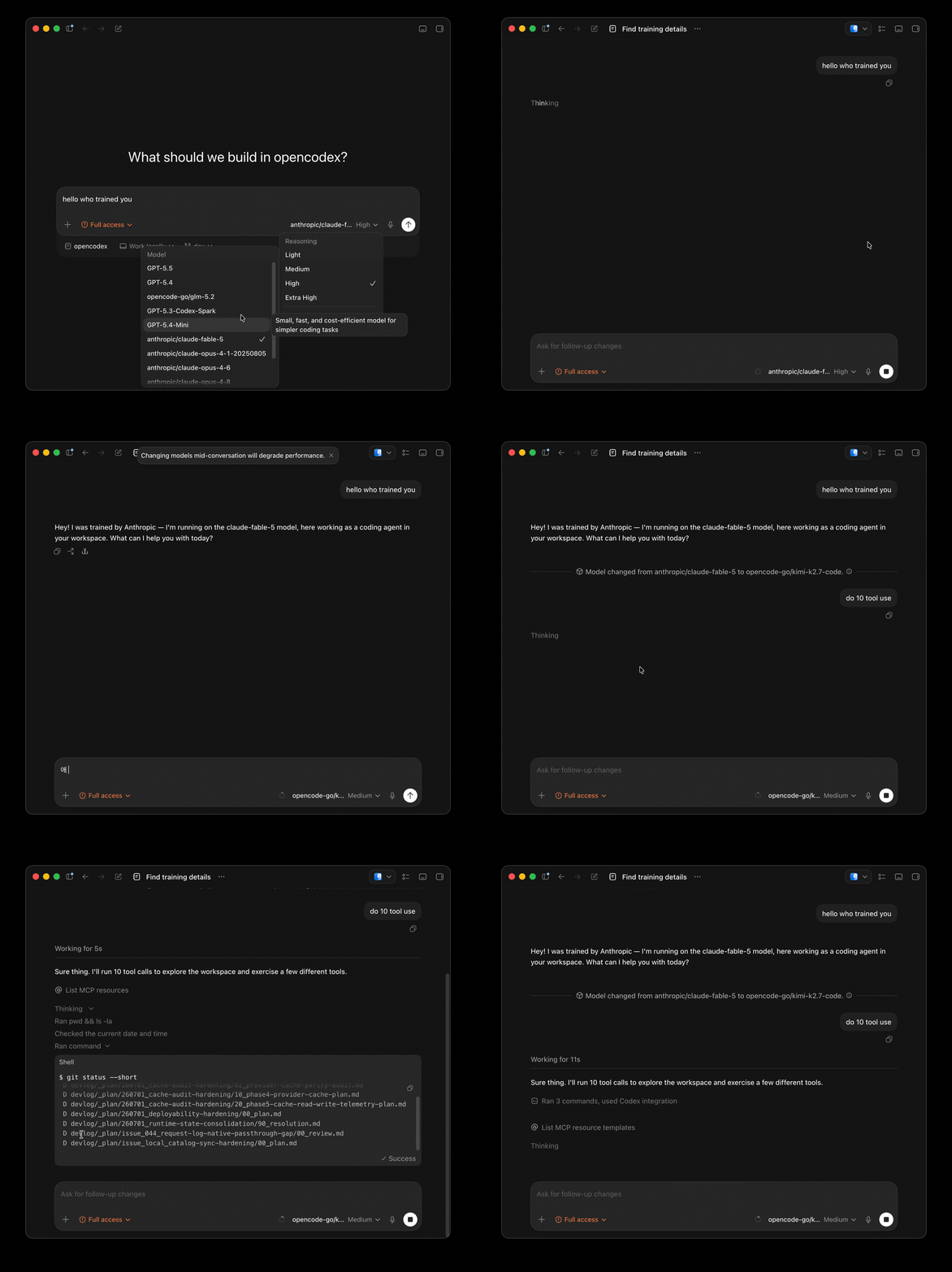
Universal provider proxy for OpenAI Codex & Claude Code — use any LLM (Claude, Gemini, Grok, DeepSeek, Ollama…) with Codex CLI, App, SDK, and Claude Code

Git-native persistent memory for AI coding agents. Implements Google OKF v0.2 with sub-300µs in-memory BM25 search, embedded MCP server, and progressive disclosure. Slashes token bloat by 80% with zero external databases or dependencies. Built in pure Go.

Local-first code intelligence graph for MCP and CLI. Builds a persistent map of your codebase so AI coding tools read only what matters, with benchmarked context reductions on reviews and large-repo workflows.

Stop your AI from making things up — it proposes, deterministic tools decide, every claim checked against ground truth with evidence. Grounded facts and context survive resets. Reverse engineering is the proving ground. MCP server + CLI.