Palm1r/llmqoreFrameworks & SDKs
Qt C++ library for working with AI/LLM Providers and MCP
42
Qt C++ library for working with AI/LLM Providers and MCP
A Lisp with first-class LLM primitives, implemented in Rust

Toward Skill-Native LLMs: Skill Entropy for Benchmarking and Training Long-Horizon Reasoning

Java AI application development framework (supports LLM-tool,skill; RAG; MCP; Agent-ReAct,Team-Agent). Compatible with java8 ~ java26. It can also be embedded in SpringBoot, jFinal, Vert.x, Quarkus, and other frameworks.
The python library for research and development in NLP, multimodal LLMs, Agents, ML, Knowledge Graphs, and more.
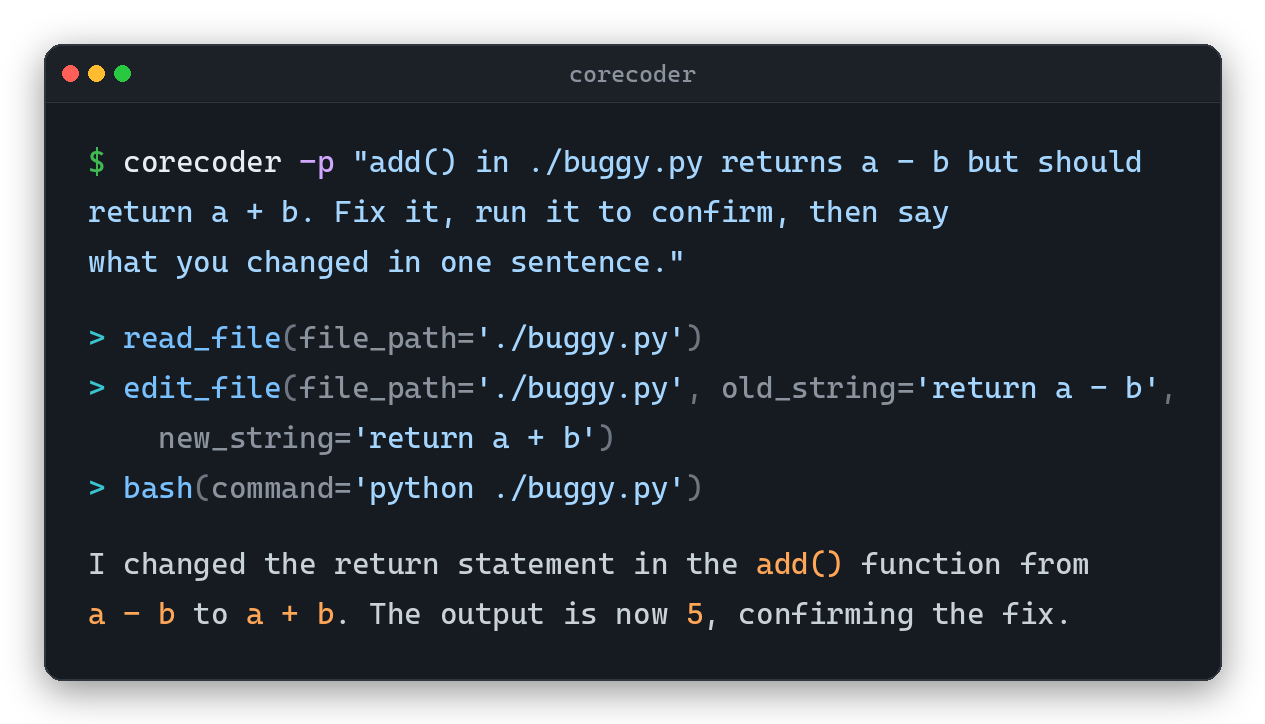
Minimal AI coding agent (~1,000 lines of Python) inspired by Claude Code. Works with any LLM. Think NanoGPT for coding agents. Formerly NanoCoder.
AI Agent Assistant & development framework that integrates lots of IM platforms, LLMs, plugins and AI feature, and can be your openclaw alternative. ✨

The AI Operating System for Delphi. 100% native framework with RAG 2.0, autonomous agents, MCP protocol, and universal LLM connector. Supports OpenAI, Claude, Gemini, Ollama, and more. Delphi 10.4+ (limited), full support from Delphi 12 Athens.

Open-World Self-Evolution for LLM Agents — agents that build both their skills and their own verification signals from scratch, with no target-task supervision. (Code coming soon.)

Deploy production-ready AI services in minutes. One YAML file for agents, RAG pipelines, and MCP servers — run anywhere. Inspired by docker-compose.
Open-source AI orchestration framework for building context-engineered, production-ready LLM applications. Design modular pipelines and agent workflows with explicit control over retrieval, routing, memory, and generation. Built for scalable agents, RAG, multimodal applications, semantic search, and conversational systems.

A modular Python framework implementing the Model Context Protocol (MCP). It features a standardized client-server architecture over StdIO, integrating LLMs with external tools, real-time weather data fetching, and an advanced RAG (Retrieval-Augmented Generation) system.
A standardized framework for enhancing how LLMs process and respond to prompts through composable decorators, featuring an official open standard specification and Python reference implementation. Claude Code plugin and MCP server integration.
Self-evolving memory OS for LLM & AI Agents: ultra-persistent memory, hybrid-retrieval, and cross-task skill reuse, with 35.24% token savings and DeepSeek Harness support.

Multi-agent research automation framework for LLM agents, with adversarial lab meetings, paper-review rounds, auditable Markdown workflows, an autonomous runtime watchdog, and a pixel-art web dashboard.
LLM agents as your hyperparameter optimizer.
🤖 Create agentic apps in a second with your prompts. Everything you need to create an LLM Agent - tools, prompts, frameworks, and models - all in one place.

1flowbase: self-hosted AI gateway with protocol translation, dispatch, chat logs, built-in backend & React blocks to combine AI with business data. All managed by your Agent via MCP.
Config-driven engine that turns JSON into production-grade AI agents. Multi-agent orchestration, 12+ LLM providers, MCP/A2A protocols, RAG, persistent memory, and enterprise compliance (EU AI Act, GDPR, HIPAA). Built on Quarkus.

SkillOpt is a text-space optimizer that trains reusable natural-language skills for frozen LLM agents through trajectory-driven edits, validation-gated updates, and deployable best_skill.md artifacts.
Build effective agents using Model Context Protocol and simple workflow patterns

Multi-language agent runtime and library for execution scope management, lifecycle events, and middleware on tool and LLM calls.
Memori is agent-native memory infrastructure. A LLM-agnostic layer that turns agent execution and conversation into structured, persistent state for production systems. Built for enterprise, Memori works with the data infrastructure you already run, no rip-and-replace, and deploys across managed cloud, single-tenant cloud, VPC, and on-premises.

🌋 Build AI agents that seamlessly combine LLM reasoning with real-world actions via MCP tools — in just a few lines of TypeScript.