



heygen-com/hyperframesFrameworks & SDKs
Write HTML. Render video. Built for agents.
49k
model-compose lets you describe AI services in YAML instead of writing a custom app. You can wire up agents, retrieval workflows, model providers, and MCP servers, then run the same file through HTTP, Docker, or other runtimes.
Builders who want a single YAML file to run agents, RAG pipelines, and MCP servers across local and production setups.
You can ship and move AI workflows without rewriting them for each model, protocol, or runtime.
Define controllers, workflows, and components in YAML instead of application code.
Describe ReAct-style agents with tools, model choices, prompts, and iteration limits.
Compose embedding, retrieval, and answer steps with vector stores like Chroma, Milvus, Qdrant, FAISS, Neo4j, ArangoDB, and Redis.
Expose the same workflow as an MCP server with a controller adapter change.
Pass tokens, audio chunks, and video frames through jobs as first-class streamed values.
Run the same definition locally, in Docker, in virtualenv, or as a process, and add Redis queues for scaling.
pip install model-compose
uv pip install model-compose
export OPENAI_API_KEY=your-key
model-compose up
Deploy production-ready AI services in minutes.
One YAML file. Any model. Any protocol. Any runtime. Build chat APIs, RAG pipelines, autonomous agents, and MCP servers without writing application code — then deploy the same file anywhere, like docker-compose.
AI systems should not be locked into a single provider, runtime, or cloud. model-compose is built on four principles:
Install with pip:
pip install model-compose
Or with uv:
uv pip install model-compose
Create model-compose.yml:
controller:
  adapter:
    type: http-server
    port: 8080
  webui:
    port: 8081

workflow:
  job:
    component: chatgpt
    input:
      prompt: ${input.prompt}

component:
  id: chatgpt
  type: http-client
  base_url: https://api.openai.com/v1
  action:
    path: /chat/completions
    method: POST
    headers:
      Authorization: Bearer ${env.OPENAI_API_KEY}
    body:
      model: gpt-4o
      messages:
        - role: user
          content: ${input.prompt}
Run it:
export OPENAI_API_KEY=your-key
model-compose up
That's it. You're serving GPT-4o at http://localhost:8080 with a web UI at http://localhost:8081. No application code. No framework boilerplate. Same file runs locally, in Docker, or in production.
Here's what a single YAML file can serve today — just a few examples.
Build a ReAct agent that plans, uses tools, and completes multi-step tasks — declaratively.
component:
  id: research-agent
  type: agent
  tools: [search-web, fetch-page]
  max_iteration_count: 10
  action:
    model:
      component: chatgpt
    system_prompt: You are a web research assistant.
    user_prompt: ${input.question}
See simple agents like a code reviewer, a RAG assistant, and a web researcher in agents/.
Compose embedding, vector search, and generation into a single workflow — no glue code.
workflow:
  jobs:
    - id: embed
      component: embedder
      input: { text: ${input.query} }

    - id: retrieve
      component: knowledge
      action: search
      input: { vector: ${jobs.embed.output} }

    - id: answer
      component: chatgpt
      input:
        context: ${jobs.retrieve.output}
        question: ${input.query}
Native drivers ship for Chroma, Milvus, Qdrant, FAISS, Neo4j, ArangoDB, and Redis.
Turn any workflow into an MCP server that Claude, ChatGPT, or Cursor can use — one line change.
controller:
  adapter:
    type: mcp-server   # ← was: http-server
    port: 8080
Full examples live in mcp-servers/, including a Slack bot MCP.
Stream tokens, audio chunks, and video frames end-to-end — first-class across every stage.
workflow:
  job:
    component: chatgpt
    output: ${output as sse-text}

component:
  id: chatgpt
  type: http-client
  action:
    body: { stream: true, ... }
    stream_format: json
    output: ${response[].choices[0].delta.content}
Real-time TTS, video-to-frames, and live chat examples live under data-streaming/ and showcase/.
The same YAML that runs on your laptop scales without a rewrite.
model-compose up
Runs on your machine with a Gradio web UI at :8081 — perfect for iteration.
Add a runtime: block. Same file, same behavior:
controller:
  runtime:
    type: docker
    image: my-ai-service:latest
    ports: [ "8080:8080" ]
Add a queue. Dispatchers accept jobs, subscribers process them across N machines:
controller:
  adapter: { type: http-server, port: 8080 }
  queue:
    driver: redis
    host: redis.internal
    name: my-queue
No shared filesystem. No code changes. Just add more subscribers to scale.
| model-compose | Managed APIs (OpenAI, etc.) | Code Frameworks (LangChain, etc.) | |
|---|---|---|---|
| Time to first API | Minutes (one YAML) | Hours (SDK + server code) | Days (framework + integration) |
| Provider Coupling | Multi-provider via config | Single provider per SDK | Multi-provider via abstractions |
| Code Coupling | Declarative YAML — no application code | Application code required | Framework-specific code required |
| Infrastructure Control | Full Sovereignty | Provider-controlled | Heavy Abstraction |
| Runtime Flexibility | Hybrid-First (Local + Cloud) | Cloud Only | Complex to customize |
| Protocol Support | HTTP / WebSocket / MCP | Provider-specific | Limited |
| Data Streaming | First-class across all stages | Response-only (SSE tokens) | Framework-wrapped generators |
| Deployment | Docker / Native / Virtualenv / Process | Provider-managed | Manual integration |
Browse examples by category:
| Category | What's inside |
|---|---|
agents/ | Code reviewer, RAG assistant, Web researcher, Web page analyzer, ... |
showcase/ | End-to-end pipelines: disk analysis, face-based scene search, real-time TTS |
model-providers/ | OpenAI, Anthropic, xAI, Google, ElevenLabs, vLLM |
model-tasks/ | Local chat, embedding, TTS, VLM, face embedding, ... |
media-processing/ | Audio/video/image processing: extraction, conversion, scene detection |
media-broadcast/ | Live broadcasting pipelines (e.g. YouTube Live over RTMP) |
web-automation/ | Web scraping, headless browser automation, page capture |
text-processing/ | Text chunking and preprocessing |
mcp-servers/ | Build MCP servers exposed to Claude, Cursor, ChatGPT |
workflow-queue/ | Redis-backed distributed dispatch (streaming + non-streaming) |
data-streaming/ | Video-to-frames, YouTube live chat, streaming inputs |
job-flow/ | Workflow control: conditional routing, hooks, interrupts |
integrations/ | Vector/graph/KV stores, search engines, channels, tunnels |
runtime/ | Component execution runtimes: Docker, Apple Container, virtualenv, ... |
Browse the full catalog in examples/README.md.
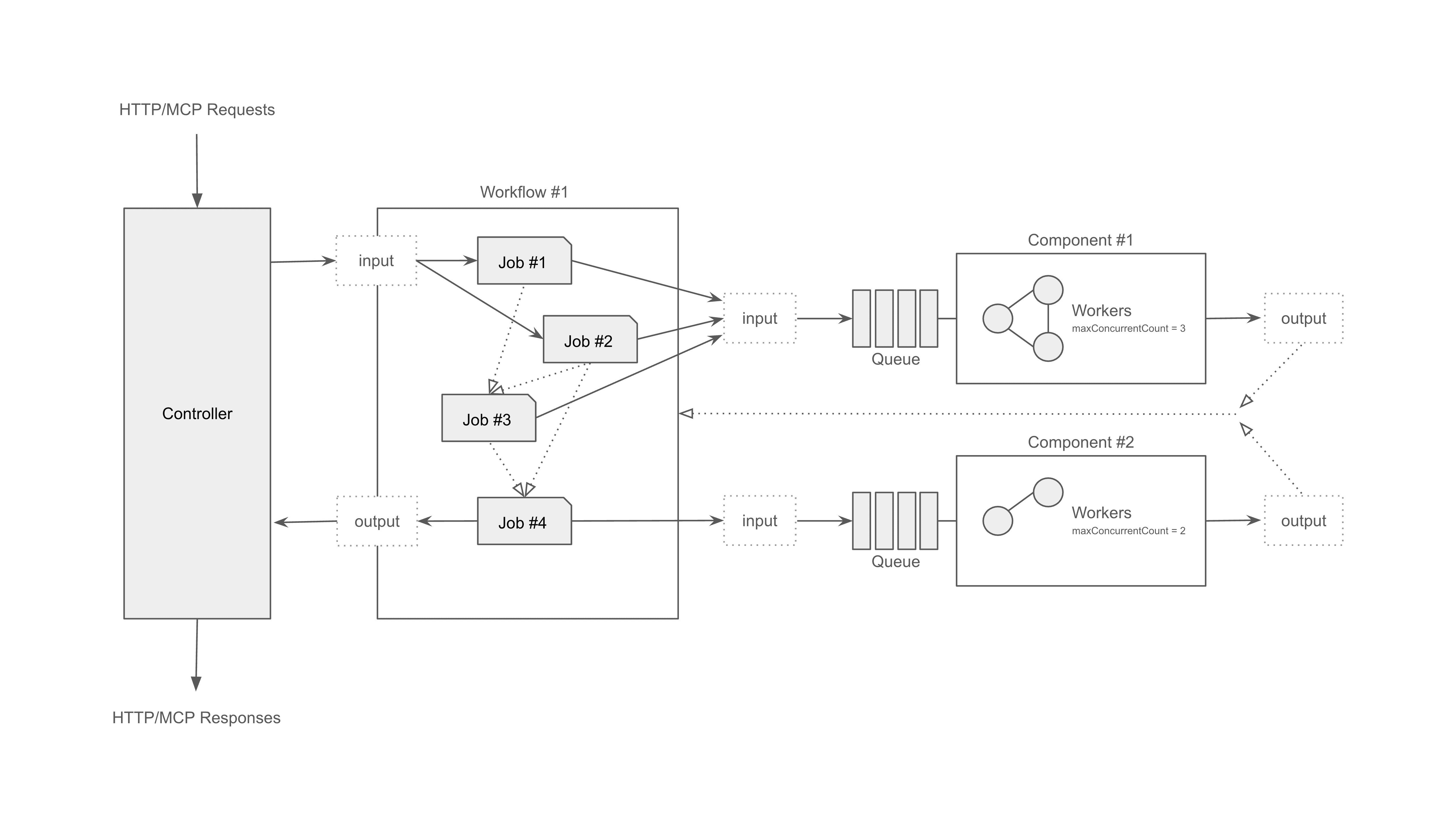
Protocol adapters → Composition engine → Runtime executors
We welcome all contributions — bug fixes, docs improvements, new examples.
git clone https://github.com/hanyeol/model-compose.git
cd model-compose
pip install -e .
See CONTRIBUTING if available, or open a PR directly.
MIT License © 2025-2026 Hanyeol Cho.
Have questions, ideas, or feedback? Open an issue or start a discussion on GitHub Discussions.
Sign in to join the discussion.
No comments yet. Be the first to say what this is good for.
Write HTML. Render video. Built for agents.
Ultra-lightweight, open-source, self-hosted personal AI agent framework in Python with WebUI, tools, memory, MCP, multi-agent workflows, automation, and chat apps

SkillOpt is a text-space optimizer that trains reusable natural-language skills for frozen LLM agents through trajectory-driven edits, validation-gated updates, and deployable best_skill.md artifacts.
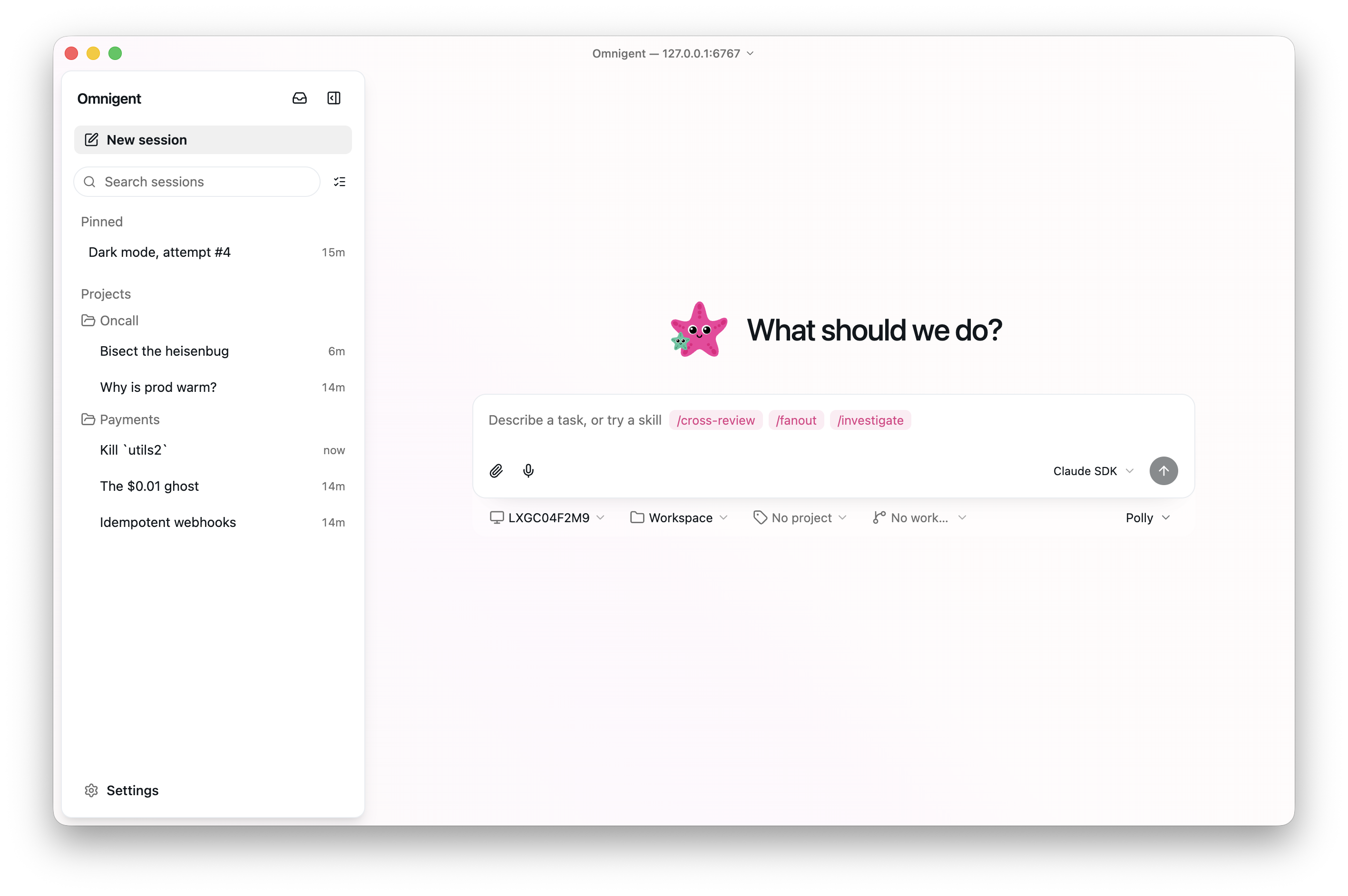
Omnigent is an open-source AI agent framework and meta-harness: orchestrate Claude Code, Codex, Cursor, Pi, and custom agents — swap harnesses without rewriting, enforce policies and sandboxing, and collaborate in real time from any device.

A theoretical reconstruction of the Claude Mythos architecture, built from first principles using the available research literature.
🕷️ An adaptive Web Scraping framework that handles everything from a single request to a full-scale crawl!