

heygen-com/hyperframesFrameworks & SDKs
Write HTML. Render video. Built for agents.
49k
optim-agent turns coding agents into proposal engines for hyperparameter and configuration search. It reads parameter context, suggests the next trial, validates the output, and keeps a study history so you can resume and compare runs.
Builders who use Claude Code or Codex to tune models, control systems, or other parameterized workflows.
You can use an agent to suggest better trial settings while keeping optimization history, validation, and results in one study.
Uses Claude, Codex, or OpenCode backends to propose the next parameter values from study history and parameter context.
Stores trials, outcomes, context, and optional rationale in JSON or SQLite so you can pick up a study later.
Includes an agent pruner that reads learning curves and decides whether to keep or stop a trial.
Can write a post-run summary with the best configuration, search-space insights, and next steps.
Ships as a Claude Code skill and as installable plugin manifests for agent sessions.
Includes tuning examples for MNIST, CIFAR-10, RL control, credit-card prediction, and synthetic functions.
$skill-installer install https://github.com/Optim-Agent/optim-agent
claude plugin marketplace add Optim-Agent/optim-agent && claude plugin install optim-agent@optim-agent
# Stable release from PyPI
python -m pip install optim-agent

# Latest source from GitHub
python -m pip install "optim-agent @ git+https://github.com/Optim-Agent/optim-agent.git"
$skill-installer install https://github.com/Optim-Agent/optim-agent
claude plugin marketplace add Optim-Agent/optim-agent
claude plugin install optim-agent@optim-agent
codex plugin marketplace add Optim-Agent/optim-agent
codex plugin add optim-agent@optim-agent

Agentic system optimization with coding agents.
Automate the iterative parameter-tuning work of an algorithm engineer.




English | 简体中文 | 日本語 | 한국어 | Français | Deutsch | Español | Português | Русский
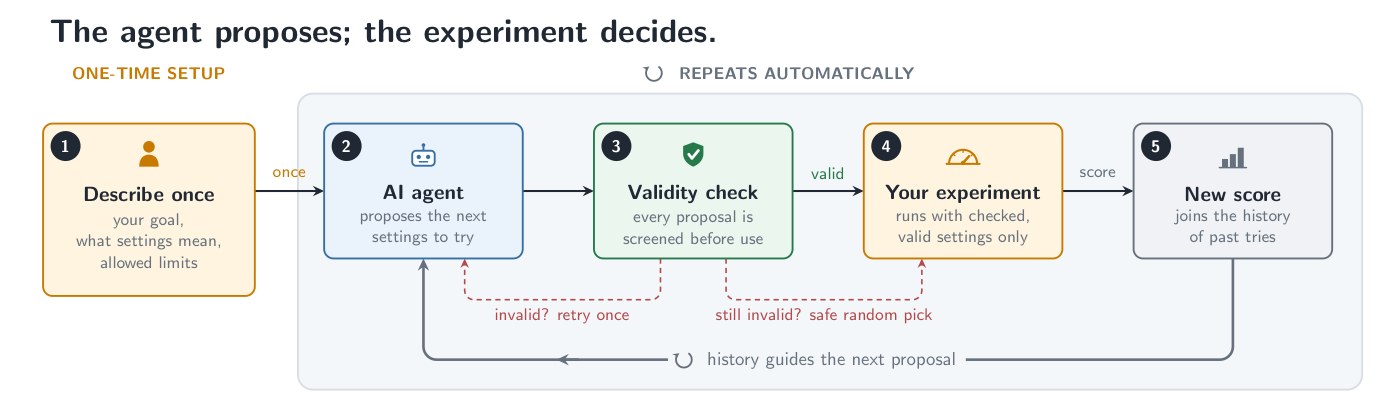
optim-agent lets Claude Code / Codex / OpenCode tune real system parameters by reading your code, proposing trials, and recording measured objective results. Use it when your system exposes configurable parameters and a measurable objective. It combines what each parameter means with what the trial history shows, then proposes the next configuration to evaluate. Objective evaluations remain authoritative: optim-agent proposes values, validates them against the declared space, records outcomes, and falls back to safe sampling when an agent reply is invalid.
| Models | Systems | Research |
|---|---|---|
| Training, architecture, and RL experiments | Inference, latency, cost, control, and decision rules | Quant signals, simulations, and scientific workflows |
Install the Codex skill:
$skill-installer install https://github.com/Optim-Agent/optim-agent
Install the Claude Code plugin:
claude plugin marketplace add Optim-Agent/optim-agent && claude plugin install optim-agent@optim-agent
Install the Python package:
# Stable release from PyPI
python -m pip install optim-agent

# Latest source from GitHub
python -m pip install "optim-agent @ git+https://github.com/Optim-Agent/optim-agent.git"
Requires one authenticated agent CLI on PATH:
claude,
codex, or
opencode.
import optim_agent as oa

def objective(trial):
    threshold = trial.suggest_float(
        "threshold", 0.05, 0.95,
        context="decision threshold; higher values trade recall for precision",
    )
    budget = trial.suggest_int(
        "budget", 10, 200, log=True,
        context="compute or operating budget; larger values may improve quality",
    )
    return evaluate_system(threshold=threshold, budget=budget)  # domain code

study = oa.create_study(
    direction="maximize",
    sampler=oa.AgentSampler(
        backend="claude",  # or "codex" / "opencode"
        effort="high",
        context="maximize system quality under a strict operating-cost budget",
        history=5,
        explicit_reasoning=True,
        qualitative_notes=True,
    ),
    storage="study.json",  # optional: persist and resume
    summarize=True,  # optional: agent-written result summary after the last trial
)
study.optimize(objective, n_trials=20)
print(study.best_value, study.best_params)
print(study.summary)  # the summary agent's narration of the finished study
Optional context gives domain meaning to the study and parameters. Provide it
study-wide on AgentSampler(context=...), per parameter on
suggest_*(..., context=...), or both.
| Area | Parameters optim-agent can tune | Example objective |
|---|---|---|
| Model training | learning rates, architectures, augmentation, regularization | validation quality, compute, robustness |
| Inference and serving | quantization, batching, decoding, caching, routing | quality, latency, throughput, cost |
| Quantitative research | signal windows, thresholds, rebalance rules, risk controls | walk-forward return, drawdown, turnover |
| Reinforcement learning and decisions | objective weights, exploration schedules, environment settings, policy thresholds | return, safety, sample efficiency |
| Scientific workflows | simulation inputs, solver settings, experimental controls | fit, error, runtime, resource use |
| Black-box systems | any bounded categorical, integer, or continuous configuration | scalar objective score |
For reinforcement learning, optim-agent tunes the system around the learning loop; it does not replace the policy-learning algorithm.
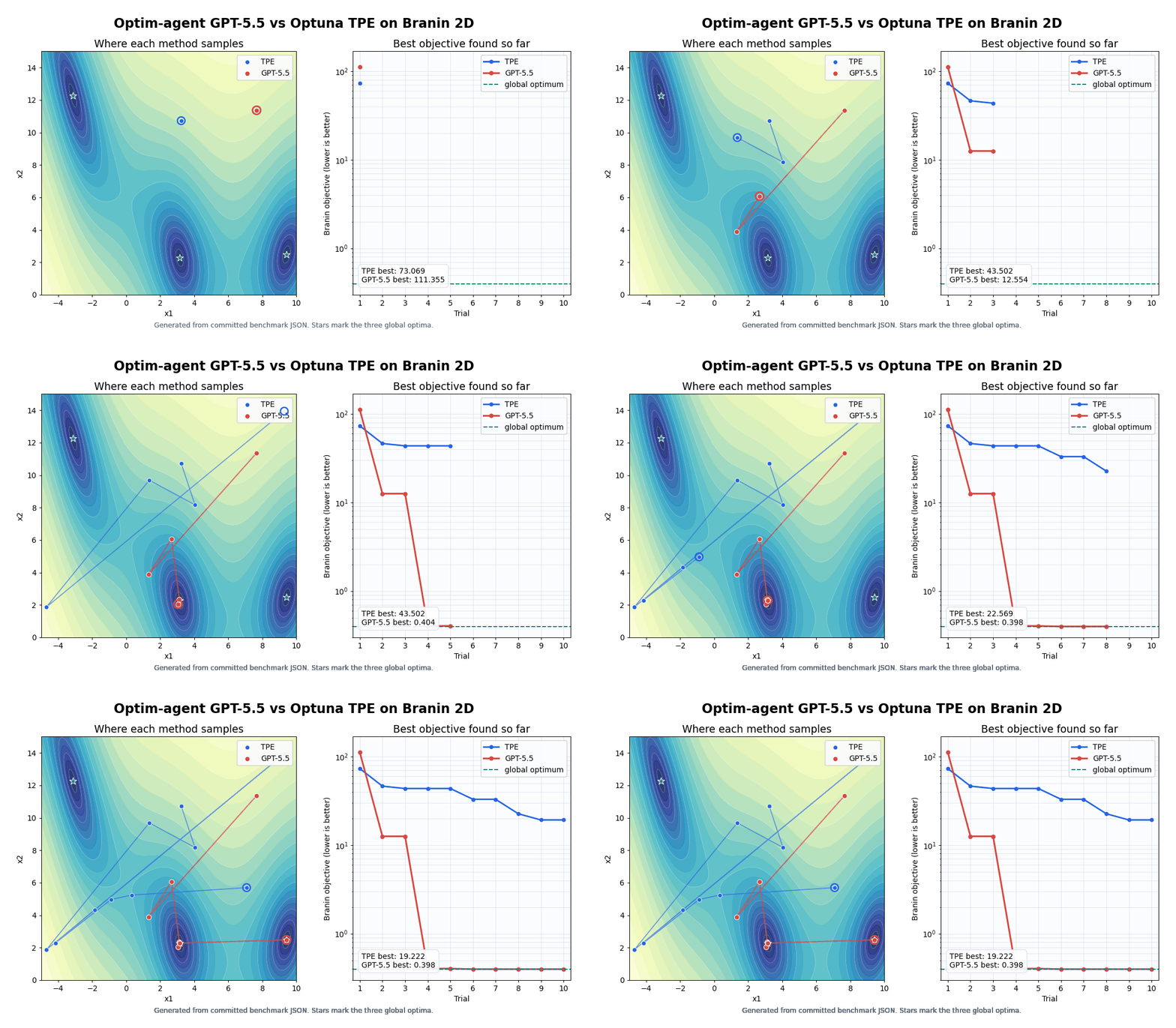
This seed-0 Branin trace compares TPE and GPT-5.5 under the same 10-trial budget, with incumbent objective values after each trial. It is a trajectory illustration; aggregate benchmark results and reproduction commands follow.
Hard-function agents receive no supplied task context: only generic
x1...x5 parameter names, numeric bounds, and trial history. Runs use 10 trials
over five seeds; Random and TPE are unchanged baselines.
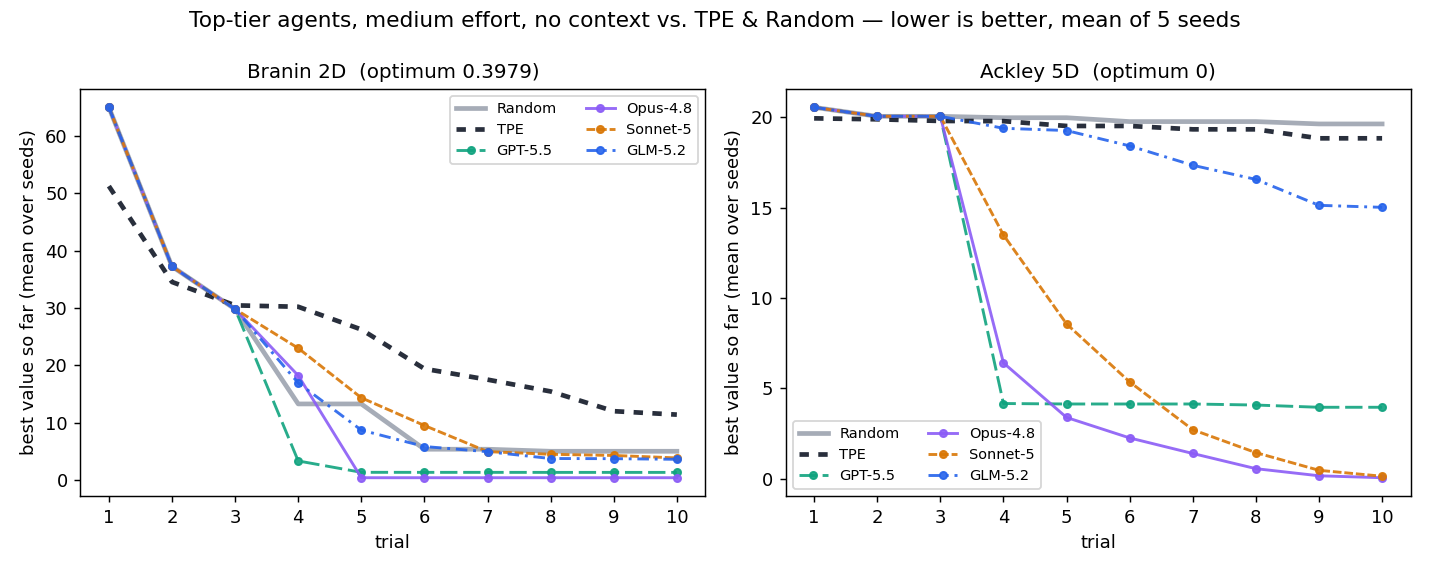
| method | mean best Branin ↓ | mean best Ackley-5D ↓ |
|---|---|---|
| Random | 5.008 | 19.639 |
| TPE | 11.395 | 18.843 |
| GPT-5.5 | 1.326 | 3.960 |
| Opus-4.8 | 0.398 | 0.061 |
| Sonnet-5 | 3.850 | 0.143 |
| Kimi-K3 | 2.082 | 0.907 |
| Minimax-M3 | 0.970 | 0.574 |
| GLM-5.2 | 3.609 | 15.023 |
The pinned models are gpt-5.5, claude-opus-4-8, claude-sonnet-5,
kimi-k3, MiniMax-M3, and glm-5.2.
Opus-4.8 reaches the Branin optimum on average and has the strongest five-seed
Ackley mean.
| method | mean best Branin ↓ | mean best Ackley-5D ↓ |
|---|---|---|
| Random | 5.008 | 19.639 |
| TPE | 11.395 | 18.843 |
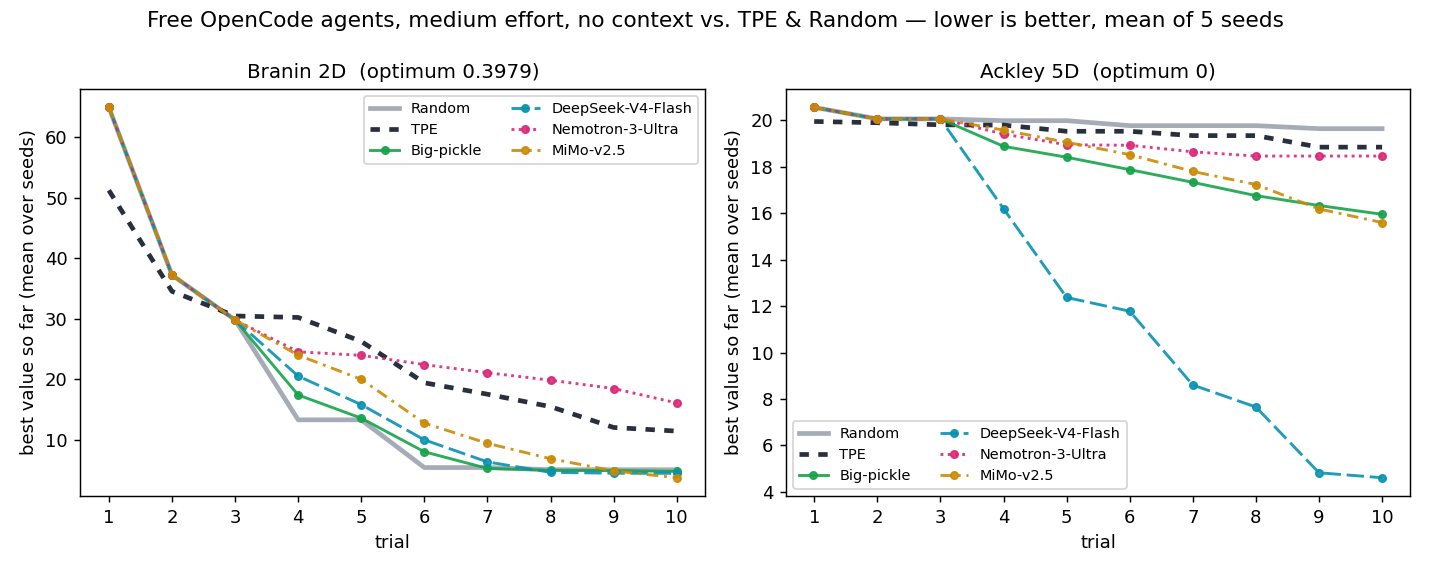
| Big-pickle | 4.734 | 15.951 |
| DeepSeek-V4-Flash | 4.410 | 4.608 |
| Nemotron-3-Ultra | 16.051 | 18.459 |
| MiMo-v2.5 | 3.682 | 15.597 |
OpenCode-hosted models require no paid model API. The free pool rotates; this
refresh pins opencode/big-pickle, opencode/deepseek-v4-flash-free,
opencode/nemotron-3-ultra-free, and opencode/mimo-v2.5-free. DeepSeek V4
Flash has the strongest free-model Ackley mean, while MiMo-v2.5 has the
strongest free-model Branin mean.
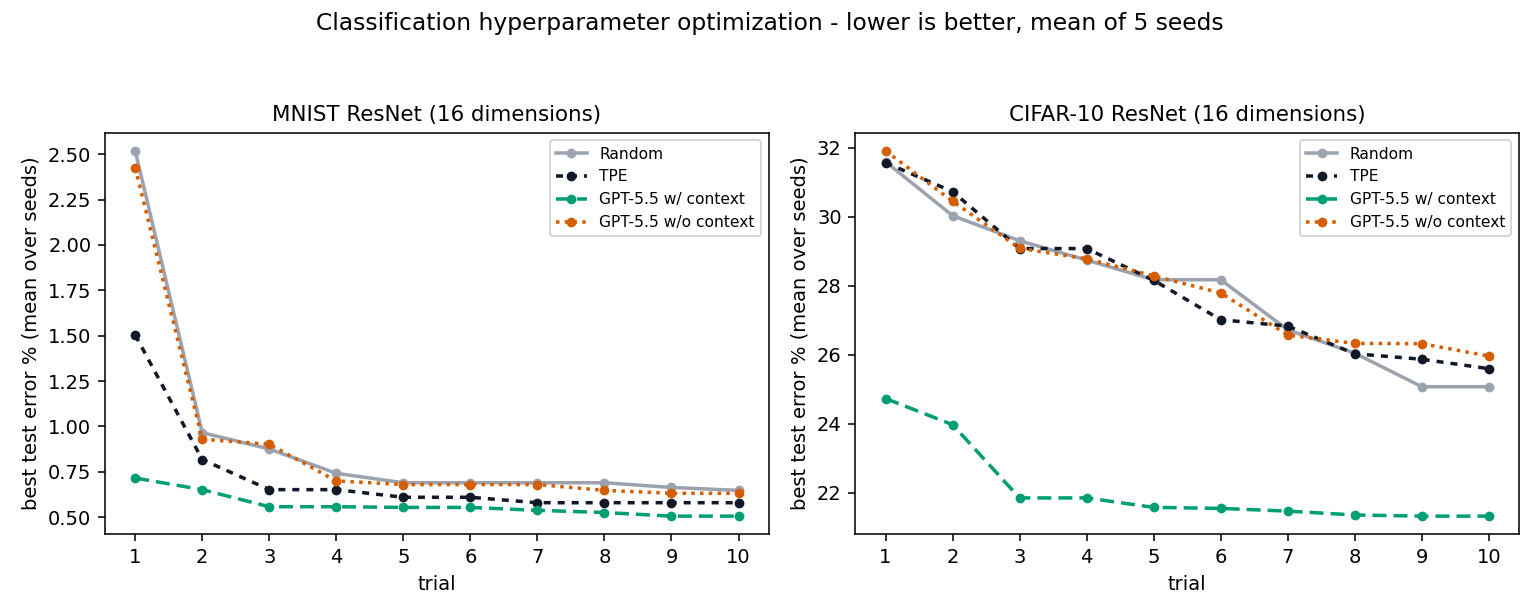
The classification benchmark compares Random, Optuna TPE,
GPT-5.5 w/ context, and GPT-5.5 w/o context over five seeds (0..4) and
10 trials. The context condition receives natural-language study and parameter
descriptions; the no-context condition receives only bounds and trial history.
For classification, the primary metric emphasizes fast improvement:
cumulative_best_so_far_error = sum(best_test_error_so_far_at_i for i in 1..10)
Lower is better.
| method | MNIST cumulative error ↓ | MNIST final error ↓ | CIFAR-10 cumulative error ↓ | CIFAR-10 final error ↓ |
|---|---|---|---|---|
| Random | 9.174 | 0.648% | 278.920 | 25.072% |
| TPE | 7.166 | 0.580% | 279.936 | 25.596% |
| GPT-5.5 w/ context | 5.668 | 0.506% | 220.994 | 21.322% |
| GPT-5.5 w/o context | 8.910 | 0.632% | 281.466 | 25.960% |
GPT-5.5 w/ context reduces cumulative best-so-far error by 20.9% relative to TPE on MNIST and by 20.8% relative to Random on CIFAR-10. Without context, it is 24.3% worse than TPE on MNIST and 0.9% worse than Random on CIFAR-10. The gap includes both semantic parameter information and earlier access to agent-guided proposals.
Both examples/mnist.py and
examples/cifar10.py tune learning rate, batch size,
weight decay, label smoothing, three stage widths, three stage depths, and four
dropout controls. MNIST adds translation and rotation; CIFAR-10 uses crop
padding and flip probability.
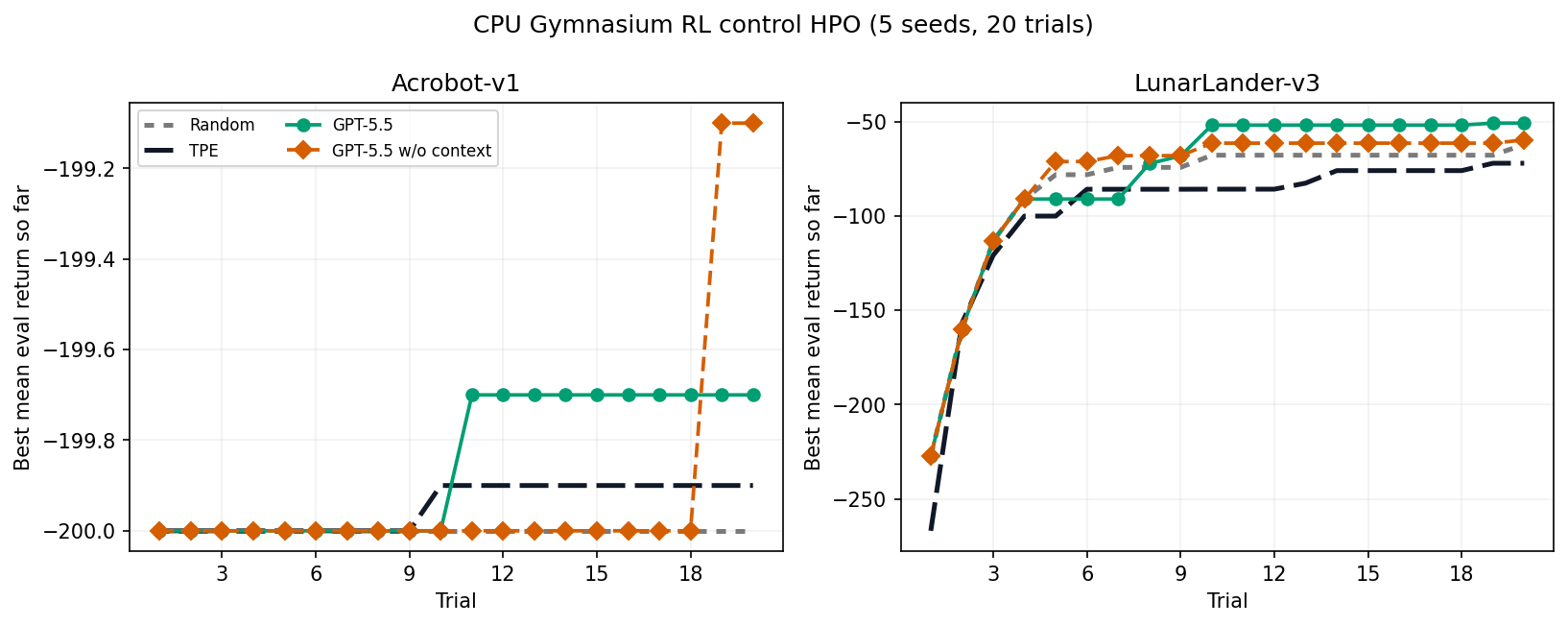
This CPU-only Gymnasium benchmark tunes a discretized Q-learning controller for
Acrobot-v1 and LunarLander-v3. Each method runs 20 trials over five seeds
(0..4); the objective is mean evaluation return, so higher is better. The
runner parallelizes across seeds and within each HPO study via --workers.
The GPT-5.5 arms use high modeling effort and the last 5 trials of history. The
winning contextual arm disables the optional explicit-reasoning and qualitative-note fields.
| method | Acrobot-v1 return ↑ | LunarLander-v3 return ↑ |
|---|---|---|
| Random | -200.000 | -62.139 |
| TPE | -199.900 | -72.088 |
| GPT-5.5 w/ context | -199.700 | -50.825 |
| GPT-5.5 w/o context | -199.100 | -59.751 |
With 20 trials and a five-trial prompt history, GPT-5.5 w/ context has the strongest mean return on both environments: 0.2 above TPE on Acrobot-v1 and 11.3 above Random on LunarLander-v3. Treat this as a CPU HPO stress test rather than a universal ranking.
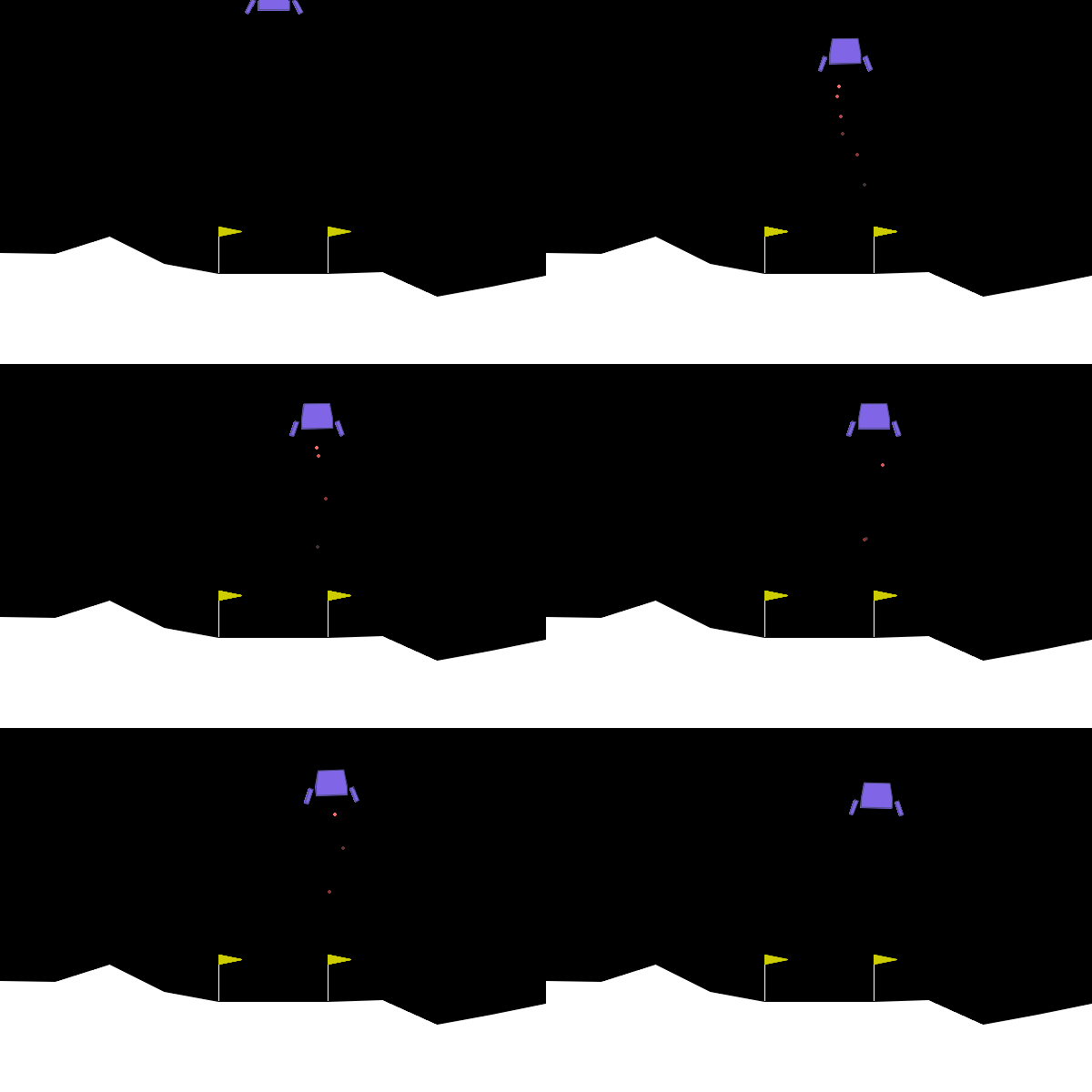
For the animation, optim-agent tunes seven gains of a deterministic LunarLander controller using one HPO seed. Each trial runs on the same 20 rollout seeds, prioritizing the number of successful landings and then mean return. A landing succeeds when Gymnasium terminates with the lander at rest and a final signal of +100. The selected trial landed in all 20 rollouts; the GIF shows its highest-return rollout.
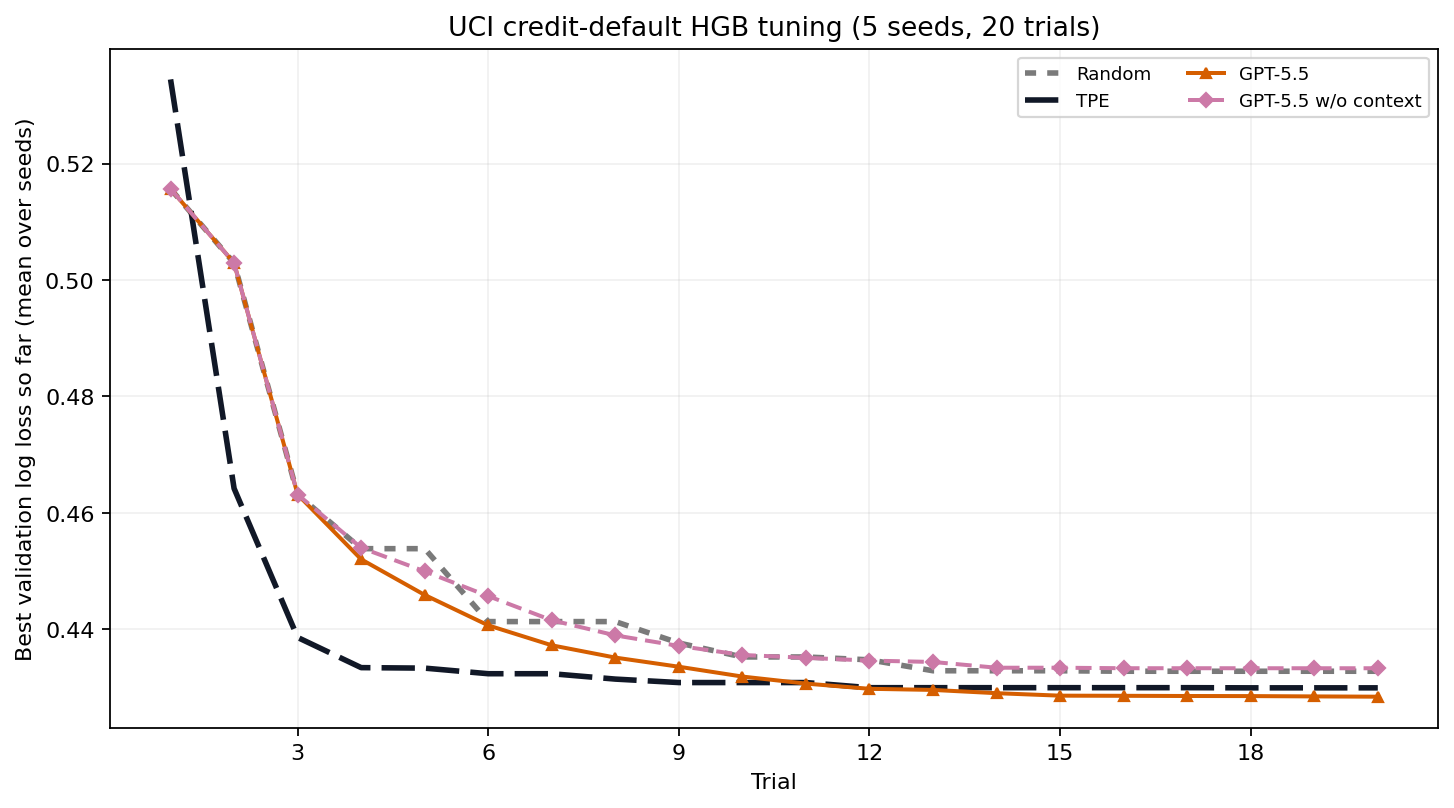
This CPU-only benchmark tunes eight training parameters of a
HistGradientBoostingClassifier on UCI's
Default of Credit Card Clients
dataset: 30,000 rows, 23 features, and a next-month default target. The official
archive is pinned by SHA-256, licensed CC BY 4.0, and split once into 60% train,
20% validation, and 20% untouched test data. All methods use the same split, 20
trials, and seeds 0..4. Both GPT-5.5 arms use high modeling effort, 20 trials
of prompt history, explicit reasoning, and qualitative notes.
| method | final validation log loss ↓ | held-out test log loss ↓ |
|---|---|---|
| Random | 0.433 | 0.425 |
| TPE | 0.430 | 0.422 |
| GP-BO | 0.430 | 0.423 |
| GPT-5.5 w/ context | 0.428 | 0.422 |
| GPT-5.5 w/o context | 0.433 | 0.427 |
Context lowers final validation log loss by 1.13% and test log loss by 1.23% relative to the matched no-context control. GPT-5.5 also has lower mean validation and test loss than Random, TPE, and GP-BO. Because the retained configuration was selected using both validation and test loss, the test result is a benchmark comparison rather than an untouched estimate of generalization.
This is a methodological benchmark, not a production credit-decision system. Deployment would require fairness, calibration, drift, governance, and legal review beyond this experiment.
Reproduce the benchmark artifacts:
pip install -e ".[examples]"

# Classification
python scripts/verify_classification_cumulative_error.py run-no-context
python scripts/verify_classification_cumulative_error.py

# Hard functions
python examples/hard_functions.py distributed \
  --agents Random TPE GPT-5.5 Opus-4.8 Sonnet-5 GLM-5.2 Big-pickle \
  DeepSeek-V4-Flash Nemotron-3-Ultra MiMo-v2.5 \
  --trials 10 --seeds 0 1 2 3 4
cp ~/.claude/settings-kimi.json ~/.claude/settings.json
python examples/hard_functions.py distributed --agents Kimi-K3 --trials 10 --seeds 0 1 2 3 4
cp ~/.claude/settings-minimax.json ~/.claude/settings.json
python examples/hard_functions.py distributed --agents Minimax-M3 --trials 10 --seeds 0 1 2 3 4
python examples/hard_functions.py plot

# Credit-card HGB
pip install -e ".[ml,examples]"
python examples/credit_card.py download
python examples/credit_card.py preflight
python examples/credit_card.py run
python examples/credit_card.py selfcheck
python examples/credit_card.py summary
python examples/credit_card.py plot

# RL control
pip install -e ".[rl,examples]"
python examples/rl_control.py preflight
python examples/rl_control.py run --seeds 0 1 2 3 4 --workers 10
python examples/rl_control.py selfcheck
python examples/rl_control.py summary
python examples/rl_control.py plot
python examples/rl_control.py gif
effort is forwarded to the backend CLI's reasoning-effort flag. The harness
prompt is controlled separately:
oa.AgentSampler(
    backend="codex",
    effort="medium",
    history=5,
    explicit_reasoning=True,
    qualitative_notes=True,
)
Set history=None to show all completed/pruned trials. Use
explicit_reasoning=False or qualitative_notes=False for shorter agent
replies.
study.optimize(..., verbose=...) controls per-trial output:
verbose=True (default) renders a table on an interactive terminal: one row
per trial with columns trial, value, best, state, plus one column per
search-space parameter in first-seen order. Long rows are truncated with an
ellipsis to fit the terminal width; missing values (e.g. failed trials)
render as -.verbose=True / "table"
automatically falls back to the greppable one-line format
([optim-agent] trial 3: value=0.91 state=complete best=0.91).verbose="line" always uses the one-line format, even on a TTY.verbose="table" uses the table on a TTY and the line format when piped.verbose=False silences per-trial output.With define-by-run spaces, a trial that introduces a new parameter key reprints the header with the superset of columns.
Pass summarize=True to create_study to have the agent narrate the finished
study once, after the last trial completes:
study = oa.create_study(
    sampler=oa.AgentSampler(backend="claude"),
    storage="study.json",
    summarize=True,
)
study.optimize(objective, n_trials=20)
print(study.summary)  # also persisted in JSON / SQLite storage
The summary is structured into four sections — best configuration, search-space
insights, trajectory highlights, and suggested next steps. It is printed to the
terminal and persisted on study.summary (additive key in JSON storage and the
SQLite meta table; old stored studies load with summary=None).
Backend resolution: an explicit summary_backend= wins; otherwise the
sampler's backend is reused when the sampler is an AgentSampler. With any
other sampler, pass summary_backend= or create_study raises a ValueError
naming the fix. summary_model= / summary_effort= override the sampler's
model/effort for the summary. Agent replies that cannot be parsed into all four
sections fall back to printing the raw text — a summary never fails the study,
and studies with zero complete trials skip it with a one-line notice.
backend="mock" works for the summarizer too, so demos and tests run without a
real agent CLI.
study = oa.create_study(
    sampler=oa.AgentSampler(backend="codex"),
    pruner=oa.AgentPruner(
        backend="codex", level="medium", effort="medium",
    ),  # level: loose | medium | tight
)

def objective(trial):
    lr = trial.suggest_float("lr", 1e-5, 1e-1, log=True,
                             context="learning rate for training an image classifier")
    for epoch in range(20):
        loss = train_one_epoch(lr)
        trial.report(loss, epoch)
        if trial.should_prune():
            raise oa.TrialPruned()
    return loss
The pruner agent compares the current learning curve against completed trials
and answers prune/keep; loose prunes only clearly underperforming runs,
while tight prunes aggressively. Agent errors never prune a trial.
Set max_concurrency (default 1) to evaluate several trials at once, and use
a SQLite storage file (.db / .sqlite) as the concurrency-safe shared
history:
study = oa.create_study(
    sampler=oa.AgentSampler(backend="claude"),
    storage="study.db",        # SQLite → safe for many workers; .json stays single-writer
    max_concurrency=8,         # up to 8 objectives run at once
)
study.optimize(objective, n_trials=100)
max_concurrency runs objectives in a thread pool. The
agent sampling queries are queued (serialized) so each proposal sees the
in-process history; only objective calls run in parallel. This works best for
I/O- or subprocess-bound evaluations such as model training or API calls.storage.
The database is the communication channel: WAL mode lets every worker append
results and read history without write conflicts, and trial numbers stay
unique.Limitations: threads share the GIL, so pure-Python CPU-bound objectives run best in separate processes with shared SQLite storage. Concurrent workers do not see each other's in-flight points, so they may occasionally probe nearby regions.
The pip package treats the objective as a black box. The
optim-agent skill goes further: loaded in a
coding-agent session, the agent first reads the project to understand each
parameter's role, then drives the same study loop itself via
study.ask(params) / study.tell(trial, value) — with the study JSON keeping
history across sessions.
$skill-installer install https://github.com/Optim-Agent/optim-agent
Claude Code plugin:
claude plugin marketplace add Optim-Agent/optim-agent
claude plugin install optim-agent@optim-agent
Codex plugin:
codex plugin marketplace add Optim-Agent/optim-agent
codex plugin add optim-agent@optim-agent
trial = study.ask({"threshold": 0.72, "budget": 80})
study.tell(trial, evaluate_system(**trial.params))
AgentSampler(backend="mock") is a token-free stand-in (hill climbing around
the best point) for testing integrations before agent calls.
claude returns 401 inside an agent session — nested sessions inherit
ANTHROPIC_API_KEY; run with env -u ANTHROPIC_API_KEY or from a clean shell.Contributions are welcome. To develop locally:
pip install -e ".[examples]"
pytest                     # runs tests/test_optim_agent.py
Please open an issue to discuss larger changes before sending a PR. Adding a new
agent backend usually means one small function in optim_agent/agent.py.
The optim-agent paper is available at paper/main.pdf.
Sign in to join the discussion.
No comments yet. Be the first to say what this is good for.
Write HTML. Render video. Built for agents.
Ultra-lightweight, open-source, self-hosted personal AI agent framework in Python with WebUI, tools, memory, MCP, multi-agent workflows, automation, and chat apps

SkillOpt is a text-space optimizer that trains reusable natural-language skills for frozen LLM agents through trajectory-driven edits, validation-gated updates, and deployable best_skill.md artifacts.
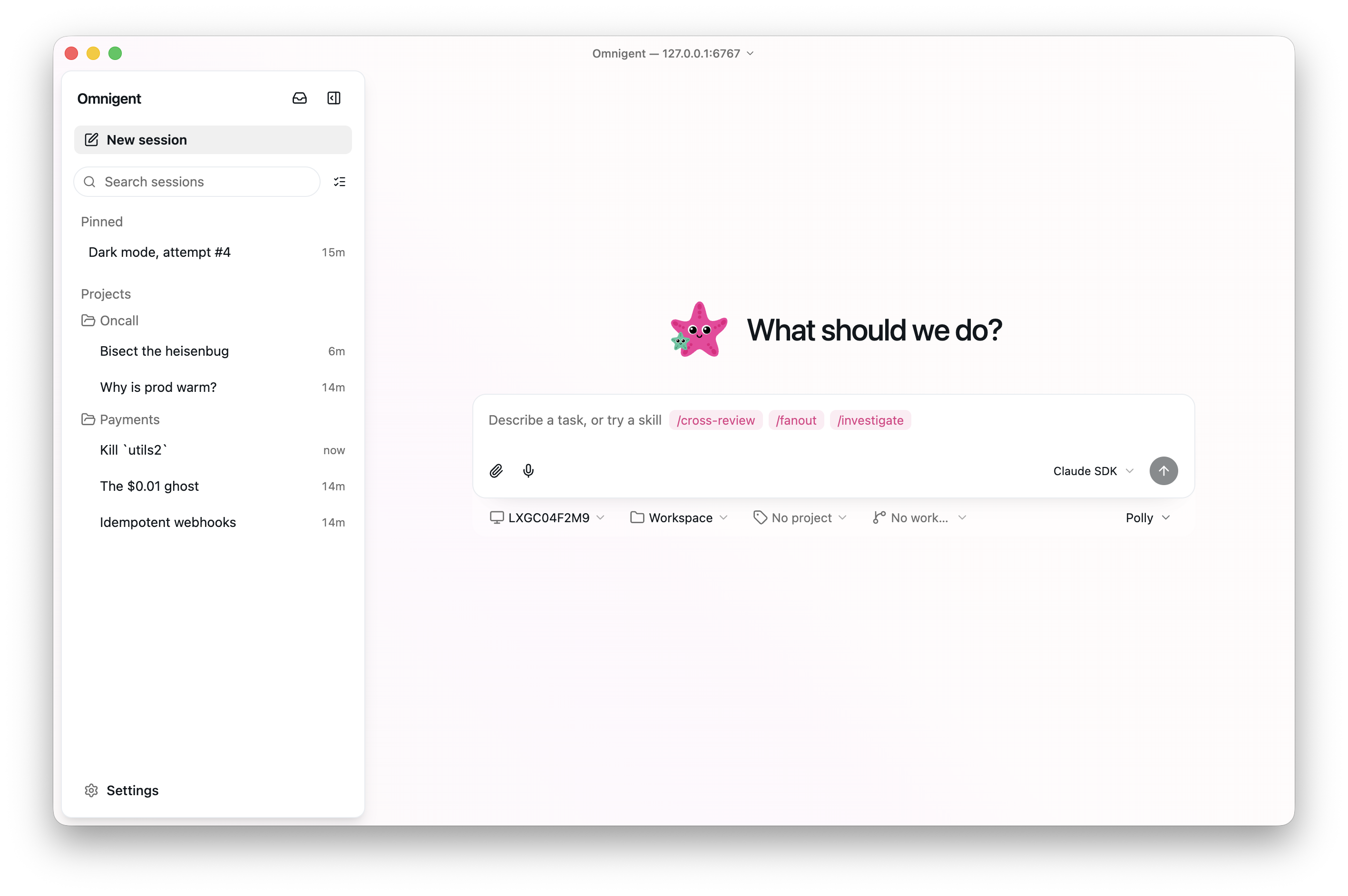
Omnigent is an open-source AI agent framework and meta-harness: orchestrate Claude Code, Codex, Cursor, Pi, and custom agents — swap harnesses without rewriting, enforce policies and sandboxing, and collaborate in real time from any device.

A theoretical reconstruction of the Claude Mythos architecture, built from first principles using the available research literature.
🕷️ An adaptive Web Scraping framework that handles everything from a single request to a full-scale crawl!