fajarhide/
omni

fajarhide/omniTools
Your agent pays twice for output it has already seen. OMNI returns a handle instead: 97.2% off a file read twice. Nothing deleted, nothing invented.
369
Your agent pays twice for output it has already seen. OMNI returns a handle instead: 97.2% off a file read twice. Nothing deleted, nothing invented.

MCP server for AI-powered GitHub project management — agent orchestration, PRD-to-issues pipeline, sprint planning, and multi-agent swarm coordination

MCP server for Kali Linux penetration testing - 121 tools for AI-assisted security testing - Giving Agents access to full pentesting tools

The Vibe Coding++™ platform - orchestrate multiple AI agents, experiment with isolated attempts, ship code you understand. Multi-agent kanban with MCP integration.

An agent skill that plays ARC-AGI-3. One rule: say what an action will do before you spend it. Claude Code on Opus 5 finished all 25 public games at 100.00 RHAE in 7,645 actions.

Let any AI coding tool — Claude Code, Cursor, Codex — drive your real Chrome. One-prompt setup, muscle memory, local-first.

Intelligent Skill routing and workflow orchestration for AI agents — +21.12 pp reward, −29.6% tokens on SkillsBench with DeepSeekV4Flash-VE.
Autoprompt is a coding-agent skill that cuts failures by 45% on agentic coding tasks.
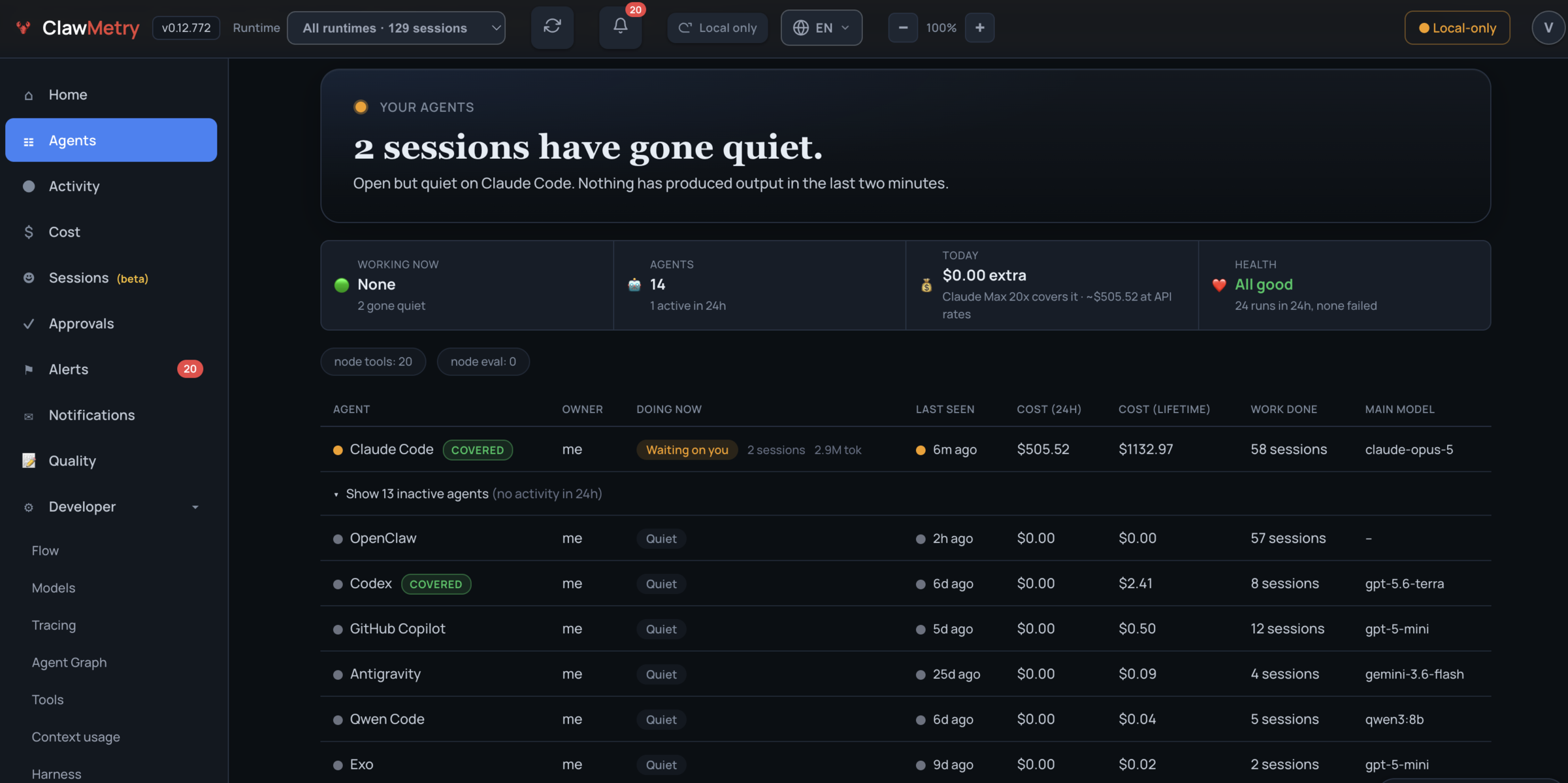
See your agent think. Zero-config observability & governance for 30 AI agent runtimes: Claude Code, OpenAI Codex, Hermes, OpenClaw & 26 more. Live token costs, sessions, tool calls, crons.

Agent Alchemy is a curated collection of plugins, apps, and extensions designed to elevate your agentic engineering workflows. Built for Claude Code and other AI coding agents, these tools help developers work smarter and ship faster.
from vibe coding to agentic engineering - practice makes claude perfect
Run any process, on your machine or in an AI agent's environment, as if it were a pod in your Kubernetes cluster: real env vars, DNS, network, traffic.
Install engineering discipline into any AI coding assistant. Composable skills for design, implementation, review, and team standards. Better process, not just better prompts.

Agentic dev environment for DevPods, Codespaces & Rackspace Spot — one-command setup of Ruflo orchestration (215+ MCP tools, 60+ agents upstream).

A disciplined methodology for AI-assisted software development. Covers architectural constraints, validation hooks, session governance, and PAG (Pattern Abstract Grammar) for structured AI collaboration. Copy claude-setup/ into your project to start.

Claude Code plugin & Agent Skills for AI-native development: codebase readiness scoring (/assess), Six Thinking Hats deliberation (/huddle), AI-slop removal (/deslop), skill hardening (/skill-forge), and more.
Practical patterns, starters & CLI tools for loop engineering with AI coding agents. Design systems that prompt and orchestrate agents (inspired by Addy Osmani and Boris Cherny). Includes loop-audit, loop-init, loop-cost.

AI coding dream team of agents for VS Code. Claude Code + openai Codex collaborate in brainstorm mode, debate solutions, and synthesize the best approach for your code.

AgentVitals Checkup (/checkup) — an AI agent skill that gives your agent a professional health checkup: dual-axis Stability + Welfare scoring, a personality-style title, and a public cross-platform leaderboard. One-line install for Claude Code / OpenClaw / Codex / Coze. Bilingual EN/ZH.

Open-source firewall for AI agents. Policy engine that audits and controls what OpenClaw, Claude Code, Cursor, Codex, and any AI tool can do on your machine.
Android Full-Stack Device Control Platform: WebRTC/H.264 remote desktop, UI/OCR/image-matching automation, one-click MITM, built-in Frida, proxy/VPN/frp/P2P networking, MCP/Agent, 160+ APIs, designed for multi-device clusters and engineered deployments.
Babysitter enforces obedience on agentic workforces and enables them to manage extremely complex tasks and workflows through deterministic, hallucination-free self-orchestration

The open-source memory and observability layer for AI agents — persistent memory, loop detection, hash-chained audit trails, and a live dashboard, automatic on pip install.

OpenBrowser is a framework for intelligent browser automation. It combines direct CDP communication with a CodeAgent architecture, where the LLM writes Python code executed in a persistent namespace, to navigate, interact with, and extract information from web pages autonomously.