

JuliusBrussee/
caveman

🪨 why use many token when few token do trick — Claude Code skill that cuts 65% of tokens by talking like caveman
105k
1 add
Rampart checks AI agent actions before they execute and applies local policy to each one. It can be wired into Claude Code, Codex, Cursor, Copilot, Gemini CLI, MCP servers, or a generic process boundary, then records decisions in a hash-chained audit trail.
Builders who want their agent actions checked, approved, or blocked before they touch files, commands, APIs, or MCP tools.
You can keep agents moving while staying in control of what they are allowed to do.
Matches shell, file, network, MCP, messaging, and other exposed actions before the host runs them.
Returns one of three outcomes for each action, with sensitive actions able to use native approval flows where supported.
Records live decisions in a local audit trail and supports `rampart audit tail --follow` and `rampart audit verify`.
Works through native hooks, plugins, proxies, CLI wrappers, and preload-based boundaries.
Uses readable YAML policy files, including project-local `.rampart/policy.yaml` created by `rampart init --project`.
Can proxy command-launched MCP servers with `rampart mcp -- ...`.
Provides `rampart status`, `rampart doctor`, `rampart verify --all`, and `rampart rules` for inspection and testing.
brew install peg/tap/rampart

rampart protect
rampart verify --all
rampart watch
curl -fsSL https://rampart.sh/install | bash
irm https://rampart.sh/install.ps1 | iex
go install github.com/peg/rampart/cmd/rampart@latest
Open-source policy and approval control for AI agents.





Install · How it works · Integrations · Policies · Documentation
AI agents can edit files, run commands, call APIs, and ship code at machine speed. Their permission systems usually ask a different question: can this tool run?
Rampart asks: should this action run?
It sits at supported hooks, plugins, proxies, and process boundaries; evaluates
the action against local policy; and returns allow, ask, or deny before the
host executes it. Decisions are visible, approvals stay human-owned, and the
result becomes part of a hash-chained audit trail.
Agent proposes an action
          │
          ▼
   ┌─────────────┐
   │   Rampart   │  policy · approval · audit
   └──────┬──────┘
          │
      allow / ask / deny
          │
          ▼
Host executes — or does not
Rampart is a security boundary, not a sandbox. It sees actions exposed by the configured integration; it does not see arbitrary syscalls or network traffic inside a process you already allowed. Start with the threat model when deciding where to rely on it.
brew install peg/tap/rampart

rampart protect
rampart verify --all
rampart watch
That is the normal path:
protect detects supported installed agents and configures their managed
boundaries.verify --all runs fixed, non-executing canaries without invoking a model.watch shows decisions as they happen.macOS and Linux installer
curl -fsSL https://rampart.sh/install | bash
Windows PowerShell
irm https://rampart.sh/install.ps1 | iex
Go
go install github.com/peg/rampart/cmd/rampart@latest
Source builds require Go 1.26.8 or newer. Windows upgrades use the PowerShell installer; binary self-upgrade is intentionally disabled there.
| What you get | |
|---|---|
| Policy before execution | Match shell, file, network, MCP, messaging, and other host-exposed actions before they run. |
| Selective approval | Routine work stays quiet. Sensitive actions can use the host's native approval UI where the integration supports it. |
| Fail-closed ownership | When Rampart owns a decision and cannot safely classify or persist it, the action does not silently proceed. |
| Auditable evidence | Inspect live decisions, verify installed boundaries, and validate a hash-chained local audit trail. |
| Local and model-free by default | The policy engine is a Go binary. Core enforcement and verification do not require an LLM or provider traffic. |
Every integration has a concrete observation boundary. Rampart normalizes the action visible there. When a supported adapter receives multiple represented targets, it evaluates each one and lets the most restrictive decision win.
ALLOW  exec  npm test                         [allow-dev]
DENY   read  ~/.ssh/id_ed25519                [block-credentials]
ASK    exec  kubectl apply -f production.yaml [approve-production]
DENY   resp  tool output contained a secret   [scan-response]
rampart status separates configuration from evidence:
HOST VERIFIED means an active safe verifier reached the installed host
boundary.ADAPTER VERIFIED means Rampart proved its installed configuration and
adapter behavior, not authenticated host ingestion.Verification receipts contain outcomes and fingerprints—not prompts, commands, credentials, host output, or agent memory.
| Integration | Boundary | Current assurance |
|---|---|---|
| OpenClaw | Native before_tool_call plugin | Live host verifier; managed fail-closed defaults and native approval cards |
| Claude Code | Native pre/post tool hooks | Installed configuration and adapter verification |
| Codex | User-level lifecycle hooks for CLI, IDE, and desktop | Installed configuration and adapter verification |
| Cline | Editor and CLI hook files | Package startup, hook shape, and adapter tested; host limitations documented |
| Antigravity | Shared CLI/IDE PreToolUse plugin | Installed plugin and adapter verification |
| GitHub Copilot | CLI adapter and VS Code Preview hooks | Package/adapter and contract testing; authenticated ingestion pending |
| Cursor | Local Agent and Cmd+K preToolUse hook | Installed fail-closed configuration and adapter verification; Cloud/Tab separate |
| Hermes Agent | Experimental pre_tool_call user plugin | Compatible hosts can use native approval; no safe live host verifier yet |
| Gemini CLI | Experimental BeforeTool/AfterTool hooks | Enterprise/API-key path; authenticated host proof pending |
| MCP servers | JSON-RPC stdio proxy | Correlated request/response policy and identity enforcement |
| Other agents | Cooperative shell wrapper or compatible process preload | Explicitly limited; prefer a native integration when available |
rampart protect openclaw
rampart setup claude-code
rampart setup codex
rampart setup cline
rampart setup antigravity
rampart setup copilot
rampart setup cursor
Experimental integrations are explicit opt-ins and stay outside bare
rampart protect auto-detection:
rampart setup hermes
rampart setup gemini
See the support matrix for platform coverage, verifier strength, and known host-owned limitations.
Rampart policies are YAML, local, and hot-reloaded:
version: "1"
default_action: allow

policies:
  - name: block-credential-reads
    match:
      tool: [read]
    rules:
      - action: deny
        when:
          path_matches:
            - "**/.ssh/id_*"
            - "**/.aws/credentials"
            - "**/.env"
        message: "Credential access blocked"

  - name: approve-production
    match:
      tool: [exec]
    rules:
      - action: ask
        when:
          command_matches:
            - "kubectl apply *"
            - "terraform apply *"
        message: "Production change requires approval"
For common cases, you do not need to edit YAML:
rampart allow "npm install *"
rampart block "curl * | bash"
rampart rules
rampart test "rm -rf /"
Project-specific policy can live with the code:
rampart init --project
That creates .rampart/policy.yaml. Set RAMPART_NO_PROJECT_POLICY=1 when
working in a repository whose policy you do not trust.
Policy guide → · Policy schema → · Community policies →
An ask rule escalates only the action that matched. Depending on the
integration, approval appears in the agent's native UI or in Rampart's CLI and
dashboard.
rampart pending
rampart approve <id>
rampart deny <id>
OpenClaw can offer allow-once, allow-always, and deny on the original tool
call. Compatible Hermes installations pause and resume that same call. Other
integrations expose only the approval behavior their host can safely support;
Rampart does not invent a second approval owner and call it equivalent.
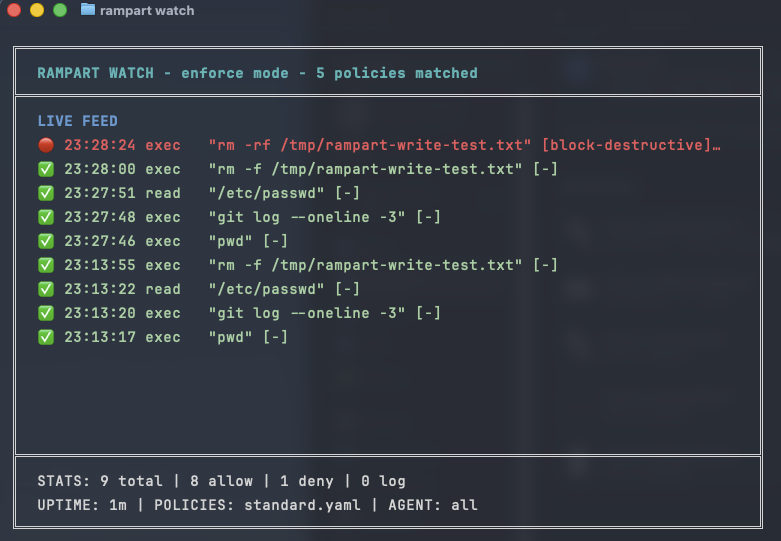
rampart status
rampart doctor
rampart verify --all
rampart audit tail --follow
rampart audit verify
Audit records are hash-chained and redact common credential shapes before normal persistence and display boundaries. They still contain operational metadata and command structure, so treat the owner-only audit directory as sensitive authorization state.
Proxy a command-launched MCP server:
rampart mcp -- npx @modelcontextprotocol/server-filesystem /path
rampart init --profile mcp-server
For an agent without native hooks:
rampart wrap -- your-agent
rampart preload -- your-agent
wrap is a cooperative $SHELL boundary and cannot intercept absolute shell
paths or direct process APIs. preload covers compatible dynamically linked
exec/spawn calls on Linux and non-SIP-protected macOS processes; static,
setuid, direct-syscall, and SIP-protected paths remain outside that boundary.
MCP proxy → · Any CLI agent → · Threat model →
Rampart 1.8 adds a native local Cursor hook, separates approval of reviewed pending calls from explicit grants for future calls, and binds those grants to the requesting credential and run. It also gives approval state one live service owner and keeps native approvals compatible with Hermes v0.20.2.
Read the changelog for the full release notes.
Focused fixes, integration compatibility work, documentation improvements, and security hardening are welcome. Start with CONTRIBUTING.md.
Please report suspected vulnerabilities privately through SECURITY.md, not a public issue.
Snare adds detective controls with canary credentials and paths. Rampart blocks; Snare catches.
Sign in to join the discussion.
No comments yet. Be the first to say what this is good for.
🪨 why use many token when few token do trick — Claude Code skill that cuts 65% of tokens by talking like caveman

The best-benchmarked open-source AI memory system. And it's free.

Orca is the ADE for working with a fleet of parallel agents. Run any coding agent with your own subscription. Available on desktop, mobile and remote runtime.
A cross-platform desktop All-in-One assistant for Claude Code, Codex, OpenCode, OpenClaw, Grok Build & Hermes Agent. Only official website: ccswitch.io

Never stop coding. Free MIT AI gateway: one endpoint, 352 providers (150+ free), 1200+ models Kimi, Claude, GPT, Gemini, GLM, DeepSeek, MiniMax. Works with Claude Code, Codex, Cursor, OpenCode, Cline & Copilot. Quota-aware auto-fallback, RTK+Caveman compression saves 15-95% tokens, MCP/A2A, Desktop/PWA. Built by 550+ contributors

Compress tool outputs, logs, files, and RAG chunks before they reach the LLM. 20% fewer tokens for coding agents, 60-95% fewer tokens for JSON, same answers. Library, proxy, MCP server.