google/adk-goFrameworks & SDKs
An open-source, code-first Go toolkit for building, evaluating, and deploying sophisticated AI agents with flexibility and control.
8.8k
An open-source, code-first Go toolkit for building, evaluating, and deploying sophisticated AI agents with flexibility and control.

Software architecture tooling for the AI age

Control 1 or more machines using computer use tools that integrates with your agents

K8s-mcp-server is a Model Context Protocol (MCP) server that enables AI assistants like Claude to securely execute Kubernetes commands. It provides a bridge between language models and essential Kubernetes CLI tools including kubectl, helm, istioctl, and argocd, allowing AI systems to assist with cluster management, troubleshooting, and deployments

Local codebase intelligence CLI + MCP server for AI coding agents: SQLite code graph, 28 languages, 287 commands, 246 MCP tools, change-safety gates, audit evidence, zero API keys.

A powerful MCP toolkit for coding, providing semantic retrieval and editing capabilities - the IDE for your agent
A Model Context Protocol (MCP) server and CLI that provides tools for agent use when working on iOS and macOS projects.

MCP server that enables AI agents to perform comprehensive web audits using Google Lighthouse with 13+ tools for performance, accessibility, SEO, and security analysis.
AI-powered E2E testing for 10 platforms. 253 MCP tools. Zero config. Works with Claude, Cursor, Windsurf, Copilot. Test Flutter, React Native, iOS, Android, Web, Electron, Tauri, KMP, .NET MAUI — all from natural language.
MCP configuration to connect AI agent to a Linux machine.

A Model Context Protocol (MCP) server that enables AI assistants to interact with AKS clusters. It serves as a bridge between AI tools (like Claude, Cursor, and GitHub Copilot) and AKS.

Grov automatically captures the context from your private AI sessions and syncs it to a shared team memory. It auto injects relevant memories across developers and future sessions to save tokens and time spent on tasks.

Multi-agent orchestration platform for Gemini CLI, Claude Code, Codex, and Qwen Code — 39 specialists, parallel subagents, persistent sessions, and built-in code review, debugging, security, SEO, accessibility, and compliance tools

Production-grade MCP server for Wazuh SIEM — 55 security tools for alert triage, threat hunting, vulnerability management, compliance (PCI DSS, GDPR, HIPAA, NIST CSF, ISO 27001) and active response. Connect Claude or any LLM to your SOC. OAuth 2.1, RBAC, multi-cluster, air-gap ready.

The orchestration layer under your coding agent. Turns work into a typed graph, runs one model per node, and takes the verdict from outside the model — exit codes, write-set checks, and a cross-family verifier. MCP server, 50 tools, bring your own models.

AI agent security scanner. Detect vulnerabilities in agent configurations, MCP servers, and tool permissions. Available as CLI, GitHub Action, ECC plugin, and GitHub App integration. 🛡️

Multi-language agent runtime and library for execution scope management, lifecycle events, and middleware on tool and LLM calls.

Patches Claude Code to show files read / commands run, and live streams thinking inline (optional) WITHOUT verbose mode.
Self-hosted runtime control plane for AI agents. Observe or HITL approve or Block rogue tool calls before it executes: secret leaks, prompt injection, supply chain etc in a local dashboard. Agent agnostic (Claude, codex, langchain etc.)
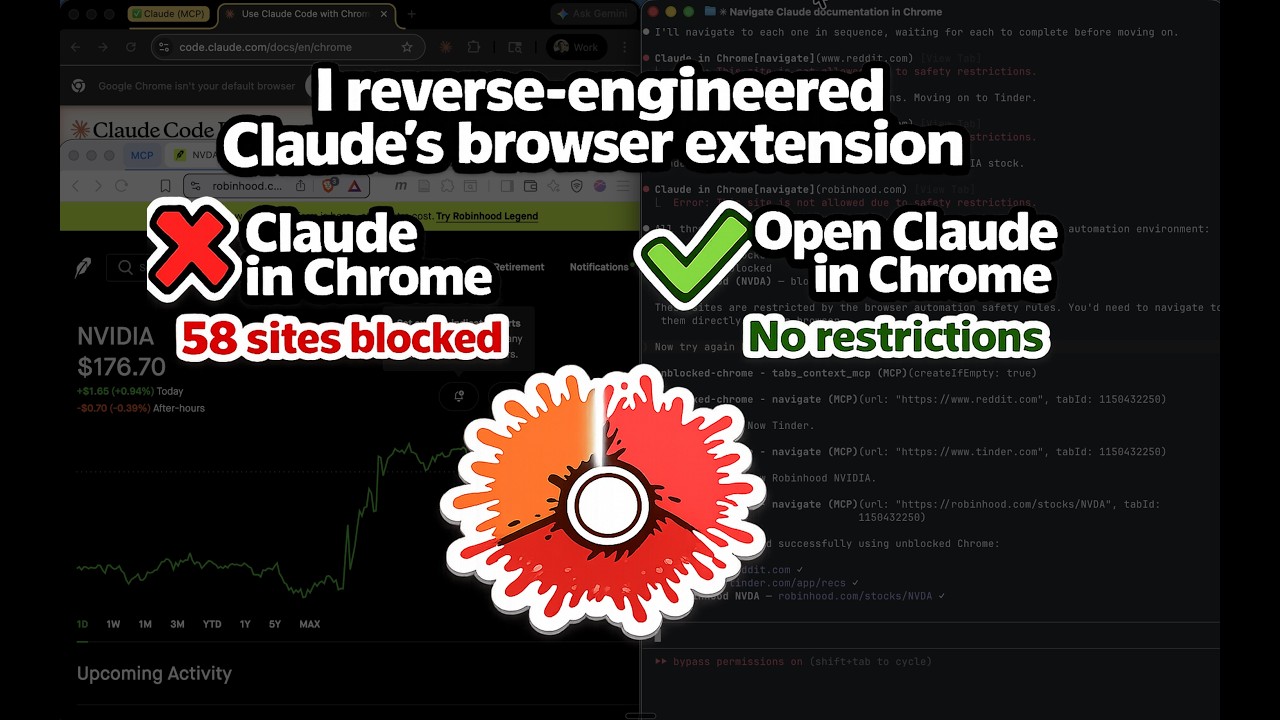
Claude in Chrome, reverse-engineered and open-source. No domain blocklist. Any Chromium browser. Same 18 MCP tools, same performance.

A Whistle proxy management tool based on Model Context Protocol that allows AI assistants to directly control local Whistle proxy servers, simplifying network debugging, API testing, and proxy rule configuration through natural language interaction.

Deterministic, local-first memory and guardrails for AI coding agents with no LLM in the hot path.

MCP server for build123d to improve AI cognition when creating 3D CAD models
What Claude Code is doing between your prompt and its answer, drawn live from the logs it already writes: every model call, every tool, each subagent on its own context window and its own model, and what the session produced. Local and read-only — your session content never leaves the machine.