
JuliusBrussee/
caveman

🪨 why use many token when few token do trick — Claude Code skill that cuts 65% of tokens by talking like caveman
105k
1 add
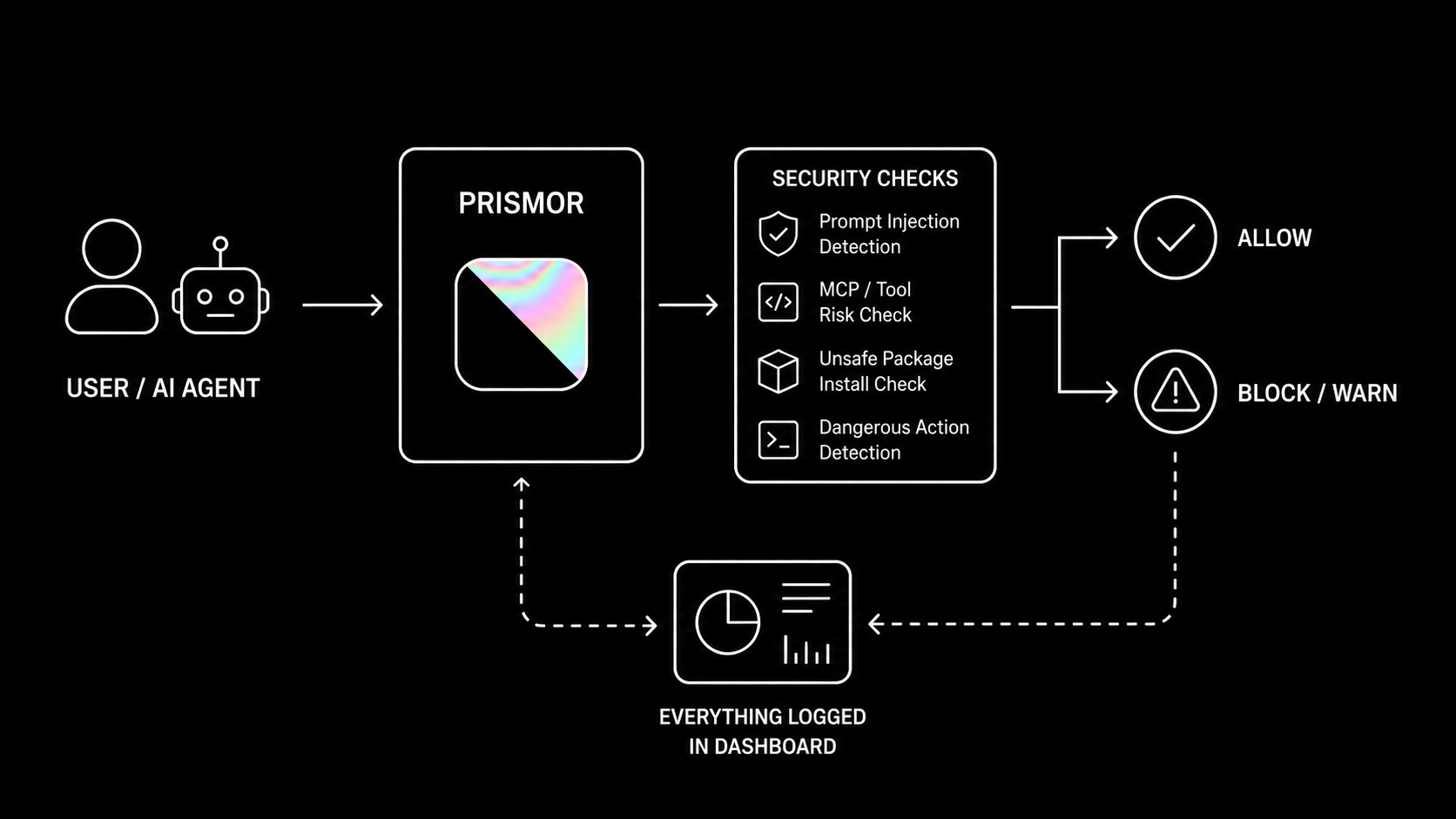
Prismor sits in front of agent tool use and evaluates each action against your policy before it executes. It can run in observe mode, require human approval, block risky calls, and write signed audit records for later review.
Builders who use Claude Code, Codex, Cursor, Gemini CLI, or other agent frameworks and want policy checks around tool use.
You can stop risky agent actions before they execute and review what happened in a local dashboard.
Each policy rule can log only or block in real time, so you decide exactly what stops the agent.
A single MCP connector can front other servers, scan responses for injection, and block specific tools or servers.
It scores package risk, watches egress, and can block unsafe installs or network calls.
Every agent action is hash-chained and Ed25519-signed so the history can be verified later.
You get a terminal and web dashboard for session forensics, telemetry, status, and approvals.
Adapters and runtime hooks let Prismor protect coding agents and framework-based agents across different runtimes.
It can replay past sessions through the live policy engine and suggest new rules from session history.
It plants honeytokens and masks sensitive output so secret reads and leaks are easier to catch.
pip install prismor
prismor setup







Plus Grok Build, Crush, OpenHands, Qwen Code, Continue CLI, Goose, Hermes, OpenClaw, Devin CLI, Factory Droid, Aider, and more — see AGENT_INTEGRATIONS.md for the full coverage matrix
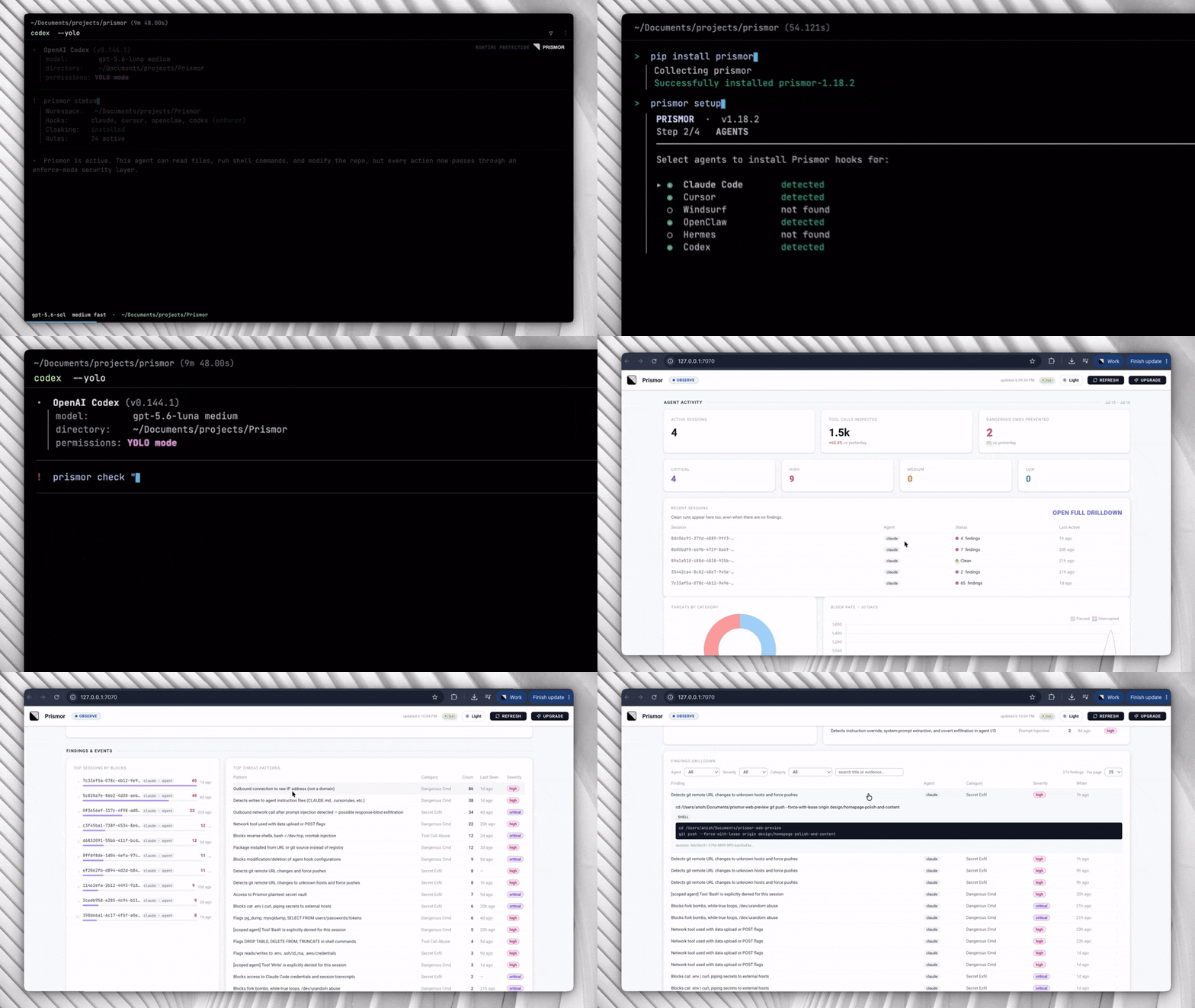
AI coding agents execute shell commands, read and write files, access credentials, and call external APIs. They do this autonomously, often across many steps, with limited checkpoints.
This creates risks that traditional security tooling isn't designed for:
.env or credential files as part of a debugging task and sends the content outboundStandard OS-level and endpoint security tools monitor the kernel and filesystem. By the time they see an action, the agent has already decided to take it. The gap is at the agent layer for avoiding the attack
pip install prismor
prismor setup
For the Skill, curl, and git-clone alternatives, plus PEP 668 systems and secret-cloaking setup, see the full installation guide.
tools/call is policy-evaluated before it forwards and each response is injection-scanned before the model sees it, so a poisoned tool result never becomes context. prismor mcp-gateway install moves an existing .mcp.json behind itprismor proxy with ANTHROPIC_BASE_URL, OPENAI_BASE_URL, or the Google Gen AI SDK's HttpOptions(base_url=...) and nothing else about the agent changes. Every tool call the model proposes — Anthropic tool_use, OpenAI tool_calls, Gemini functionCall — is reshaped into the same event a Bash hook produces and judged by the same rule, with streamed calls held until they can be judgedprismor inference-hook serve, which runs your policy on the transcript and answers allow/deny before the model runs — signed requests (Standard Webhooks), fail-closed, shadow mode, nothing to install on user devices. prismor inference-hook test sends signed sample frames to check the wiring_meta, and prismor tags lists, tests, and lints the rule expressionsuse_subject("user:alice") and a multi-tenant agent gets per-user attribution, per-user IAM profiles, and per-user suspensionprismor allow makes narrow exceptions, and prismor unlock opens a password-gated, time-boxed window in which an agent may edit policy (never the self-protection rules that guard Prismor itself)prismor tokens breaking down where a session's context and token spend actually wentprismor doctor health-checks every subsystem (hooks, policy signature, enrollment, telemetry sink, chain state), and prismor pause / pause-hard suspends enforcement only for a human during an incident while observe-mode logging keeps runningprismor trail verify proves the history hasn't been edited, deleted, or rewrittenprismor attest verifyprismor discover and flags any AI agent running without Prismor hooks (shadow AI)prismor ingest --discover replays on-disk session transcripts through the live policy engine, so the dashboard is populated on day one and you can see exactly what flipping a rule to enforce would have blocked, plus --coverage for sessions that ran unmonitoredFull command map across every capability: CLI Reference.
These capabilities map to the OWASP Top 10 for LLM Applications - covering prompt injection (LLM01), sensitive information disclosure (LLM02), supply chain (LLM03), improper output handling (LLM05), and excessive agency (LLM06).
Real workflows with the commands and config that make them work — onboarding a team in observe mode, per-user IAM attribution for multi-agent and framework pipelines, shadow AI discovery, step-up approval for high-stakes operations, and generating a signed attestation bundle for a compliance audit. See USE_CASES.md.
Full command map: docs/cli-reference.md.
prismor setup asks you to pick one posture instead of configuring six policy axes by hand. Each compiles into .prismor/policy.yaml — enforcement, egress, tool access, tag rules, sandbox and data boundary together.

| Mode | For | Coverage | Friction |
|---|---|---|---|
dev-safe | Feature work on code you haven't read | 31% | 9% |
trusted-workspace | Trusted internal repos, local Docker work | 34% | 9% |
regulated-airgap | PII/PHI, SOC 2, EU AI Act — no network, no shell | 100% | 90% |
prismor mode list                            # compare the three
prismor mode explain dev-safe                # the trade, including what it does NOT stop
prismor mode apply dev-safe                  # compile it into this workspace
prismor mode apply regulated-airgap --observe   # what it would block, blocking nothing
Every mode states its residual risk. Full breakdown: docs/modes.md.
Enforcement is decided per rule by your policy, not by a single global switch. Each rule carries a mode, and settings.default_mode (default observe) covers any rule that doesn't set one:
| Mode | Behavior |
|---|---|
observe (default) | Logs the tool call and the finding. Never blocks. Safe for onboarding and auditing. |
enforce | Blocks the action in real time before the agent executes it. |
Out of the box everything observes — nothing is blocked until you flip rules (or default_mode) to enforce in your policy:
# .prismor/policy.yaml
settings:
  default_mode: observe        # global default for rules without their own mode
rules:
  - id: destructive-rm-rf
    mode: enforce              # this rule blocks; the rest still just observe
Policy is authoritative: a rule set to enforce blocks regardless of how the hook was installed (--mode), so an admin who flips a rule to enforce via the control plane blocks even on observe-installed devices. See Layered Policy & Exemptions for org / project / repo precedence and the non-overridable floor.
prismor setup makes the choice explicit rather than implied: an observe install ships with the defaults on, while an enforce install starts with nothing selected and asks you to pick what blocks (the safety floor is pre-marked recommended — press a to take it). Your selection is written to .prismor/policy.yaml as settings.selection: explicit plus one line per rule, so what blocks is readable in the file. When a rule then blocks something legitimate, the deny message prints the exact prismor allow <rule> --pattern '<literal>' that fixes it — for the human to run; agents are stopped from editing Prismor's own config by always-on self-protection rules, unless the human opens a short password-gated window with prismor unlock. See Choosing what blocks and Making exceptions.
The install flag still sets the starting posture, and an observe install combined with PRISMOR_LOCAL_DRY_RUN=1 acts as a local dry-run kill-switch that suppresses all blocking:
prismor install-hooks --agent all --mode observe    # start in observe everywhere
prismor install-hooks --agent all --mode enforce    # honor policy enforce rules
Upgrading from a pre-
moderelease? Backward compatibility is preserved: a policy that predates per-rule modes (it setssettings.block_categoriesbut nodefault_modeand no rule-levelmode) keeps its original behavior — those categories still block when installed with--mode enforce. The moment your policy adopts the per-rule model (anymode/default_mode), it becomes fully policy-authoritative as described above.
Every tool call takes the same path: it enters through an integration surface (stage 1), is evaluated before it executes (stage 2), produces an allow/warn/block verdict, and lands in tamper-evident evidence (stage 3). Stage 4 is optional — a self-hosted control plane whose signed policy becomes authoritative for stage 2 once a device is enrolled.
flowchart TD

%% ── sources ────────────────────────────────────────────────
subgraph SRC["Agents Prismor protects"]
    direction LR
    AC["<b>Coding agents</b><br/>Claude Code · Codex · Cursor · Windsurf · Copilot<br/>OpenClaw · Hermes · Grok · Kiro · Crush<br/>OpenHands · Qwen · Continue · Goose"]
    AF["<b>Production frameworks</b><br/>OpenAI Agents · LangChain / LangGraph · CrewAI · browser-use<br/>Pydantic AI · AutoGen Core · Agno · Semantic Kernel · Google ADK<br/>BeeAI · Claude Agent SDK · Vercel AI SDK · Mastra"]
end

%% ── stage 1 ────────────────────────────────────────────────
subgraph ENTRY["Stage 1  ·  Integration surface"]
    direction LR
    H(["<b>Runtime hooks</b><br/>pre / post tool-call<br/>per-agent config"])
    G(["<b>MCP gateway</b><br/>fronts every MCP server<br/>injection-scans responses"])
    F(["<b>Framework adapters</b><br/>in-process + HTTP eval server<br/>per-user via use_subject"])
end

%% ── stage 2 ────────────────────────────────────────────────
subgraph EVAL["Stage 2  ·  Evaluated before the call executes"]
    direction TB
    D(["<b>Tool-call dispatcher</b>"])
    P["<b>Policy engine</b><br/>YAML rules · per-rule observe / enforce<br/>layered org → project → repo · non-overridable floor"]
    CHK["<b>Pre-execution checks</b><br/>Semantic guard · Egress control · MCP guardrails · Tool tags<br/>IAM and agent controls · Scoped session rules<br/>Script-content inspection · Docker sandbox"]
    SEC["<b>Secret and supply-chain protection</b><br/>Cloak placeholders + output scrub · Env guard · Sweep<br/>Canary tripwires · Skill scanner<br/>Supply-chain scoring → npm · pip · cargo · go"]
end

FEED[/"Signed advisory feed  ·  Prismor intel + NVD"/]
V{"<b>Allow  ·  Warn  ·  Block</b><br/>every block prints narrowest-first unblock steps"}

%% ── stage 3 ────────────────────────────────────────────────
subgraph EV["Stage 3  ·  Evidence and feedback"]
    direction LR
    ST[("<b>Session store</b><br/>SQLite + JSONL<br/>session forensics")]
    VIEW["<b>Views</b><br/>Web + terminal dashboard<br/>Status · Tokens · Audit · Doctor"]
    PROOF["<b>Tamper-evident</b><br/>Signed trail — hash chain + Ed25519<br/>Attestation bundle · Host discovery"]
    LEARN["<b>Learning</b><br/>propose rules · flag false<br/>positives · detect evasion"]
end

PAST[/"Transcript ingest  ·  replays pre-install history through the live policy"/]

%% ── stage 4 ────────────────────────────────────────────────
subgraph ORG["Stage 4  ·  Optional self-hosted control plane"]
    direction LR
    RP["<b>Signed remote policy</b><br/>layered rules · time-boxed<br/>exemptions · pause / resume"]
    TEL["<b>Live telemetry</b><br/>redacted events<br/>offline spool"]
    OD["<b>Org dashboard</b><br/>policy · devices<br/>sessions · approvals"]
end

%% ── flow ───────────────────────────────────────────────────
AC --> ENTRY
AF --> ENTRY
ENTRY --> D
D --> P
P --> CHK
P --> SEC
FEED -.-> SEC
CHK --> V
SEC --> V
V --> ST
PAST -.-> ST
ST --> VIEW
ST --> PROOF
ST --> LEARN
LEARN -.->|"proposed rules"| P
RP ==>|"authoritative once enrolled"| P
ST -->|"redacted"| TEL
TEL --> OD
Stage 1 has more than one door, and that is deliberate: no single interposition point covers every agent. Hooks are the widest but not every host offers them; MCP is the only place some agents can be intercepted at all; production framework agents run where there is no host to hook.
So each surface normalizes what it saw into one canonical event and asks the same evaluator for a verdict. A rule written once covers the same action however it arrives.
| surface | what it governs | refuse | rewrite input | redact output |
|---|---|---|---|---|
| Coding-agent hooks | an agent's entire tool surface | yes | Claude/Qwen | no |
| MCP gateway | every MCP server behind one connector | yes | yes | yes |
| Mirrored built-ins | the agent's own Bash/Read/Write, over MCP | yes | yes | yes |
| Framework SDK adapters | in-process agents (13 frameworks) | yes | no | no |
prismor eval-server | non-Python callers, external proxies | yes | yes | yes |
| Inference-hook channel | hosted transcript-turn webhook | yes | no | no |
"Redact output" is why the mirror exists: a pre-action hook can only refuse a file read, while a surface that carries the response can return the file with the credential masked.
This is checked rather than asserted — tests/test_surface_conformance.py
replays one action through each surface's own normalizer and fails if they
disagree on the verdict or the rule.
See the decision contract for the event shape and verdict vocabulary, and [governance surf
Sign in to join the discussion.
No comments yet. Be the first to say what this is good for.
🪨 why use many token when few token do trick — Claude Code skill that cuts 65% of tokens by talking like caveman

The best-benchmarked open-source AI memory system. And it's free.

Orca is the ADE for working with a fleet of parallel agents. Run any coding agent with your own subscription. Available on desktop, mobile and remote runtime.
A cross-platform desktop All-in-One assistant for Claude Code, Codex, OpenCode, OpenClaw, Grok Build & Hermes Agent. Only official website: ccswitch.io

Never stop coding. Free MIT AI gateway: one endpoint, 352 providers (150+ free), 1200+ models Kimi, Claude, GPT, Gemini, GLM, DeepSeek, MiniMax. Works with Claude Code, Codex, Cursor, OpenCode, Cline & Copilot. Quota-aware auto-fallback, RTK+Caveman compression saves 15-95% tokens, MCP/A2A, Desktop/PWA. Built by 550+ contributors

Compress tool outputs, logs, files, and RAG chunks before they reach the LLM. 20% fewer tokens for coding agents, 60-95% fewer tokens for JSON, same answers. Library, proxy, MCP server.