aiurda/cursor10x-mcpConnectors
The Cursor10x MCP is a persistent multi-dimensional memory system for Cursor that enhances AI assistants with conversation context, project history, and code relationships across sessions.
80
The Cursor10x MCP is a persistent multi-dimensional memory system for Cursor that enhances AI assistants with conversation context, project history, and code relationships across sessions.

Persistent memory graph for AI agents. Facts, decisions, entities, and relationships that survive across sessions, tools, and providers. MCP server — works with Claude, Cursor, ChatGPT, and any MCP client.

🚀 A real-time monitoring dashboard for Claude Code & Codex, built with SQLite3, Node.js, Express, React, Vite, TailwindCSS, & WebSockets. It tracks sessions, agent activity, tool usage, and subagent orchestration, providing live analytics, a Kanban status board, status notifications, a cute buddy, & an interactive web UI/MacOS/Windows native app.
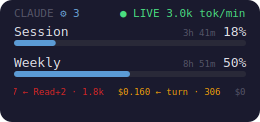
Cross-platform desktop widget + CLI for real-time Claude Code (and opt-in OpenAI Codex) usage — session/weekly limits, cost, forecasts, burn alerts, 11 themes. One pip install (Linux/macOS/Windows).

Orchestrate AI coding agents (Claude Code, Codex) as parallel subagents over tmux — a loop-engineering runtime with auto-continue, execute-then-review, and cross-session memory.

MCP-native code retrieval for AI agents — 84-88% fewer read tokens, BM25F + semantic search, AST chunks, session dedup

Persistent memory for AI coding agents. Local-first, cross-session context, global knowledge, and optional autonomous task execution.
An agentic memory database that cuts session tokens by 82–99%. One portable SQLite file — your agent's memory, anywhere.

Supercharge your Claude Code CLI experience with a powerful statusline that displays key session metrics (Git state, context usage, model info and cost) at a glance — minimal setup, maximum insight.

Read the Qur'an while Claude Code works. Start a session with 'claude --cwq' and a reader beside it walks forward through the Qur'an one ayah per prompt, resuming where you left off — in a terminal pane or a browser tab. Zero dependencies, fully offline.
Persistent file-based planning for AI coding agents and long-running tasks. Crash-proof markdown plans, session recovery after /clear and compaction, per-turn re-injection against context rot, deterministic completion gate. Manus-style. Install from npm, the Claude Code plugin marketplace, or npx skills. Codex, Cursor, OpenCode, 60+ agents.

The meta-skill that builds and improves all your skills, including itself. Watches your work sessions (autonomous or human-led), captures patterns, corrections and judgement calls, and turns them into skill improvements and new skill candidates for your review. Practical application of the Augmented Expertise methodology. Open source: CC BY 4.0.

Let AI write the code — you own the view. Termdock: the AI-native terminal for macOS & Windows. Claude Code / Codex / Gemini / GitLab Duo agent sessions, diff impact analysis, visual Git review, and a fully customizable backdrop (your images, themes, fonts). GPU-fast, battery-kind.

Run Claude Code, Codex & Gemini in parallel on Windows & macOS — git worktree fan-out with atomic hunk adoption, approval gates, reboot-surviving sessions

First open-source OpenEvidence MCP server: browser-session medical research tools for Codex, Claude Code, and MCP clients

One config to rule all your AI agents: portable (every project, every session), effective (curated writing, routing, skills), and safer (destructive-command guard).

A disciplined methodology for AI-assisted software development. Covers architectural constraints, validation hooks, session governance, and PAG (Pattern Abstract Grammar) for structured AI collaboration. Copy claude-setup/ into your project to start.

ccteam turns the coding agents you already run (Claude Code, Codex, Grok, DeepSeek Harness, Kimi, Pi) into one team — any session can spawn, dispatch, and collect work from any vendor on any machine, while you steer it all from Telegram, Lark, or a browser tab. 把你在用的编程 agent 编成一支团队,跨厂商跨机器派活,Telegram/飞书/网页统一指挥。

Node-based terminal manager for AI coding agents — tmux-backed terminals and parallel agent sessions as draggable nodes on an infinite pan/zoom canvas. macOS, Linux, and a browser Server Edition.

Adam Framework for OpenClaw — 5-layer persistent memory and identity architecture for AI agents. Production-validated over 353+ sessions. First documented case of emergent values in persistent AI, quantum-verified on IBM hardware.

📜 An MCP server for conversation history search and retrieval in Claude Code

Claude Code learns from your corrections: self-correcting memory that compounds over 50+ sessions. Context engineering, parallel worktrees, agent teams, and 17 battle-tested skills.

Governance gateway for AI agents — bounded, auditable, session-aware control with MCP proxy, shell proxy & HTTP API. Works with Cursor, Claude Code, Codex, and any MCP-compatible agent.

Drive your real, logged-in Chrome from any AI agent (Claude Code, Codex, Cursor, VS Code) — works where headless dies. Reads emailed login codes from your Gmail, 40 tools, up to 20 concurrent sessions. MIT, local-only.