DY-2026/
GameDesignOS

DY-2026/GameDesignOSHarnesses
Local-first game design OS for AI agents: turn sessions into evidence, experiments, reviewable decisions, and durable project memory—Human Gates and rollback.
385
Local-first game design OS for AI agents: turn sessions into evidence, experiments, reviewable decisions, and durable project memory—Human Gates and rollback.
A Claude skill that writes the accurate prompts for any AI tool. Zero tokens or credits wasted. Full context and memory retention

AI Agent Orchestrator with Skills System - Give AI Agents superpowers: memory search, code graph queries, agent-to-agent messaging. Manage Claude, Codex or any AI Agent from one dashboard. Move Agents between computers and locations

Local-first AI memory MCP server — query your ChatGPT, Claude Code, Cursor & Codex history from any LLM. DuckDB+parquet.
Project memory for coding agents and humans: the reasoning behind a codebase as Markdown in the repo, versioned by Git, so nothing rejected is proposed twice. No database, no daemon, no account.
Persistent Context Across Sessions for Every Agent – Captures everything your agent does during sessions, compresses it with AI, and injects relevant context back into future sessions. Works with Claude Code, OpenClaw, Codex, Gemini, Hermes, Copilot, OpenCode + More

Deterministic, local-first memory and guardrails for AI coding agents with no LLM in the hot path.
Open Brain — The infrastructure layer for your thinking. One database, one AI gateway, one chat channel — any AI plugs in. No middleware, no SaaS.
Multi-agent orchestration for Claude Code. Persistent memory, tasks, rules, and skills that make AI agents actually coordinate.

Understand any codebase instantly. System intelligence for codebases, built for humans and AI.
Mine your Claude Code and Codex logs into a local you.md agent profile.
Context window optimization for AI coding agents. Sandboxes tool output (98% reduction), persists session memory, and enforces routing across 17 platforms via MCP + hooks.
Provider-neutral control plane for durable-state agent swarms: subprocess workers, leases, artifacts, memory, and deterministic stitching.

Independently authored prompt templates for AI coding agents — system prompts, tool prompts, agent delegation, memory management, and multi-agent coordination. Informed by studying Claude Code.

Evidence-based learning engine — first-principles curricula, free-recall verification with receipts, FSRS-scheduled memory, and explorable artifacts. Learn anything; keep it.

Control Claude Code, Codex CLI and Gemini CLI from Telegram. Live streaming, persistent memory, cron jobs, webhooks, Docker sandboxing.

Persistent memory for Claude Code and 6 other CLI agents, stored as plain markdown in your Obsidian vault. Stop re-explaining your projects, decisions and people every session. 45 commands: hybrid semantic search, self-rewriting notes, key-less web research, and scheduled agents that maintain the vault while you sleep.

Claude Code learns from your corrections: self-correcting memory that compounds over 50+ sessions. Context engineering, parallel worktrees, agent teams, and 17 battle-tested skills.

Your Personal AI OS

BMAD Method skills for Claude Code - Auto-detection, Memory integration, Slash commands. Transform Claude Code into a BMAD-powered development environment.
🌊 The original agent meta-harness. Deploy intelligent multi-player swarms, coordinate autonomous workflows, and build conversational AI systems. Features adaptive memory, self-learning intelligence, RAG integration, and native Claude Code / Codex / Hermes and many more Integrated

Orchestrate a crew of specialist AI agents in one local-first workspace. Each role on its best model, with memory and skills that compound. Free, MIT.
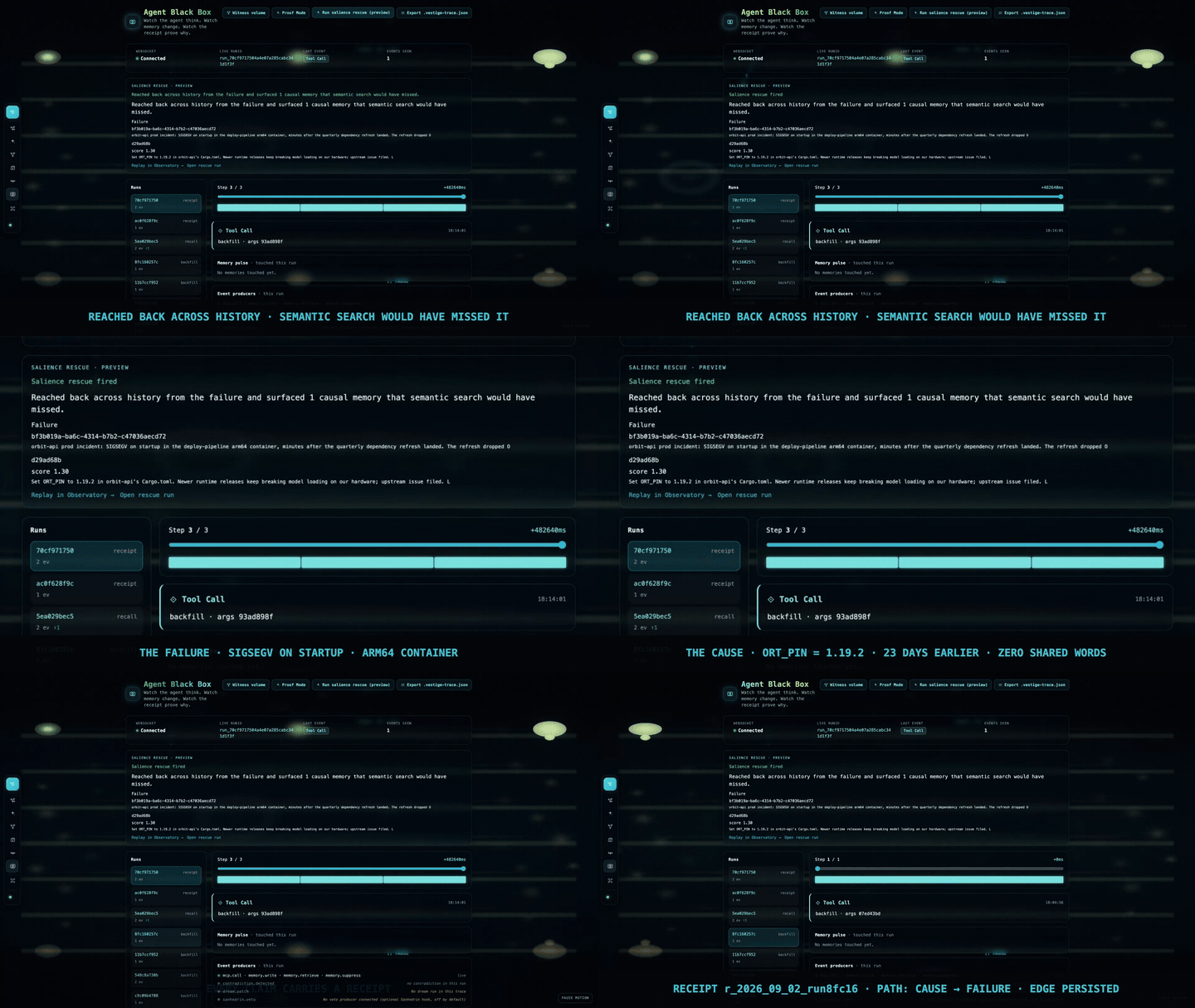
Vestige enhances agents by deterministic root-cause retrieval that reaches backward through time to find the quiet change, decision, or service that caused today’s failure, not the lookalike.

🛠️ The meta-harness for AI agents — scaffold your own focused, branded agent harness with its own npx CLI, MCP server, memory, learning loop, and witness-signed releases. Works with Claude Code, Codex, pi.dev, Hermes, OpenClaw, and RVM (hardware-isolated sandbox).