




DietrichGebert/ponytailPlugins
Makes your AI agent think like the laziest senior dev in the room. The best code is the code you never wrote.
138k
1 add
This project connects terminal agents to an Obsidian vault so the vault becomes their shared memory. It saves conversations into notes, searches existing context before starting new work, rewrites pages when new facts arrive, and runs background maintenance with hooks and scheduled agents.
Builders who want Claude Code, Codex, Gemini CLI, or Grok Bot to remember projects, people, and decisions across sessions.
You can stop re-explaining your context and keep a living vault that your agents update over time.
Stores context as plain markdown in an Obsidian vault so multiple CLI agents can read and update the same knowledge base.
Includes slash commands like `/obsidian-save`, `/obsidian-find`, `/obsidian-daily`, `/obsidian-reconcile`, and `/obsidian-synthesize`.
Uses hooks and scheduled agents to consolidate notes, heal links, rebuild indexes, and keep the vault fresh.
Pulls in web, X, and YouTube content, then updates existing notes instead of only appending new ones.
Uses frontmatter, provenance, recency markers, and a future-agent preamble to make notes easier for agents to retrieve and revise.
/plugin marketplace add eugeniughelbur/obsidian-second-brain
/plugin install obsidian-second-brain@obsidian-second-brain
curl -fsSL https://raw.githubusercontent.com/eugeniughelbur/obsidian-second-brain/main/scripts/quick-install.sh | bash
git clone https://github.com/eugeniughelbur/obsidian-second-brain ~/.claude/skills/obsidian-second-brain
bash ~/.claude/skills/obsidian-second-brain/install.sh
bash ~/.claude/skills/obsidian-second-brain/scripts/setup.sh "/path/to/your/vault"
cd ~/.claude/skills/obsidian-second-brain
uv run python scripts/bootstrap_vault.py --path ~/Documents/MyVault --name "Your Name"
bash scripts/setup.sh ~/Documents/MyVault
git clone https://github.com/eugeniughelbur/obsidian-second-brain
cd obsidian-second-brain
bash scripts/build.sh --platform codex-cli   # or gemini-cli, or opencode
cp -R dist/codex-cli/. /path/to/your/vault/   # or dist/gemini-cli/. or dist/opencode/.
git clone https://github.com/eugeniughelbur/obsidian-second-brain
cd obsidian-second-brain
bash scripts/build.sh --platform pi
pi install ./dist/pi          # or: cp -R dist/pi/.pi/ /path/to/your/vault/
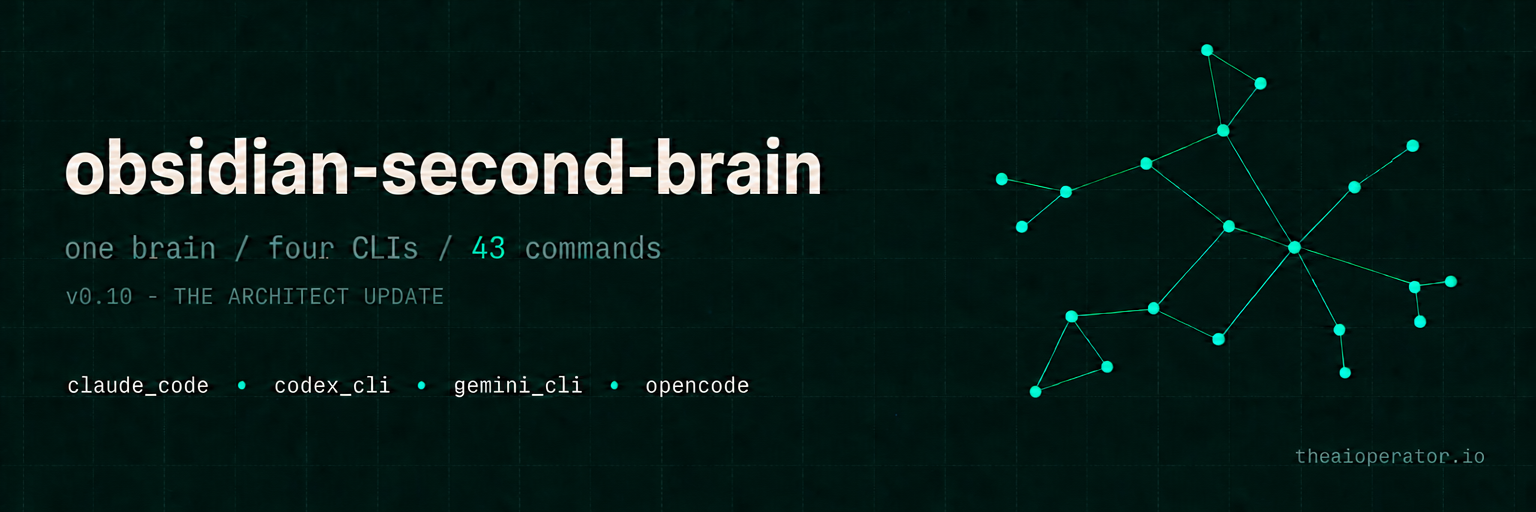





Your vault is the memory. Claude, Grok Bot, Codex - same brain.
Your vault outlives whichever CLI you switch to.





An evolution of Karpathy's LLM Wiki pattern: a vault that rewrites itself.
Every source updates existing pages instead of just appending new ones. Contradictions reconcile automatically. Your vault compounds while you sleep.
Powered by OKM - Open Knowledge Metabolism: every stored fact is timeless, dated, or a pointer - so your knowledge base never fills with facts that used to be true.
Built for developers · founders and operators · writers · researchers - pick a preset at setup
Start with three: /obsidian-init to set up, /obsidian-save to capture, /obsidian-find to recall. The other 42 are there when you need them.
auto-synthesis · thinking tools that argue with you
live research from X, the web, and YouTube · 4 scheduled agents · 4 role presets
write-time AI-first validator · /create-command interview flow · multilingual trigger schema
Install → ·
Demos ·
See it in action ·
All commands ·
Presets ·
OKM ·
Discussions

One /obsidian-save - five cross-linked notes. Real footage, synthetic vault. More demos →
If this looks useful, star the repo. It is how other people find it.
v0.15 - The Port (September 2026): the plugin now runs on Windows the way it runs on macOS and Linux, fixed end to end by a contributor across two PRs.
Windows paths, CRLF and BOM notes, UTF-8 everywhere, a USERPROFILE-aware config home; plus Gemini-first /podcast with a free Whisper fallback, tag syntax and taxonomy checks, Simplified Chinese triggers, /obsidian-reindex, an Obsidian lint plugin, platform ownership, AI-FIRST.md, a reproducible retrieval benchmark, a generated docs site, typed edges, and the callout preamble. 763-test CI wall.
See the changelog →
You use Claude every day. Every session starts from scratch. You re-explain everything. The conversation ends. Everything disappears. Claude Code has no persistent memory across sessions - and neither does Grok Bot, Codex, Gemini, or any of the others.
You take notes in Obsidian. Hundreds of files. They just sit there. You make the same decision twice because you forgot you made it six months ago. Ideas rot in daily notes. Nobody connects the dots.
Two powerful tools. Completely disconnected. You already have the long-term memory. The thing doing the thinking cannot reach it.
Karpathy's pattern is brilliant. Drop sources, LLM creates wiki pages, ask questions. This skill takes it further:
| Karpathy's LLM Wiki | obsidian-second-brain | |
|---|---|---|
| New sources | Append new pages, cross-reference | Rewrite existing pages. People get updated, claims revised, stale facts replaced. |
| Contradictions | Flagged, you resolve manually | /obsidian-reconcile resolves them automatically |
| Patterns | Surface when you ask | /obsidian-synthesize finds unnamed patterns and writes synthesis pages on its own |
| When it runs | On demand, when you prompt | 4 scheduled agents: morning brief, nightly consolidation, weekly review, vault-health check |
| Note format | Human-readable wiki pages | AI-first: ## For future agent preamble + frontmatter for LLM retrieval, not human review |
If Karpathy's wiki is a knowledge base you maintain with an LLM, this is a knowledge base that maintains itself.
After a meeting: /obsidian-save
Claude pulls out every decision, person, task, and idea and saves each one to the right note. You do nothing.
You recorded a voice memo: /obsidian-ingest meeting.m4a
Claude transcribes it with a local Whisper install, attributes speakers where the transcript makes them identifiable, extracts every promise and action item, and distributes across entity pages, task boards, and the daily note.
You screenshot a whiteboard: /obsidian-ingest photo.png
Claude reads the image, extracts text and structure, creates concept notes, links to related projects. A photo becomes knowledge.
You find a great video: /obsidian-ingest https://youtube.com/...
Claude doesn't summarize into one note. It REWRITES your existing pages. People get updated. Contradictions get resolved. Patterns trigger new synthesis pages. One URL in. The vault is smarter.
Before a big decision: /obsidian-challenge
Claude searches your vault for past failures and reversed decisions on the same topic. Pushes back with your own words. Your vault holds you accountable.
You want to see the big picture: /obsidian-visualize
Claude generates a visual canvas of your entire vault. Hub nodes centered, color-coded by type, orphans highlighted. Open it in Obsidian and see the shape of your knowledge.
You go to sleep: The nightly agent runs 5 phases: closes the day, reconciles contradictions, synthesizes cross-source patterns, heals orphan notes, and rebuilds the index. You wake up to a smarter vault.
You start a new day: /obsidian-daily
Claude pulls your calendar events, overdue tasks, and overnight changes into today's note. Your morning starts informed.
Someone shares an X post: /x-read https://x.com/...
Grok with live X access fetches the post, the thread, and the replies. Returns verbatim text + TL;DR + key claims + reply sentiment + voices to watch. No more screenshots.
You're planning today's content: /x-pulse "AI automation"
Grok scans X for what's trending in your topic right now. Returns 3-5 emerging themes (with rep posts + key voices), gaps nobody is filling, hook formats that are working, and 3 specific post ideas you could write today.
You need real research: /research "AI memory tools"
Perplexity Sonar Pro pulls a deep dossier with citations: summary, key facts (every claim with a recency marker and source domain), timeline, key players, contrarian views, recommended further reading, open questions. Saved to your vault, auto-opens in Obsidian.
You want vault-first deep research: /research-deep "AI memory tools"
Scans your vault for what you already know. Identifies gaps. Spawns 3-5 targeted searches via Perplexity (web) and Grok (X discourse). Synthesizes a delta report: what's new, what's confirmed, contradictions to resolve, recommended vault updates. Vault baseline doesn't get re-researched. Only gaps get filled.
You hit a great YouTube video: /youtube https://youtu.be/...
Free transcript via youtube-transcript-api. Optional metadata + top comments via YouTube Data API v3. Gemini (free tier, Grok fallback) summarizes into TL;DR, Key Points, Notable Quotes (verbatim), Themes, Comment Sentiment, and Worth Following Up On. Saved as an AI-first note in your vault. Add --visual to also watch it: scene-change frame extraction (ffmpeg) that Claude reads with its own vision to capture on-screen text, code, diagrams, and demos the transcript misses.
You never open Obsidian. Everything happens through Claude.
| Without this skill | With this skill | |
|---|---|---|
| Saving decisions | Copy-paste or lose them | Auto-saved to the right project note |
| Daily notes | Write it yourself, forget half the time | Created automatically |
| Finding patterns | Re-read dozens of notes | /emerge finds them for you |
| Challenging yourself | Nobody pushes back | /challenge uses your own history against you |
| Session continuity | Re-explain every time | /world loads full context in 10 seconds |
| Ingesting content | Read it, forget it | /ingest rewrites 5-15 vault pages from 1 source (URLs, PDFs, audio, screenshots) |
| Contradictions | You don't know they exist | /reconcile resolves them automatically |
| Synthesis | You connect dots manually | /synthesize finds patterns across sources on its own |
| Sharing vault data | Only Claude can read it | /export gives any AI tool a clean snapshot |
| Facts change over time | Old info gets overwritten | Bi-temporal facts track when it was true AND when the vault learned it |
| Starting a new session | Re-explain who you are | CRITICAL_FACTS.md loads your identity in ~120 tokens |
| Reading an X thread | Open X, scroll, screenshot, paste | /x-read [url] returns post + thread + sentiment + voices |
| Knowing what to post | Guess what's trending | /x-pulse scans X and returns hot themes + gaps + hooks + post ideas |
| Web research | Open 12 tabs, copy quotes manually | /research [topic] returns a sourced dossier with recency markers |
| Researching what you already know | Re-research from scratch | /research-deep scans vault first, fills only the gaps, flags contradictions |
| YouTube videos | Watch passively, forget | /youtube [url] transcript + summary + quotes saved to vault |
| Vault notes for future agent | Notes for human reading | AI-first rule: every note has "For future agent" preamble + recency markers + citations |
The product is above. This is where it came from and where it goes next.
From the blog · The AI Operator →
Featured: "HUGE update on obsidian-second-brain: The Architect"
/obsidian-architect · document your codebase into your vault · the full before-and-after
Deep dive: "I rebuilt Karpathy's LLM Wiki. Here's what's missing from the original."
Why append-only breaks at scale · the AI-First Vault Principle · three bugs in v1
Origin story: "I built this for myself. Then 1,374 strangers cloned it."
Two disconnected tools · the institutional-amnesia problem · 1,000+ stars in 7 weeks
One post per Tuesday on Obsidian + AI workflows and bringing AI into real work.
Research toolkit · dual-track
/x-read · /x-pulse · /research · /research-deep · /notebooklm · /youtube · /podcast
Open-web track · /research-deep via Perplexity + Grok. Pulls fresh signal from outside.
Source-grounded track · /notebooklm via Gemini File Search. Reads your own vault.
Run both for high-stakes topics. Contradictions across the two are where the insight is.
Built by Eugeniu Ghelbur · AI Automation Engineer @ Single Grain
building in public · sharing what works
Follow alongWeekly posts on AI second-brain systems, vault patterns, and what actually works.
|
  +------------------------------------------+
  |                                          |
  |   LAYER 1: Operations (28 commands)      |
  |   Claude remembers everything            |
  |                                          |
  +------------------------------------------+
  |                                          |
  |   LAYER 2: Thinking Tools (9 commands)   |
  |   Claude thinks with you                 |
  |                                          |
  +------------------------------------------+
  |                                          |
  |   LAYER 3: Context Engine (1 command)    |
  |   Claude knows who you are               |
  |                                          |
  +------------------------------------------+
  |                                          |
  |   LAYER 4: Research Toolkit (7 commands) |
  |   Claude pulls knowledge in              |
  |                                          |
  +------------------------------------------+
  |                                          |
  |   ALWAYS ON                              |
  |   Background agent + 4 scheduled agents  |
  |   Auto-synthesis + save reminders        |
  |                                          |
  +------------------------------------------+
47 commands total. The calendar command (/obsidian-calendar) is Claude Code only (needs the Google Calendar MCP), so the Codex / Gemini / OpenCode / Hermes / Pi / Agent Skills builds ship 46.
Layer 1 saves, organizes, ingests, reconciles, exports, schedules your calendar, and maintains your vault. Layer 2 challenges your ideas, surfaces hidden patterns, bridges unrelated domains, and graduates ideas into projects. Layer 3 loads your identity and current state so every session picks up where the last one ended. Layer 4 pulls live external knowledge into the vault: X posts, X trends, web research with citations (key-less by default), YouTube and podcast transcripts. Vault-first synthesis knows what you already know. Always On keeps the vault alive without you lifting a finger.
| Command | What it does |
|---|---|
/obsidian-save | Saves everything from the conversation -- decisions, tasks, people, ideas |
/obsidian-ingest | Drop a URL, PDF, audio file, or screenshot. The vault REWRITES itself. 5-15 pages touched per source. |
/obsidian-synthesize | Auto-finds patterns across sources and writes synthesis pages |
/obsidian-reconcile | Finds contradictions and resolves them. The vault maintains its own truth. |
/obsidian-export | Clean JSON/markdown snapshot any AI tool can read |
/obsidian-daily | Creates or updates today's daily note |
/obsidian-calendar <mode> | One calendar command, four modes: agenda (read a snapshot), reconcile (flag commitments not yet scheduled), meeting (event to note), schedule (create/move an event from a task or standalone) |
/obsidian-recurring | Tracks a recurring obligation with a cadence and a computed next-due date |
/obsidian-log | Logs a work session, links it everywhere |
/obsidian-task | Adds task to the right board with priority and due date |
/obsidian-person | Creates or updates a person note |
/obsidian-capture | Zero-friction idea capture |
/obsidian-catchup | Process captures dumped from the Telegram bot (voice/text/image/PDF/link) into the vault |
/obsidian-find | Smart search with context |
/obsidian-recap | Summary of a day, week, or month |
/obsidian-review | Structured weekly or monthly review |
/obsidian-board | Kanban board view and updates |
/obsidian-board-hygiene | Bulk-triage a board -- surface stale/overdue items, then archive / reschedule / mark-Done in one pass |
/obsidian-project | Project note with board and daily links |
/obsidian-projects | Live project status from git + local docs -- infers all context from vault notes, no config required |
/obsidian-health | Vault audit -- contradictions, gaps, stale claims, orphans, freshness violations (the freshness policy: every fact timeless, dated, or a pointer), typed-edge lint (unknown types, dangling targets, contradiction cycles in the relations: graph), and a tag taxonomy audit (opt-in via _meta/taxonomy.md) |
/obsidian-merge | Merge two near-duplicate notes from /obsidian-health into one -- dry run by default, frontmatter union, retired note becomes a redirect (never deleted) |
/obsidian-reindex | Refreshes the incremental semantic index and reports coverage before and after, with clear embedding-backend failures |
/obsidian-retrieval-eval | Measures vault search quality -- recall@k + MRR on natural-language questions, with the concrete failures and ranked fixes |
/obsidian-decide [--formal] | Logs decisions to the right project notes; --formal writes a full ADR record (the vault knows why it's structured this way) |
/obsidian-visualize | Generates a visual canvas map of your second brain |
/obsidian-learn | Reviews vault learnings, prunes stale ones, surfaces patterns to promote into rules |
/obsidian-init | Generates _CLAUDE.md, index.md, log.md |
/obsidian-architect | Scans a codebase and writes maintained architecture notes (overview, modules, decisions) into the vault; re-run to refresh |
/create-command | Interview flow that scaffolds a new command into commands/<name>.md, no markdown editing |
| Command | What it does |
|---|---|
/obsidian-brainstorm [topic] | Multi-turn Socratic interview - one question per turn until the idea converges, then a design note with named alternatives |
/obsidian-challenge | Your vault argues against your idea using your own history |
/obsidian-panel | Convenes a panel of distinct perspectives on a decision, one verdict each + synthesis |
/obsidian-emerge | Surfaces patterns from 30 days of notes you never named |
/obsidian-connect [A] [B] | Bridges two unrelated domains to spark new ideas |
/vault-deep-synthesis [topic] | Cross-references every note on a topic: agreements, contradictions, stale claims, gaps |
/obsidian-distill [note or source] | Condenses a long note/source into key claims, each tagged with provenance back to the exact source block |
/idea-discovery | Ranks 3-5 next-direction candidates from ideas, open questions, and orphan research |
/obsidian-graduate | Turns an idea fragment into a full project with tasks |
| Command | What it does |
|---|---|
/obsidian-world | Loads identity + state with progressive token budgets (L0-L3) |
Powered by xAI Grok (live X access) + Perplexity Sonar (web research) + YouTube. Findings save to Research/ as AI-first notes (preamble, frontmatter, recency markers, sources verbatim).
| Command | What it does |
|---|---|
/x-read [url] | Deep-read an X post: verbatim post + thread + TL;DR + claims + reply sentiment + voices |
/x-pulse [topic] | Scan X for what's trending: themes, voices, hooks, post ideas |
/research [topic] | Web research with citations: full dossier with recency markers and open questions. Uses Perplexity when keyed, free key-less sources (Wikipedia, HackerNews, arXiv, Reddit, and more) otherwise |
/research-deep [topic] | Vault-first synthesis (open web): scans your va |
Sign in to join the discussion.
No comments yet. Be the first to say what this is good for.
Makes your AI agent think like the laziest senior dev in the room. The best code is the code you never wrote.
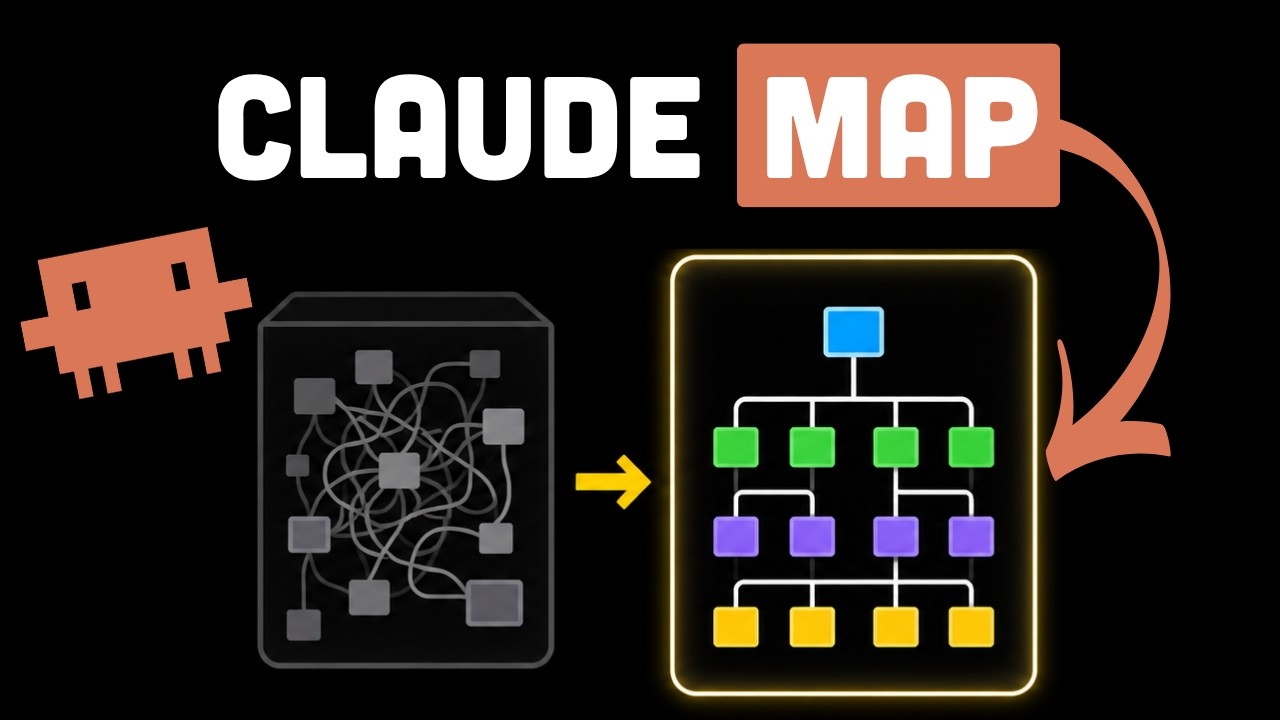
Graphs that teach > graphs that impress. Turn any code into an interactive knowledge graph you can explore, search, and ask questions about. Works with Claude Code, Codex, Cursor, Copilot, Gemini CLI, and more.

OmO: Just type "mass ulw" keyword with your prompt. Now you are the master of graph engineering.
Persistent Context Across Sessions for Every Agent – Captures everything your agent does during sessions, compresses it with AI, and injects relevant context back into future sessions. Works with Claude Code, OpenClaw, Codex, Gemini, Hermes, Copilot, OpenCode + More
Opinionated Oxlint rules for rejecting low-evidence TypeScript and JavaScript patterns
Teams-first Multi-agent orchestration for Claude Code