
JuliusBrussee/
caveman

🪨 why use many token when few token do trick — Claude Code skill that cuts 65% of tokens by talking like caveman
105k
1 add
Ix parses a repository into a local graph of symbols, calls, imports, and relationships, then keeps that graph on your machine between sessions. Agents query the graph through MCP, while builders can use the CLI to map, explain, trace, and measure impact without grepping through files.
Builders who want Claude Code, Codex, Cursor, or another MCP client to understand a repository from a persistent graph instead of fresh file reading.
You can ask what a symbol does, what it touches, and what breaks if you change it without rebuilding context every session.
`ix map .` parses a codebase with tree-sitter and builds a graph of symbols, calls, imports, and relationships.
The graph is stored locally and survives between sessions, so the same structure does not need to be re-derived.
Commands like `ix explain`, `ix trace`, `ix impact`, `ix callers`, and `ix callees` return bounded structural answers.
`ix mcp install` registers the MCP server with supported clients so agents can query the graph directly.
`skills/ix/SKILL.md` and the install script let supported agents learn how to drive Ix from their own skill folders.
`ix view` opens the Compass visualizer for browsing the mapped system graph.
curl -fsSL https://ix-infra.com/install.sh | sh
irm https://ix-infra.com/install.ps1 | iex
ix map .
ix mcp install
brew tap ix-infrastructure/ix https://github.com/ix-infrastructure/Ix
brew install ix

System intelligence for humans and AI.
Ix parses your repository into a persistent system graph of symbols, calls, imports and relationships
so you and your coding agents can query structure instead of grepping and guessing.




Website · Docs · Live demo · Discord
Kartr is an agent platform built on the same memory engine we use for Ix, extended to the sources a codebase does not contain: docs and files, email and calendar, meetings and notes, and team chat. Agents carry context across all of them.
Kartr is in alpha and onboarding early users.

curl -fsSL https://ix-infra.com/install.sh | sh # macOS / Linux
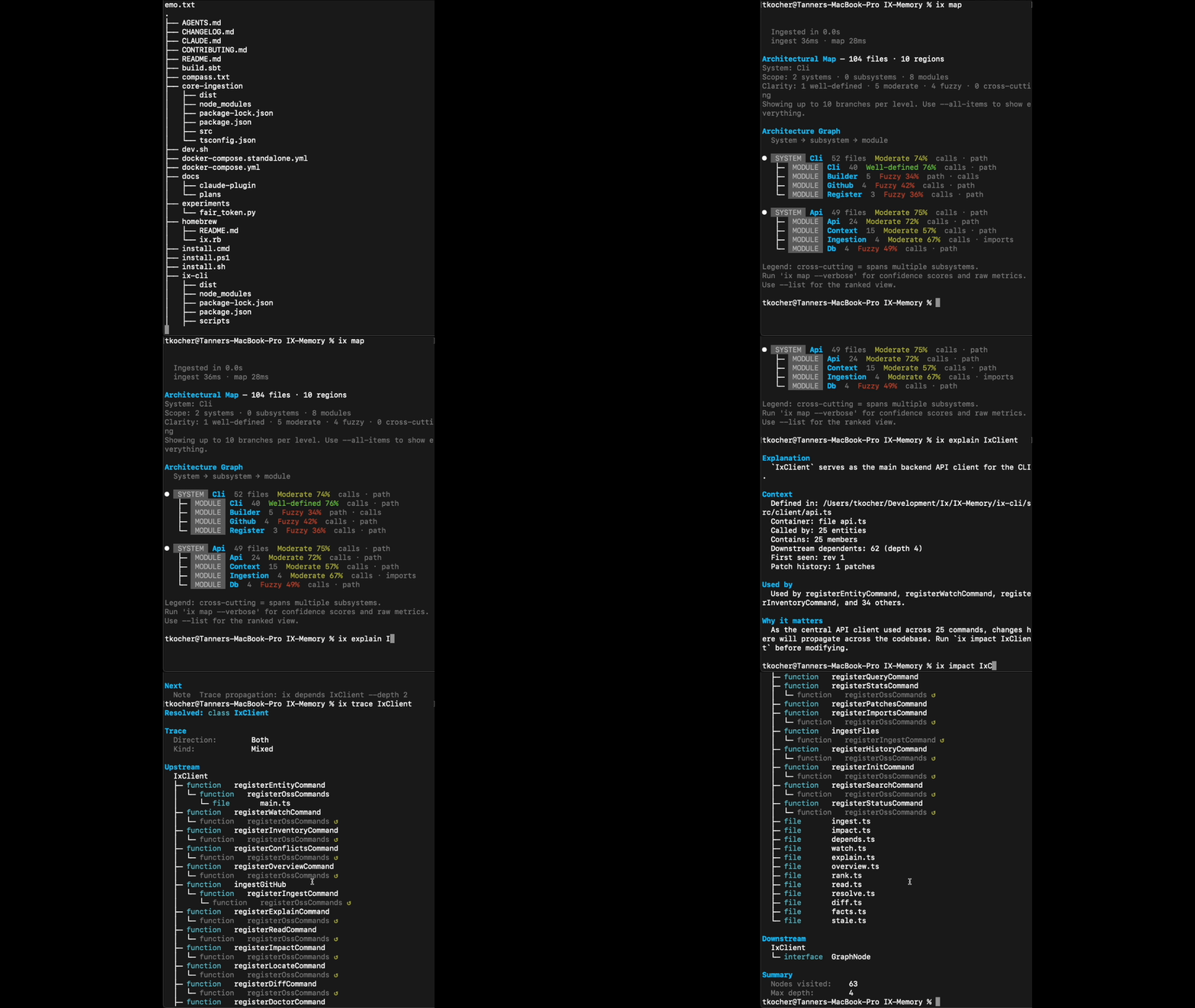
ix map .                      # build the graph for this repo
ix explain AuthService        # what is this, and what does it touch?
ix trace user_login_flow      # how does this actually flow?
ix impact verify_token        # what breaks if I change this?
The graph lives on your machine and persists between sessions. Your agent navigates it through MCP instead of re-deriving your architecture from whatever fits in a prompt.
| Without Ix | With Ix | |
|---|---|---|
| Finding things | Search, read, search again | Query a structured graph |
| Architecture | Re-derived every session | Mapped once, kept |
| Agent context | Whole files pasted into the prompt | Bounded structural slices |
| Between sessions | Context is lost | The graph persists |
| Relationships | Inferred from fragments | Read from real edges |
Map → Structure → Retrieve → Remember
| Step | What happens |
|---|---|
| Map | ix map . parses the repo with tree-sitter and extracts symbols, calls and imports. |
| Structure | Those become nodes and edges in a graph of what calls, contains and imports what. |
| Retrieve | Commands return bounded answers about one symbol or flow, not whole files. |
| Remember | The graph is stored locally and survives between sessions and agent runs. |
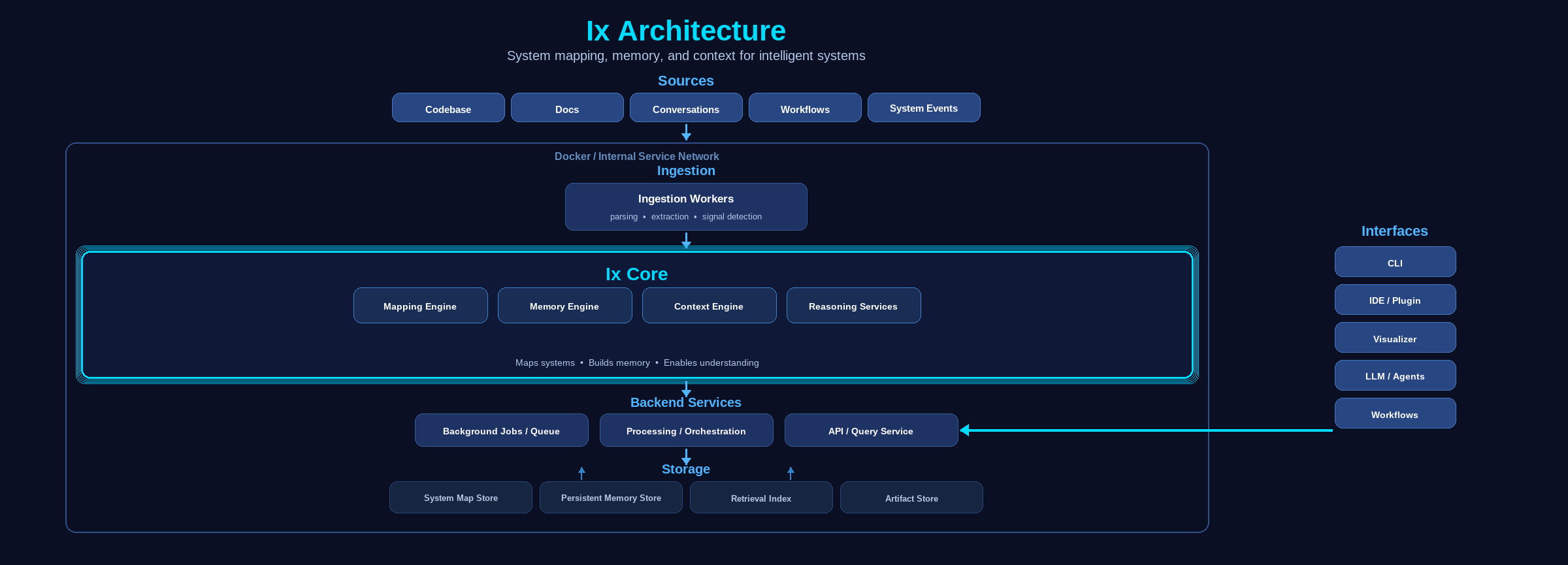
ix map parses your repository with tree-sitter, extracts symbols, calls and
imports, and persists them as a graph in a local backend: ArangoDB plus the memory
layer, run for you in Docker. Three clients read that graph: the ix CLI, the
ix mcp server your AI clients connect to, and Compass, the visualizer ix view
opens.
The backend ships as a released Docker image; it is not built from this repo. See the HTTP API reference for the endpoints all three clients share.
Across our own development work, querying the graph instead of feeding files into the prompt cut token use by 30–99.7%, varying widely with the task and the size of the repo. These are internal measurements, not a published benchmark.
The mechanism is the plain part: ix explain AuthService returns that symbol and
its immediate relationships. Answering the same question by reading the file and
the files it imports costs far more, and costs it again next session.
Ix ships a stdio MCP server, so any MCP-capable client can use the same graph tools.
ix mcp install            # detect installed clients and register `ix mcp` with each
ix mcp install --dry-run  # show what would change, write nothing
ix mcp doctor             # check each client's registration
install knows Claude Code, Codex, Cursor, VS Code, Gemini CLI, OpenClaw and
opencode. It writes through each client's own MCP command where one exists, and
never overwrites a server name it does not own. Pass --force to replace one, or
--host <id> to limit the run. Per-client write mechanics, repair and process
isolation are in docs/mcp.md.
To register one client by hand:
codex mcp add ix-memory -- ix mcp
skills/ix/ teaches any LLM agent to drive the CLI. It follows the
Claude Code skill format and the
agents.md standard, so Claude Code, Agents, Codex and Cursor all
load the same tree from their own skills directory.
bash scripts/install-skill.sh # deploy to every harness found (--dry-run to preview)
Then ask your agent: "Set up Ix and map this repo."
Optional per-client packages, if you prefer them to ix mcp install:
# Claude Code
/plugin marketplace add ix-infrastructure/ix-claude-plugin
/plugin install ix-memory

# Codex
curl -fsSL https://ix-infra.com/codex-install.sh | sh

# OpenClaw
openclaw plugins install ix-infrastructure/ix-openclaw-plugin

# Gemini
gemini extensions install https://github.com/ix-infrastructure/ix-gemini-plugin

# OpenCode
curl -fsSL https://raw.githubusercontent.com/ix-infrastructure/ix-opencode-plugin/main/install.sh | bash

# Cursor
curl -fsSL https://raw.githubusercontent.com/ix-infrastructure/ix-cursor-plugin/main/install.sh | bash
Each also publishes a Windows PowerShell installer. Swap install.sh | bash for
install.ps1 | iex via irm.
macOS / Linux
curl -fsSL https://ix-infra.com/install.sh | sh
Windows: install Node.js 22+ and Docker Desktop first, then:
irm https://ix-infra.com/install.ps1 | iex
Then map a repo and register your AI clients:
ix map .
ix mcp install
The installer checks for and installs anything missing: Node.js 22+, Git, ripgrep
(powers ix text), and Docker + Docker Compose for the local backend. All you need
beforehand is a terminal with curl or wget.
Pre-built CLI packages are published for Apple Silicon macOS, Linux (x86-64 and arm64) and Windows x86-64.
Intel Macs have no pre-built package. Install with Homebrew, which builds from source:
brew tap ix-infrastructure/ix https://github.com/ix-infrastructure/Ix
brew install ix
For the full list, including the endpoints the installer reaches and the directories it creates, see docs/prerequisites.md.
Ix talks to a local backend, so start there if a command reports
Ix backend not reachable:
ix status          # is the backend reachable?
ix docker start    # start it (ArangoDB + memory layer)
ix doctor          # server, database and graph integrity
Set IX_DEBUG=1 for full stack traces on any error.
Build the graph
ix map .           # map this repo
ix watch           # re-map on change
Understand
ix search <term>       # find an entity by name
ix locate <symbol>     # jump to a definition
ix explain <symbol>    # what it is and what it touches
ix overview <target>   # one-shot structural summary
ix impact <target>     # blast radius of a change
ix read <target>       # read source, by symbol or path:line-range
Explore
ix trace <symbol>      # follow a flow up and down
ix callers <symbol>    # what calls this
ix callees <symbol>    # what this calls
ix rank --by dependents --top 10   # find the load-bearing code
ix inventory --kind function       # list components
ix history <target>    # how an entity changed
ix diff <from> <to>    # compare two revisions
Inspect the system
ix view            # open the Compass visualizer
ix stats           # graph statistics
ix smells          # detect structural issues
Query commands take --format text|json|llm. Use llm when an agent reads the
output. It is token-minimal and newline-delimited
(spec). Use json when chaining commands.
Exhaustive references: commands · flags · output formats · troubleshooting
Symbols, calls and imports are extracted across 27 languages:
JavaScript TypeScript Python Java C C++ C# Go Ruby Rust PHP
Kotlin Swift Scala R SAS Elixir Haskell Zig Lua Bash
PowerShell HTML XML CSS HCL / Terraform Makefile
CUDA (.cu / .cuh) is parsed with the C++ grammar, including kernel-launch
syntax (kernel<<<grid, block>>>(args)), so host-to-kernel calls appear in the
graph. Python stub files (.pyi) are parsed as Python.
Also recognized as config and data formats: YAML JSON TOML SQL
Protocol Buffers Dockerfile Markdown LaTeX
Alpha, and moving quickly. APIs and behavior may change. If you are running Ix on a large or unusual codebase, we want the bug report.
Issues and pull requests are welcome. See CONTRIBUTING.md for local setup, and SECURITY.md to report a vulnerability.
Docs · Website · Live demo · Discord
Licensed under Apache 2.0. ⭐ Star the repo if Ix is useful to you.
Sign in to join the discussion.
No comments yet. Be the first to say what this is good for.
🪨 why use many token when few token do trick — Claude Code skill that cuts 65% of tokens by talking like caveman

The best-benchmarked open-source AI memory system. And it's free.

Orca is the ADE for working with a fleet of parallel agents. Run any coding agent with your own subscription. Available on desktop, mobile and remote runtime.
A cross-platform desktop All-in-One assistant for Claude Code, Codex, OpenCode, OpenClaw, Grok Build & Hermes Agent. Only official website: ccswitch.io

Never stop coding. Free MIT AI gateway: one endpoint, 352 providers (150+ free), 1200+ models Kimi, Claude, GPT, Gemini, GLM, DeepSeek, MiniMax. Works with Claude Code, Codex, Cursor, OpenCode, Cline & Copilot. Quota-aware auto-fallback, RTK+Caveman compression saves 15-95% tokens, MCP/A2A, Desktop/PWA. Built by 550+ contributors

Compress tool outputs, logs, files, and RAG chunks before they reach the LLM. 20% fewer tokens for coding agents, 60-95% fewer tokens for JSON, same answers. Library, proxy, MCP server.