
koala73/worldmonitorConnectors
Real-time global intelligence dashboard. AI-powered news aggregation, geopolitical monitoring, and infrastructure tracking in a unified situational awareness interface
86k
brain-mcp records transcripts from Claude Code, Codex, and Pi into a local append-only lake, then indexes them in DuckDB for search. It keeps citations tied to file, line span, and sha256 so you can verify answers against the original text. It also includes health, backup, and redaction commands for managing the recorded history.
Builders who want their agent conversations searchable, cited, and kept on their own machine.
You can recover past agent context with checkable citations instead of re-explaining work after cleanup deletes old sessions.
Records Claude Code through Stop/SessionEnd hooks and scans Codex and Pi on a 60-second schedule.
Stores transcripts in `~/.brain/lake/<lane>/<session>.jsonl` and keeps an append-only sha256 manifest.
Returns search hits with `{file, line span, sha256}` and can abstain when nothing is found.
Reports whether each lane is fresh, stale, or unknown instead of guessing.
`brain-mcp backup <dest>` copies the lake and manifest and re-hashes sampled files at the destination.
Includes plugin metadata and hooks so Claude Code users can install the recorder as a bundle.
pipx install brain-mcp --pre     # or: uvx brain-mcp
brain-mcp install cc             # CC hooks + 60-second scheduler
brain-mcp serve                  # the MCP server (stdio) — add to your client config
/plugin marketplace add mordechaipotash/brain-marketplace
/plugin install brain
Your AI history is being deleted right now. Claude Code deletes session files older
than cleanupPeriodDays (default 30) at startup. Run this and see your own cliff edge:
# macOS
find ~/.claude/projects -name '*.jsonl' -exec stat -f '%Sm  %N' -t '%Y-%m-%d' {} + | sort | head -3
# Linux
find ~/.claude/projects -name '*.jsonl' -printf '%TY-%Tm-%Td %p\n' | sort | head -3
The oldest date you see is where your history ends. brain-mcp records it before it goes —
byte-exact, content-hashed, locally — and makes it queryable with citations you can verify
with sed and shasum.
pipx install brain-mcp --pre     # or: uvx brain-mcp
brain-mcp install cc             # CC hooks + 60-second scheduler
brain-mcp serve                  # the MCP server (stdio) — add to your client config
Or as a Claude Code plugin (hooks + server in one step):
/plugin marketplace add mordechaipotash/brain-marketplace
/plugin install brain
~/.brain/lake/<lane>/<session>.jsonl — append-only,
byte-identical to the original, with an append-only sha256 manifest. Nothing is parsed
and discarded; the DuckDB index is a cache, fully re-derivable from the lake.{file, line span, sha256} — checkable
by anyone with sed -n 'A,Bp' file | shasum -a 256, no database required. Zero hits
return an explicit abstention naming the lanes and dates actually searched.fresh = the floor holds everything the agent's files show;
stale = the agent has content the recorder missed; unknown = unmeasured, not
healthy — never folded into "looks fine".brain-mcp backup <dest> syncs lake+manifest and re-hashes
sampled files at the destination. The verify can fail; that is the point.| tool | what |
|---|---|
brain_search | BM25 over everything recorded; cited hits or an explicit abstention |
brain_get | the raw lines behind a citation, with sha verification |
brain_recent | time-ordered recent activity, every row cited |
brain_sessions | session cards per day/agent |
brain_health | per-lane origin-vs-floor freshness; unknown ≠ healthy |
brain_capture_status | is the machinery itself moving (spool, heartbeats, floor) |
brain_backup | verified backup; writes only outside the floor |
You're reading this because your human runs THE RECORDER and gave you access to their AI history. This is the honesty contract.
The one rule: everything you state from these tools is either CITED or ABSTAINED —
there is no third state. A cited claim carries a checkable pointer (file + line span +
sha256); verify it with brain_get(expect_sha256=...) before building on it. An
abstention means "not found above threshold in the lanes and dates the tool measured" —
it does NOT mean "it never happened". Never fill an abstention with your own guess.
verified: false from brain_get means the floor changed since indexing. Say so plainly.unknown lane is never "everything looks fine".
The honest sentence is: "2 lanes fresh, 1 stale, 1 unmeasured."brain_search(query, role="user"). "How did my thinking
evolve" → add order="time_asc" and read the citations in time order. The server has
no opinion about your human's mind; it has their words, with receipts.~/.brain/
spool/<lane>/ hooks + scanner write here (atomic, dot-tmp invisible)
lake/<lane>/<session>.jsonl THE FLOOR: append-only, byte-identical to the origin;
a rewrite opens <session>.g2.jsonl — old kept, never deleted
manifest/manifest.jsonl one versioned line per chunk: byte range, line range, sha256
offsets/<lane>/<session> hook fast-path line counters
health/*.last_run side-effect heartbeats (mtimes are the proof, never a report)
brain.duckdb the index — a cache, re-derivable from lake/ + manifest/
Where your agents keep their transcripts: Claude Code ~/.claude/projects/**/*.jsonl
(rolling window!), Codex ~/.codex/sessions/YYYY/MM/DD/rollout-*.jsonl, Pi
~/.pi/agent/sessions/**/*.jsonl.
brain-mcp record                  # one capture tick (the scheduler runs this every 60s)
brain-mcp health [--exit-nonzero-on-stale]   # cron-able
brain-mcp doctor                  # capture status + health summary
brain-mcp redact <file> --lines A B --reason "..."   # tombstone a secret; audited in manifest
brain-mcp migrate-v1 <all_conversations.parquet>     # import v1 data (marked v1_derived)
brain-mcp uninstall               # removes hooks + scheduler; your floor is KEPT
v2 is a rebuild around one principle: capture the bytes first; derive everything else.
v1 parsed conversations into a parquet and discarded the originals — v2's floor makes that
structurally impossible. v1's 25 tools became 7: the synthesis tools ("cognitive patterns",
"switching cost") are gone because a claim that can't carry a line-span citation isn't one
this server makes. Migration: brain-mcp migrate-v1 — v1 rows are kept, marked as derived,
and floor-backed rows win wherever the source still exists.
Windows: out of scope for v2.0. Scheduling is LaunchAgent (macOS) / systemd user timer (Linux).
MIT.
Sign in to join the discussion.
No comments yet. Be the first to say what this is good for.
Real-time global intelligence dashboard. AI-powered news aggregation, geopolitical monitoring, and infrastructure tracking in a unified situational awareness interface
High-performance code intelligence MCP server. Indexes codebases into a persistent knowledge graph — average repo in milliseconds. 158 languages, sub-ms queries, 99% fewer tokens. Single static binary, zero dependencies.
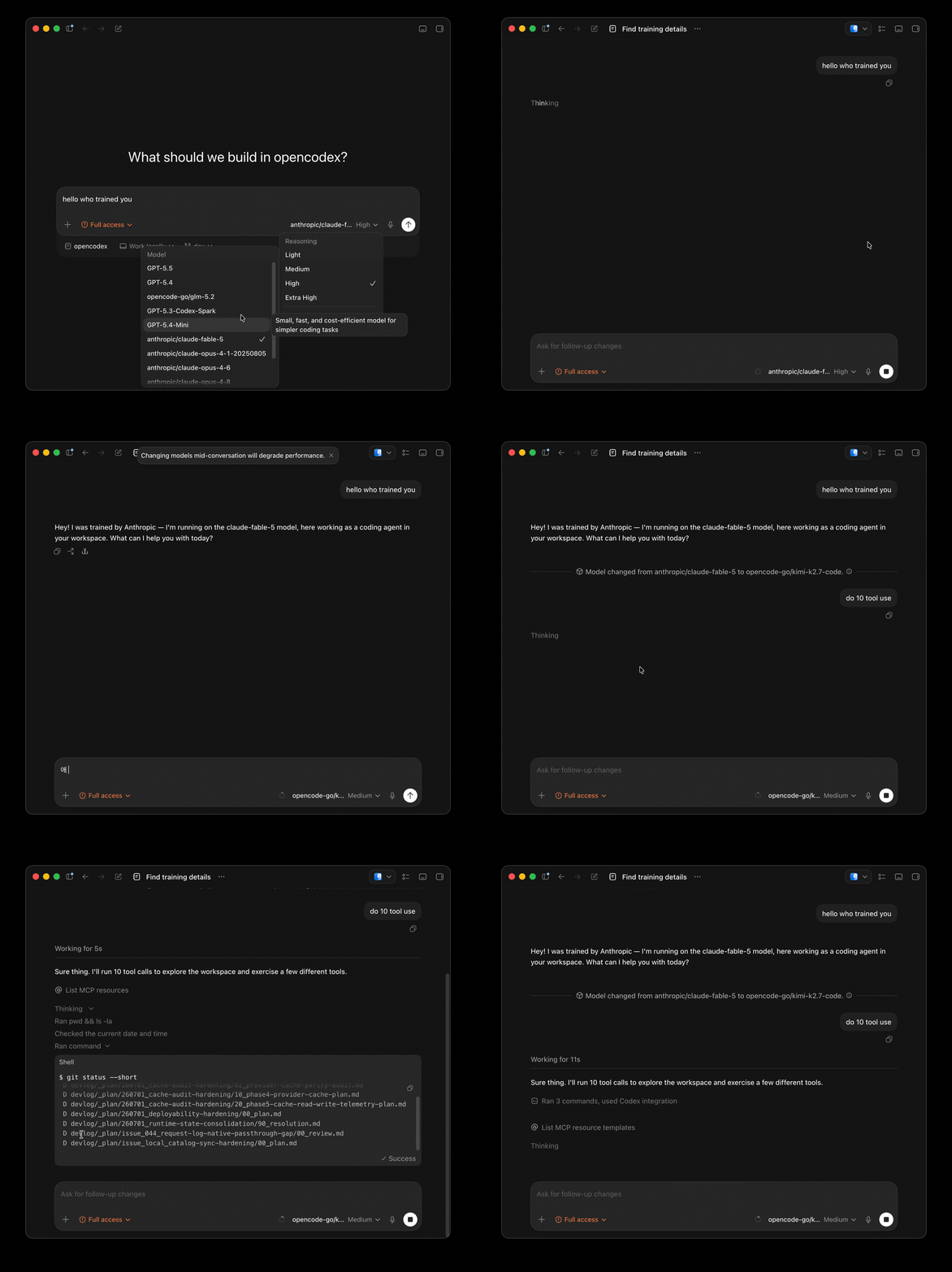
Universal provider proxy for OpenAI Codex & Claude Code — use any LLM (Claude, Gemini, Grok, DeepSeek, Ollama…) with Codex CLI, App, SDK, and Claude Code

Git-native persistent memory for AI coding agents. Implements Google OKF v0.2 with sub-300µs in-memory BM25 search, embedded MCP server, and progressive disclosure. Slashes token bloat by 80% with zero external databases or dependencies. Built in pure Go.

Local-first code intelligence graph for MCP and CLI. Builds a persistent map of your codebase so AI coding tools read only what matters, with benchmarked context reductions on reviews and large-repo workflows.

Stop your AI from making things up — it proposes, deterministic tools decide, every claim checked against ground truth with evidence. Grounded facts and context survive resets. Reverse engineering is the proving ground. MCP server + CLI.