
VinvAI/VinvAITools
Tools for AI agents to test, fix and optimise your codebase
46
Tools for AI agents to test, fix and optimise your codebase

Better subagent experience for Codex and Claude users

Rebuild the object in a reference image as a code-only, procedural, quality-gated, animation-ready Three.js model. Token-efficient image-to-3D.

Compiles AI agent traces and truns them into reusable context.
Open-source governed, local-first memory control plane for AI agents and teams. arXiv:2608.08253

Context engine for large codebases, exposed through MCP. Gives AI coding agents precise repository context; benchmarked at frontier-agent quality with ~25x lower model cost and 45% fewer tokens with semantic search.

AI conversations that actually remember. Never re-explain your project to your AI again. Join our Discord: https://discord.gg/tyvKNccgqN

Understand any codebase instantly. System intelligence for codebases, built for humans and AI.
The OKF toolkit for Claude Code — author, maintain, validate & visualize Open Knowledge Format bundles. Plugin, agent skills, and a GitHub Action.

Open-source memory and context for user-aware agents: scoped memory, provenance, retrieval quality, correction, boundaries, evals, and MCP/HTTP access.

🦦 ADHDev — Agent Dashboard Hub. Monitor & control AI coding agents from a single dashboard. Self-hosted, open-source.
AI video skill for Claude Code & Codex — cinematic product videos with Remotion: 152 shot recipe cards, 209 motion previews, a production-ready template

🧠 RepoBrain (formerly Antigravity) — Give your repo a brain. ChatGPT for your codebase: works in Claude Code, Cursor, Codex, Windsurf & more.

Persistent memory for AI coding agents: automatic capture, explainable recall, knowledge consolidation, privacy controls, and portable offline storage. One Python file, zero dependencies.

open source grok bot. gawk bots automate your menial work via AI models and build you microapps to manage the outcome, so that you have a false sense of control.

Local-first persistent agentic memory powered by Recursive Memory Harness (RMH). Open source must win.
Compile, verify, and run multi-agent DAGs across Pi, Codex, Claude Code, OpenCode, and Grok—with resume, replay, and incremental recomputation.

Human-like memory for AI agents — semantic, episodic & procedural. Experience-driven procedures that learn from failures. Free API, Python & JS SDKs, LangChain, CrewAI & OpenClaw integrations.

Cut AI context cost without trusting the compressor. Every reduction is reversible, byte-exact recoverable, and carries an auditable receipt. Local-first, works through proxy, MCP, SDK, or agent wrapper.

Turn your coding agent into a video studio: describe a video in plain language, and your agent writes the timeline and produces the file.

Research-first architecture engine for Python, TS, Go and Rust. Mines GitHub Issues for real production failures before scaffolding, then audits drift, cycles and fragility in code you already have. Zero import cycles, zero critical anti-patterns - measured against itself.

A git-native, review-gated knowledge base for AI agents: they propose writes, you approve them. Every claim cites a source, every change is a diff in your repo. MCP + CLI.

A personal knowledge base that builds and maintains itself. Drop in sources — Claude (or Codex/Gemini) reads them, extracts knowledge, and maintains a persistent interlinked wiki. Works with Claude Code, Codex, OpenCode, Gemini CLI. No API key needed.
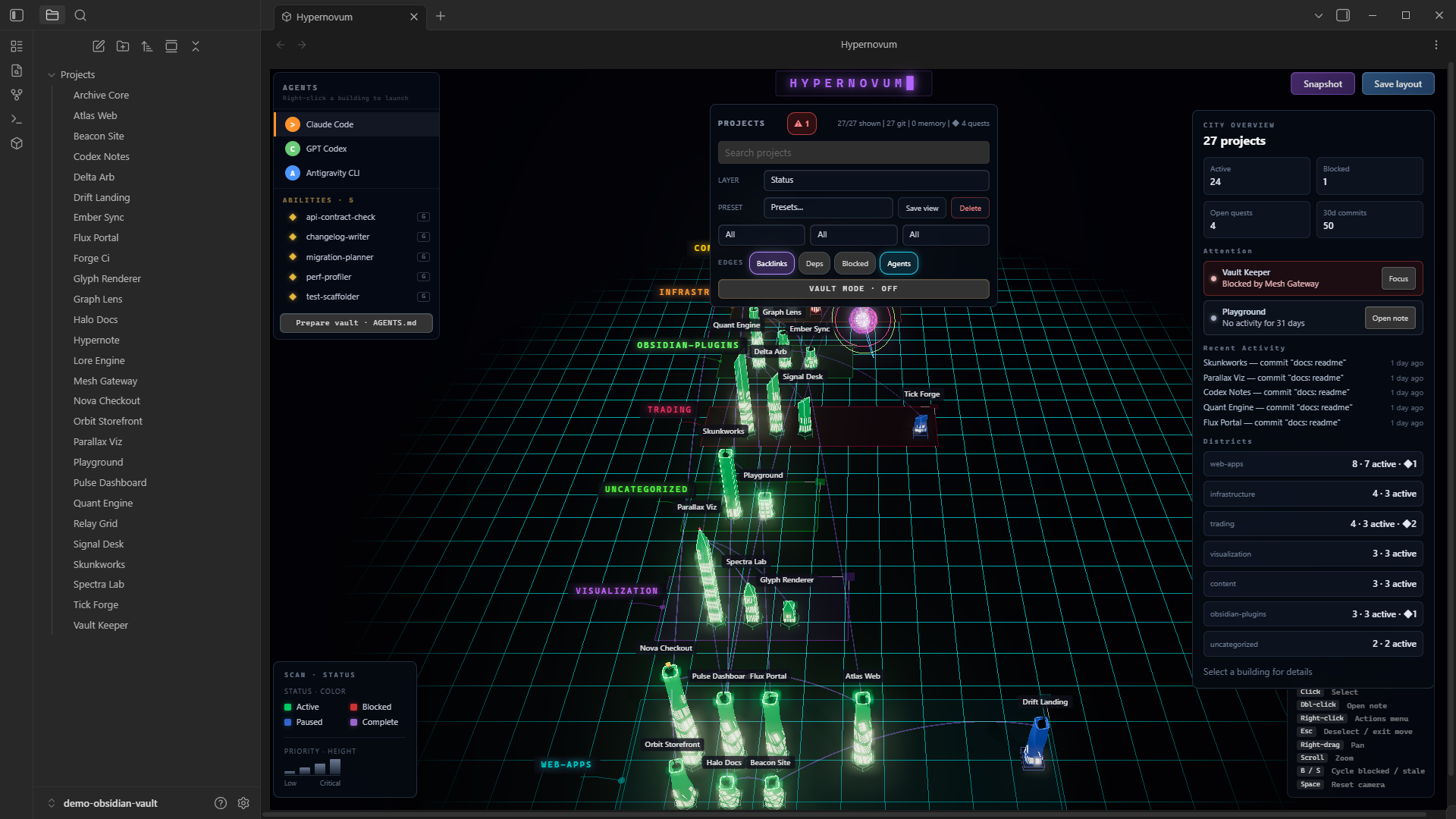
Agent Ops for your second brain - a 3D IDE for Obsidian built on Three.js. Visualize your vault as a code city, dispatch AI coding agents (Claude Code, Codex, Antigravity), post research quests, and watch your agent fleet work in real time.