





koala73/worldmonitorConnectors
Real-time global intelligence dashboard. AI-powered news aggregation, geopolitical monitoring, and infrastructure tracking in a unified situational awareness interface
86k
Mengram stores facts, events, and workflows so an agent can recall what happened before and adapt what it does next. It connects through MCP, SDKs, hooks, and integrations, and it can run against the hosted API or a local memory folder.
Builders who want their agent to keep context across sessions, tools, and failures.
You can stop re-explaining context and let your agent reuse remembered facts, past events, and proven workflows.
Stores semantic facts, episodic events, and procedural workflows in one system.
Procedures update when a step fails, so later runs can carry the learned fix.
Exposes memory tools to Claude Desktop, Cursor, Codex, Windsurf, and other MCP clients.
Loads context on start, recalls on prompts, saves after responses, and can gate risky workflow commands.
Works with the hosted API or with a local memfmt folder for offline memory.
Includes Python and JavaScript SDKs plus LangChain, CrewAI, and OpenClaw integrations.
Can import history from Claude Code, ChatGPT, Obsidian, and files, then search or ask across memories.
Install Mengram for me. Fetch the canonical install guide at
https://mengram.io/agent-install.txt and follow it precisely.
My email is YOUR_EMAIL_HERE.
pip install mengram-ai   # or: npm install mengram-ai

mengram try              # see what memory would know about you — local only,
                         # no account, nothing leaves your machine
from mengram import Mengram
m = Mengram(api_key="om-...")           # Free key → mengram.io

m.add([{"role": "user", "content": "I use Python and deploy to Railway"}])
m.search("tech stack")                  # → facts
m.ask("what's my tech stack?")          # → synthesized answer + citations
m.episodes(query="deployment")          # → events
m.procedures(query="deploy")            # → workflows that evolve from failures
Native multilingual: ask in Russian, Chinese, Spanish, Japanese — Mengram retrieves and answers across 23 languages (Cohere multilingual embeddings + rerank).
Paste this into Claude Desktop, Cursor, Codex, Claude Code, or Windsurf — the agent reads our setup guide, installs the SDK, configures the MCP server, and verifies the round-trip end-to-end. No terminal context-switching.
Install Mengram for me. Fetch the canonical install guide at
https://mengram.io/agent-install.txt and follow it precisely.
My email is YOUR_EMAIL_HERE.
Works in any agent with shell + file-edit + web-fetch tools. Prefer doing it manually? See the plain-text guide — it's structured for human eyes too.
Persistent memory that survives /clear, auto-compaction, machine switches, and team handoffs — the SessionStart hook fires after every compact and re-injects your context. The summary can be lossy; the memory isn't.
# 1. Get a free key at https://mengram.io and save it once
mkdir -p ~/.mengram && echo '{"api_key": "om-your-key-here"}' > ~/.mengram/config.json

# 2. Install the plugin (hooks + MCP server + skill)
claude plugin marketplace add alibaizhanov/mengram
claude plugin install mengram@mengram

# 3. Skip the cold start — import your existing session history
#    (secrets are redacted on your machine before anything is uploaded)
mengram import claude-code
What happens:
Session Start  →  Loads your cognitive profile (fires after /clear, compaction, and restarts)
Every Prompt   →  Searches past sessions for relevant context (auto-recall)
After Response →  Saves new knowledge in background (auto-save)
Before a Bash  →  If the command matches a learned workflow with a weak record, asks you first (policy gate, CLI hooks)
No manual saves. No tool calls. Claude just knows what you worked on yesterday — even after compaction ate the transcript.
Prefer CLI-managed hooks instead of the plugin? pip install mengram-ai && mengram setup does the same via mengram hook install.
pip install mengram-ai
mengram local init ./memory --provider anthropic --api-key sk-ant-...   # or openai / ollama
mengram import claude-code --memory ./memory                             # seed it from your Claude Code sessions
mengram local map --memory ./memory --open                               # one page: who you are, what happened, what it learned
mengram hook install --memory ./memory                                   # the same four hooks, all local
mengram server --memory ./memory                                         # MCP for Claude Desktop, Cursor, any client
The folder is the memory: a memfmt tree of Markdown you own — git diffs it, Obsidian draws it, memfmt validate checks it. Same procedures-with-outcomes as the cloud: versions, success/fail counts per step, the policy gate, and the regression gate that quarantines a fix that would break another workflow. Only extraction and a failure revision need a model, and that one you bring. Nothing expires and nothing asks for a key. Docs.
Every AI memory tool stores facts. Mengram stores 3 types of memory — and procedures evolve when they fail.
| Mengram | claude-mem | Mem0 | Zep | Letta | |
|---|---|---|---|---|---|
| Semantic memory (facts, preferences) | Yes | Yes | Yes | Yes | Yes |
| Episodic memory (events, decisions) | Yes | Partial | No | No | Partial |
| Procedural memory (workflows) | Yes | No | No | No | No |
| Procedures evolve from failures | Yes | No | No | No | No |
| Cognitive Profile | Yes | No | No | No | No |
| Native multilingual retrieval (23 languages) | Yes | Partial | No | No | No |
| Ask & Citations (synthesized answer) | Yes | No | No | No | No |
| Multi-user isolation | Yes | No | Yes | Yes | No |
| Knowledge graph | Yes | No | Yes | Yes | Yes |
| Claude Code hooks (auto-save/recall) | Yes | Yes | No | No | No |
| MCP server | Yes | Yes | Yes | Yes | Yes |
| LangChain + CrewAI integrations | Yes | No | Partial | Partial | Partial |
| Import Claude Code history / ChatGPT / Obsidian | Yes | No | No | No | No |
| Pricing | Free tier | Free OSS (+cloud backup) | $19-249/mo | Enterprise | Self-host |
1. Install
pip install mengram-ai
2. Setup — one command does everything: account, Claude Code hooks, MCP configs for detected tools (Cursor, Claude Desktop, Windsurf), history import, and a round-trip check
mengram setup
Or get a key manually at mengram.io and export MENGRAM_API_KEY=om-...
3. Use
from mengram import Mengram

m = Mengram(api_key="om-...")

# Add a conversation — auto-extracts facts, events, and workflows
m.add([
    {"role": "user", "content": "Deployed to Railway today. Build passed but forgot migrations — DB crashed. Fixed by adding a pre-deploy check."},
])

# Search across all 3 memory types at once
results = m.search_all("deployment issues")
# → {semantic: [...], episodic: [...], procedural: [...]}
# Upload a PDF — auto-extracts memories using vision AI
result = m.add_file("meeting-notes.pdf")
# → {"status": "accepted", "job_id": "job-...", "page_count": 12}

# Poll for completion
m.job_status(result["job_id"])
// Node.js — pass a file path
await m.addFile('./report.pdf');

// Browser — pass a File object from <input type="file">
await m.addFile(fileInput.files[0]);
# REST API
curl -X POST https://mengram.io/v1/add_file \
  -H "Authorization: Bearer om-..." \
  -F "file=@meeting-notes.pdf" \
  -F "user_id=default"
npm install mengram-ai
const { MengramClient } = require('mengram-ai');
const m = new MengramClient('om-...');

await m.add([{ role: 'user', content: 'Fixed OOM by adding Redis cache layer' }]);
const results = await m.searchAll('database issues');
// → { semantic: [...], episodic: [...], procedural: [...] }
# Add memory
curl -X POST https://mengram.io/v1/add \
  -H "Authorization: Bearer om-..." \
  -H "Content-Type: application/json" \
  -d '{"messages": [{"role": "user", "content": "I prefer dark mode and vim keybindings"}]}'

# Search all 3 types
curl -X POST https://mengram.io/v1/search/all \
  -H "Authorization: Bearer om-..." \
  -d '{"query": "user preferences"}'
m.search("tech stack")
# → ["Uses Python 3.12", "Deploys to Railway", "PostgreSQL with pgvector"]
m.episodes(query="deployment")
# → [{summary: "DB crashed due to missing migrations", outcome: "resolved", date: "2025-05-12"}]
Week 1:  "Deploy" → build → push → deploy
                                         ↓ FAILURE: forgot migrations
Week 2:  "Deploy" v2 → build → run migrations → push → deploy
                                                          ↓ FAILURE: OOM
Week 3:  "Deploy" v3 → build → run migrations → check memory → push → deploy ✅
This happens automatically when you report failures:
m.procedure_feedback(proc_id, success=False,
                     context="OOM error on step 3", failed_at_step=3)
# → Procedure evolves to v3 with new step added
Every failure-driven revision records which assumption turned out false — not just which step broke — and derives a precondition that travels with the procedure at recall time:
{
  "version": 3,
  "violated_assumption": "the build container had enough memory for a full build",
  "preconditions": ["check available memory before building"],
  "success_count": 11, "fail_count": 2
}
An agent loading v3 doesn't repeat the two mistakes that produced it — and knows what to verify before trusting the workflow.
Or fully automatic — just add conversations and Mengram detects failures and evolves procedures:
m.add([{"role": "user", "content": "Deploy failed again — OOM on the build step"}])
# → Episode created → linked to "Deploy" procedure → failure detected → v3 created
m.ask() returns a synthesized answer with citations — not a raw fact list.
Mengram embeds your query, retrieves the top relevant facts, and uses
Cohere Chat to write a grounded answer with native source attribution.
result = m.ask("what programming languages do I use?")

print(result["answer"])
# 'You use Python and Rust. Python is your daily language [1] and
#  Rust is your favorite [2]. You also know Java for enterprise
#  systems [3].'

for cit in result["citations"]:
    print(f'  "{cit["text"]}" → {cit["sources"][0]["fact"]}')
# "Python and Rust" → uses Python daily for backend development
# "favorite [2]"   → Rust is favorite language
# "Java"           → specializes in Java/Spring Boot
Multilingual: ask in any of 23 languages, get an answer in the same language with citations linking back to facts in the original language they were stored. Premium feature (Pro / Growth / Business).
One API call generates a system prompt from all memories:
profile = m.get_profile()
# → "You are talking to Ali, a developer in Almaty. Uses Python, PostgreSQL,
#    and Railway. Recently debugged pgvector deployment. Prefers direct
#    communication and practical next steps."
Insert into any LLM's system prompt for instant personalization.
Kill the cold-start problem:
mengram import chatgpt ~/Downloads/chatgpt-export.zip --cloud   # ChatGPT history
mengram import obsidian ~/Documents/MyVault --cloud              # Obsidian vault
mengram import files notes/*.md --cloud                          # Any text/markdown
|
Claude Code — Auto-memory hooks 4 hooks: profile on start, recall on every prompt, save after responses, and a policy gate before workflow-shaped Bash commands. Policy gate. Outcome history changes what the agent may do, not only how results rank. When a |
MCP Server — Claude Desktop, Cursor, Codex, Windsurf, Cline 30 tools for memory management. |
|
LangChain — |
CrewAI |
|
OpenClaw Auto-recall before every turn, auto-capture after. 12 tools, slash commands, Graph RAG. |
CLI — Full command-line interface |
|
Claude Managed Agents — MCP memory for hosted agents 30 memory tools via MCP. Docs |
n8n — HTTP nodes for any workflow No code needed — drag and drop memory into any n8n workflow. |
One API key, many users — each sees only their own data:
m.add([...], user_id="alice")
m.add([...], user_id="bob")

m.search_all("preferences", user_id="alice")  # Only Alice's memories
m.get_profile(user_id="alice")                 # Alice's cognitive profile
Non-blocking Python client built on httpx:
from mengram import AsyncMengram

async with AsyncMengram() as m:
    await m.add([{"role": "user", "content": "I use async/await"}])
    results = await m.search("async")
    profile = await m.get_profile()
Install with pip install mengram-ai[async].
Filter search results by metadata:
results = m.search("config", filters={"agent_id": "support-bot", "app_id": "prod"})
Get notified when memories change:
m.create_webhook(
    url="https://your-app.com/hook",
    event_types=["memory_add", "memory_update"],
)
Clone, set API key, run in 5 minutes:
| Template | Stack | What it shows |
|---|---|---|
| DevOps Agent | Python SDK | Procedures that evolve from deployment failures |
| Customer Support | CrewAI | Agent with 5 memory tools, remembers returning customers |
| Personal Assistant | LangChain | Cognitive profile + auto-saving chat history |
cd examples/devops-agent && pip install -r requirements.txt
export MENGRAM_API_KEY=om-...
python main.py
Mengram works as a persistent memory backend for autonomous agents. Your agent stores what it learns, and recalls it on the next run — getting smarter over time.
from mengram import Mengram

m = Mengram(api_key="om-...")

# Agent completes a task → store what happened
m.add([
    {"role": "user", "content": "Apply to Acme Corp on Greenhouse"},
    {"role": "assistant", "content": "Applied successfully. Had to use React Select workaround for dropdowns."},
])
# → Extracts: fact ("applied to Acme Corp"), episode ("Greenhouse application"),
#   procedure ("React Select dropdown workaround")

# Next run → agent recalls what worked before
context = m.search_all("Greenhouse application tips")
# → Returns past procedures, failures, and successful strategies

# Report outcome → procedures evolve
m.procedure_feedback(proc_id, success=False,
                     context="Dropdown fix stopped working")
# → Procedure auto-evolves to a new version
Works with any agent framework — CrewAI, LangChain, AutoGPT, custom loops. The agent just calls add() after actions and search() before decisions.
When running locally with Ollama, use models with 8B+ parameters and 8K+ context window. The extraction prompt is ~4,000 tokens — smaller models will hallucinate or mix examples with real data.
| Model | Parameters | Works? |
|---|---|---|
llama3.1:8b | 8B | Yes |
mistral:7b | 7B | Yes |
gemma2:9b | 9B | Yes |
llama3.1:70b | 70B | Best |
phi4-mini:3.8b | 3.8B | No — context too small |
| Endpoint | Description |
|---|---|
POST /v1/add | Add memories (auto-extracts all 3 types) |
POST /v1/add_text | Add memories from plain text |
POST /v1/add_file | Upload file (PDF, DOCX, TXT, MD) — vision AI extraction |
POST /v1/search | Semantic search |
POST /v1/search/all | Unified search (semantic + episodic + procedural) |
GET /v1/episodes/search | Search events and decisions |
GET /v1/procedures/search | Search workflows |
PATCH /v1/procedures/{id}/feedback | Report outcome — triggers evolution |
GET /v1/procedures/{id}/history | Version history + evolution log |
GET /v1/profile | Cognitive Profile |
GET /v1/triggers | Smart Triggers (reminders, contradictions, patterns) |
POST /v1/agents/run | Memory agents (Curator, Connector, Digest) |
GET /v1/me | Account info |
Full interactive docs: mengram.io/docs
Every authenticated response includes usage headers:
| Header | Description |
|---|---|
X-Quota-Add-Used | Add calls used this month |
X-Quota-Add-Limit | Add calls allowed this month |
X-Quota-Search-Used | Search calls used this month |
X-Quota-Search-Limit | Search calls allowed this month |
SDKs expose this via .quota:
m.search("test")
print(m.quota)  # {"add": {"used": 5, "limit": 30}, "search": {"used": 12, "limit": 100}}
Apache 2.0 — free for commercial use.
Get your free API key · Built by Ali Baizhanov · mengram.io
Sign in to join the discussion.
No comments yet. Be the first to say what this is good for.
Real-time global intelligence dashboard. AI-powered news aggregation, geopolitical monitoring, and infrastructure tracking in a unified situational awareness interface
High-performance code intelligence MCP server. Indexes codebases into a persistent knowledge graph — average repo in milliseconds. 158 languages, sub-ms queries, 99% fewer tokens. Single static binary, zero dependencies.
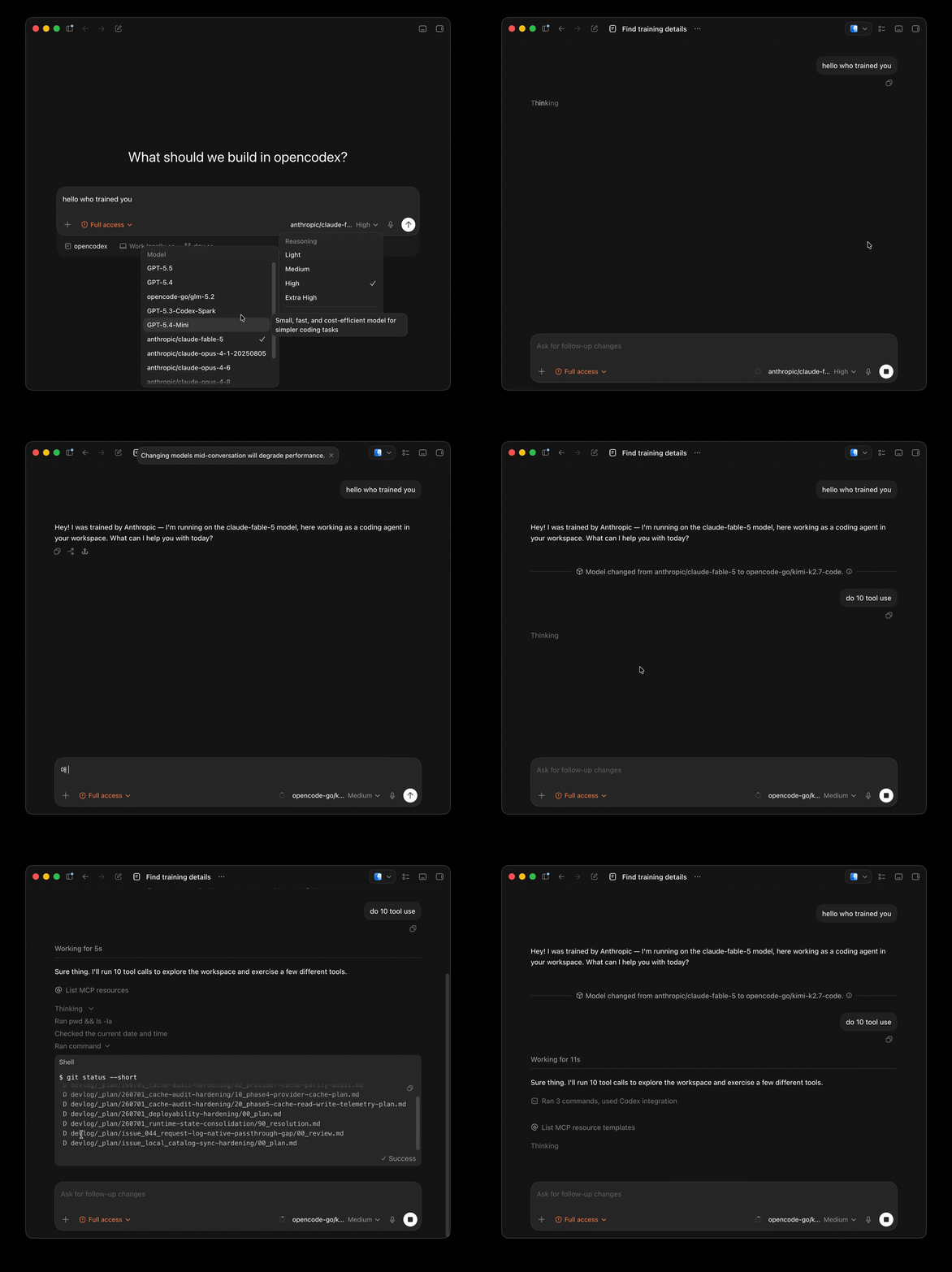
Universal provider proxy for OpenAI Codex & Claude Code — use any LLM (Claude, Gemini, Grok, DeepSeek, Ollama…) with Codex CLI, App, SDK, and Claude Code

Git-native persistent memory for AI coding agents. Implements Google OKF v0.2 with sub-300µs in-memory BM25 search, embedded MCP server, and progressive disclosure. Slashes token bloat by 80% with zero external databases or dependencies. Built in pure Go.

Local-first code intelligence graph for MCP and CLI. Builds a persistent map of your codebase so AI coding tools read only what matters, with benchmarked context reductions on reviews and large-repo workflows.

Stop your AI from making things up — it proposes, deterministic tools decide, every claim checked against ground truth with evidence. Grounded facts and context survive resets. Reverse engineering is the proving ground. MCP server + CLI.