


affaan-m/
ECC

affaan-m/ECCHarnesses
The agent harness performance optimization system. Skills, instincts, memory, security, and research-first development for Claude Code, Codex, Opencode, Cursor and beyond.
258k
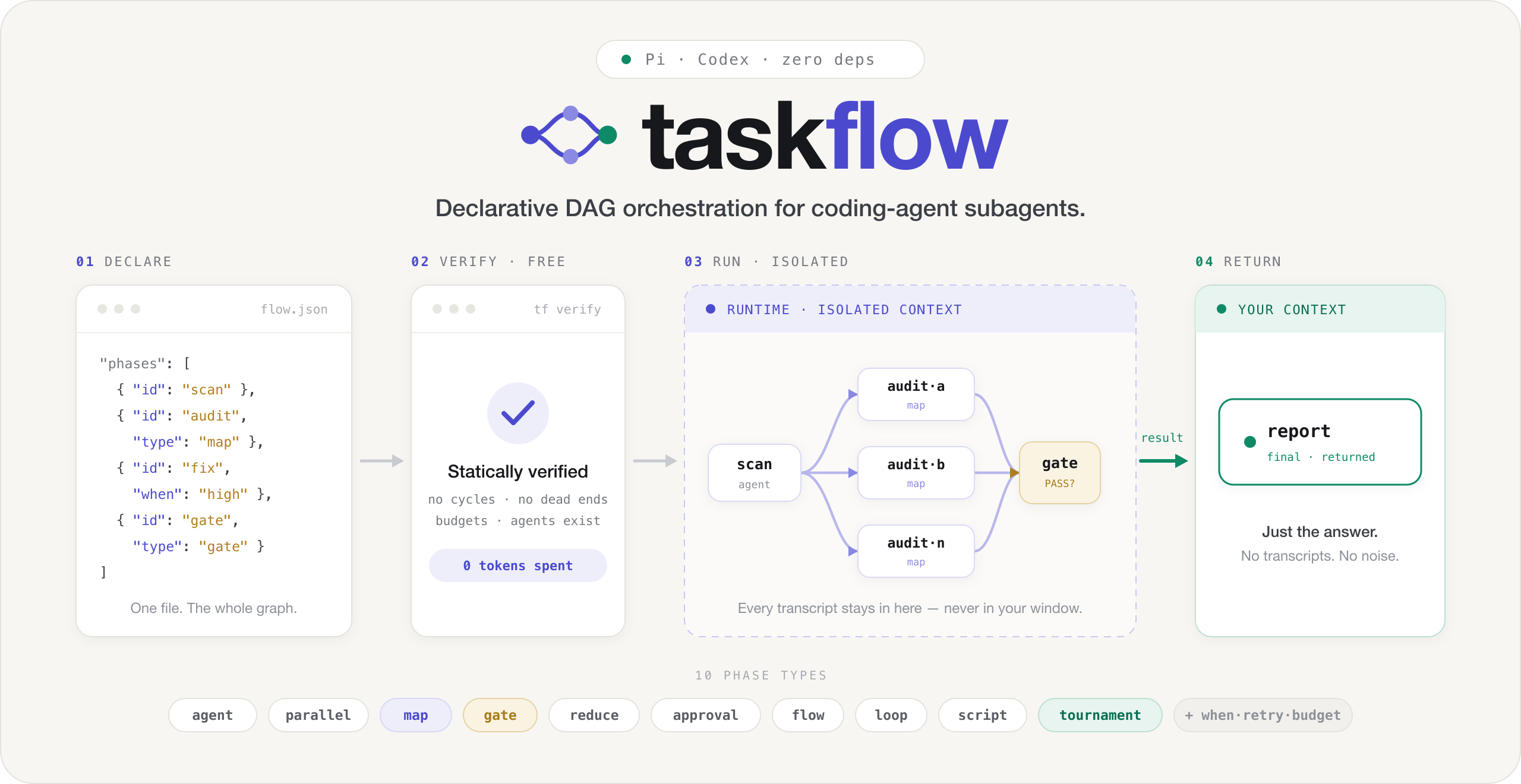
taskflow turns a flow definition into a verified execution contract for coding agents. It compiles JSON or TypeScript DSL into FlowIR, runs phases with isolation and budgets, and keeps intermediate work inside the runtime unless you inspect it. It also adds resume, replay, recompute, trace, and declared filesystem effects. Host adapters and MCP tools let Pi, Codex, Claude Code, OpenCode, Grok Build, and Hermes use the same flow contract.
Builders who want their agent runs to follow a checked workflow instead of ad hoc prompts.
You can run multi-agent coding flows with replayable steps, isolated work, and checked side effects.
Turns JSON or `.tf.ts` flows into canonical FlowIR and checks the graph before it runs.
Executes agent, script, gate, approval, flow, loop, tournament, race, and expand phases with dependencies and budgets.
Restarts from saved state, replays prior runs, and finds the smallest affected frontier after changes.
Validates `effects[]` declarations, tracks file targets, and explains why an effect was allowed or rejected.
Ships adapters for Pi, Codex, Claude Code, OpenCode, Grok Build, and Hermes Agent.
Offers runtime tools like `taskflow_plan`, `taskflow_verify`, `taskflow_trace`, and `taskflow_recompute`.
git clone https://github.com/heggria/taskflow.git
cd taskflow
git checkout rc/0.3.0-trusted-effects
pnpm install
pnpm run typecheck
pnpm test
npm install --global pi-taskflow@beta
npm install --global codex-taskflow@beta
pnpm exec node --conditions=development --experimental-strip-types --test \
  packages/taskflow-core/test/effects-e2e-fixture.test.ts
taskflow is a declarative runtime for coding-agent workflows. It turns a graph into a verifiable execution contract, runs phases in isolation, and keeps intermediate work out of the host conversation. In the 0.3 candidate, the contract also describes the effects a phase is allowed to propose.
Status: 0.3.0-beta.1.2 Trusted Effects beta — beta channel, not GA. This release candidate is prepared for npm's
betachannel; the beta ships the Trusted Effects MVP described below. The 0.3-C Control Plane remains a follow-on candidate track; it is not a shipped beta surface.
An agent can propose content. It should not become the mutation authority merely because it can run a command.
For admitted, declared filesystem-write targets, taskflow 0.3 makes the path explicit and routes the final mutation through the resources transaction:
flow / .tf.ts
       │
       ▼
  validate + verify ──► EffectIR + FlowIR hash
       │                         │
       │                         ▼
       │                 admit declared targets
       │                         │
       ▼                         ▼
  isolated phase ───────► stage → commit | restore + reject
                                      │
                                      ▼
                          ledger-backed why-effect
This is not an OS sandbox. Resolve-only hosts cannot prevent every write to an undeclared path. Secret and service references are typed and fail closed in this cut; they do not imply a vault or network backend.
| Layer | What it does | Candidate status |
|---|---|---|
| Taskflow runtime | Declarative DAGs, 12 phase types, budgets, retries, approvals, isolation, resume, replay, trace, and recompute | Existing 0.2 foundation |
| Trusted Effects | Closed EffectIR, PathRef / SecretRef / ServiceRef, confidentiality/integrity labels, effect validation, overlap checks, and ledger-backed why-* explainers | 0.3 MVP implementation |
| Resource transaction | Snapshot → lease → durable intent/permit → stage → commit, or restore and reject | 0.3 MVP implementation |
| Host adapters | Pi, Codex, Claude Code, OpenCode, Grok Build, and Hermes Agent use the same flow contract | Existing host surface; support remains host-specific |
| Control Plane | ControlHost scaffold, proposed wire contracts, singleton/fencing, and hello negotiation; future stores, approvals, receipts, and coordination | Active 0.3-C track; not shipped and not the 0.3 MVP GA claim |
| WebUI | Runs, approvals, receipts, and evidence browsing | Planned in the 0.3-C sequence; not shipped in this candidate |
The normative MVP definition is docs/internal/0.3.0-trusted-effects-mvp.md. The 0.3-C Control Plane plan is docs/internal/0.3-c-control-plane-plan.md.
The 0.3 beta can be installed from npm, or exercised from a clean source checkout. Use Node.js ≥ 22.19.0:
git clone https://github.com/heggria/taskflow.git
cd taskflow
git checkout rc/0.3.0-trusted-effects
pnpm install
pnpm run typecheck
pnpm test
The beta commands below become usable after the tag workflow completes; until then they are release-target examples, not proof of registry availability.
npm install --global pi-taskflow@beta
npm install --global codex-taskflow@beta
The host-specific plugin and MCP commands remain in the host guides. Stable 0.2.x installs remain available through exact stable pins.
Run the no-LLM Trusted Effects vertical-slice fixture:
pnpm exec node --conditions=development --experimental-strip-types --test \
  packages/taskflow-core/test/effects-e2e-fixture.test.ts
This exercises the checked-in examples/trusted-effects-write.json path without a live LLM. For an interactive run, use the host guide for the adapter you already run. The stable 0.2 installation path remains documented separately in the host guides.
Effects are part of the flow contract, not a free-form prompt promise:
{
  "name": "trusted-effects-write",
  "phases": [
    {
      "id": "write-report",
      "type": "script",
      "run": ["node", "scripts/render-report.mjs"],
      "effects": [
        {
          "id": "report",
          "kind": "fs.write",
          "purpose": "write final report",
          "target": {
            "kind": "path",
            "path": {
              "workspace": "project",
              "subpath": { "literalPath": "out/report.md" },
              "intent": "create-file"
            }
          },
          "confidentiality": "internal",
          "integrity": "project"
        }
      ],
      "final": true
    }
  ]
}
The declaration is not authorization by itself. The runtime resolves the PathRef, checks labels and overlaps, records the resource intent, and only then permits the transaction to stage and finalize the declared target. taskflow_why_effect explains the resulting authorization and ledger state without model calls.
The 0.2 runtime remains the foundation. A flow can be authored as portable JSON or compiled from TypeScript DSL to FlowIR:
JSON / .tf.ts
      │
      ▼
validate → Taskflow JSON → FlowIR + content hash
                                  │
                                  ▼
                         isolated DAG runtime
                                  │
                   resume · replay · recompute · trace
                                  │
                                  ▼
                         finalOutput to the host
| Family | Phases | Use them for |
|---|---|---|
| Work | agent · parallel · map · reduce · script | Single tasks, static concurrency, dynamic fan-out, aggregation, and zero-token shell steps |
| Control | gate · approval · flow · loop | Quality decisions, human checkpoints, composition, and iterative refinement |
| Selection | tournament · race | Best-of-N quality or first-success latency |
| Dynamic graph | expand | Validate and execute a runtime-produced nested or grafted fragment |
Across those phase types, the runtime provides shared behavior: dependencies, conditions, retries, timeouts, output contracts, budgets, workspace isolation, explicit final-output selection, and persistence for resume. Each phase kind accepts only the fields that are safe and meaningful for it.
Useful zero-token operations include:
| Operation | Question it answers |
|---|---|
taskflow_plan | What will run, what arguments bind, and what is the worst-case agent-call bound? |
taskflow_verify / taskflow_compile | Is the graph structurally valid and what is its canonical form? |
taskflow_trace / taskflow_replay | What happened, or what would a zero-token what-if replay decide? |
taskflow_why_stale / taskflow_recompute | What changed and what is the smallest affected frontier? |
taskflow_why_effect | Why was a declared effect allowed, staged, committed, rejected, or left unknown? |
taskflow_analytics | How have recent runs behaved? |
The MCP surface currently exposes 20 tools. Intermediate transcripts remain inside the runtime unless you explicitly inspect them with peek or trace; the host normally receives only finalOutput.
The same flow contract can be delivered through six coding-agent hosts:
/tf commands, live run views, and interactive approvals.Host support is not a blanket security guarantee. Read the host support baseline and the Trusted Effects documentation before enabling mutating phases.
effects[] is a declaration and validation surface; it is not ambient authority.SecretRef and ServiceRef are typed handles only; no vault or live service adapter ships in this cut.pnpm install
pnpm run typecheck
pnpm test
pnpm run build
pnpm run build:website
pnpm run test:pack
The monorepo contains the host-neutral taskflow-core, Trusted Effects and resources code, the taskflow-control 0.3-C contract package, the TypeScript DSL, MCP/host adapters, examples, and the website. See AGENTS.md for architecture and coding conventions.
| Start here | Use it for |
|---|---|
| 0.3 overview | Candidate scope, status, and the honest security boundary |
| Getting Started | First flow and host setup |
| Core Concepts | DAGs, isolation, verification, resume, and evidence |
| Compiler & Runtime | JSON, TypeScript DSL, FlowIR, replay, and recompute |
| Host Guides | Pi, Codex, Claude Code, OpenCode, Grok, and Hermes |
| Examples | Runnable flow definitions, including Trusted Effects |
| Changelog | Release history and candidate notes |
Declare the effect. Verify the path. Commit through one authority.
Sign in to join the discussion.
No comments yet. Be the first to say what this is good for.
The agent harness performance optimization system. Skills, instincts, memory, security, and research-first development for Claude Code, Codex, Opencode, Cursor and beyond.
from vibe coding to agentic engineering - practice makes claude perfect
🌊 The original agent meta-harness. Deploy intelligent multi-player swarms, coordinate autonomous workflows, and build conversational AI systems. Features adaptive memory, self-learning intelligence, RAG integration, and native Claude Code / Codex / Hermes and many more Integrated
Practical patterns, starters & CLI tools for loop engineering with AI coding agents. Design systems that prompt and orchestrate agents (inspired by Addy Osmani and Boris Cherny). Includes loop-audit, loop-init, loop-cost.

Git. Ship. Done - Core

The most RAM efficient harness