sparkplug604/
praxis

sparkplug604/praxisFrameworks & SDKs
Turn scattered knowledge, operational data, and history into source-linked context that your agents can inspect, explain, and reuse.
56
Turn scattered knowledge, operational data, and history into source-linked context that your agents can inspect, explain, and reuse.

Persistent memory graph for AI agents. Facts, decisions, entities, and relationships that survive across sessions, tools, and providers. MCP server — works with Claude, Cursor, ChatGPT, and any MCP client.

Turbocharge Claude Code, Cursor, Codex, Gemini & every coding agent: faster, cheaper, with contextual understanding specific to your codebase.
The OKF toolkit for Claude Code — author, maintain, validate & visualize Open Knowledge Format bundles. Plugin, agent skills, and a GitHub Action.

Open-source memory and context for user-aware agents: scoped memory, provenance, retrieval quality, correction, boundaries, evals, and MCP/HTTP access.

🧠 RepoBrain (formerly Antigravity) — Give your repo a brain. ChatGPT for your codebase: works in Claude Code, Cursor, Codex, Windsurf & more.

OKF (Open Knowledge Format) — curated catalog of tools, plugins, skills, proposals, and docs for agent-friendly knowledge. YAML-driven, agent-searchable, MCP-ready.

Persistent memory for AI coding agents: automatic capture, explainable recall, knowledge consolidation, privacy controls, and portable offline storage. One Python file, zero dependencies.

Open-source local-first cognitive memory. AGM-compliant belief revision (49/49 postulates). When a fact changes, downstream beliefs are automatically re-evaluated, not just flagged.

Local-first AI PKM for coding conversations: import Claude Code/Cursor/Codex, distill notes, semantic search, tag graph, MCP memory.

open source grok bot. gawk bots automate your menial work via AI models and build you microapps to manage the outcome, so that you have a false sense of control.

Local-first persistent agentic memory powered by Recursive Memory Harness (RMH). Open source must win.

Local-first code intelligence graph for MCP and CLI. Builds a persistent map of your codebase so AI coding tools read only what matters, with benchmarked context reductions on reviews and large-repo workflows.

Cognitive memory database for AI agents — consolidates duplicates, detects contradictions, fades stale memories via temporal decay. Rust, Apache-2.0, ships as library / MCP server / HTTP cluster.

Ontology-based MCP server that analyzes database schemas (PostgreSQL, Snowflake, ClickHouse, Dremio) and generates RDF/OWL ontologies with SQL mappings for fan-trap-free Text-to-SQL.

AI-native ontology engine: a Rust MCP server with tools for building, validating, querying, and reasoning over RDF/OWL ontologies. In-memory Oxigraph triple store, native OWL2-DL tableaux reasoner, SHACL validation, SPARQL, versioning. Single binary, no JVM.

Deterministic, local-first memory and guardrails for AI coding agents with no LLM in the hot path.

Human-like memory for AI agents — semantic, episodic & procedural. Experience-driven procedures that learn from failures. Free API, Python & JS SDKs, LangChain, CrewAI & OpenClaw integrations.

A universal, industry-neutral taxonomy of cognitive core skills (perception, memory, reasoning, planning, action, verification, learning, governance) for LLMs, SLMs, AI agents, and world models — with schemas, 159 skill cards, benchmarks, and CI.

Omnia Vault - the all-in-one project brain: an Obsidian LLM wiki, Graphify code graphs, a living plan that triages new videos against itself, and a Claude Code ⇄ Codex relay. Everything your project knows, in one clonable vault.

The open-source memory and observability layer for AI agents — persistent memory, loop detection, hash-chained audit trails, and a live dashboard, automatic on pip install.
Neo.mjs is a self-evolving software organism: a professional end-to-end AI engineering team whose cross-model swarm inhabits live apps via Neural Link, Active Hybrid GraphRAG, DreamService, and self-healing loops.
Structural memory for AI coding agents. Bi-temporal graph, MCP-native, zero LLM calls. Cursor · Claude Code · Codex · DeepSeek Harness · Hermes · VS Code · Windsurf.
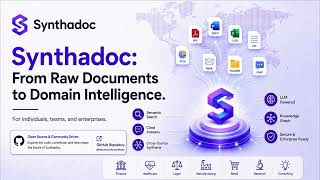
Synthadoc: An open-source LLM knowledge compilation engine that turns raw documents into structured, local-first wikis. A transparent, human-readable alternative to traditional RAG, which can be self-managed and self-improved without the use of any tools.