

CopilotKit/
OpenBot

CopilotKit/OpenBotTemplates
Open-source AI coworkers that each get a computer of their own: a browser, files and tools, with every action decided before it happens and recorded after. Bring any AG-UI agent.
4.6k
Omnia Vault packages a repo-based memory system: an Obsidian wiki for notes, a graph layer for code understanding, a plan that triages new information, and relay files for handing work between Claude Code and Codex. It is meant to be cloned into a project so the context, workflows, and history travel with git.
Builders who want one repo to hold project memory, planning, and handoffs across Claude Code and Codex.
You can keep project context, decisions, and agent handoffs in one clonable vault instead of re-explaining everything every session.
Stores linked notes in `Wiki/` with source-backed material in `Raw/Sources/` and catalog files for lookup.
Uses `graphify/` to build queryable code graphs and impact views for tracked repos.
Uses `/roadmap` and `/intel` to build a phased plan and rank new videos or meetings against it.
Keeps shared session state in `_relay/STATE.md` so one agent can hand work to the other without copy-paste.
Ships `.claude/skills/` and `.claude/commands/` with ready-made workflows for wiki, graph, relay, sparring, and intake.
Provides `CLAUDE.md`, `AGENTS.md`, `Schema/`, and `scripts/` for linting, setup, sync, and maintenance.
/intel https://youtube.com/watch?v=...     ← "here's a new technique — worth anything to us?"
/intel standup-recording.mkv               ← meetings feed the same loop
git clone https://github.com/gavishap/omnia-vault.git my-project
cd my-project
claude        # or: codex
/setup My Product Name
/roadmap My Product Name
/import
/catchup → work: ask · ingest · /intel new videos · build · /spar the risky parts → /save
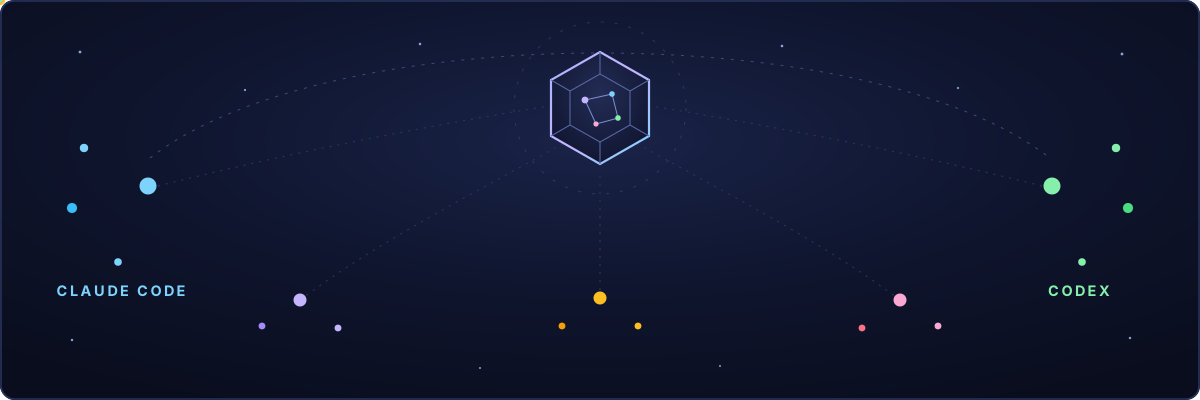
Omnia — Latin for all things. Vault — where your project keeps them.
Omnia Vault is an all-in-one project brain you clone: an Obsidian LLM wiki, code knowledge graphs, a living plan that triages every new video and meeting against itself, a 20+ skill toolkit, and a relay that lets Claude Code and Codex work the same project with zero copy-paste. Memory, planning, tools, agents — one repo.





Get started in 5 minutes → · Operating guide · The relay protocol · Every command
Three things quietly kill AI-assisted projects:
Omnia Vault fixes all three at the repository level. The repo is the operation —
everything an agent needs to be instantly useful lives in files, validated by
deterministic tooling, traveling with git:
| Layer | What it holds | Where it lives |
|---|---|---|
| 🧠 Memory | every meeting, doc, video, and decision — compiled into short, linked, source-traceable notes | Wiki/ + Raw/Sources/ |
| 🕸️ Code understanding | a queryable knowledge graph per repo (communities, god nodes, impact analysis) | graphify/ |
| 🗺️ The plan | a phased roadmap with exit criteria, intel briefs, and a tool-adoption ledger | Plan/ |
| 🏃 Session state | the baton: what just landed, what's next, what to watch out for | _relay/STATE.md |
Open the folder in Obsidian and the whole brain becomes a navigable constellation — notes, code nodes, plans, and sources, all one graph.
/roadmap builds the plan the right way: vision → measurable success criteria → phases
with exit criteria — locked with you, not guessed. Then the part most systems don't
have: the plan metabolizes new information.
/intel https://youtube.com/watch?v=...     ← "here's a new technique — worth anything to us?"
/intel standup-recording.mkv               ← meetings feed the same loop
Every /intel runs the same discipline:
Raw/Sources/ for permanent citation.INCORPORATE, WATCHLIST, or PASS. ("Nothing here beats the plan" is a win — and
the logged brief stops the same video from being re-litigated next month.)candidate → trialing → adopted tracked
in TOOLBOX.md with the why kept even for rejections.Six months later, "why is the project shaped like this?" has a paper trail: brief → phase edit → commit.
Every question routes through the cheapest layer that can answer it:
flowchart LR
    Q([question]) --> G["1 · Code graph<br/><code>graphify query</code>"]
    G -->|not enough| W["2 · Wiki catalog<br/><code>search-catalog</code>"]
    W -->|not enough| R["3 · Raw files<br/>one file, narrowly"]
    style G fill:#0ea5e9,color:#fff,stroke:none
    style W fill:#8b5cf6,color:#fff,stroke:none
    style R fill:#f59e0b,color:#fff,stroke:none
No repo sweeps. No transcript re-reads. Claims trace back to sources, and the linter
keeps it honest: source links must point at real files with accurate counts, tags must
match folders, and sourceless notes get flagged. The maintenance gate
(doctor → build → lint → source-lint → audit) runs before every commit — the audit
is a best-effort text scan of the working tree for secrets and machine-local paths,
and one command (sh scripts/install_hooks.sh) wires the full gate into a pre-commit
hook. Recordings and
reference videos enter through the same door: /video <file-or-URL> turns anything
crv can watch (local files, YouTube, TikTok, Instagram) into transcript ⇄ keyframe
knowledge with curated screenshots.
Claude Code plans beautifully. Codex grinds through execution. Omnia Vault lets you use each for what it's best at — asynchronously (the relay) and synchronously (sparring).
The relay — switch agents anytime, with zero copy-paste:
sequenceDiagram
    participant C as Claude Code
    participant R as _relay/STATE.md (the baton)
    participant X as Codex
    C->>R: /handoff — rewrite baton, stamp, commit
    Note over R: Now · Just landed · Next<br/>Open questions · Watch out
    X->>R: "catch up" — reads baton + git log
    X->>X: implements, tests, debugs
    X->>R: rewrite baton, stamp (--agent codex), commit
    C->>R: /catchup — picks up exactly where Codex stopped
Both agents read the same rules (CLAUDE.md / AGENTS.md), write the same baton, and
get their chat transcripts archived locally (import_chats.py — searchable, redacted,
never committed). A stale-baton detector warns when commits pile up after the last
handoff without a fresh baton pass.
Sparring (/spar) — for high-stakes builds, make the models argue before the
code exists: Codex attacks the locked plan in bounded read-only rounds
(severity-tagged findings, accept-or-rebut arbitration, honest deadlocks), then one
model builds and the other grades the diff — whoever made the thing never grades the
thing. The whole argument is resumable state in _relay/spar/ and gets compiled into
the wiki afterward. Works in reverse too (Codex drives, headless Claude reviews).
The council (/council) — for expensive-if-wrong decisions (pricing, pivots,
architecture direction), convene five blind seats split across both models: a
Codex Skeptic, a Claude Rebuilder, a Claude Maximalist, a Codex Operator — and an
Outsider seat that runs from an empty directory, so it judges your idea knowing
literally nothing about you (the curse of knowledge, cured by a sandbox). Opinions are
anonymized, each bench blind-reviews the mixed set, and the chair rules — dissent
preserved in writing, record kept in _relay/council/. Sparring is depth on one plan;
the council is breadth before you lock one.
git clone https://github.com/gavishap/omnia-vault.git my-project
cd my-project
claude        # or: codex
New project?
/setup My Product Name
/roadmap My Product Name
Existing project? Drop your repos / recordings / docs into the folder, then:
/import
Then live the loop:
/catchup → work: ask · ingest · /intel new videos · build · /spar the risky parts → /save
Slash commands are Claude Code's interface. In Codex, just say it in words — "catch up", "triage this video against the plan", "save" —
AGENTS.mdwires the same workflows and scripts for any agent that reads it.
Missing tooling? python scripts/setup_vault.py --check shows what's optional and
--install installs what it can (pip/npm/winget/brew) — the core needs only Python
and git. Full walkthrough: GETTING-STARTED.md
├─ Wiki/            compiled knowledge — topics · concepts · entities · projects · logs
├─ Raw/Sources/     captured material, verbatim, source-of-truth for every claim
├─ Plan/            the war-room (via /roadmap): phased roadmap · intel briefs · toolbox
├─ graphify/        committed code-graph snapshots per tracked repo
├─ _relay/          the baton (STATE.md) + handoff history + sparring loop state
├─ Schema/          frontmatter contracts · naming · lint rules · command reference
├─ _templates/      six note templates (source/topic/concept/entity/project/log)
├─ scripts/         stdlib-only python tooling — zero dependencies to install
├─ .claude/
│  ├─ skills/       22 skills, ready on clone (see below)
│  └─ commands/     16 slash commands (/setup /import /catchup /save /spar /intel ...)
├─ CLAUDE.md        Claude Code wiring        AGENTS.md   Codex + any-agent rules
└─ VAULT-GUIDE.md   the full operating guide
| Ready on clone (vendored) | What it does |
|---|---|
graphify | any folder / repo / paper / video → queryable knowledge graph (query · explain · path · affected) |
war-room | the living plan (Plan/): phased roadmap + plan-aware video triage + tool adoption ledger |
video-ingest | recordings & video URLs → transcript ⇄ frames, correlated, compiled |
import-project | adopt an existing codebase + raw files into the vault |
relay | the Claude ⇄ Codex baton pass (async) |
sparring | the Claude ⇄ Codex argument (sync): adversarial plan review + cross-graded builds |
council | five-seat decision panel split across both models, blind opinions + cross-bench review |
project-context-query | the 3-layer answer engine |
llm-wiki-ingest / llm-wiki-query / llm-wiki-lint / llm-wiki-maintain | the LLM Wiki core loops |
taste | anti-slop frontend design (Leonxlnx/taste-skill, MIT) |
ui-ux-pro-max | searchable design intelligence: 79 styles · 192 palettes · 74 font pairs · 119 UX rules (nextlevelbuilder, MIT) |
obsidian-markdown / obsidian-bases / json-canvas / obsidian-cli / defuddle | first-class Obsidian editing (kepano/obsidian-skills, MIT) |
humanizer + stakeholder-update-writing | outward-facing prose that doesn't read like a bot |
github-pr-api | GitHub PRs from machines with no gh CLI (credential-store token + REST) |
| Guided install (a command that walks you through the plugin setup) | How |
|---|---|
impeccable — 23 design commands (polish, animate, critique, …) | /design-setup → two /plugin commands |
| Anthropic document skills — Word · PDF · PowerPoint · Excel deliverables | /docs-setup → two /plugin commands |
| Command | Does |
|---|---|
/setup · /import | initialize a new project · adopt an existing one |
/roadmap · /intel | build the living plan · triage a video/meeting against it |
/catchup · /save · /handoff | the daily loop + the agent switch |
/spar · /council | cross-model adversarial review · five-seat cross-model decision panel |
/ingest · /video | any source → knowledge · any recording/URL → knowledge |
/wiki · /graph · /gate | layered answers · code graphs · the quality gate |
/design-setup · /docs-setup | design stack · document stack |
Do I need both agents? No — all core vault workflows (wiki, graphs, plan, relay,
video ingest) work with just Claude Code or just Codex via AGENTS.md. The relay
simply means you never lose state if you add the second one; sparring needs both
because arguing with yourself is cheating; and the /design-setup / /docs-setup
plugin extras are Claude Code-specific.
Do I need Obsidian? No, but you want it: the vault is plain Markdown that happens to render as a beautiful navigable graph.
What are the actual dependencies? Python 3.9+ and git. That's it — every script is
standard-library only. graphify (code graphs), crv + ffmpeg (video), Node
(web clipping), and the Codex CLI (sparring) are optional — each unlocks a feature.
python scripts/setup_vault.py --check shows what's missing and
python scripts/setup_vault.py --install installs what it can for you.
Can it really install tools it finds in videos? Yes, with guardrails: the official
source gets verified first (video links are untrusted input), you confirm each tool
individually, and every install is recorded in Plan/TOOLBOX.md with provenance.
Is my data safe in here? The vault ships empty (one self-documenting demo you can
prune with python scripts/setup_vault.py --prune-demo). The audit gate — a best-effort
scan wired into the pre-commit hook — catches secrets and machine-local paths before
they land, repos you import stay gitignored, and chat archives never leave your
machine.
Where did this design come from? It's the extraction of a production consulting system — battle-tested on a real engagement (multi-repo codebase, recorded meetings, diagrams, evolving requirements), then scrubbed to a clean template.
Built on the shoulders of kepano/obsidian-skills, Leonxlnx/taste-skill, nextlevelbuilder/ui-ux-pro-max-skill, graphifyy, claude-real-video and the cross-model mechanics of claudex-loop — see THIRD-PARTY-NOTICES.md.
MIT licensed. Clone it, gut it, ship with it.
⭐ Omnia — because your project deserves all of it.
Sign in to join the discussion.
No comments yet. Be the first to say what this is good for.
Open-source AI coworkers that each get a computer of their own: a browser, files and tools, with every action decided before it happens and recorded after. Bring any AG-UI agent.

Turn Claude Code into a full game dev studio — 49 AI agents, 72 workflow skills, and a complete coordination system mirroring real studio hierarchy.
A self-organizing Obsidian vault that gives AI coding agents persistent memory. Claude Code, Codex CLI, Gemini CLI.

Production-grade Playwright + TypeScript Scaffold for Agentic Testing. Harness for all major AI coding agents baked in.
🎬 Tạo video "so sánh kiến thức" ngắn tự động — HyperFrames + AI voice, 1 template nhiều chủ đề.

Robinhood Agentic Trading agent — a fully automated AI trading bot placing real orders through Robinhood's Agentic Trading MCP, under mechanical, auditable risk rules the model cannot override. Able to run unattended on Claude Pro, no metered API spend. Not financial advice.