Corbell-AI/CorbellTools
AI-powered spec generation and review using multi-repo code graph intelligence for backend teams that ship to production.
626
AI-powered spec generation and review using multi-repo code graph intelligence for backend teams that ship to production.

A bio-inspired cognitive memory engine — a new paradigm for Graph RAG.
Graph-vector database that queried 1 billion edges for $2.50. Rust, OpenCypher, vector search, 14 graph algorithms. 74M nodes / 1B edges on a single machine.

A Model Context Protocol (MCP) server that implements the Zettelkasten knowledge management methodology, allowing you to create, link, explore and synthesize atomic notes through Claude and other MCP-compatible clients.

Self-hosted AI agent memory server with MCP, evidence provenance, typed claims, conflict detection, embeddings, recall, PostgreSQL, and pgvector
Give your AI agents persistent, collective memory — with deduplicating absorb, supersession lineage, semantic search, and a graph UI. Speaks MCP.

Turn scattered knowledge, operational data, and history into source-linked context that your agents can inspect, explain, and reuse.

Persistent memory graph for AI agents. Facts, decisions, entities, and relationships that survive across sessions, tools, and providers. MCP server — works with Claude, Cursor, ChatGPT, and any MCP client.
The OKF toolkit for Claude Code — author, maintain, validate & visualize Open Knowledge Format bundles. Plugin, agent skills, and a GitHub Action.

Open-source memory and context for user-aware agents: scoped memory, provenance, retrieval quality, correction, boundaries, evals, and MCP/HTTP access.

OKF (Open Knowledge Format) — curated catalog of tools, plugins, skills, proposals, and docs for agent-friendly knowledge. YAML-driven, agent-searchable, MCP-ready.

Open-source local-first cognitive memory. AGM-compliant belief revision (49/49 postulates). When a fact changes, downstream beliefs are automatically re-evaluated, not just flagged.
Your agent seeks what search can't find. A self-hosted perception MCP server that transcribes speech, reads behind logins, sees images and video frames, crosses languages, and remembers.

Local-first persistent agentic memory powered by Recursive Memory Harness (RMH). Open source must win.
An always-on second brain you talk to. Voice notes in Telegram → typed, linked knowledge in your Obsidian vault. Runs 24/7 on the Claude subscription you already have.

Cognitive memory database for AI agents — consolidates duplicates, detects contradictions, fades stale memories via temporal decay. Rust, Apache-2.0, ships as library / MCP server / HTTP cluster.

Ontology-based MCP server that analyzes database schemas (PostgreSQL, Snowflake, ClickHouse, Dremio) and generates RDF/OWL ontologies with SQL mappings for fan-trap-free Text-to-SQL.

AI-native ontology engine: a Rust MCP server with tools for building, validating, querying, and reasoning over RDF/OWL ontologies. In-memory Oxigraph triple store, native OWL2-DL tableaux reasoner, SHACL validation, SPARQL, versioning. Single binary, no JVM.

Deterministic, local-first memory and guardrails for AI coding agents with no LLM in the hot path.

A universal, industry-neutral taxonomy of cognitive core skills (perception, memory, reasoning, planning, action, verification, learning, governance) for LLMs, SLMs, AI agents, and world models — with schemas, 159 skill cards, benchmarks, and CI.

Omnia Vault - the all-in-one project brain: an Obsidian LLM wiki, Graphify code graphs, a living plan that triages new videos against itself, and a Claude Code ⇄ Codex relay. Everything your project knows, in one clonable vault.

The open-source memory and observability layer for AI agents — persistent memory, loop detection, hash-chained audit trails, and a live dashboard, automatic on pip install.
Neo.mjs is a self-evolving software organism: a professional end-to-end AI engineering team whose cross-model swarm inhabits live apps via Neural Link, Active Hybrid GraphRAG, DreamService, and self-healing loops.
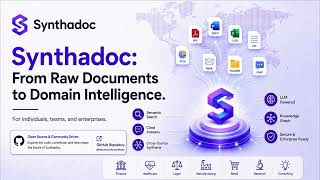
Synthadoc: An open-source LLM knowledge compilation engine that turns raw documents into structured, local-first wikis. A transparent, human-readable alternative to traditional RAG, which can be self-managed and self-improved without the use of any tools.