
koala73/worldmonitorConnectors
Real-time global intelligence dashboard. AI-powered news aggregation, geopolitical monitoring, and infrastructure tracking in a unified situational awareness interface
86k
Dense-Mem gives agents a durable memory layer with evidence staging, typed claims, conflict detection, and support-gated recall. It keeps PostgreSQL as the authority, exposes the memory contract at `/mcp`, and adds browser portals for administration and review.
Builders who want an agent memory service they can self-host and plug into MCP clients.
You can let your agent store and recall durable evidence without re-explaining the same context every session.
Exposes `remember`, `recall_memory`, `retract_evidence`, `correct_relationship`, and `trace_memory` over Streamable HTTP at `/mcp`.
Stages exact evidence, keeps append-only lifecycle history, and preserves provenance instead of overwriting records.
Validates Entity, Value, and Relationship proposals with server policy before committing durable state.
Returns active evidence contexts only when the relationship support path is eligible for the requested view.
Uses PostgreSQL as the durable authority for knowledge, lifecycle, provenance, search, authorization, and audit.
Includes evaluation-only tools and compose files for replaying recall and dream-cycle cases.
MCP:            http://127.0.0.1:8080/mcp
User portal:    http://127.0.0.1:8080/ui
Control portal: http://127.0.0.1:8090/
ollama pull nomic-embed-text
ollama pull llama3.1:8b
AI_API_URL=http://host.docker.internal:11434/v1
AI_API_KEY=ollama
AI_API_EMBEDDING_MODEL=nomic-embed-text
AI_API_EMBEDDING_DIMENSIONS=768
AI_VERIFIER_MODEL=llama3.1:8b
AI_VERIFIER_TIMEOUT_SECONDS=300

Self-hosted MCP memory with durable evidence, explicit lifecycle, and support-gated recall.






Dense-Mem is a standalone HTTP MCP memory server using Streamable HTTP. It stages exact evidence, derives semantic state through validated server policy, and returns active evidence contexts with graph-shaped Relationship handles. PostgreSQL is the durable authority for knowledge, lifecycle, provenance, search, authorization, and audit; Redis is coordination only. A single-node deployment may use process-local coordination; a multi-instance deployment requires Redis or an equivalent distributed coordination implementation.
The host LLM owns conversation and judgment. Dense-Mem owns durable evidence,
owner authorization, lifecycle events, support eligibility, and bounded recall.
The external memory automation contract is MCP at /mcp; browser routes are
first-party interfaces, not an alternative public automation API.
Dense-Mem is part of the research preprint Governed Enterprise AI Memory Beyond RAG: From Vector Retrieval to Permissioned Knowledge Graphs.
Create a temporary isolated team at https://demo-dense-mem.markhuang.ai to test disposable data before self-hosting.
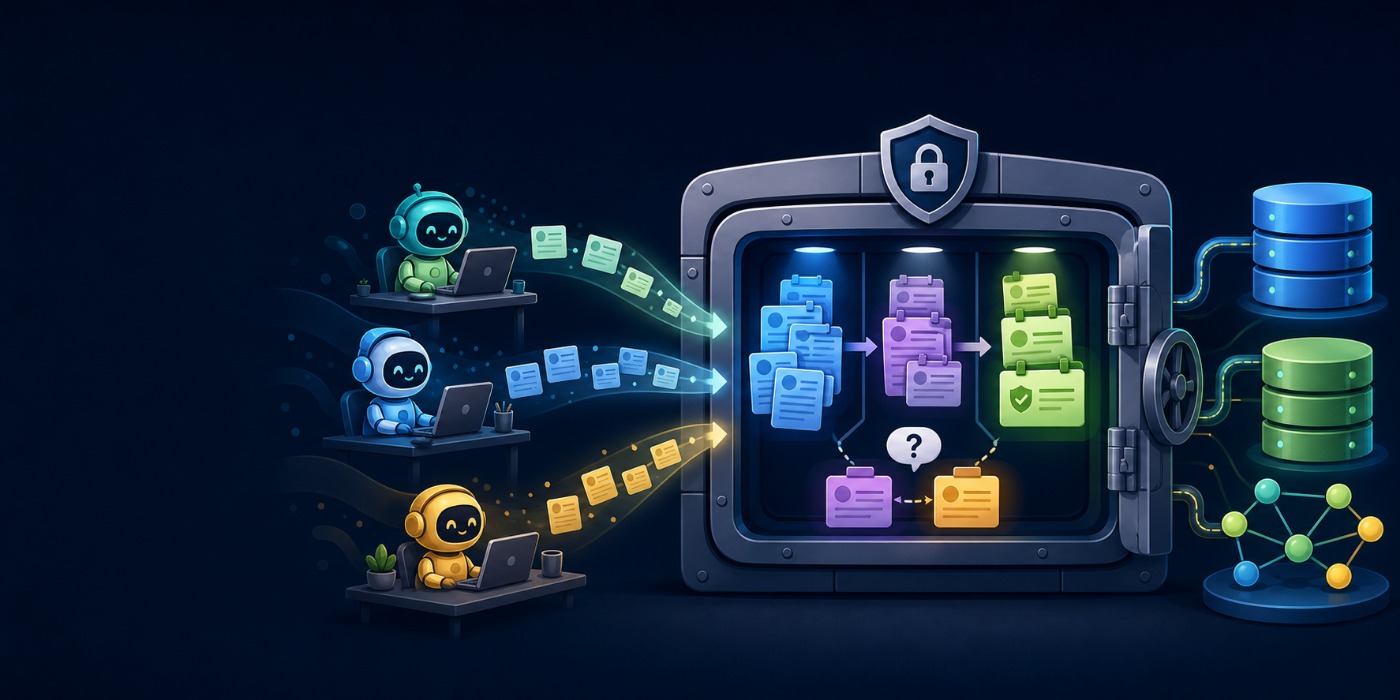
Authentication resolves one immutable actor as team + identity + membership + permanent owner alias + optional credential. An SSO browser session uses the
selected membership's permanent owner alias and has no direct credential. An
API-key request carries a credential whose stable ID is also its permanent
owner alias. Team, identity, membership, and credential fields never let a
client choose or replace the semantic owner.
Download the local compose example and environment template, configure the required secrets, and start Dense-Mem:
mkdir dense-mem-local
cd dense-mem-local

curl -fsSLo docker-compose.yml \
  https://raw.githubusercontent.com/markhuangai/dense-mem/main/examples/docker-compose.base.yml
curl -fsSLo .env.example \
  https://raw.githubusercontent.com/markhuangai/dense-mem/main/examples/.env.example

cp .env.example .env
# Fill in POSTGRES_PASSWORD, CONTROL_PORTAL_TOKEN, and AI_API_KEY.
${EDITOR:-vi} .env

docker compose up -d
The base stack uses PostgreSQL with pgvector as the only durable authority. The v2.6.2 release requires the compatible cutover marker created by the stopped-service migration; it has no legacy database runtime or fallback. The local ports are:
MCP:            http://127.0.0.1:8080/mcp
User portal:    http://127.0.0.1:8080/ui
Control portal: http://127.0.0.1:8090/
Open the control portal with CONTROL_PORTAL_TOKEN, then create a team and its
first credential/API key. For control-plane automation, use the same private
API:
control_token="<CONTROL_PORTAL_TOKEN from .env>"

curl -fsS -X POST http://127.0.0.1:8090/control/api/teams \
  -H "Authorization: Bearer ${control_token}" \
  -H "Content-Type: application/json" \
  -d '{"name":"primary-memory"}'

curl -fsS -X POST http://127.0.0.1:8090/control/api/teams/<team-id>/credentials \
  -H "Authorization: Bearer ${control_token}" \
  -H "Content-Type: application/json" \
  -d '{"name":"default credential"}'
The release image contains one project executable, /app/server. It applies
pending PostgreSQL migrations under a database session lock before serving, so
the Compose stack does not need a separate migration container. Multiple server
replicas that share one writable primary serialize this startup step. Keep
ordinary rolling-deployment migrations backward compatible with the previous app
version. The v2.6.1 synchronous Remember migration remains the stopped-service
boundary; v2.6.2 evidence-first activation runs after it. For the v2.6.1
migration, stop every server instance, take the required PostgreSQL snapshot,
and apply the stopped-service boundary before starting the new binary. Independent databases
must each be migrated by a server connected to that database. Administration
stays on the private control portal/API, while dreaming and automatic conflict
review run as server background workers.
The image healthcheck allows the default 30-minute migration window and becomes
active after its first success. If POSTGRES_MIGRATION_TIMEOUT_SECONDS is set
above 1800, override the deployment healthcheck start period to at least the
same duration.
Release candidates use vX.Y.Z-rc.N and demo-vX.Y.Z-rc.N. Stable releases use
vX.Y.Z, latest, and demo-vX.Y.Z; there is no rolling demo tag.
The server requires complete embedding and verifier configuration at
startup: AI_API_URL, AI_API_KEY, AI_API_EMBEDDING_MODEL,
AI_API_EMBEDDING_DIMENSIONS, and AI_VERIFIER_MODEL.
The compose examples provide OpenAI defaults for embeddings; choose the chat
models explicitly in .env.
Verifier and assessor calls send temperature: 0 by default. Set
AI_VERIFIER_DISABLE_TEMPERATURE=true to omit the field for providers or models
that reject temperature.
Any OpenAI-compatible endpoint can provide embeddings and verification. With Ollama running on the Docker host:
ollama pull nomic-embed-text
ollama pull llama3.1:8b
AI_API_URL=http://host.docker.internal:11434/v1
AI_API_KEY=ollama
AI_API_EMBEDDING_MODEL=nomic-embed-text
AI_API_EMBEDDING_DIMENSIONS=768
AI_VERIFIER_MODEL=llama3.1:8b
AI_VERIFIER_TIMEOUT_SECONDS=300
Use host.docker.internal, not 127.0.0.1, because the server calls the
provider from the compose network. AI_API_KEY must remain non-empty because
startup validation requires a complete provider configuration.
AI_VERIFIER_MODEL to a model that exists on the selected chat endpoint.
Startup validates the model configuration before the service accepts memory
writes. A 7B-8B class model works for local smoke tests; larger models can
exceed the default 60-second timeout while they load. Remember runs
synchronously within the request deadline; use the idempotency key to retry
after a client timeout or transient provider failure.remember durably stages exact evidence, completes provider validation and the
semantic commit, then returns a terminal result. The response includes the
owner-scoped processing and search state; it does not expose provider output or
internal run IDs.
Callers submit logical Entity, predicate, and Value proposals rather than text
offsets. remember does not accept span, surface, or relationship supports
fields. Each optional Relationship lists the zero-based evidence_indices that
support it; proposals may be omitted, and their indices do not need to cover every
evidence item. The single assessor session reviews every evidence item for security
and grounds or normalizes only submitted Relationship proposals against their
cited evidence. It never searches memory or discovers Relationships. Closed-schema
validation and deterministic server policy decide what is safe to commit.
Each Relationship may also list up to 20 explicit known_evidence_ids. These UUIDs
are resolved only from evidence visible to the caller and remain read-only assessor
context; they do not receive security results. A stored Relationship must still cite
at least one submitted evidence_indices span. Entity grounding accepts current
canonical or alias names, and a pronoun only when the assessor is given a server-issued
anchor for an earlier exact name span. Inaccessible or stale known evidence leaves the
Relationship unsupported without revealing whether an ID exists. The aggregate known
evidence content in one request is bounded to 20,000 Unicode code points before
assessor boundary expansion; larger requests return input_budget_exceeded. The
current public contract is dense-mem.v2.6.3; dense-mem.v2.6.2 remains accepted
for compatible replays.
To replace a specific current evidence item you own, put its UUID in the new
item's supersedes_evidence_ids. Direct targeting is separate from advancing a
source revision with previous_source_revision; do not combine them.
{
  "evidence": [
    {
      "content": "Dense-Mem now uses PostgreSQL as its only deployment target.",
      "source_type": "manual",
      "supersedes_evidence_ids": ["<owned-current-evidence-uuid>"]
    }
  ],
  "relationships": [
    {
      "ref": "deployment-target",
      "subject": {
        "name": "Dense-Mem",
        "entity_kind": "project"
      },
      "predicate": {
        "proposed_key": "uses_as_only_deployment_target"
      },
      "object": {
        "entity": {
          "name": "PostgreSQL",
          "entity_kind": "product"
        }
      },
      "polarity": "+",
      "evidence_indices": [0]
    }
  ],
  "idempotency_key": "deployment-target-correction-batch-20260729"
}
Direct supersession is staged with the complete batch. The target is retired only inside the accepted semantic transaction; a failed submission leaves it active. This prevents a replacement that never becomes supported memory from invalidating current evidence.
Remember uses one assessor conversation for the complete batch. Every evidence
item receives a security result, including evidence-only submissions. Unsafe
evidence fails the complete batch with submission_policy_rejected and no
semantic, search, or embedding writes. Safe evidence is stored and indexed even
when no Relationship is proposed or accepted. The assessor may ground and
normalize only submitted Relationship proposals against their cited evidence; it
does not search memory, find support for evidence, or discover Relationships.
Every submitted Relationship ref gets a stored or not_stored disposition;
unsupported proposals are completed-result warnings. Exact client-owned changes
after staging are reported as stale_input. Provider, configuration, database,
and internal faults are typed operational failures. All accepted semantic effects
commit atomically, with no partial replacement or interactive placement review.
Remember requires one top-level idempotency_key; evidence-level and derived
keys are not accepted. If a complete batch needs correction, submit the entire
batch again with a new key.
To retract evidence without a replacement, call retract_evidence with owned
current IDs, a bounded reason, and an idempotency key:
{
  "evidence_ids": ["<owned-current-evidence-uuid>"],
  "reason": "The source was withdrawn.",
  "idempotency_key": "withdrawn-source-20260729"
}
Both operations append lifecycle events. They never physically delete evidence
or trace lineage. Current recall excludes retired evidence, while a historical
known_at view before the event can still show what the system knew then.
correct_relationship replaces a specific active Relationship owned by the
caller's permanent owner alias. It does not rewrite or delete the original
record. The caller
supplies the current Relationship version, its exact effective evidence spans,
a bounded reason, and only the endpoints or predicate that need correction:
{
  "action": "submit",
  "relationship_id": "<owned-active-relationship-uuid>",
  "expected_version": 1,
  "patch": {
    "object_entity": {
      "entity_id": "<correct-same-team-entity-uuid>"
    }
  },
  "supports": [
    { "evidence_id": "<supporting-evidence-uuid>", "start": 0, "end": 38 }
  ],
  "reason": "The object was resolved to the wrong Entity.",
  "idempotency_key": "relationship-correction-20260808"
}
On acceptance, Dense-Mem atomically supersedes the original Relationship,
creates or reuses the active successor, copies the effective support lineage,
and appends the correction event and corrects cross-reference. A different
owner in the same team may read team-visible memory but cannot correct the
author's Relationship. Ambiguous Entity names require one owner confirmation;
the original remains active until that confirmation succeeds.
recall_memory is evidence-first but support-path gated. Its results[]
contain evidence contexts only after final hydration proves an active,
query-relevant Relationship support path remains eligible for the requested
valid_at and known_at view. Related Relationships, communities, and
Hypotheses are separate bounded fields; candidates and Hypotheses are not
default memory results.
remember evidence (+ optional Entity/Relationship proposals)
        |
        v
durable staging -> validated terminal commit -> active eligible Relationships
        |                                      |
        +-- lifecycle event -------------------+
                                               |
                                               v
                         support-gated evidence recall and trace lineage
Discover the current closed-schema catalog with MCP tools/list; callers do
not select a contract version. The server applies the same scope, feature, and
visibility checks to tools/call.
| Tool | Used by | Registration | Use case and capability |
|---|---|---|---|
remember | Both | Production and evaluation images | Production evidence intake; the harness also imports corpus rows through this real intake path. |
retract_evidence | Production | Production and evaluation images | Retire caller-owned evidence while preserving append-only provenance. |
correct_relationship | Production | Production and evaluation images | Owner-only replacement of an active supported Relationship; supersedes the original and preserves support lineage. |
recall_memory | Production | Production and evaluation images | Recall active evidence contexts and Relationship handles. When enabled features produce an actionable follow-up, the result includes suggested_actions. |
trace_memory | Production | Production and evaluation images | Trace one same-team Relationship through evidence, decisions, and lineage. |
submit_recall_session_feedback | Production | Conditional in both images | Record bounded session-level recall quality feedback. Registered only while recall feedback is enabled. |
list_dreams | Production | Conditional in both images | List reviewable Hypotheses without treating them as memory. Registered only when Dreaming is effective for the authenticated team. |
get_dream | Production | Conditional in both images | Fetch one authorized Hypothesis and its source references under the same team Dreaming gate. |
resolve_dream_feedback | Production | Conditional in both images | Confirm independently supported or refuted Hypotheses; uncertain items remain unresolved. Uses the same team Dreaming gate. |
export_memory_pack | Production | Production and evaluation images | Export selected active Relationships with support provenance. |
eval_list_knowledge_refs | Evaluation harness | Evaluation image only | Page stable team-scoped knowledge references used to map seed documents to stored records. |
eval_run_dream_cycle | Evaluation harness | Evaluation image only | Run an isolated, bounded manual Dream cycle, optionally with seed Hypotheses, for evaluation. |
eval_run_recall_case | Evaluation harness | Evaluation image only | Execute current recall logic and return ranked/context references for deterministic scoring. |
The production release binary is compiled without the evaluation build tag,
so no environment variable or control-panel setting can register evaluation
tools in a live release. The evaluation target adds only the three harness tools
above. eval_get_manifest, eval_get_knowledge_item,
eval_list_recall_feedback_events, eval_get_recall_feedback_event, and
eval_score_retrieval_case are removed because the current harness does not use
them.
When recall feedback is enabled and the feedback snapshot is stored,
recall_memory.suggested_actions points to
submit_recall_session_feedback with the matching recall ID. When effective
team Dreaming is enabled and recall returns Hypotheses, it also points to
resolve_dream_feedback: confirm true or false only with independent evidence,
and leave uncertain Hypotheses unresolved.
For local evaluation, the committed compose example builds the evaluation
target and loads the ignored repository-root .env by default:
docker compose -p densemem_eval \
  -f examples/docker-compose.evaluation.yml up -d --build

go run ./cmd/eval-seedgen \
  --preset local_eval_100 \
  --out tests/eval/seeds/local_eval_100 \
  --suite tests/eval/suites/local_eval_100.jsonl
The local_eval_100 CLI preset emits the versioned local_eval_100_v2 seed
identity with 100 corpus rows and 25 scored cases. It is a smoke check for the
evaluation image and harness plumbing, not a replacement for the approved
deterministic 1k release gate. Use IMPORT_CONCURRENCY=5 for this smoke; the
full evaluation remains configurable up to the harness limit of 10.
Memory-pack export emits the current dense-mem.memory-pack.v2.4 artifact. Import
and candidate-discovery workflows are not part of the public contract.
| Surface | Path | Intended use |
|---|---|---|
| Streamable HTTP MCP | GET /mcp, POST /mcp | Supported external memory integration contract. |
| User portal | /ui and /ui/api/* | First-party browser interface. |
| Control portal | /control/api/* | Private or dedicated administrative ingress. |
| Health | /health, /ready | Container liveness and readiness checks. |
There is no supported public REST memory API. Do not automate browser routes or
depend on retired /api/v1 paths.
Prometheus telemetry is optional and off by default. To collect HTTP, embedding, verifier, assessor, recall feedback, Remember, conflict-review, cost, and Relationship lifecycle telemetry for the first-party dashboards, start the base stack with the overlay:
curl -fsSLo prometheus.yml \
  https://raw.githubusercontent.com/markhuangai/dense-mem/main/examples/prometheus.yml
curl -fsSLo docker-compose.telemetry.yml \
  https://raw.githubusercontent.com/markhuangai/dense-mem/main/examples/docker-compose.telemetry.yml

export TELEMETRY_SCRAPE_TOKEN="$(openssl rand -hex 32)"
docker compose -f docker-compose.yml -f docker-compose.telemetry.yml up -d
The overlay starts Prometheus on 127.0.0.1:9090 and scopes dashboard queries
to TELEMETRY_PROMETHEUS_JOB=dense-mem. Dashboard snapshots report whether each
item is ready, inactive, unavailable, or unsupported. A valid zero is shown as
zero; missing provider usage or pricing stays unavailable. Partial source
failures keep successful cards and charts visible. System, team, and profile
scopes apply the same visibility rules as the underlying data. Free-text
recall-feedback comments stay in bounded investigation records; Prometheus
receives only bounded labels. Conflict queue state gauges are emitted by each
instance, so multi-instance dashboards should use max by (team_id, status) (or
the equivalent label set), while event counters retain normal sum and rate
semantics.
| Area | Dense-Mem owns | Host LLM owns |
|---|---|---|
| Evidence | Exact staging, provenance, lifecycle, and owner checks | Choosing what source material to submit |
| Semantic state | Validation, deterministic policy, support eligibility | Proposing optional Entity/Relationship hints |
| Recall | Active evidence contexts and Relationship handles | Selecting what to cite or ask in the conversation |
| Corrections | Authorized supersession, retraction, and append-only lineage | Deciding whether a correction is warranted |
| Operations | Teams, memberships, credentials, API keys, audit, and portals | MCP client configuration |
Dense-Mem can send evidence text, proposal context, and recall queries to the configured embedding and verifier providers. Self-hosted providers keep that traffic within your boundary; hosted providers do not. Embeddings are derived, versioned state and cannot overwrite newer sources. Startup checks prevent mixing incompatible embedding models or dimensions.
| Goal | Wiki page |
|---|---|
| Run Dense-Mem locally | Quick Start |
| Use evidence lifecycle and recall | Using Dense-Mem |
| Configure providers, Redis, and ingress | Configuration |
| Understand the design | Architecture |
| Review MCP and portal routes | Technical Reference |
Apache-2.0
Sign in to join the discussion.
No comments yet. Be the first to say what this is good for.
Real-time global intelligence dashboard. AI-powered news aggregation, geopolitical monitoring, and infrastructure tracking in a unified situational awareness interface
High-performance code intelligence MCP server. Indexes codebases into a persistent knowledge graph — average repo in milliseconds. 158 languages, sub-ms queries, 99% fewer tokens. Single static binary, zero dependencies.
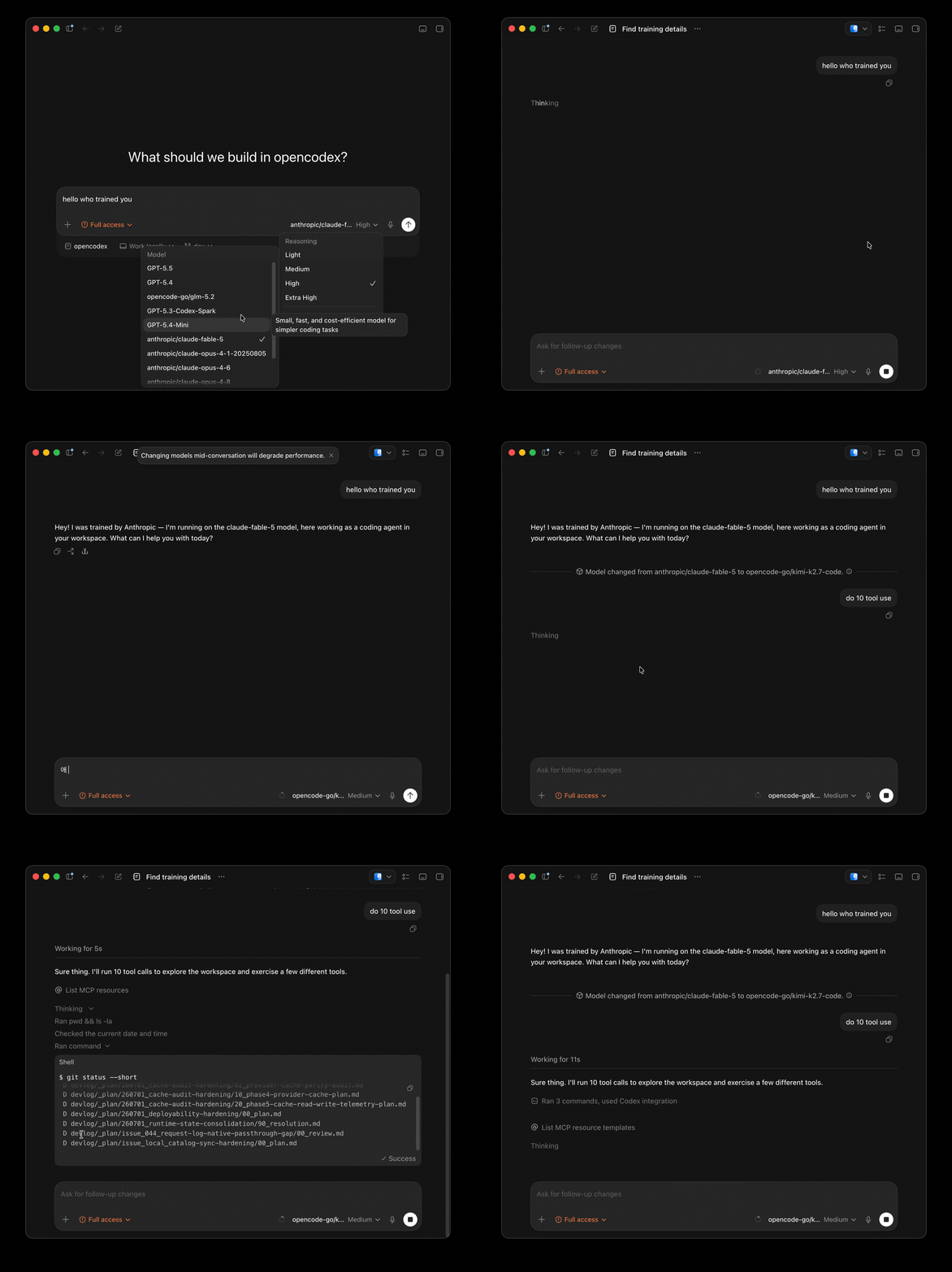
Universal provider proxy for OpenAI Codex & Claude Code — use any LLM (Claude, Gemini, Grok, DeepSeek, Ollama…) with Codex CLI, App, SDK, and Claude Code

Git-native persistent memory for AI coding agents. Implements Google OKF v0.2 with sub-300µs in-memory BM25 search, embedded MCP server, and progressive disclosure. Slashes token bloat by 80% with zero external databases or dependencies. Built in pure Go.

Local-first code intelligence graph for MCP and CLI. Builds a persistent map of your codebase so AI coding tools read only what matters, with benchmarked context reductions on reviews and large-repo workflows.

Stop your AI from making things up — it proposes, deterministic tools decide, every claim checked against ground truth with evidence. Grounded facts and context survive resets. Reverse engineering is the proving ground. MCP server + CLI.