

koala73/worldmonitorConnectors
Real-time global intelligence dashboard. AI-powered news aggregation, geopolitical monitoring, and infrastructure tracking in a unified situational awareness interface
86k
OmniSeek is an MCP server that lets an agent search across public and logged-in sources, read pages and PDFs, inspect images and video frames, and transcribe audio locally. It also stores retrieval memory and an evidence graph so later searches can build on earlier findings.
Builders who want an agent that can search past plain text, cross languages, and keep evidence over time.
You can get answers from sources that plain search misses, without re-explaining context every session.
`omniseek_search` fans out across the catalog, deduplicates results, and ranks them with semantic and lexical matching.
`omniseek_read` turns web pages, PDFs, and arXiv links into clean text.
`omniseek_view` reads images, document figures, and video frames with vision.
`omniseek_transcribe` transcribes audio and video locally, with bilingual ASR and timestamp slicing.
`omniseek_graph`, `omniseek_statement`, and `omniseek_ruling` store and query remembered evidence over time.
The walled-source tier can use your own browser session to reach login-protected sites when you opt in.
`omniseek_sources`, `omniseek_curator_act`, and `omniseek_curator_view` manage source routing, admission, and retirements.
`skills/omniseek-investigate/SKILL.md` packages the investigation workflow as a reusable skill.
git clone https://github.com/Battam1111/omniseek.git && cd omniseek
docker compose up -d
docker compose logs omniseek        # bearer token printed on first start
curl -s http://127.0.0.1:8765/healthz
python -m venv .venv && . .venv/bin/activate
scripts/bootstrap.sh
python -m omniseek.serve_http

The answer is sitting in minute 47 of a podcast, three replies deep in a comment thread, behind a login, in another language. Your agent gets it anyway.
Self-hosted perception MCP server · one connection




Search gives your agent indexed pages, in one language, in text, and stops there.
OmniSeek gives it the senses to keep going: through languages, logins, comment threads, audio, and pixels, all on your machine.
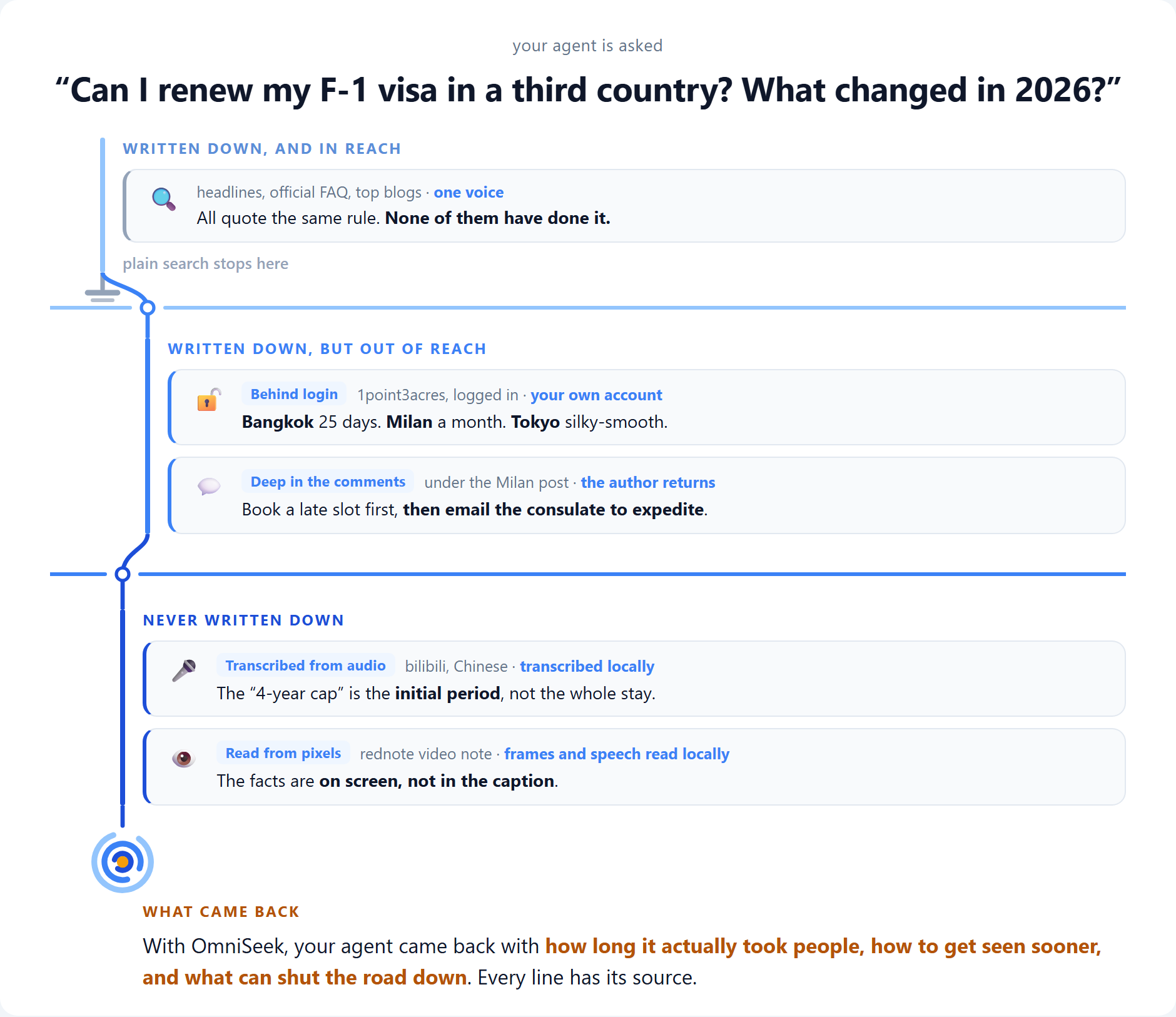
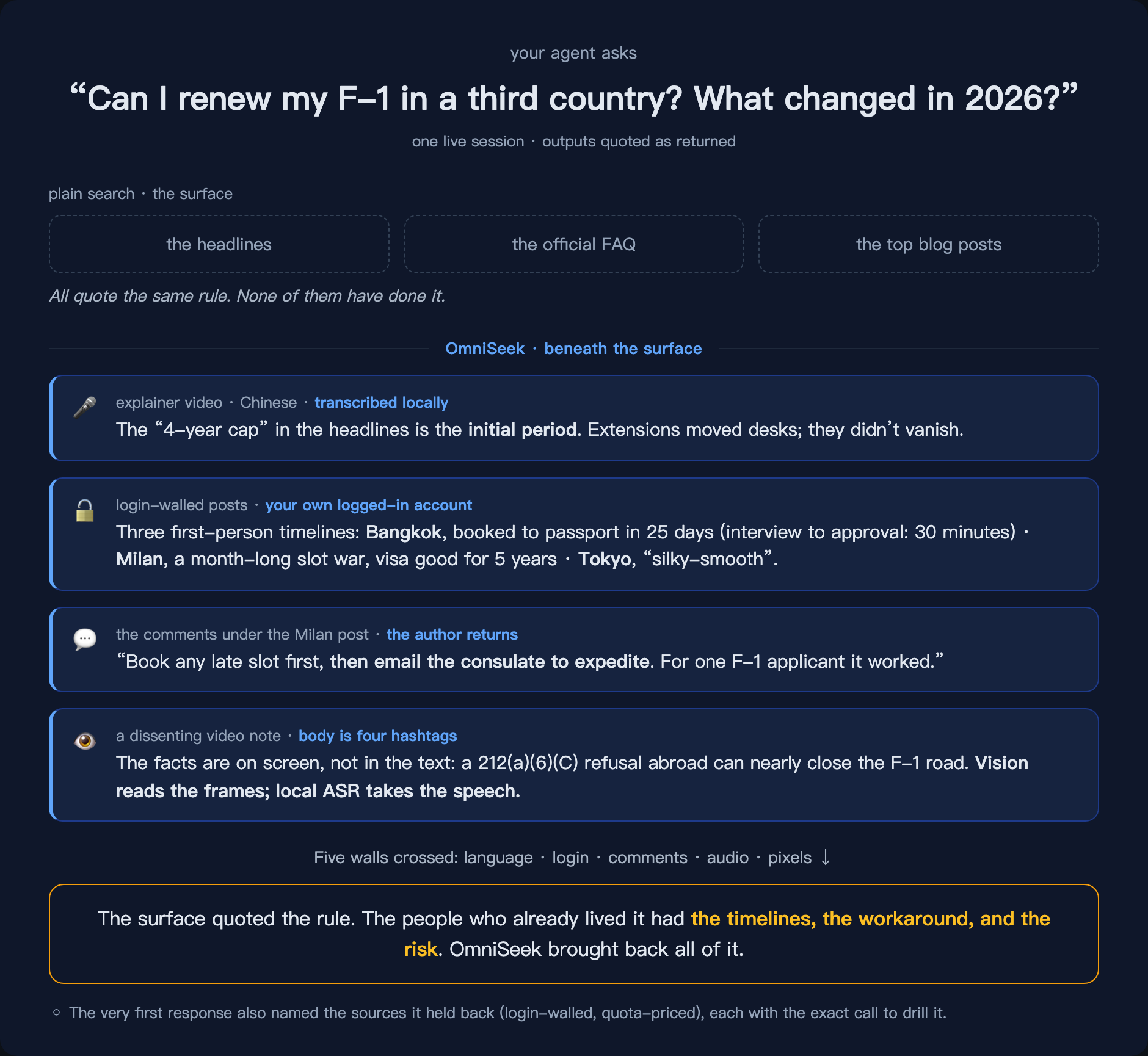
What each layer gave back, verbatim:
Plain search quoted the rule and stopped. The people who had lived it held the timelines, the workaround, and the risk. OmniSeek also named the sources it held back, each with the exact call to drill it.
It hears (local bilingual ASR, no cloud), sees (images and video frames, in-band), crosses languages (a Chinese query finds English results and vice versa), reads behind login walls (your credentials, your machine, off by default), and remembers (persistent retrieval memory plus a typed, source-traced evidence graph).
Crossing languages draws on the index OmniSeek builds as you use it, so a fresh install starts at a floor. The published claim-verification tests run on exactly that fresh install, which makes their cross-lingual number the coldest case rather than the typical one.
Every source in the catalog, the curated roster of everything OmniSeek can reach, earned its place by beating plain search at one of five jobs (structure, unwalling, transcription, recall, monitoring): citation graphs, regulatory filings, login-walled forums, Chinese-language video. And the catalog is built to grow: a curator pipeline probes, judges, and admits new sources, and retires the ones that decay.
Worked examples, real outputs · A full case study · Every claim above is a test (latest results) · Source health, updated weekly
git clone https://github.com/Battam1111/omniseek.git && cd omniseek
docker compose up -d
docker compose logs omniseek        # bearer token printed on first start
curl -s http://127.0.0.1:8765/healthz
On success, it returns:
{"ok":true}
Point your MCP client at http://127.0.0.1:8765/mcp with Authorization: Bearer <token>. The token is generated on first start and stored in ~/.omniseek/credentials/omniseek_http.json (with the compose file, that's ./.omniseek/credentials/omniseek_http.json on the host).
Two paths from here. The prebuilt core image (docker pull ghcr.io/battam1111/omniseek, amd64 + arm64) needs no build and carries every core sense; it is Apache-clean and ships without PDF reading, hearing (ASR + video frames), and login-walled sources. Wanting those extras is what triggers a local build: set EXTRAS="[pdf,asr,walled]" and run docker compose build, then up -d (the first build also fetches headless Chromium; later starts are instant). Optional but recommended: set OMNISEEK_CONTACT_EMAIL for a faster lane with Crossref, SEC, and Unpaywall.
python -m venv .venv && . .venv/bin/activate
scripts/bootstrap.sh
python -m omniseek.serve_http
The bare install is the Core tier: every keyless API and static source, document reading minus PDF, and the lexical memory index. pip install "omniseek[pdf,asr,recall,ocr]" wakes the Research tier (PDF, hearing, cross-lingual vectors, OCR); omniseek[walled] adds the login-walled tier, which stays off until you bring your own accounts; omniseek[all] takes everything. The server prints which senses are online, and which are dormant, at every boot.
On Windows, run bootstrap.sh under Git Bash or WSL; Docker is the simplest path. For an always-on Linux service, see deploy/omniseek.service.
Prefer stdio? The install also ships an omniseek command that speaks MCP over stdio, for clients that launch servers themselves; Dockerfile.stdio wraps the same thing in a container.
OmniSeek binds 127.0.0.1 and requires the bearer token on every request. Do not expose without a reverse proxy (SECURITY.md).
One MCP connection; no model, no agent loop inside. Your model thinks, your harness drives the loop, OmniSeek reaches. Start with omniseek_search; explore what's available with omniseek_sources.
| Tool | What it does |
|---|---|
omniseek_search | Fan out across the whole catalog, deduplicate, rank. Cross-lingual (semantic + lexical). |
omniseek_read | Normalize any URL or document (web page, PDF, arXiv) into clean text. |
omniseek_view | Read images, document figures, video frames with vision. |
omniseek_transcribe | Transcribe audio/video locally. Bilingual ASR, sliceable by timestamp. |
omniseek_field_skeleton | Map a research field's citation neighborhood: foundational core vs. frontier. |
omniseek_resolve_identity | Resolve a person's name to candidate author IDs across databases. |
omniseek_coauthors | Map a researcher's collaboration network by joint-paper count. |
omniseek_institution_cohort | List who actively publishes at a lab, scoped to a field. |
omniseek_paper_enrich | Open-access PDF, retraction/integrity status, citation count for a paper. |
omniseek_paper_recommend | Semantically similar papers (SPECTER embeddings) that keyword search misses. |
omniseek_graph | Query the accumulated evidence graph: find, neighborhood, between, since, similar. |
omniseek_sensor | Standing queries with novelty detection. Only tells you what is new. |
omniseek_ruling | Record identity judgments (same/not-same) the graph applies at read time. |
omniseek_statement | Record directed relations the graph carries forward. |
omniseek_curator_act | Source lifecycle: submit, probe, judge, admit, retire. |
omniseek_curator_view | Read the source-admission queue or a per-source audit dossier. |
omniseek_gather | Run multiple tools in parallel, one response. |
omniseek_sources | List and route: domains, regions, capabilities, health. |
The login-walled tier has no tool of its own: once you opt in per source, the same omniseek_search(..., sources=["xiaohongshu"], raw=True) runs through your own logged-in browser. See walled sources.
Full reference in tools.md · FAQ
Using Claude Code? skills/omniseek-investigate ships the investigation methodology (sweep, zoom, structure) as a ready-made skill.
OmniSeek is catalog-first: with no config, every benign source is on and login-walled sources are off. Tune in one file, ~/.omniseek/profile.json (example):
| Tier | Default |
|---|---|
| free (public, no key) | on |
| keyed (a free or paid API key you supply) | on once the key is set |
| walled (a login you hold) | off; you bring your own browser |
| circumvention | off; none in the default pack |
Full reference: configuration · walled sources · legal posture
There is no OmniSeek cloud. No telemetry, no accounts, no relay: a query leaves your machine only as direct requests to the sources you enabled, and OmniSeek adds no other party to that path. Walled-source credentials stay in your own browser, presented only to the site they belong to; OmniSeek never stores, uploads, or even sees your passwords. The retrieval memory and evidence graph it accumulates over months are local files you own: stop running OmniSeek and you keep everything. Not a feature toggle. The architecture.
See CONTRIBUTING.md. The bar for a new source: it must beat plain web search via a mode (structure / unwall / transcribe / recall / monitor). The bar for fixing a decayed source: low, please do. python tests/smoke.py before you push.
By participating you agree to the Code of Conduct.
Sign in to join the discussion.
No comments yet. Be the first to say what this is good for.
Real-time global intelligence dashboard. AI-powered news aggregation, geopolitical monitoring, and infrastructure tracking in a unified situational awareness interface
High-performance code intelligence MCP server. Indexes codebases into a persistent knowledge graph — average repo in milliseconds. 158 languages, sub-ms queries, 99% fewer tokens. Single static binary, zero dependencies.
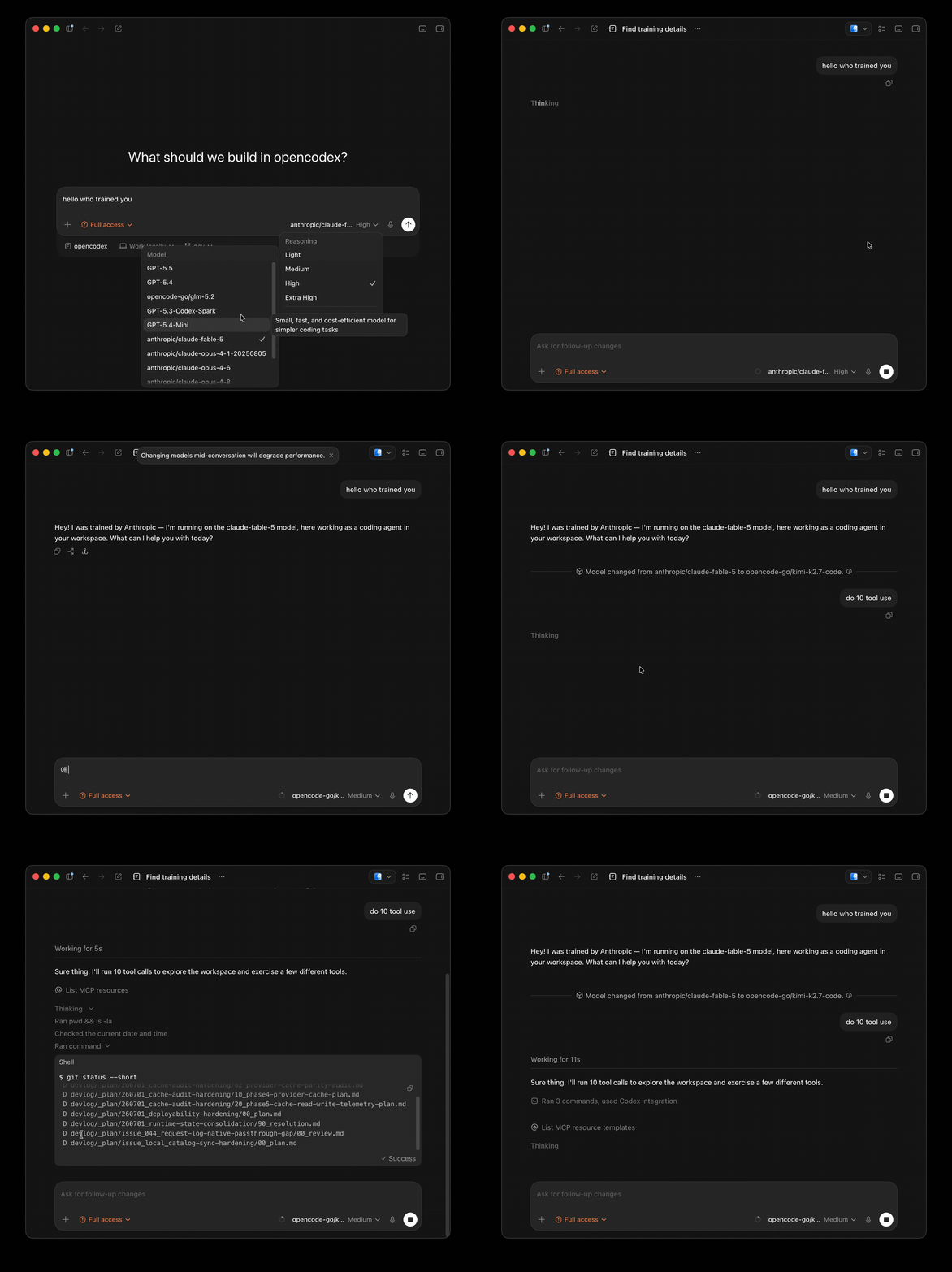
Universal provider proxy for OpenAI Codex & Claude Code — use any LLM (Claude, Gemini, Grok, DeepSeek, Ollama…) with Codex CLI, App, SDK, and Claude Code

Git-native persistent memory for AI coding agents. Implements Google OKF v0.2 with sub-300µs in-memory BM25 search, embedded MCP server, and progressive disclosure. Slashes token bloat by 80% with zero external databases or dependencies. Built in pure Go.

Stop your AI from making things up — it proposes, deterministic tools decide, every claim checked against ground truth with evidence. Grounded facts and context survive resets. Reverse engineering is the proving ground. MCP server + CLI.
20 MB lightweight cross-platform database client for 90+ databases, including MySQL, PostgreSQL, SQLite, Redis, MongoDB, DuckDB, SQL Server, and Dameng. Built-in AI, MCP Server, CLI, desktop and Docker. | 轻量级跨平台数据库管理工具,支持 MySQL、PostgreSQL、SQLite、Redis、MongoDB、达梦等 90+ 数据库,提供桌面端、Docker、CLI、内置 AI 助手和 MCP Server。