Octo-Lex/ChatGPT-Web2APIConnectors
OpenAI-compatible API proxy for ChatGPT web — expose ChatGPT as an MCP server, REST API, and OpenAI SDK endpoint via CDP-driven browser automation
47
OpenAI-compatible API proxy for ChatGPT web — expose ChatGPT as an MCP server, REST API, and OpenAI SDK endpoint via CDP-driven browser automation

Two-mode MCP music studio: scored composition (ABC notation) and live performance (Strudel). Interactive ext-apps UI with sheet music rendering, 30+ instruments, style presets, and live coding REPL.
MCP server to interact with LogSeq via its Local HTTP API - enabling AI assistants like Claude to seamlessly read, write, and manage your LogSeq graph.

HexStrike AI MCP Agents is an advanced MCP server that lets AI agents (Claude, GPT, Copilot, etc.) autonomously run 150+ cybersecurity tools for automated pentesting, vulnerability discovery, bug bounty automation, and security research. Seamlessly bridge LLMs with real-world offensive security capabilities.
Open-source coding agents memory. Records issues, attempts, fixes and decisions, then warns your agent before it repeats an approach that already failed. Native MCP server for Claude Code, Cursor, Antigravity and Codex. 100% local, no cloud, no telemetry. MIT.

Agentic AI memory with Ebbinghaus forgetting curve decay. +16pp better recall than Mem0 on LoCoMo.
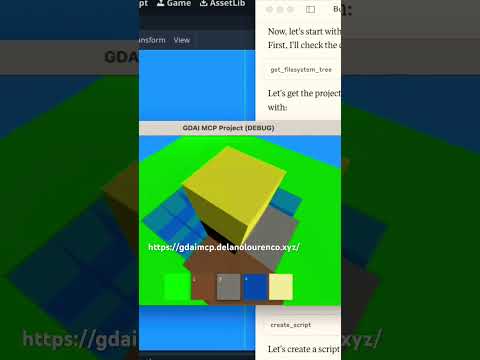
A MCP server integration for Godot Engine that allows Claude, Cursor, Windsurf, VSCode, etc to perform actions like creating scenes, resources, scripts, reading errors and much more.

TouchDesigner MCP server, describe a visual to Claude, Cursor or Codex and it builds a real, playable node network (audio-reactive, generative, particle, 3D, feedback) with live knobs + MIDI/OSC/DMX, then checks for errors and previews its own work.
An MCP server that gives your AI agent agentic RAG over your PDFs, one file or a whole folder: hybrid semantic + keyword search, selective page reads, tables, images, OCR, chart data, and multi-column/CJK layouts. The agent decides when to search; pdf-mcp does the retrieval.
MCP server for Things 3 with read/write support for tasks, projects, areas and tags.

AI conversations that actually remember. Never re-explain your project to your AI again. Join our Discord: https://discord.gg/tyvKNccgqN

Real-time Slack ingest and MCP server to power your agentic Slack bots
20 MB lightweight cross-platform database client for 90+ databases, including MySQL, PostgreSQL, SQLite, Redis, MongoDB, DuckDB, SQL Server, and Dameng. Built-in AI, MCP Server, CLI, desktop and Docker. | 轻量级跨平台数据库管理工具,支持 MySQL、PostgreSQL、SQLite、Redis、MongoDB、达梦等 90+ 数据库,提供桌面端、Docker、CLI、内置 AI 助手和 MCP Server。

Let any AI coding tool — Claude Code, Cursor, Codex — drive your real Chrome. One-prompt setup, muscle memory, local-first.

Provide different cloud products MCP Server tools to help developers manage cloud resources with AI-agent

Turbocharge Claude Code, Cursor, Codex, Gemini & every coding agent: faster, cheaper, with contextual understanding specific to your codebase.
Keep private data, internal infrastructure and secrets out of cloud coding agents without breaking your workflow.
docx ↔ LLM translator. Projects .docx office files to Markdown for editing. Projects edits back to OOXML as tracked changes (redlines). Python and Node.js implementations.
x64dbg-MCP Server is a native MCP (Model Context Protocol) plugin for x64dbg that exposes the debugger's full functionality over HTTP. Connect any MCP-compatible AI assistant and control x64dbg programmatically: set breakpoints, step through code, read memory, dump registers, and more. Built with Zig — zero dependencies, single-binary output, cros

An native MCP server extension for Ghidra
Connect Cursor, Copilot & Claude AI directly to Cheat Engine via MCP. Automate reverse engineering, pointer scanning, and memory analysis using natural language.

Drive your real, logged-in Chrome from any AI agent (Claude Code, Codex, Cursor, VS Code) — works where headless dies. Reads emailed login codes from your Gmail, 40 tools, up to 20 concurrent sessions. MIT, local-only.

Simple standalone MCP server giving Claude the ability to remember your conversations and learn from them over time.
An MCP server that scales development into controllable agentic, recursive flows, and build a feature from bottom-up