
koala73/worldmonitorConnectors
Real-time global intelligence dashboard. AI-powered news aggregation, geopolitical monitoring, and infrastructure tracking in a unified situational awareness interface
86k
tdmcp gives AI assistants tools to build TouchDesigner networks instead of just describing them. The server supplies TouchDesigner operator knowledge, and a bridge inside TouchDesigner actually creates, connects, verifies, and previews nodes. It supports creative-coding workflows like audio-reactive visuals, particles, feedback, GLSL, MIDI, OSC, and DMX. The repo also ships recipe files and docs for common visual builds and setup.
Builders who want an AI assistant to create and debug TouchDesigner visuals inside a live project.
You can describe a visual and get a working TouchDesigner node network with preview and error checks.
Exposes hundreds of tools for node creation, inspection, layout, and control inside TouchDesigner.
Runs a local bridge that lets the server create, connect, inspect, and preview real nodes in `/project1`.
Checks generated networks for errors and shows a preview so the assistant can fix its own work.
Includes tools for control panels, parameter animation, and external I/O such as OSC, MIDI, and DMX.
Ships many JSON recipes for audio-reactive, particle, feedback, shader, 3D, and generative visual setups.
Provides a docs site, Claude Desktop `.mcpb` install, and source setup for Claude Code, Codex, and Cursor.
You + your AI            tdmcp server               TouchDesigner
  (Claude / Cursor)   ─▶   (a small program)    ─▶   (the bridge inside TD)
   "make a feedback                                      builds real nodes
tunnel from noise" in /project1Install and connect tdmcp for me using the official install guide: https://pantani.github.io/tdmcp/guide/install Do every step yourself; only stop when you need me to do the TouchDesigner bridge step.
git clone https://github.com/Pantani/tdmcp.git cd tdmcp npm run setup # installs, builds, and prints the exact line to connect your client


tdmcp is a Model Context Protocol (MCP) server for TouchDesigner — build TouchDesigner from plain language. You describe a visual to an AI assistant (Claude, Claude Code, Cursor, Codex); the AI builds the actual network of nodes inside your project, checks it for errors, and shows you a preview.
"Create a feedback tunnel from noise with blur and displace, then add bloom and output it to a window."
…and the nodes appear, wired up, in your /project1.
It works because it pairs two things every other tool was missing:
Full guides and reference live on the docs site → https://pantani.github.io/tdmcp/
🇧🇷 Portuguese documentation: https://pantani.github.io/tdmcp/pt/
Three pieces talk to each other on your computer:
You + your AI tdmcp server TouchDesigner
(Claude / Cursor) ─▶ (a small program) ─▶ (the bridge inside TD)
"make a feedback builds real nodes
tunnel from noise" in /project1
Node.js is only needed for the build-from-source path (Node 20+).
The one-click Claude Desktop extension needs nothing extra — the server is bundled
inside the .mcpb extension file.
You set up two sides: your AI (so it gets the tdmcp tools) and TouchDesigner (so the AI can drive it).
🤖 Easiest — let your AI install it. Using Claude Code, Codex, or Cursor? Paste this one message in:
Install and connect tdmcp for me using the official install guide:
https://pantani.github.io/tdmcp/guide/install
Do every step yourself; only stop when you need me to do the TouchDesigner bridge step.
It clones, builds and wires everything up; the only manual step is pasting one line into TouchDesigner (Step 2 below).
🟢 Claude Desktop — one-click .mcpb (no terminal, no Node). Download
tdmcp.mcpb,
then in Claude Desktop open Settings → Extensions and install it (drag it in or
Install from file). Leave host/port at 127.0.0.1 / 9980. Full walkthrough:
the install guide.
🛠️ Claude Code / Codex / Cursor — build from source.
git clone https://github.com/Pantani/tdmcp.git
cd tdmcp
npm run setup   # installs, builds, and prints the exact line to connect your client
Easiest — no Textport. Download
tdmcp_bridge_package.tox
from the latest release, drag it into your /project1 network, and click
Install on the component. The package self-bootstraps and starts the bridge on
port 9980. ✅
Open the Textport (Dialogs → Textport and DATs), paste this one line and
press Enter:
import urllib.request; exec(urllib.request.urlopen("https://github.com/Pantani/tdmcp/raw/v0.13.2/td/bootstrap.py").read().decode())
You should see [tdmcp] bridge running on port 9980 (/project1/tdmcp_bridge).
Either way it's safe and reversible — it adds one tidy component; remove it later
with from mcp import install; install.uninstall(). Other install methods (module
path, terminal, Palette package) are in the
bridge docs.
With TouchDesigner open and your AI connected, ask in plain language:
"Create an audio-reactive particle galaxy and show me a preview."
The AI builds the network, checks it for errors, and returns a thumbnail. Iterate: "make it warmer," "add a feedback trail," "output it fullscreen." More ideas in the prompt cookbook.
Not connecting? The two most common fixes: make sure the bridge is on (
curl http://127.0.0.1:9980/api/inforeturns JSON), and restart your AI client after adding the server. Full troubleshooting.
508 tools across three layers, plus foundation primitives, CLI automation,
library/packaging, AI session memory and
Obsidian vault integrations — from one-line artist generators
(create_feedback_network, create_audio_reactive, create_particle_system,
create_generative_art, …) to building blocks (create_control_panel,
animate_parameter, create_external_io for OSC/MIDI/DMX/NDI, …) down to
atomic node CRUD and inspection. Many systems arrive already playable, with
a control panel you can tweak, preset, or map to a controller. See the full,
always-current
tools reference and the
recipe gallery.
A local, opt-in creative repertoire of open-licensed artworks/artists/techniques
the AI can search for inspiration. Off by default. Repertoire, not policy — no
bridge, DMX or Python exec. Enable with TDMCP_RAG_ENABLED=1 plus a local
Ollama install, then tdmcp creative-rag {sync|index|search}.
Full guide: docs/CREATIVE_RAG.md.
The bridge runs arbitrary Python inside your TD process and listens on port
9980 on all interfaces — treat it like an open door to that machine. Run it only
on a trusted network, and for untrusted networks turn on bridge auth
(TDMCP_BRIDGE_TOKEN) and/or disable the exec endpoints
(TDMCP_BRIDGE_ALLOW_EXEC=0). Details:
Security.
Build with npm install && npm run build; run npm test, npm run typecheck,
npm run lint. Work on the docs with npm run docs:dev (the
tools reference is generated by
scripts/gen-tool-docs.ts). See CONTRIBUTING.md,
CHANGELOG.md, and the roadmap.
MIT — see LICENSE.
Sign in to join the discussion.
No comments yet. Be the first to say what this is good for.
Real-time global intelligence dashboard. AI-powered news aggregation, geopolitical monitoring, and infrastructure tracking in a unified situational awareness interface
High-performance code intelligence MCP server. Indexes codebases into a persistent knowledge graph — average repo in milliseconds. 158 languages, sub-ms queries, 99% fewer tokens. Single static binary, zero dependencies.
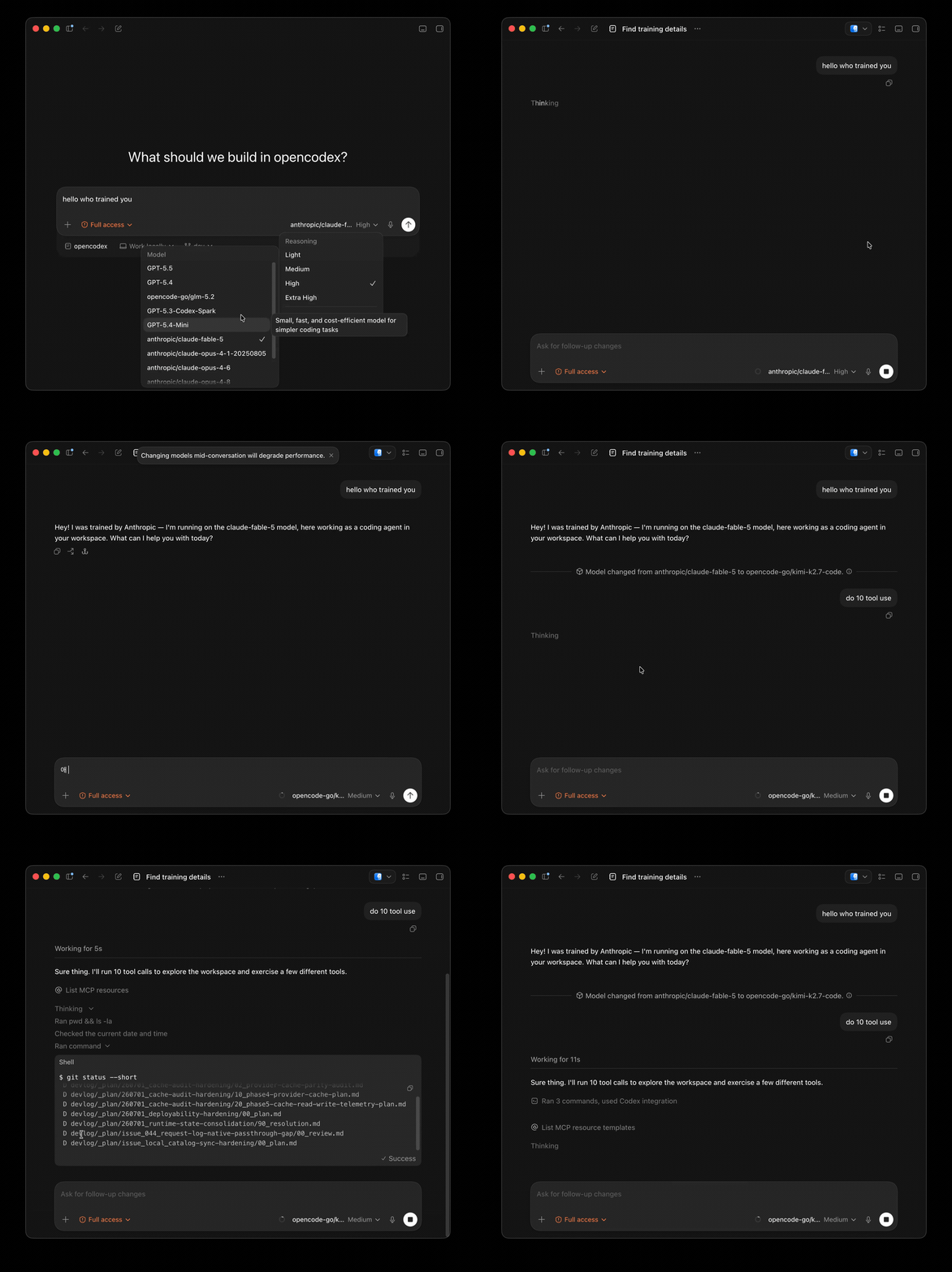
Universal provider proxy for OpenAI Codex & Claude Code — use any LLM (Claude, Gemini, Grok, DeepSeek, Ollama…) with Codex CLI, App, SDK, and Claude Code

Git-native persistent memory for AI coding agents. Implements Google OKF v0.2 with sub-300µs in-memory BM25 search, embedded MCP server, and progressive disclosure. Slashes token bloat by 80% with zero external databases or dependencies. Built in pure Go.

Local-first code intelligence graph for MCP and CLI. Builds a persistent map of your codebase so AI coding tools read only what matters, with benchmarked context reductions on reviews and large-repo workflows.

Stop your AI from making things up — it proposes, deterministic tools decide, every claim checked against ground truth with evidence. Grounded facts and context survive resets. Reverse engineering is the proving ground. MCP server + CLI.