
koala73/worldmonitorConnectors
Real-time global intelligence dashboard. AI-powered news aggregation, geopolitical monitoring, and infrastructure tracking in a unified situational awareness interface
86k
This plugin runs inside x64dbg and turns debugger actions into MCP tools over HTTP. An agent can connect with a bearer token and call tools for breakpoints, memory, registers, threads, analysis, and dumping.
Builders who want an MCP client to control x64dbg during reverse engineering or malware analysis.
You can let an agent drive x64dbg instead of copying debugger steps by hand.
Exposes x64dbg actions as MCP tools so a client can load binaries, run, pause, step, and inspect state.
Reads and writes process memory, dumps registers, follows pointers, and extracts strings or memory regions.
Creates, edits, deletes, and lists breakpoints, plus trace and run-to-address actions.
Lists modules, exports, imports, symbols, functions, references, and PE analysis results.
Uses streamable HTTP and SSE with mandatory bearer-token authentication.
Runs inside x64dbg with zero runtime dependencies and auto-starts when the debugger launches.
zig build -Doptimize=ReleaseSafe --prefix dist
dist/
├── x32/
│   └── plugins/
│       └── x64dbg-MCP-Server.dp32
└── x64/
    └── plugins/
        └── x64dbg-MCP-Server.dp64




Features • Install • Usage • Tools • Configuration • Building • Structure
x64dbg-MCP Server is a native MCP (Model Context Protocol) plugin for x64dbg that exposes the debugger's full functionality over HTTP. Connect any MCP-compatible AI assistant and control x64dbg programmatically: set breakpoints, step through code, read memory, dump registers, and more.
Built with Zig — zero dependencies, single-binary output, cross-compiles to both x32 and x64 from any host. No .NET, no Python, no runtime — just drop the plugin into your x64dbg plugins folder and go.
MCP 2024-11-05 — Streamable HTTP + SSE transports, JSON-RPC 2.0.
Download the latest release or build from source:
dist/ into your x64dbg root folder (deploys both x32 and x64)The MCP server starts automatically. Default ports:
0.0.0.0:90940.0.0.0:9095Add to your MCP client config (.mcp.json, etc.):
Streamable HTTP (recommended):
{
  "mcpServers": {
    "x64dbg": {
      "type": "http",
      "url": "http://localhost:9094/",
      "headers": {
        "Authorization": "Bearer YOUR_TOKEN_HERE"
      }
    }
  }
}
SSE (legacy clients):
{
  "mcpServers": {
    "x64dbg": {
      "type": "sse",
      "url": "http://localhost:9094/sse",
      "headers": {
        "Authorization": "Bearer YOUR_TOKEN_HERE"
      }
    }
  }
}
If connecting from WSL or a remote machine, use the host's IP address and set the bind address to 0.0.0.0 in the config dialog.
Example — AI-assisted reverse engineering session:
You:    Load calc.exe and break at the entry point
AI: [calls LoadBinary, SetBreakpoint, run, WaitForPause]
        Loaded calc.exe, hit breakpoint at 0x7FF7A1234000 in calc.exe

You:    What are the current registers?
AI: [calls GetAllRegisters]
        RAX: 0x0, RCX: 0x7FF7A1234000, RDX: 0x1, ...

You:    Read 64 bytes at the current instruction pointer
AI: [calls ReadMemory]
        48 83 EC 28 E8 12 34 00 00 ...

You:    Step over the next 3 instructions and show me the stack
AI: [calls StepOver x3, GetCallStack]
        Stepped to 0x7FF7A1234010, call stack: ...
72 MCP tools covering the full x64dbg debugging workflow.
| Tool | Description |
|---|---|
GetDebugState | Current debugger state, PID, instruction pointer |
LoadBinary | Load an executable into the debugger |
ExecuteDebuggerCommand | Run any x64dbg command |
ListCommandsByCategory | List available MCP tools |
SearchForStrings | Search process memory for text |
GetEventLog | Last N debugger events (exceptions, breakpoints, DLL loads) |
ClearEventLog | Clear the event log |
EvalExpression | Evaluate any x64dbg expression (address, register, arithmetic) |
AttachProcess | Attach to a running process by PID |
Echo | Echo input back |
WaitForEvent | Long-poll for debugger events (breakpoint, pause, resume, exception) |
| Tool | Description |
|---|---|
GetCurrentAddress | Current EIP/RIP with label and comment |
Disassemble | Disassemble N instructions at an address |
DisassembleFunction | Disassemble an entire function by boundaries |
ReadMemory | Hex dump of process memory |
WaitForPause | Block until target pauses |
run | Resume execution (F9) |
StepInto | Single-step into calls (F7) |
StepOver | Step over calls (F8) |
StepOut | Run until return (Ctrl+F9) |
PauseDebug | Pause the target (F12) |
StopDebug | Terminate debug session |
RestartDebug | Restart debug session |
SetBreakpoint | Set INT3 breakpoint at address/symbol |
SetHardwareBreakpoint | Set hardware breakpoint (DR0-DR3, read/write/execute) |
SetConditionalBreakpoint | Set breakpoint with condition expression and optional log |
EnableBreakpoint | Enable a breakpoint at a given address |
DisableBreakpoint | Disable a breakpoint without deleting it |
ToggleBreakpoint | Toggle a breakpoint between enabled and disabled |
DeleteBreakpoint | Remove a breakpoint |
DeleteAllBreakpoints | Remove all breakpoints (normal, hardware, memory) |
ResetHitCount | Reset a breakpoint's hit counter to zero |
ListBreakpoints | List all active breakpoints |
GetAllRegisters | Dump all general-purpose registers |
SetRegister | Set a CPU register value |
GetCallStack | Current thread call stack |
GetThreads | List all threads with IDs and instruction pointers |
SwitchThread | Switch active thread context |
SuspendThread | Suspend a thread by its thread ID |
ResumeThread | Resume a suspended thread |
ListModules | List loaded modules with base addresses and sizes |
GetMemoryMap | Memory regions with addresses, sizes, and protection |
GetDumpableRegions | List committed, readable memory regions |
AllocateMemory | Allocate memory in the target process |
FreeMemory | Free allocated memory in the target process |
WriteMemToAddress | Patch memory with hex bytes |
RestorePatches | Restore all patches to original bytes |
Assemble | Assemble an instruction at an address |
CommentOrLabelAtAddress | Add comment/label in disassembly |
SetBookmark | Set a bookmark at an address |
DeleteBookmark | Delete a bookmark |
ListBookmarks | List all bookmarks |
GetImports | Show module import table |
GetExports | Show module export table |
SearchSymbols | Search for symbols matching a pattern |
ListSymbols | List exported symbols of a module |
GetPatches | List all memory patches |
FindPattern | Scan module memory for byte pattern with ?? wildcards |
GetStrings | Extract ASCII strings from a module's memory |
GetReferences | Find CALL/JMP xrefs to a target address |
GetFunctions | List analyzed functions with addresses and labels |
AnalyzeModule | PE structure analysis: sections, EP, image size |
DetectOEP | Detect Original Entry Point for packed executables |
DumpMemory | Save memory region to file on disk |
DumpModule | Dump an entire module to a file |
RunToAddress | Run until hitting a specific address |
TraceInto | Step N instructions recording address + disassembly |
FollowPointer | Dereference pointer chain N levels deep |
WatchExpressions | Evaluate multiple expressions in one call |
GetSEHChain | Walk Structured Exception Handler chain (x32) |
GetPEB | Read Process Environment Block fields |
GetArguments | Read function arguments from stack/registers |
SetMemoryBreakpoint | Set memory breakpoint (read/write/execute) |
SetExceptionBreakpoint | Configure exception breakpoint (break or ignore, first/second/all chance) |
DeleteExceptionBreakpoint | Delete an exception breakpoint |
AnalyzeCode | Run code analysis (function, module, or control flow) |
TraceOver | Trace N instructions stepping over calls |
SetBreakpointCommand | Set a command to execute when a breakpoint is hit |
SetBreakpointFastResume | Enable/disable fast resume (auto-continue) on a breakpoint |
SaveDatabase | Save the x64dbg database (.dd64/.dd32) |
Go to Plugins > x64dbg-MCP Server > Configure MCP Server... to change the bind address, port, and auth token.
0.0.0.0 — listen on all interfaces (for WSL/remote access)127.0.0.1 — local-only accessA Bearer token is auto-generated on first run and required on every request. The MCP server has full debugger control and can read/write process memory — all requests without a valid token receive 401 Unauthorized. Click Generate in the config dialog to rotate the token, or Copy to copy it to clipboard. Clients must include the token as an Authorization: Bearer <token> header.
Changes take effect immediately — the server auto-restarts on save. Config is persisted to mcp_config.json next to the x64dbg executable.
Requires Zig 0.16-dev or later. Builds on Windows, WSL, Linux, or macOS.
zig build -Doptimize=ReleaseSafe --prefix dist
Output mirrors x64dbg's folder structure — copy the contents of dist/ into your x64dbg root to deploy both architectures at once:
dist/
├── x32/
│   └── plugins/
│       └── x64dbg-MCP-Server.dp32
└── x64/
    └── plugins/
        └── x64dbg-MCP-Server.dp64
├── build.zig                     # build config — x32 + x64 cross-compilation
├── build.zig.zon                 # package manifest
└── src/
    ├── main.zig                  # plugin entry point, menu, callbacks
    ├── core/
    │   ├── bridge.zig            # x64dbg SDK bindings (runtime-resolved)
    │   ├── config.zig            # Win32 config dialog and persistence
    │   └── mcp_server.zig        # HTTP server and JSON-RPC dispatch
    ├── mcp/
    │   ├── json.zig              # JSON writer and parser helpers
    │   └── tools.zig             # MCP tool definitions and handlers
    └── resources/
        └── icons.zig             # embedded PNG icon data
The plugin loads into x64dbg at startup, resolves the debugger's API symbols at runtime from x64bridge.dll and x64dbg.dll, then spins up an HTTP server on a background thread. MCP clients connect over HTTP and send JSON-RPC requests to invoke tools — each tool maps directly to x64dbg SDK calls (breakpoints, memory reads, command execution, etc.).
No polling, no external processes — the plugin lives inside x64dbg's address space with direct access to the debugger API.
This tool is intended for legitimate reverse engineering, malware analysis, security research, and educational purposes only. It provides full debugger control over running processes — including memory read/write, code execution, and process manipulation — over a network interface.
By using this software, you accept full responsibility for how it is used. The author is not liable for any misuse, damage, or legal consequences resulting from the use of this tool. Always ensure you have proper authorization before debugging or analyzing any software.
Do not expose the MCP server to untrusted networks. While Bearer token authentication is enforced, the server communicates over unencrypted HTTP.
MIT. See LICENSE.
Made with 🖤 by @duty1g
Sign in to join the discussion.
No comments yet. Be the first to say what this is good for.
Real-time global intelligence dashboard. AI-powered news aggregation, geopolitical monitoring, and infrastructure tracking in a unified situational awareness interface
High-performance code intelligence MCP server. Indexes codebases into a persistent knowledge graph — average repo in milliseconds. 158 languages, sub-ms queries, 99% fewer tokens. Single static binary, zero dependencies.
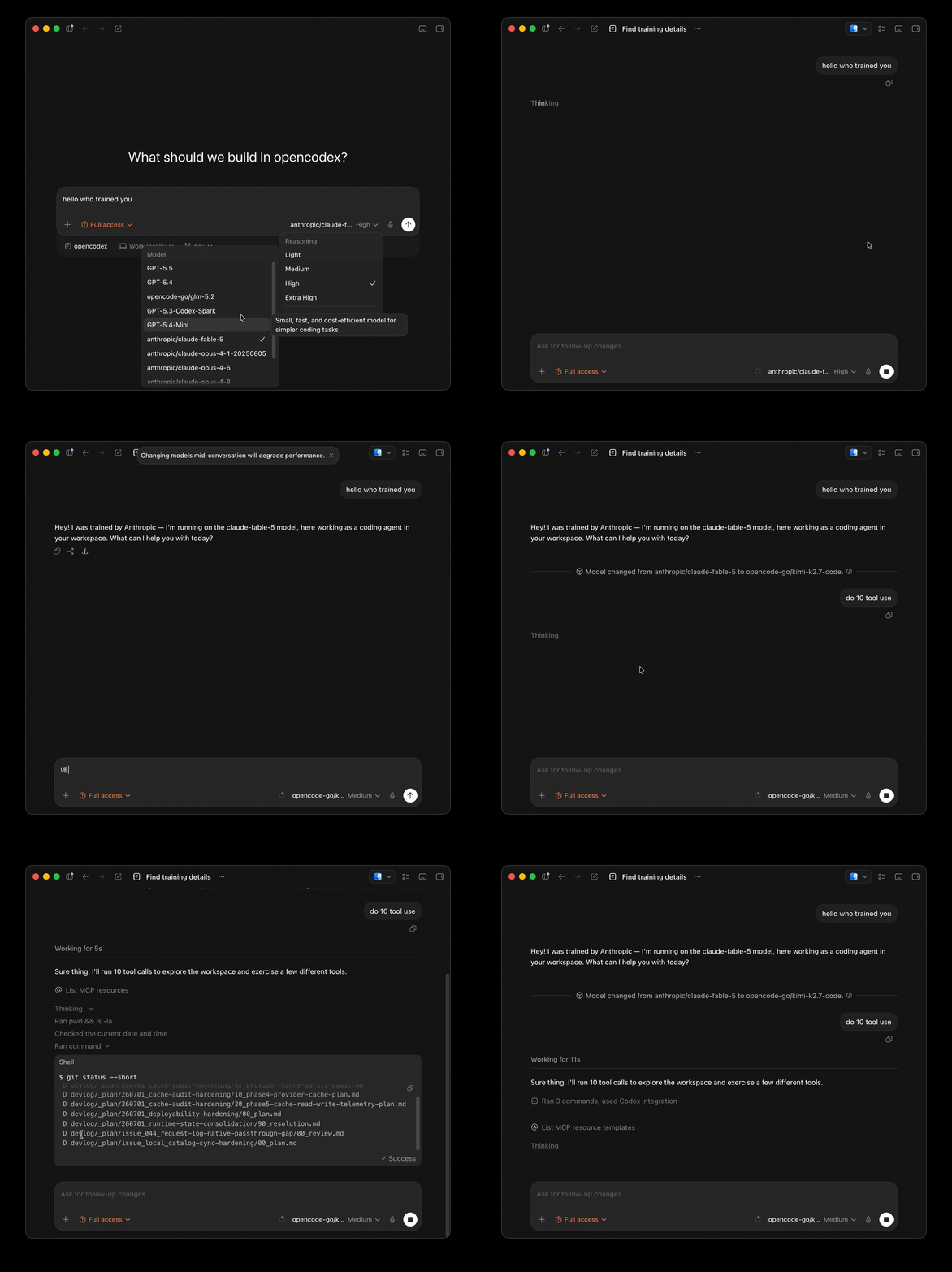
Universal provider proxy for OpenAI Codex & Claude Code — use any LLM (Claude, Gemini, Grok, DeepSeek, Ollama…) with Codex CLI, App, SDK, and Claude Code

Git-native persistent memory for AI coding agents. Implements Google OKF v0.2 with sub-300µs in-memory BM25 search, embedded MCP server, and progressive disclosure. Slashes token bloat by 80% with zero external databases or dependencies. Built in pure Go.

Local-first code intelligence graph for MCP and CLI. Builds a persistent map of your codebase so AI coding tools read only what matters, with benchmarked context reductions on reviews and large-repo workflows.

Stop your AI from making things up — it proposes, deterministic tools decide, every claim checked against ground truth with evidence. Grounded facts and context survive resets. Reverse engineering is the proving ground. MCP server + CLI.