
koala73/worldmonitorConnectors
Real-time global intelligence dashboard. AI-powered news aggregation, geopolitical monitoring, and infrastructure tracking in a unified situational awareness interface
86k
This server connects an AI assistant to your Logseq pages through the Local HTTP API. It lets the agent list pages, read and edit content, run Logseq queries, and optionally search by meaning with vector search. It also supports access controls for tags and namespaces, plus DB-mode graph properties.
Builders who want Claude Code or another MCP client to work directly with a Logseq knowledge base.
You can ask your agent to read, write, organize, and search your Logseq graph without copying notes by hand.
List, read, create, update, rename, and delete pages and blocks in Logseq.
Search content across the graph and run Logseq DSL queries for tasks, tags, and page properties.
Browse namespace trees, find pages by property, and inspect backlinks to a page.
Converts markdown into Logseq blocks, headings, lists, checkboxes, and code blocks when creating or updating pages.
Adds semantic search, index sync, and index status tools using local or hosted embeddings with LanceDB.
Hides excluded tags and namespaces from listings, search, queries, and direct access.
claude mcp add mcp-logseq \
  --env LOGSEQ_API_TOKEN=your_token_here \
  --env LOGSEQ_API_URL=http://localhost:12315 \
  -- uv run --with mcp-logseq mcp-logseq
"Please help me organize my LogSeq notes. Show me what pages I have."
# .env
LOGSEQ_API_TOKEN=your_token_here
LOGSEQ_API_URL=http://localhost:12315
export LOGSEQ_API_TOKEN=your_token_here
export LOGSEQ_API_URL=http://localhost:12315
Connect Claude to your LogSeq knowledge base. Read, create, and manage pages — with optional semantic vector search and DB-mode graph support.
Transform your LogSeq knowledge base into an AI-powered workspace! This MCP server enables Claude to seamlessly interact with your LogSeq graphs.
📊 Intelligent Knowledge Management
"Analyze all my project notes from the past month and create a status summary"
"Find pages mentioning 'machine learning' and create a study roadmap"
"Search for incomplete tasks across all my pages"
📝 Automated Content Creation
"Create a new page called 'Today's Standup' with my meeting notes"
"Add today's progress update to my existing project timeline page"
"Create a weekly review page from my recent notes"
🔍 Smart Research & Analysis
"Compare my notes on React vs Vue and highlight key differences"
"Find all references to 'customer feedback' and summarize themes"
"Create a knowledge map connecting related topics across pages"
🧠 Semantic Search (optional, requires vector setup)
"Find everything I wrote about burnout, even if I didn't use that word"
"What notes relate to my thoughts on deep work?"
"Search across my Dutch and English notes for ideas about productivity"
🤝 Meeting & Documentation Workflow
"Read my meeting notes and create individual task pages for each action item"
"Get my journal entries from this week and create a summary page"
"Search for 'Q4 planning' and organize all related content into a new overview page"
claude mcp add mcp-logseq \
  --env LOGSEQ_API_TOKEN=your_token_here \
  --env LOGSEQ_API_URL=http://localhost:12315 \
  -- uv run --with mcp-logseq mcp-logseq
Add to your config file (Settings → Developer → Edit Config):
{
  "mcpServers": {
    "mcp-logseq": {
      "command": "uv",
      "args": ["run", "--with", "mcp-logseq", "mcp-logseq"],
      "env": {
        "LOGSEQ_API_TOKEN": "your_token_here",
        "LOGSEQ_API_URL": "http://localhost:12315"
      }
    }
  }
}
"Please help me organize my LogSeq notes. Show me what pages I have."
Semantic search over your Logseq graph using configurable embeddings — find notes by meaning, not just keywords. Searches across all your pages using vector similarity and full-text search combined, with cross-language support.
Use Ollama for fully local embeddings, OpenAI, or another OpenAI-compatible embeddings endpoint. LanceDB remains local in every configuration. Hosted providers receive the note text being embedded.
→ Full setup guide: VECTOR_SEARCH.md
The server provides 16 tools with intelligent markdown parsing, plus 3 optional vector search tools:
| Tool | Purpose | Example Use |
|---|---|---|
list_pages | Browse your graph | "Show me all my pages" |
get_page_content | Read page content | "Get my project notes" |
create_page | Add new pages with structured blocks | "Create a meeting notes page with agenda items" |
update_page | Modify pages (append/replace modes) | "Update my task list" |
delete_page | Remove pages | "Delete the old draft page" |
delete_block | Remove a block by UUID | "Delete this specific block" |
update_block | Edit block content by UUID | "Update this specific block text" |
search | Find content across graph | "Search for 'productivity tips'" |
query | Execute Logseq DSL queries | "Find all TODO tasks tagged #project" |
find_pages_by_property | Search pages by property | "Find all pages with status = active" |
get_pages_from_namespace | List pages in a namespace | "Show all pages under Customer/" |
get_pages_tree_from_namespace | Hierarchical namespace view | "Show Projects/ as a tree" |
rename_page | Rename with reference updates | "Rename 'Old Name' to 'New Name'" |
get_page_backlinks | Find pages linking to a page | "What links to this page?" |
insert_nested_block | Insert child/sibling blocks | "Add a child block under this task" |
set_block_properties | Set DB-mode class properties on a block | "Set the status of this block to active" (DB-mode only) |
vector_search ⚗️ | Semantic search by meaning | "Find notes about shadow work or Jung" |
sync_vector_db ⚗️ | Sync vector DB with graph files | "Update the search index" |
vector_db_status ⚗️ | Show vector DB health and staleness | "Is my search index up to date?" |
⚗️ Requires vector search setup — see VECTOR_SEARCH.md
The create_page and update_page tools now automatically convert markdown into Logseq's native block structure:
Markdown Input:
---
tags: [project, active]
priority: high
---

# Project Overview
Introduction paragraph here.

## Tasks
- Task 1
  - Subtask A
  - Subtask B
- Task 2

## Code Example
```python
def hello():
    print("Hello Logseq!")
```
Result: Creates properly nested blocks with:
tags, priority)#, ##, ###)- [ ] → TODO, - [x] → DONE)Update Modes:
append (default): Add new content after existing blocksreplace: Clear page and replace with new contentcreate_page fails with a clear error if a page with the same title already exists, instead of letting Logseq silently create numbered duplicates (Page(1), Page 2, ...). This makes retries after a timeout safe: if a previous create_page call timed out but actually committed, the retry tells you the page exists rather than fragmenting your content across ghost pages.
For large writes, prefer this pattern over one giant create_page call:
create_page with just the title and properties)update_page (mode: append)get_page_content to verify the resultIf you hit the "already exists" error mid-ingest, use get_page_content to see what landed, then continue with update_page instead of re-creating.
LOGSEQ_API_TOKEN (required): Your LogSeq API tokenLOGSEQ_API_URL (optional): Server URL (default: http://localhost:12315)LOGSEQ_API_CONNECT_TIMEOUT (optional): HTTP connect timeout in seconds (default: 3)LOGSEQ_API_READ_TIMEOUT (optional): HTTP read timeout in seconds (default: 6)LOGSEQ_DB_MODE (optional): Set to true to enable DB-mode property support. Only for Logseq DB-mode graphs (beta). Markdown/file-based graph users should leave this unset.LOGSEQ_EXCLUDE_TAGS (optional): Comma-separated tags — pages with these tags are hidden from all tools. See Privacy & Access Control below.LOGSEQ_INCLUDE_NAMESPACES (optional): Comma-separated namespace allow-list (e.g. work,projects). When set, only pages in these namespaces and their sub-pages are accessible — everything else, including top-level pages without a namespace, is hidden from listings/search and denied on direct access. See Privacy & Access Control below.LOGSEQ_EXCLUDE_NAMESPACES (optional): Comma-separated namespace deny-list (e.g. finance,work/secret). These namespaces are always blocked, taking priority over the include list. See Privacy & Access Control below.LOGSEQ_CONFIG_FILE (optional): Path to a shared JSON config file holding the graph path, ACL defaults, and the vector block. Env vars (LOGSEQ_EXCLUDE_TAGS, LOGSEQ_INCLUDE_NAMESPACES, LOGSEQ_EXCLUDE_NAMESPACES) override the matching keys in this file.MCP_HTTP_AUTH_TOKEN (required for --transport http): Bearer token clients must send as Authorization: Bearer <token>. The server refuses to start in HTTP mode without it. See Serving over HTTP.Pages tagged with excluded tags are completely hidden from AI — they won't appear in listings, searches, or queries, and attempting to read them directly returns an access-denied error.
Quick setup via env var:
LOGSEQ_EXCLUDE_TAGS=private,secret
Via config file (also used for vector search):
{
  "logseq_graph_path": "/path/to/your/logseq/pages",
  "exclude_tags": ["private", "secret"]
}
Point to it with LOGSEQ_CONFIG_FILE=/path/to/config.json.
In your Logseq pages, tag any page you want to protect:
tags:: private
The exclusion applies to all tools: list_pages, get_page_content, search, query, and the optional vector search. If you also use vector search, exclude_tags at the root is automatically merged into the vector index exclusion list — private pages are never embedded.
You can restrict access to specific namespaces using LOGSEQ_INCLUDE_NAMESPACES and LOGSEQ_EXCLUDE_NAMESPACES.
Include list (strict allow-list): Only the listed namespaces and their sub-pages are visible; everything else is hidden.
LOGSEQ_INCLUDE_NAMESPACES=work,projects
Exclude list (deny-list): The listed namespaces are always blocked, even if they appear in the include list.
LOGSEQ_EXCLUDE_NAMESPACES=work/secret,finance
Via config file:
{
  "include_namespaces": ["work", "projects"],
  "exclude_namespaces": ["work/secret", "finance"]
}
Matching is segment-based and case-insensitive: work matches work and work/projects but not workshop. The behavior mirrors LOGSEQ_EXCLUDE_TAGS: list/search results silently omit blocked pages; direct read, write, delete, and block operations return an access-denied error.
Access control is enforced at the page level and applied across every tool: list/search/query results omit blocked pages, direct page/block access and backlinks are denied, and vector search is filtered. Block-level results from search and query are resolved back to their owning page, so a block belonging to a restricted page is filtered out of those results too.
Index-time namespace scoping (vector DB only). The keys above are query-time: every page is embedded, and blocked ones are filtered out of each response. For the vector DB you can also scope at index time — decide which namespaces are embedded into the DB at all — with include_namespaces / exclude_namespaces inside the vector block of the config file:
{
  "vector": {
    "enabled": true,
    "include_namespaces": ["work"],
    "exclude_namespaces": ["work/secret"]
  }
}
This is global (it shapes the shared DB for every consumer), and it keeps unwanted content off disk entirely rather than filtering it on read — useful for secrets you never want embedded, or to keep the index small when everyone only cares about a subset. Matching is the same segment-based, case-insensitive rule. Because it changes what the index contains, it only takes effect after a full re-index: logseq-sync --rebuild.
By default the server speaks stdio — your client spawns it as a subprocess, and most users need nothing more. To serve sandboxed or remote clients over the network, mcp-logseq can run as a long-lived HTTP service with bearer auth, per-profile isolation, and TLS:
mcp-logseq --transport http --host 127.0.0.1 --port 12320 # requires MCP_HTTP_AUTH_TOKEN
The full deployment guide — the server-side security model, the per-profile multi-instance pattern, the separate logseq-sync writer, and native TLS / reverse-proxy setup — lives in docs/SERVING.md. Non-loopback binds over plain HTTP are refused unless you supply TLS or pass --insecure.
# .env
LOGSEQ_API_TOKEN=your_token_here
LOGSEQ_API_URL=http://localhost:12315
export LOGSEQ_API_TOKEN=your_token_here
export LOGSEQ_API_URL=http://localhost:12315
uv run --with mcp-logseq python -c "
from mcp_logseq.logseq import LogSeq
api = LogSeq(api_key='your_token')
print(f'Connected! Found {len(api.list_pages())} pages')
"
claude mcp list # Should show mcp-logseq
npx @modelcontextprotocol/inspector uv run --with mcp-logseq mcp-logseq
Claude Desktop can't find uv. Use the full path:
which uv # Find your uv location
Update config with full path:
{
  "mcpServers": {
    "mcp-logseq": {
      "command": "/Users/username/.local/bin/uv",
      "args": ["run", "--with", "mcp-logseq", "mcp-logseq"],
      "env": { "LOGSEQ_API_TOKEN": "your_token_here" }
    }
  }
}
Common uv locations:
~/.local/bin/uv/opt/homebrew/bin/uvwhich uvFor local development, testing, and contributing, see DEVELOPMENT.md.
Ready to supercharge your LogSeq workflow with AI?
⭐ Star this repo if you find it helpful!
Sign in to join the discussion.
No comments yet. Be the first to say what this is good for.
Real-time global intelligence dashboard. AI-powered news aggregation, geopolitical monitoring, and infrastructure tracking in a unified situational awareness interface
High-performance code intelligence MCP server. Indexes codebases into a persistent knowledge graph — average repo in milliseconds. 158 languages, sub-ms queries, 99% fewer tokens. Single static binary, zero dependencies.
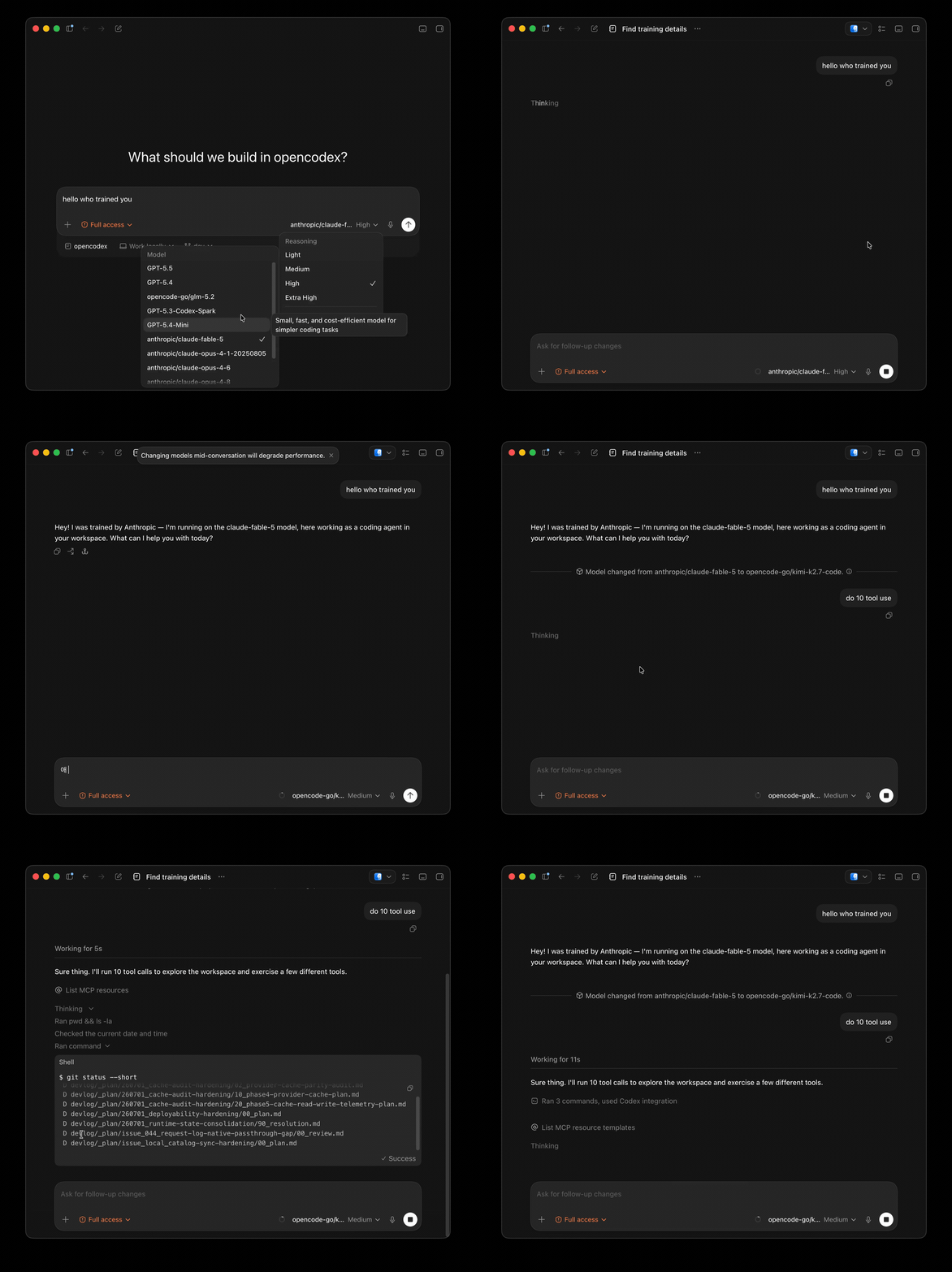
Universal provider proxy for OpenAI Codex & Claude Code — use any LLM (Claude, Gemini, Grok, DeepSeek, Ollama…) with Codex CLI, App, SDK, and Claude Code

Git-native persistent memory for AI coding agents. Implements Google OKF v0.2 with sub-300µs in-memory BM25 search, embedded MCP server, and progressive disclosure. Slashes token bloat by 80% with zero external databases or dependencies. Built in pure Go.

Stop your AI from making things up — it proposes, deterministic tools decide, every claim checked against ground truth with evidence. Grounded facts and context survive resets. Reverse engineering is the proving ground. MCP server + CLI.
x64dbg-MCP Server is a native MCP (Model Context Protocol) plugin for x64dbg that exposes the debugger's full functionality over HTTP. Connect any MCP-compatible AI assistant and control x64dbg programmatically: set breakpoints, step through code, read memory, dump registers, and more. Built with Zig — zero dependencies, single-binary output, cros