
koala73/worldmonitorConnectors
Real-time global intelligence dashboard. AI-powered news aggregation, geopolitical monitoring, and infrastructure tracking in a unified situational awareness interface
86k
Tiger Slack connects Slack to an agent through real-time ingest and an MCP server. The ingest service captures messages, reactions, users, and channels into TimescaleDB, and the MCP server lets an agent query that data with thread context and permalinks.
Builders who want Claude Code or other MCP-capable agents to work from Slack history instead of isolated messages.
You can ask an agent about past Slack conversations and get answers with the right thread context.
The Python ingest service connects to Slack Socket Mode and captures messages, reactions, user changes, and channel updates.
The ingest service can load a Slack export into the database for backfilling older conversations.
The MCP server provides channel and user browsing, conversation retrieval with full threading context, and message permalink generation.
Slack content is stored in TimescaleDB with chunk partitioning, compression, sparse indexes, and full-text search.
The README includes Claude Code MCP commands for connecting over HTTP or stdio.
git clone --recurse-submodules git@github.com:timescale/tiger-slack.git
cd tiger-slack
./setup-tiger-slack.sh
cp .env.sample .env
docker compose up -d --build
Conversational Memory for AI Slack Bots
Tiger Slack gives Slack-native AI assistants the ability to understand and engage with your team's conversations naturally. By providing real-time access to Slack message history and context through an MCP server, it enables AI bots to respond to questions with the same contextual awareness that humans have - understanding references to past discussions, ongoing projects, and team dynamics.
Tiger Slack is the superpower behind Eon, TigerData's Slack-native AI assistant.
Ready to get started? Jump to the quick start.
Built for teams who want their AI assistants to:
ingest/)The ingest service is a Python app that:
The ingest service can process a Slack historical export into the database.
See the ingest README.md for more details.
mcp/)A Streamable HTTP Model Context Protocol server provides:
See the mcp README.md for more details.
###️TimescaleDB Database Tiger Slack uses a TimescaleDB database to store the Slack content.
graph TB
    %% External Systems
    S[Slack Workspace]
    C[Claude/LLM Client]

    %% Core Components
    I[Ingest Service<br/>Python]
    D[TimescaleDB<br/>Time-series Database]
    M[MCP/HTTP Server<br/>TypeScript]

    %% Data Flow - Ingestion
    S -->|WebSocket Events| I
    S -->|Historical Export| I
    I -->|Store Events| D

    %% Data Flow - Analysis
    C -->|MCP Protocol| M
    M -->|SQL Queries| D
    M -->|Structured Data| C
Start by cloning the repo.
git clone --recurse-submodules git@github.com:timescale/tiger-slack.git
cd tiger-slack
The ingest service requires an app configured in Slack with proper privileges and tokens. You can run a script to automate this setup, or you can do it manually.
Execute the following script to guide you through the setup process:
./setup-tiger-slack.sh
Create a Slack App
Next.Next.Create.SLACK_APP_TOKEN (It starts with xapp-).SLACK_BOT_TOKEN (It starts with xoxb-)cp .env.sample .env
Add the Slack tokens to the .env file.
After setting up the .env file, you are ready to run the system!
Build and run the system in docker compose:
docker compose up -d --build
docker compose up -d          # Start all services in background
docker compose down           # Stop all services
docker compose build          # Build all images
docker compose logs -f        # View live logs from all services
docker compose restart        # Restart all services

# Reset with fresh volumes (deletes all data)
docker compose down -v
docker compose up -d

# Nuclear reset (complete cleanup)
docker compose down -v --remove-orphans
docker system prune -f --volumes
docker compose up -d --build
Use Claude Code and/or the MCP Inspector to exercise the MCP Server.
Connect Claude Code to the MCP Server
To connect to the MCP server running in docker, run:
claude mcp add -s project --transport http tiger-slack http://localhost:3001/mcp
To use the MCP server via stdio (not docker), run this after building the mcp:
export PGHOST=localhost
export PGPORT=5432
export PGUSER=tsdbadmin
export PGDATABASE=tsdb
export LOGFIRE_TOKEN=<your-logfire-token> # optional. sends traces from the mcp server to logfire
claude mcp add -s project tiger-slack node /absolute/path/to/tiger-slack/mcp/dist/index.js stdio
Connect to Logfire (Optional) Giving Claude Code the ability to "see" the tracing data for the project can drive powerful AI insights.
claude mcp add -s project logfire -e LOGFIRE_READ_TOKEN="your-token-here" -- uvx logfire-mcp@latest
Start Analyzing Ask Claude: "Show me recent conversations in #engineering"
You can use the MCP Inspector to interact with the MCP server via a web UI. Run the following from the mcp directory:
./bun run inspector
This strategy ensures no gaps in data.
Tiger Slack features full-stack monitoring via Logfire integration:
This project is licensed under the Apache License 2.0 - see the LICENSE file for details.
Transform your Slack workspace into an intelligent knowledge base with AI-powered analytics and insights.
Sign in to join the discussion.
No comments yet. Be the first to say what this is good for.
Real-time global intelligence dashboard. AI-powered news aggregation, geopolitical monitoring, and infrastructure tracking in a unified situational awareness interface
High-performance code intelligence MCP server. Indexes codebases into a persistent knowledge graph — average repo in milliseconds. 158 languages, sub-ms queries, 99% fewer tokens. Single static binary, zero dependencies.
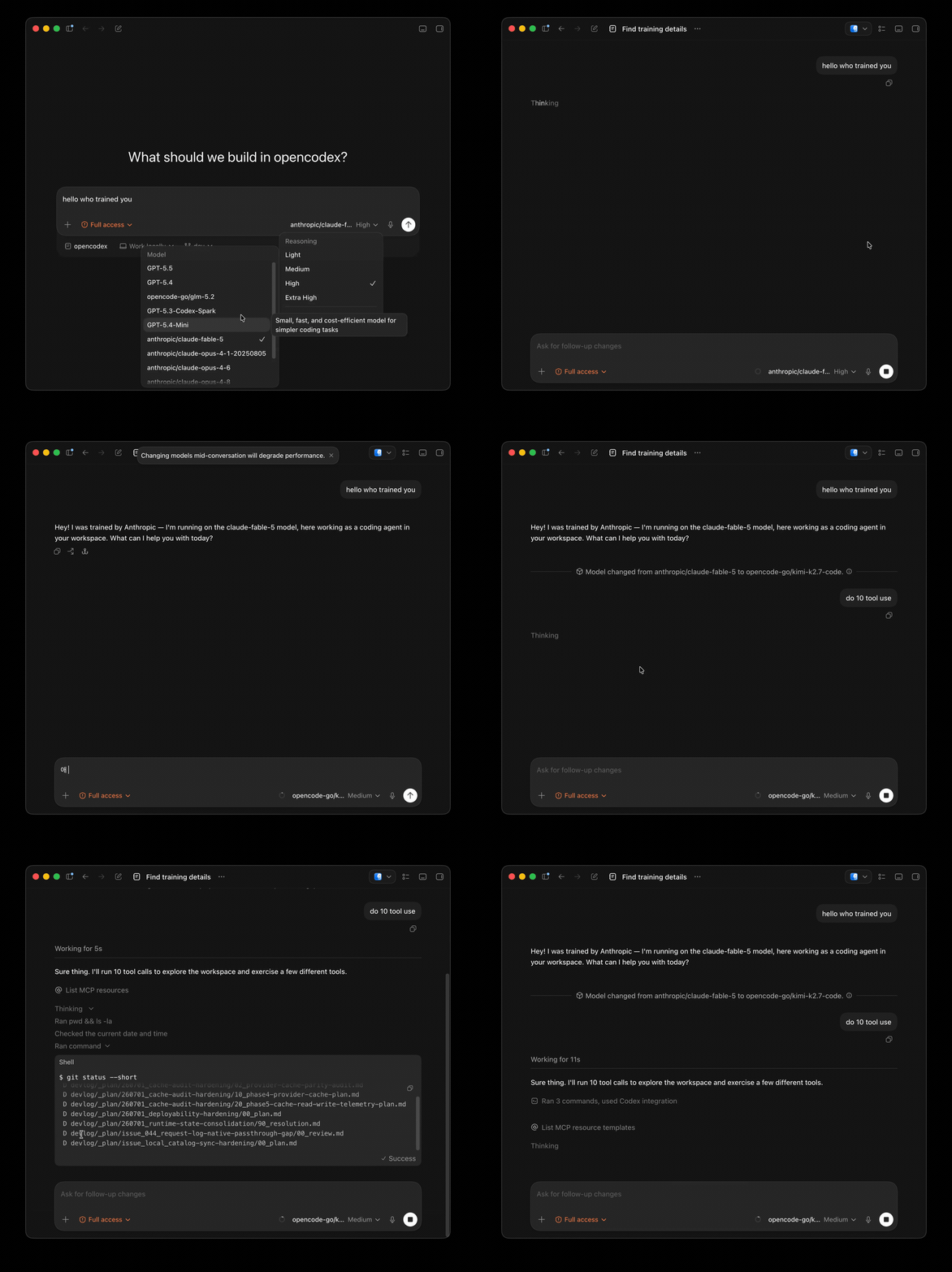
Universal provider proxy for OpenAI Codex & Claude Code — use any LLM (Claude, Gemini, Grok, DeepSeek, Ollama…) with Codex CLI, App, SDK, and Claude Code

Git-native persistent memory for AI coding agents. Implements Google OKF v0.2 with sub-300µs in-memory BM25 search, embedded MCP server, and progressive disclosure. Slashes token bloat by 80% with zero external databases or dependencies. Built in pure Go.

Stop your AI from making things up — it proposes, deterministic tools decide, every claim checked against ground truth with evidence. Grounded facts and context survive resets. Reverse engineering is the proving ground. MCP server + CLI.
x64dbg-MCP Server is a native MCP (Model Context Protocol) plugin for x64dbg that exposes the debugger's full functionality over HTTP. Connect any MCP-compatible AI assistant and control x64dbg programmatically: set breakpoints, step through code, read memory, dump registers, and more. Built with Zig — zero dependencies, single-binary output, cros