saadnvd1/
agent-os

saadnvd1/agent-osTools
Mobile-first web UI for managing AI coding sessions (Claude Code, Codex, Aider, Gemini CLI, Amp, Pi). Self-hosted with multi-pane terminals, git integration, and session orchestration.
168
Mobile-first web UI for managing AI coding sessions (Claude Code, Codex, Aider, Gemini CLI, Amp, Pi). Self-hosted with multi-pane terminals, git integration, and session orchestration.

External-agent-first orchestration for AI coding workflows: dispatch to Antigravity CLI, Grok CLI, Claude Code, and Codex CLI with structured receipts, recovery, and low-token wait/watch.

Agent Fusion is a local RAG semantic search engine that gives AI agents instant access to your code, documentation (Markdown, Word, PDF). Query your codebase from code agents without hallucinations. Runs 100% locally, includes a lightweight embedding model, and optional multi-agent task orchestration. Deploy with a single JAR

Nexent is a zero-code platform for auto-generating production-grade AI agents using Harness Engineering principles — unified tools, skills, memory, and orchestration with built-in constraints, feedback loops, and control planes.

An enterprise AI development framework for building AI agents. It provides unified management of multi-provider LLMs, secure enterprise knowledge bases with high-precision retrieval, visual workflow orchestration and multi-agent coordination. Compatible with mainstream Agent Skill standards, it enables developers to efficiently build production-gra

28 plugins and MCP servers for Claude Code — TDD, multi-agent orchestration, iterative refinement, binary RE, structured decisions. Install any skill in one command.
MCP server that orchestrates language servers into agent-native workflows. 65 tools, 30 CI-verified languages.

AI-native agent harness for coding workflows by python: multi-model LLM orchestration, stateful sessions, tool governance, traceable delivery, and provider routing for GPT, Claude, DeepSeek, Qwen, Kimi, GLM, and MiniMax.

Self-hosted agent OS with skills, workflows, MCP, and second brain storage.

Agent OS: keep specialist agents in a hub, spin up a temporary orchestrator per task. Local-first, works with any model.

The Vibe Coding++™ platform - orchestrate multiple AI agents, experiment with isolated attempts, ship code you understand. Multi-agent kanban with MCP integration.

Intelligent Skill routing and workflow orchestration for AI agents — +21.12 pp reward, −29.6% tokens on SkillsBench with DeepSeekV4Flash-VE.

Better subagent experience for Codex and Claude users
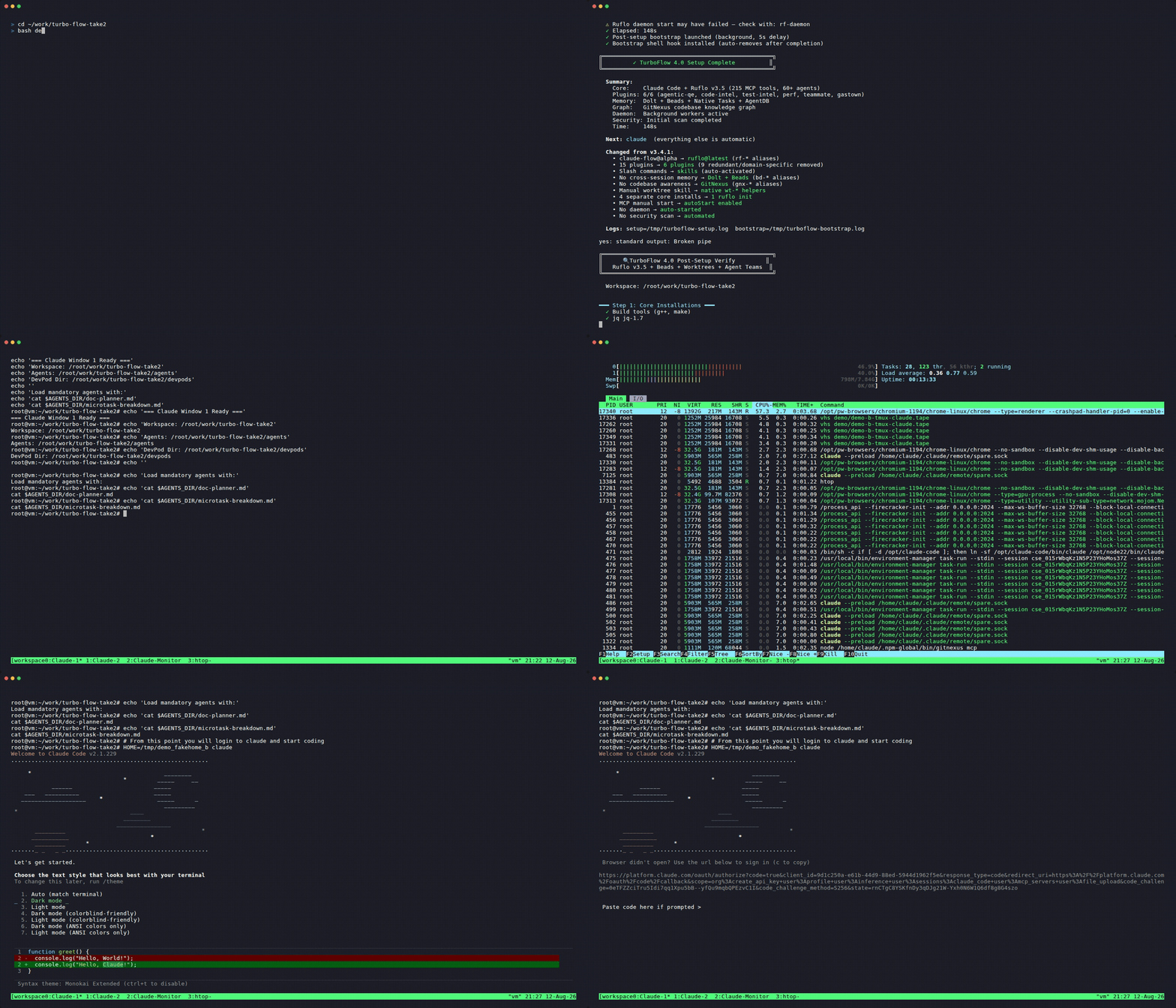
Agentic dev environment for DevPods, Codespaces & Rackspace Spot — one-command setup of Ruflo orchestration (215+ MCP tools, 60+ agents upstream).
Practical patterns, starters & CLI tools for loop engineering with AI coding agents. Design systems that prompt and orchestrate agents (inspired by Addy Osmani and Boris Cherny). Includes loop-audit, loop-init, loop-cost.

High-performance AI pipeline engine with a C++ core and 50+ Python-extensible nodes. Build, debug, and scale LLM workflows with 13+ model providers, 8+ vector databases, and agent orchestration, all from your IDE. Includes VS Code extension, TypeScript/Python SDKs, and Docker deployment.
Agor - team command center for all things agentic

Run Claude Code dynamic workflows on a local Codex (GPT) backend, plus an interactive run viewer

One dashboard for all your local AI coding agents. Switch providers, manage sessions, and orchestrate tasks across Codex, Claude Code, Gemini CLI, CodeBuddy Code, Pi, OpenCode, KiloCode, and OpenClaw. Zero cloud, local-first control plane.
CoCo Super Intelligence is the orchestration layer that turns Claude Code, Cursor, or Codex into an engineering department: a routed advisory board, 185 skills, 280 commands, persistent state. Local. Open-core — MIT core; Super Intelligence is proprietary, own-use.

ADE( Agentic Development Environment) The spec-driven environment for AI coding agents, where your planning becomes lasting, shared project context.

GoClaw - GoClaw is OpenClaw rebuilt in Go — with multi-tenant isolation, 5-layer security, and native concurrency. Deploy AI agent teams at scale without compromising on safety.

Multi-agent research automation framework for LLM agents, with adversarial lab meetings, paper-review rounds, auditable Markdown workflows, an autonomous runtime watchdog, and a pixel-art web dashboard.

This open-source curriculum introduces the fundamentals of Model Context Protocol (MCP) through real-world, cross-language examples in .NET, Java, TypeScript, JavaScript, Rust and Python. Designed for developers, it focuses on practical techniques for building modular, scalable, and secure AI workflows from session setup to service orchestration.