

JuliusBrussee/
caveman

🪨 why use many token when few token do trick — Claude Code skill that cuts 65% of tokens by talking like caveman
105k
1 add
Codex Mate gives you one local place to manage providers, sessions, skills, and tasks across several coding agents. It works through a CLI, a web UI, and an MCP server, while storing config and session data in your home directory.
Builders who want one local control plane for multiple coding agents and their sessions.
You can switch between agents, inspect past work, and orchestrate tasks without juggling separate configs.
Search, inspect, filter, convert, and export sessions from Codex, Claude Code, Gemini CLI, CodeBuddy Code, Pi, and others.
Switch and configure providers and models for Codex, Claude Code, OpenCode, KiloCode, OpenClaw, and Pi from the CLI or web UI.
Normalize Codex requests for OpenAI-compatible UIs and connect Claude Code to OpenAI Chat Completions-compatible providers and Ollama.
Import and share skills between different agent apps from a local-first skills market.
Edit global and project-level `CLAUDE.md` and `AGENTS.md` with shared presets and auto-detected project paths.
Plan and execute tasks with dependency tracking and logs.
Expose local tools and resources through MCP stdio.
Probe provider routes, surface broken configs, and remove failed entries without touching healthy ones.
brew tap SakuraByteCore/codexmate
brew install codexmate
npm install -g codexmate
codexmate run
CODEXMATE_PORT=8080 codexmate run
$env:CODEXMATE_PORT=8080; codexmate run
curl -fsSL https://raw.githubusercontent.com/SakuraByteCore/codexmate/main/scripts/install.sh | bash
One dashboard for all your local AI coding agents. Switch providers, manage sessions, and orchestrate tasks across Codex, Claude Code, Gemini CLI, CodeBuddy Code, Pi, OpenCode, KiloCode, and OpenClaw. Zero cloud, local-first control plane.
[Documentation] [Quick Start] [简体中文] [Tiếng Việt]









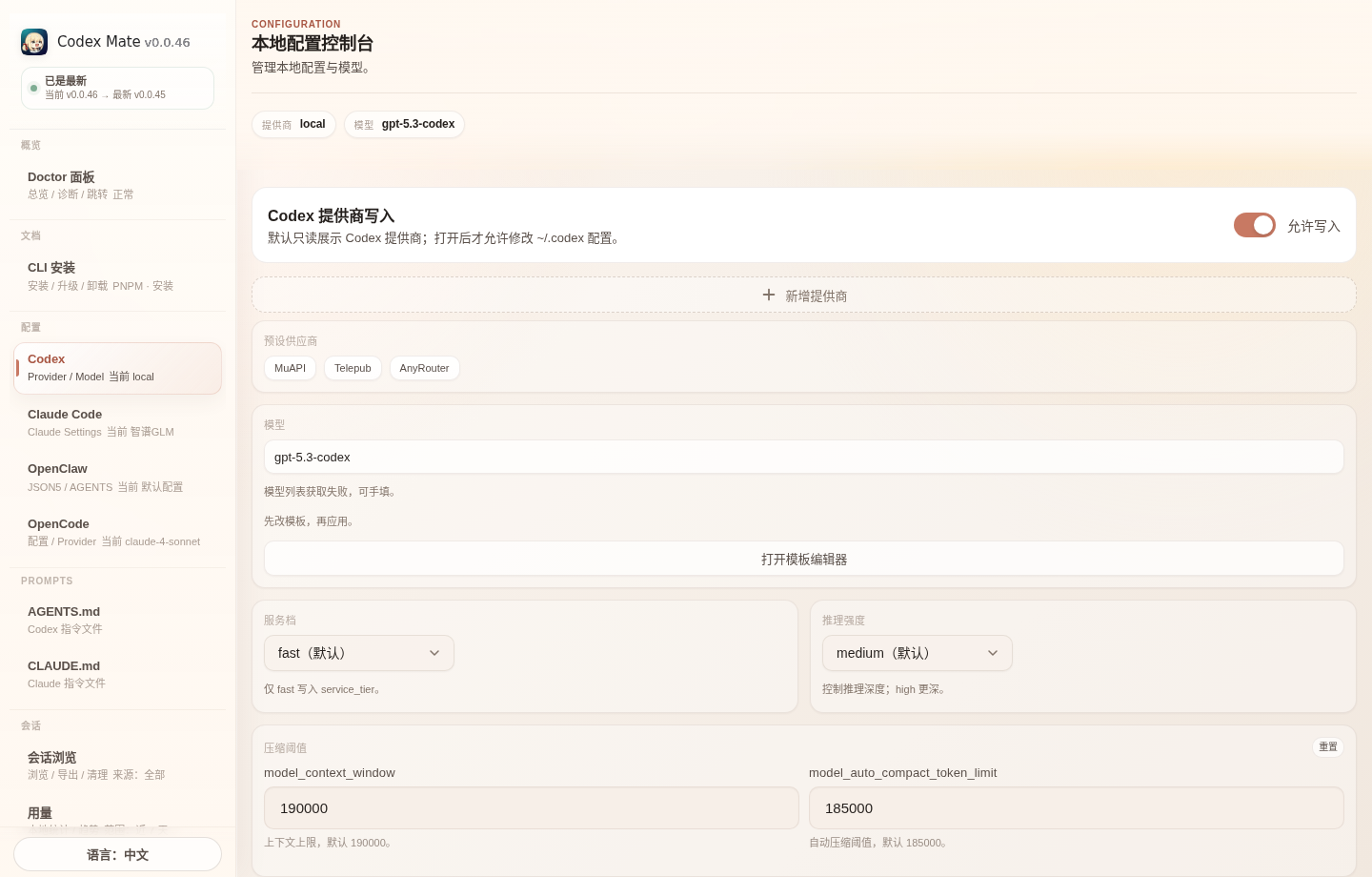
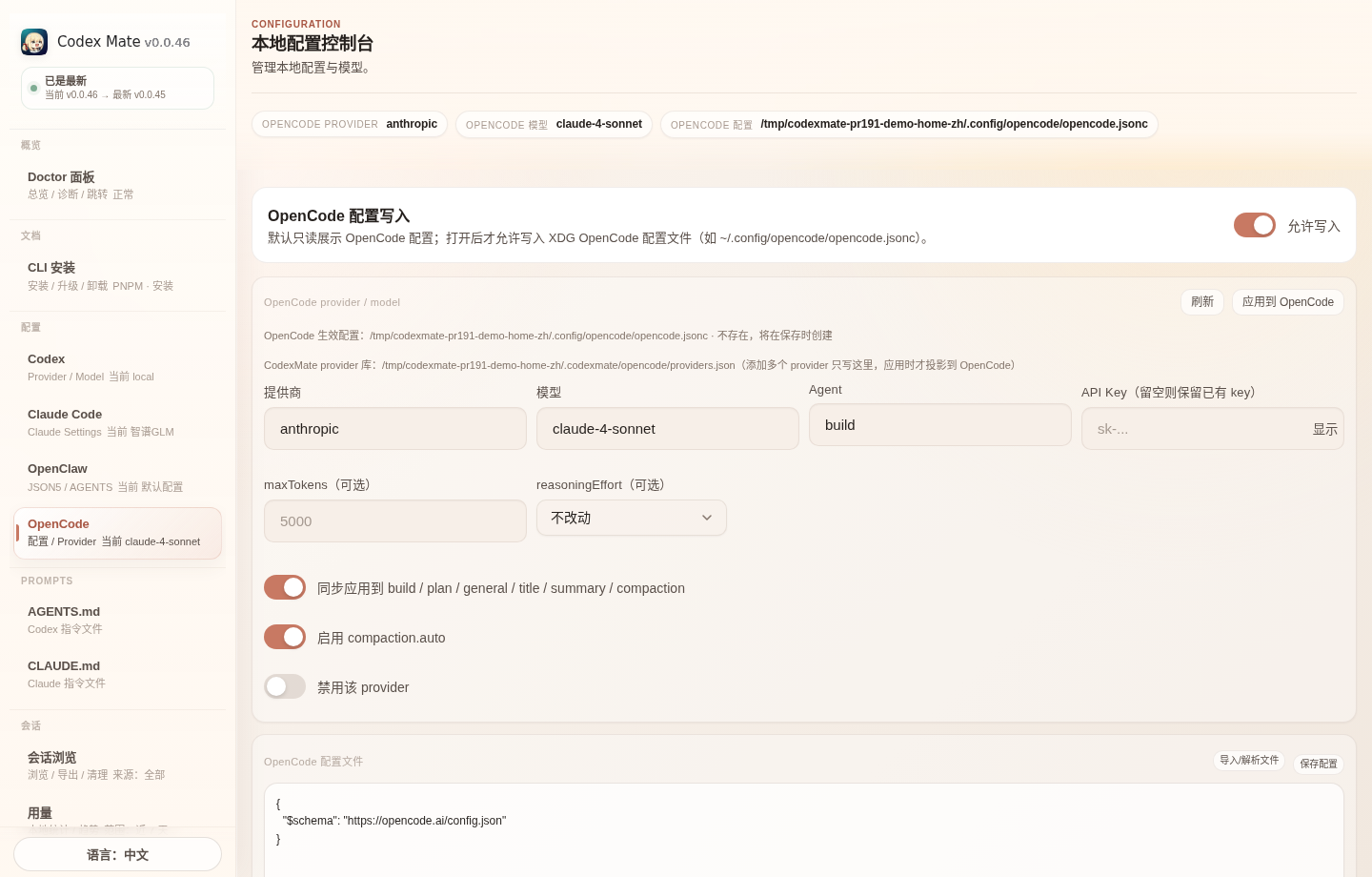
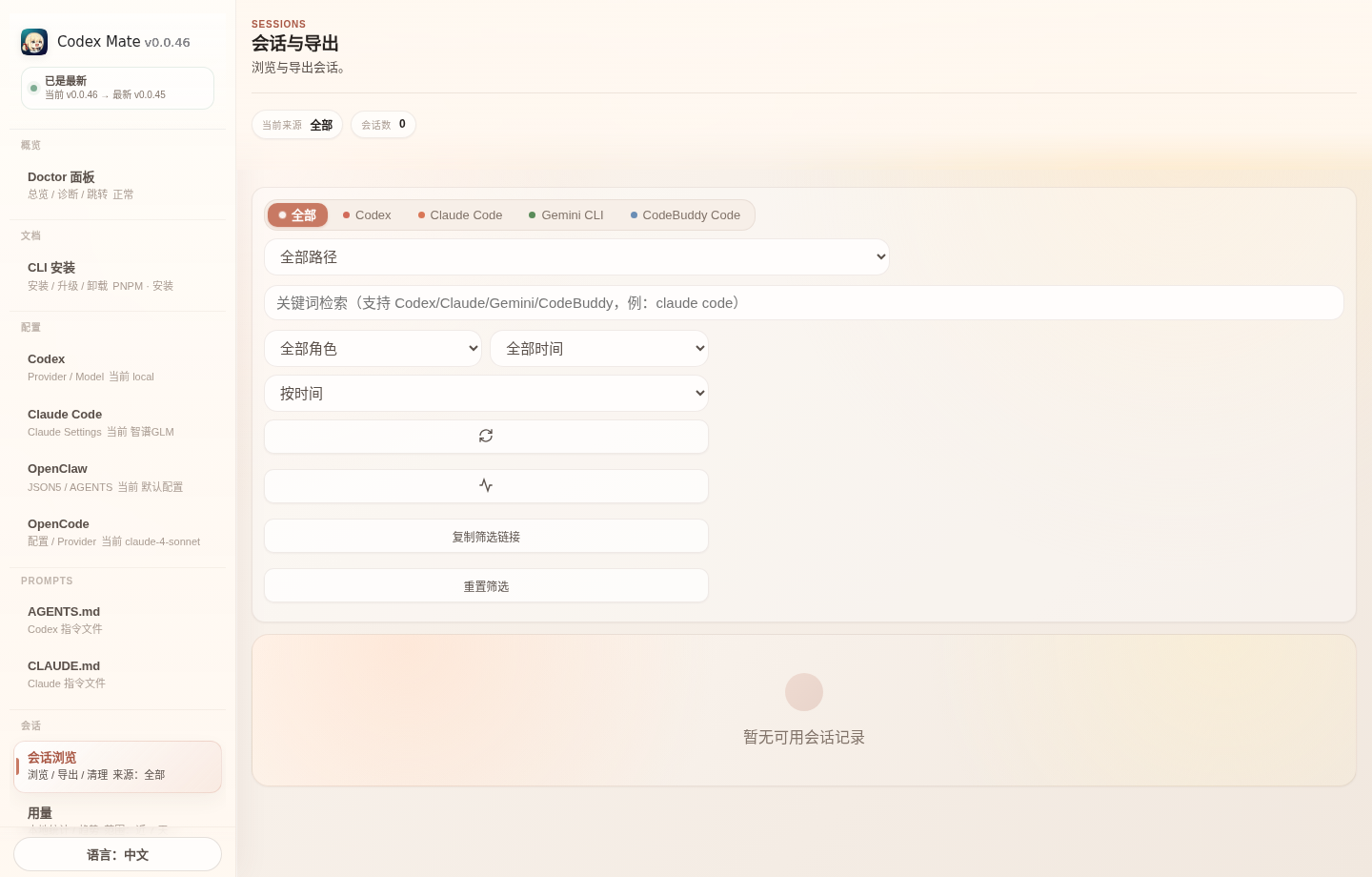
[!TIP] Local First: All configurations and sessions are stored in your home directory. No telemetry, no cloud accounts required.
[!IMPORTANT] This project is currently in early stage. We are seeking developers to help build the local agent ecosystem!
Have you ever felt overwhelmed by managing multiple local AI agents? Each has its own config format, session storage, and skills directory.
Codex Mate offers a unified control plane to bring order to the chaos. It's a local-first CLI + Web UI designed to manage Codex, Claude Code, OpenCode, KiloCode, OpenClaw, and Pi seamlessly.
Unlike simple wrappers, Codex Mate acts as a Local Agent Bridge:
User-Agent, Version, OpenAI-Beta, and Originator so upstream providers see an official Codex CLI-shaped request.~/.codexmate, projecting only the active provider into native OpenCode config to avoid polluting or deleting user-owned settings.~/.config/kilo/kilo.jsonc while preserving stored API keys.~/.pi/agent/models.json, auto-fetched remote model lists, and one-click default provider/model switching via ~/.pi/agent/settings.json.CLAUDE.md and AGENTS.md with auto-detection of project paths, plus a shared preset pool for reusable prompts.| Feature | Status | Description |
|---|---|---|
| Provider Management | ✅ | Switch providers/models for Codex, Claude, OpenCode, KiloCode, OpenClaw, and Pi |
| Live Agent Sync | ✅ | Real-time monitoring of Codex/Claude config & status |
| Session Browser | ✅ | Search, preview, filter, and export sessions across Codex, Claude Code, Gemini CLI, CodeBuddy Code, and Pi |
| Usage Analytics | ✅ | Visualize message trends and top projects |
| Local Skills Market | ✅ | Cross-app import/export of agent skills |
| Task Queue | ✅ | DAG-based task execution and logs |
| OpenAI Bridge | ✅ | Convert Codex Responses API to standard OpenAI format and attach/normalize Codex fingerprints in the built-in conversion |
| Claude Provider Bridge | ✅ | Connect Claude Code to OpenAI Chat Completions-compatible providers and Ollama via the built-in Claude-compatible proxy |
| OpenCode Provider Store | ✅ | Keep multiple OpenCode providers in ~/.codexmate while projecting only the selected provider to native OpenCode config |
| KiloCode Config Bridge | ✅ | Configure KiloCode through codexmate kilo config or the Web UI, writing provider URL/model/API key data to ~/.config/kilo/kilo.jsonc |
| Pi Provider Config | ✅ | Manage Pi providers in the Web UI writing to ~/.pi/agent/models.json (unknown fields preserved) and switch the default provider/model in ~/.pi/agent/settings.json |
| Provider Health Check | ✅ | Probe local Codex/Claude provider routes, highlight failed configs, and bulk-remove selected broken providers safely |
| Prompt Templates | ✅ | Reusable prompt plugins with variables |
| Prompt File Editor | ✅ | Edit global and project-level CLAUDE.md / AGENTS.md with auto-detect, path switching, and a shared preset pool. Applying a preset only updates the editor; save manually to write the file. |
| MCP Integration | ✅ | Expose local tools and resources via MCP stdio |
| Auto Update | ✅ | Quick update CLI via codexmate update |
brew tap SakuraByteCore/codexmate
brew install codexmate
Requires Node.js (brew install node if not present).
npm install -g codexmate
codexmate run
If the default Web UI port 3737 is unavailable, Codex Mate automatically tries the next ports (3738, 3739, ...). To force a fixed port, set CODEXMATE_PORT:
CODEXMATE_PORT=8080 codexmate run
Windows PowerShell:
$env:CODEXMATE_PORT=8080; codexmate run
curl -fsSL https://raw.githubusercontent.com/SakuraByteCore/codexmate/main/scripts/install.sh | bash
npm install -g @openai/codexnpm install -g @anthropic-ai/claude-codenpm install -g @google/gemini-clinpm install -g @tencent-ai/codebuddy-codenpm install -g @kilocode/cli (kilo / kilocode)~/.pi/agent/sessions; provider config lives in ~/.pi/agent/models.json and the default provider/model in ~/.pi/agent/settings.json%%{ init: { 'flowchart': { 'curve': 'catmullRom' } } }%%
flowchart TD
User([User])
CLI[CLI]
WebUI[Web UI]
MCP[MCP Server]
subgraph Mate [Codex Mate Core]
API[HTTP API]
Config[Config Engine]
Session[Session Manager]
Skills[Skills Market]
Tasks[Task Runner]
end
subgraph Local [Local Filesystem]
CodexDir[~/.codex]
ClaudeDir[~/.claude]
ClawDir[~/.openclaw]
OpenCodeDir[~/.config/opencode]
MateDir[~/.codexmate]
State[Sessions/Usage/Trash]
end
User --> CLI & WebUI & MCP
CLI & WebUI & MCP --> API
API --> Config & Session & Skills & Tasks
Config --> CodexDir & ClaudeDir & ClawDir & OpenCodeDir & MateDir
Session --> State
Skills --> Local
Special thanks to all contributors for their contributions to Codex Mate ❤️
Apache-2.0
Sign in to join the discussion.
No comments yet. Be the first to say what this is good for.
🪨 why use many token when few token do trick — Claude Code skill that cuts 65% of tokens by talking like caveman

The best-benchmarked open-source AI memory system. And it's free.

Orca is the ADE for working with a fleet of parallel agents. Run any coding agent with your own subscription. Available on desktop, mobile and remote runtime.
A cross-platform desktop All-in-One assistant for Claude Code, Codex, OpenCode, OpenClaw, Grok Build & Hermes Agent. Only official website: ccswitch.io

Never stop coding. Free MIT AI gateway: one endpoint, 352 providers (150+ free), 1200+ models Kimi, Claude, GPT, Gemini, GLM, DeepSeek, MiniMax. Works with Claude Code, Codex, Cursor, OpenCode, Cline & Copilot. Quota-aware auto-fallback, RTK+Caveman compression saves 15-95% tokens, MCP/A2A, Desktop/PWA. Built by 550+ contributors

Compress tool outputs, logs, files, and RAG chunks before they reach the LLM. 20% fewer tokens for coding agents, 60-95% fewer tokens for JSON, same answers. Library, proxy, MCP server.