Interactive terminals for AI agents, built for what you can't --yes away. SSH+MFA, GRUB/U-Boot, debconf installers, SOL/serial consoles, fsck, cryptsetup, pdb/gdb, apt, certbot, pwsh and even Vim in tmux-backed sessions. Agent-driven, human-assisted for secrets/MFA. Single-file Python. Agent Skill. CI with 700+ tests. BSD License.

Local-first 3-in-1 AI memory layer & MCP server for Claude Code, Codex, Grok, Gemini, VS Code and Cursor. Fuses session history, codebase indexing & concept graphs in SQLite. Enables zero-cloud, privacy-first context & instant recall, supports multi-agent swarms.
Collaborative multi-agent AI coding workspace: aggregate sessions from Claude Code, Codex, OpenCode, Pi, Grok Build, etc. Desktop app, self-hosted server, or Docker.
Personal AI assistant for work inside corporate constraints, built on coding agents and the tools, sessions, and permissions you already have.
Persistent, branch-aware workflow state memory MCP server for AI coding assistants. Tracks tasks, accepted decisions, and active blockers to prevent session context bloat and speed up development.

The Cursor10x MCP is a persistent multi-dimensional memory system for Cursor that enhances AI assistants with conversation context, project history, and code relationships across sessions.
Persistent memory graph for AI agents. Facts, decisions, entities, and relationships that survive across sessions, tools, and providers. MCP server — works with Claude, Cursor, ChatGPT, and any MCP client.
🚀 A real-time monitoring dashboard for Claude Code & Codex, built with SQLite3, Node.js, Express, React, Vite, TailwindCSS, & WebSockets. It tracks sessions, agent activity, tool usage, and subagent orchestration, providing live analytics, a Kanban status board, status notifications, a cute buddy, & an interactive web UI/MacOS/Windows native app.

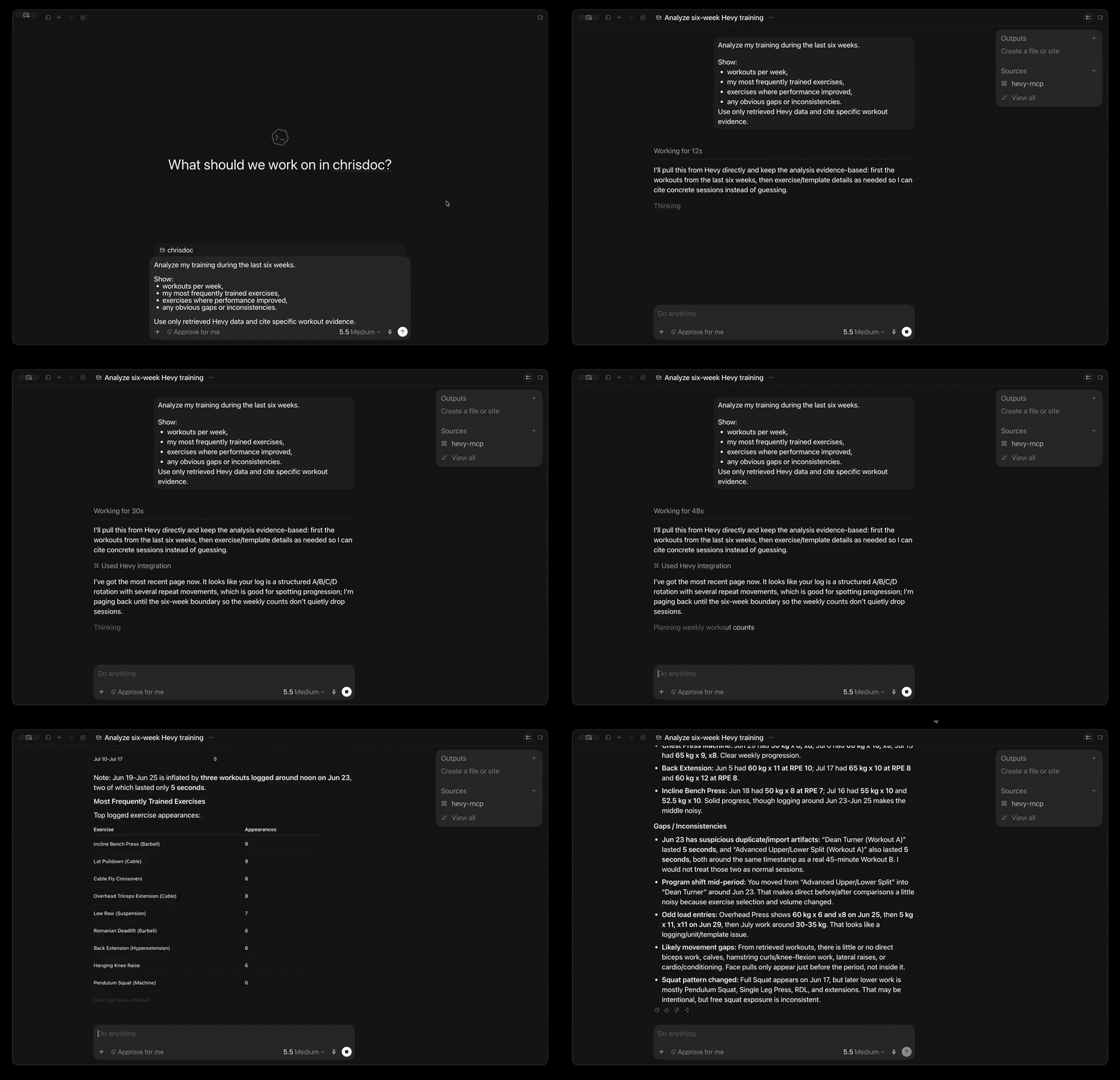
Manage your Hevy workouts, routines, folders, and exercise templates. Create and update sessions faster, organize plans, and search exercises to build workouts quickly. Stay synced with changes so your training log is always up to date.
MCP-native code retrieval for AI agents — 84-88% fewer read tokens, BM25F + semantic search, AST chunks, session dedup
Persistent file-based planning for AI coding agents and long-running tasks. Crash-proof markdown plans, session recovery after /clear and compaction, per-turn re-injection against context rot, deterministic completion gate. Manus-style. Install from npm, the Claude Code plugin marketplace, or npx skills. Codex, Cursor, OpenCode, 60+ agents.
Local RAG layer and optimizer for your Markdown knowledge base. CLI + MCP server: grounded answers for any AI client, stale-note detection, session harvesting into memories. Local-first.
First open-source OpenEvidence MCP server: browser-session medical research tools for Codex, Claude Code, and MCP clients
One config to rule all your AI agents: portable (every project, every session), effective (curated writing, routing, skills), and safer (destructive-command guard).

A disciplined methodology for AI-assisted software development. Covers architectural constraints, validation hooks, session governance, and PAG (Pattern Abstract Grammar) for structured AI collaboration. Copy claude-setup/ into your project to start.
📜 An MCP server for conversation history search and retrieval in Claude Code
Claude Code learns from your corrections: self-correcting memory that compounds over 50+ sessions. Context engineering, parallel worktrees, agent teams, and 17 battle-tested skills.
Governance gateway for AI agents — bounded, auditable, session-aware control with MCP proxy, shell proxy & HTTP API. Works with Cursor, Claude Code, Codex, and any MCP-compatible agent.
Drive your real, logged-in Chrome from any AI agent (Claude Code, Codex, Cursor, VS Code) — works where headless dies. Reads emailed login codes from your Gmail, 40 tools, up to 20 concurrent sessions. MIT, local-only.
🔮 Run all your AI coding agents in tmux: jump to the one that needs you, spawn them into worktrees, and hand work between them
This open-source curriculum introduces the fundamentals of Model Context Protocol (MCP) through real-world, cross-language examples in .NET, Java, TypeScript, JavaScript, Rust and Python. Designed for developers, it focuses on practical techniques for building modular, scalable, and secure AI workflows from session setup to service orchestration.
Multi-harness control protocol that turns requests into approved design contracts, orchestrating isolated worker sessions for sequential implementation and independent code reviews under Orca supervision for Claude Code, Codex, Cursor, Antigravity, and other AI coding agents.

The native macOS & iOS app for browsing AI agent memory files — Claude Code, OpenClaw, Codex, Cursor, Gemini
Task tracking for Agents