
koala73/worldmonitorConnectors
Real-time global intelligence dashboard. AI-powered news aggregation, geopolitical monitoring, and infrastructure tracking in a unified situational awareness interface
86k
This repo exposes SO-ARM100 robot control through MCP so agent clients can send natural language requests to a real robot. It also ships a direct keyboard controller and a CLI agent that talks to Claude, Gemini, or GPT through the same MCP server.
Builders who want their agent to control an SO-ARM100 or LeKiwi arm.
You can connect an MCP client to a robot and control it with natural language instead of manual scripts.
Runs `mcp_robot_server.py` with `stdio`, `sse`, or `streamable-http` transports so MCP clients can call robot actions.
Lets you move the robot locally with `python keyboard_controller.py` before using the agent setup.
Runs `agent.py` to talk to the robot through MCP with Claude, Gemini, or OpenAI models.
Uses `python check_positions.py` to inspect robot state and calibration without sending movement commands.
Includes provider code in `llm_providers/` for Claude, Gemini, and OpenAI model wiring.
python -m venv .venv
source .venv/bin/activate  # or .venv\Scripts\activate on Windows
pip install -r requirements.txt
python check_positions.py
python keyboard_controller.py
mcp dev mcp_robot_server.py
mcp run mcp_robot_server.py --transport SELECTED_TRANSPORT
python agent.py

A companion repository to my video about MCP server for the robot:
If you want to know more about MCP refer to the official MCP documentation
This repository suppose to work with the SO-ARM100 / 101 robots. Refer to lerobot SO-101 setup guide for the detailed instructions on how to setup the robot.
Update! Now it partially supports LeKiwi (only arm, the mobile base control through MCP is TBD). I also added a simple agent that uses MCP server to control the robot. It supports Claude, Gemini and GPT models. In my experience Claude is the best and GPT is not so good, Gemini is in between.
After I released the video and this repository, LeRobot released a significant update of the library that breaks the compatibility with the original code.
If you want to use the original code and exactly follow the video, please use this release.
For simplicity I use simple pip instead of uv that is often recommended in MCP tutorials - it works just fine.
python -m venv .venv
source .venv/bin/activate  # or .venv\Scripts\activate on Windows
pip install -r requirements.txt
It may be required to install lerobot separately, just use the official instructions from the lerobot repository
config.py with your serial port for so-arm (e.g., /dev/tty.usbmodem58FD0168731) or robot_ip for lekiwi (e.g., 192.168.1.1)config.py with the correct indices and names (for lekiwi only names are important)🔍 Check Robot Status and Calibration:
python check_positions.py
This will show you the current robot state without actual control. Move your robot manually to make sure it is properly calibrated and configured.
After the latest update, lerobot is using the normalized joints states instead of degrees. You can update MOTOR_NORMALIZED_TO_DEGREE_MAPPING in config.py to match your robot calibration. You will need to update these values every time you recalibrate the robot.
🎮 Manual Keyboard Control:
python keyboard_controller.py
Now you can try to control the robot manually using the keyboard. Test it before moving on to the MCP step, to make sure it works properly.
🛠️ MCP server in the dev mode
mcp dev mcp_robot_server.py
Final test step - to debug the MCP server, use the UI to connect to it and try to send some requests.
🤖 AI Agent Control (MCP Server):
WARNING: using MCP server itself is free, but it requires MCP client that will send requests to some LLM. Generally it is not free - and controlling the robot with MCP can become expensive, as it sends multiple agentic requests with images that use a lot of tokens. Make sure you understand and control your token usage and corresponding costs before doing it. The actual cost depends on the client and models you use, and it is your responsibility to monitor and control it.
mcp run mcp_robot_server.py --transport SELECTED_TRANSPORT
Supports: stdio, sse, streamable-http
Now your server can be added to any MCP client.
Different clients can support different transports, you can choose the one that works best for you. The functionality is the same.
Add to your MCP configuration:
{
  "mcpServers": {
    "SO-ARM100 robot controller": {
      "command": "/path/to/.venv/bin/python",
      "args": ["/path/to/mcp_robot_server.py"]
    }
  }
}
Run the server in terminal with the SSE transport:
mcp run mcp_robot_server.py --transport sse
Add to your MCP configuration:
{
  "mcpServers": {
    "SO-ARM100 robot controller": {
      "url": "http://127.0.0.1:3001/sse"
    }
  }
}
It is suppose to be a replacement for SSE but currently not so many clients support it.
Run the server in terminal with the Streamed-HTTP transport:
mcp run mcp_robot_server.py --transport streamable-http
Add to your MCP configuration:
{
  "mcpServers": {
    "SO-ARM100 robot controller": {
      "url": "http://127.0.0.1:3001/mcp"
    }
  }
}
Now you can go to you Client and it should be able to control the robot when you give it the natural language instructions.
Start the MCP server with the SSE transport:
mcp run mcp_robot_server.py --transport sse
Now you can use the AI agent to control the robot with natural language instructions.
Create a .env file in the project root with your API keys:
# API Keys (at least one required)
ANTHROPIC_API_KEY=your_anthropic_api_key_here
GEMINI_API_KEY=your_gemini_api_key_here
OPENAI_API_KEY=your_openai_api_key_here

# MCP Server Configuration (optional)
MCP_SERVER_IP=127.0.0.1
MCP_PORT=3001
python agent.py
# Use Gemini instead of Claude
python agent.py --model gemini-2.5-flash

# Override API key
python agent.py --api-key your_api_key_here

# Enable image viewer window
python agent.py --show-images

# Increase thinking budget for better reasoning
python agent.py --thinking-budget 2048

# Custom MCP server location
python agent.py --mcp-server-ip 192.168.1.100 --mcp-port 3002
Claude (Anthropic):
claude-3-7-sonnet-latest (default)Gemini (Google):
gemini-2.5-flashgemini-2.5-proGPT (OpenAI):
gpt-4o and variantsOverall I didn't manage to get good results with GPT models.
--model: LLM model to use (default: claude-3-7-sonnet-latest)--api-key: API key override (uses .env file by default)--show-images: Display robot camera images in a window--thinking-budget: Thinking tokens budget (default: 1024, 0 to disable)--thinking-every-n: Use thinking every N steps (default: 3)--mcp-server-ip: MCP server IP address (default: 127.0.0.1)--mcp-port: MCP server port (default: 3001)Token Usage:
Sign in to join the discussion.
No comments yet. Be the first to say what this is good for.
Real-time global intelligence dashboard. AI-powered news aggregation, geopolitical monitoring, and infrastructure tracking in a unified situational awareness interface
High-performance code intelligence MCP server. Indexes codebases into a persistent knowledge graph — average repo in milliseconds. 158 languages, sub-ms queries, 99% fewer tokens. Single static binary, zero dependencies.
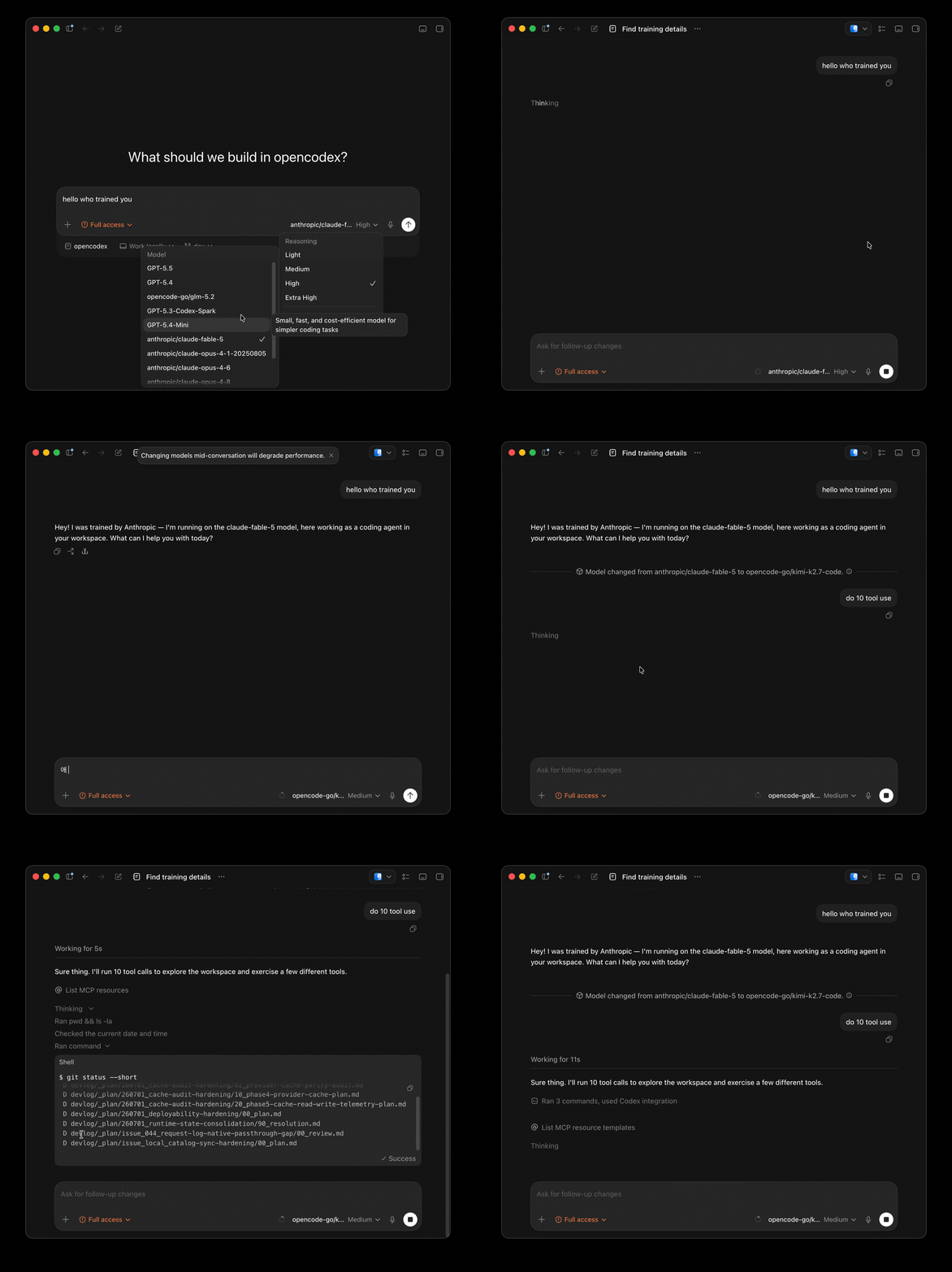
Universal provider proxy for OpenAI Codex & Claude Code — use any LLM (Claude, Gemini, Grok, DeepSeek, Ollama…) with Codex CLI, App, SDK, and Claude Code

Git-native persistent memory for AI coding agents. Implements Google OKF v0.2 with sub-300µs in-memory BM25 search, embedded MCP server, and progressive disclosure. Slashes token bloat by 80% with zero external databases or dependencies. Built in pure Go.

Stop your AI from making things up — it proposes, deterministic tools decide, every claim checked against ground truth with evidence. Grounded facts and context survive resets. Reverse engineering is the proving ground. MCP server + CLI.
x64dbg-MCP Server is a native MCP (Model Context Protocol) plugin for x64dbg that exposes the debugger's full functionality over HTTP. Connect any MCP-compatible AI assistant and control x64dbg programmatically: set breakpoints, step through code, read memory, dump registers, and more. Built with Zig — zero dependencies, single-binary output, cros