
koala73/worldmonitorConnectors
Real-time global intelligence dashboard. AI-powered news aggregation, geopolitical monitoring, and infrastructure tracking in a unified situational awareness interface
86k
This repo adds persistent project memory for agent workflows using the OKF v0.2 format. It keeps the memory in plain Markdown under `knowledge/`, searches it with local BM25, validates links and metadata, and exposes it through `okf mcp` for agent tools.
Builders who want their agents to keep and query project memory inside the repo.
You can keep important decisions, facts, and conventions available across sessions without an external database.
Stores memory in `knowledge/` as Markdown files with YAML frontmatter so changes stay reviewable in git.
Finds concepts in-memory with sub-millisecond search instead of calling an embedding service.
Runs `okf mcp knowledge` over stdio so agent apps can query project memory as a tool.
Creates the OKF memory structure, agent skill files, `AGENTS.md`, and helper Makefile targets.
Checks bundle conformance, graph connectivity, and description drift with the CLI.
make build
# Bootstrap full memory stack into target project
./bin/okf bootstrap /path/to/my-project --name "My Service"
./bin/okf mcp knowledge
A Domain-Neutral, Git-Native Persistent Project Memory for AI Agents based on the Open Knowledge Format (OKF) v0.2.




Conversations with AI agents reset when context windows close. Valuable architectural decisions, domain discoveries, and operational facts are lost unless stored persistently.
OKF Agent Memory provides a standardized, vendor-neutral memory layer that lives directly in your repository (knowledge/) as plain Markdown files with YAML frontmatter. It bridges the gap between unstructured ad-hoc markdown files (CLAUDE.md, AGENTS.md) and complex, black-box vector databases.
flowchart TD
    L1["1. OKF v0.2 Specification<br/>(Normative Markdown & YAML Format)"]
    L2["2. Agent Memory Convention<br/>(Behavioral Rules: Search, Review, Trust)"]
    L3["3. Agent Skill<br/>(LLM Prompts & Operational Workflows)"]
    L4["4. Tooling Layer: Go Library & CLI<br/>(Deterministic Parsing, Validation, Search, MCP)"]
    L5["5. Project Knowledge Corpus<br/>(knowledge/ OKF Bundle)"]

    L1 --> L2
    L2 --> L3
    L3 --> L4
    L4 --> L5
git diff and git log. No external database required.sources), trust tiers (generated vs. verified), and lifecycle metadata (status, stale_after).index.md files and link graphs) so agents only load the exact concepts they need.okf mcp).Built in Go with zero external dependencies, okf is engineered for high-frequency agent tool calling loops:
| Benchmark Metric | Python / Vector DB Runtimes (Mem0, Letta) | Deno / Node.js Tooling | OKF Agent Memory (Go) |
|---|---|---|---|
| Concept Search Latency | 150ms – 800ms (Embedding API + Vector DB) | 40ms – 120ms | < 300 µs (Microseconds, In-Memory BM25) |
| Full Corpus Parse & Graph Validation | 200ms – 1.5s | 80ms – 250ms | ~4.0 ms (50+ concepts, bidirectional graph) |
| Process Cold-Start Overhead | 250ms – 600ms (Python VM boot) | 80ms – 180ms (V8 / Deno boot) | < 4 ms (Compiled Single Binary) |
| Retrieval Cost per 1,000 Queries | ~$0.10 – $0.50 (Embedding tokens) | $0.00 | $0.00 (Zero API cost, fully local) |
| Memory Footprint (RSS) | ~120 MB – 350 MB | ~60 MB – 140 MB | < 15 MB |
[!TIP] Reproduce Locally with your own LLM: We provide an automated benchmark runner in pure Go to verify Time-To-First-Token (TTFT) speedups and -80% token reduction on your local hardware (LM Studio / Ollama with Gemma, Qwen, Llama). Run
make benchmarkor explore the Progressive Disclosure Benchmark Suite.
Clone the repository and compile the standalone okf executable:
make build
This generates the standalone binary at bin/okf.
# Validate bundle conformance, graph connectivity, and description drift
./bin/okf validate knowledge --strict --drift

# Search concepts via in-memory BM25 scoring
./bin/okf search "architecture layers" knowledge

# Inspect a concept and its relationships (with --json support)
./bin/okf show architecture/layers knowledge --json

# Create a new concept with automated log.md and index.md bookkeeping
./bin/okf create decisions/auth-flow knowledge \
  --type Decision \
  --title "OAuth2 Authorization Flow" \
  --desc "Standardized on PKCE for client authentication."

# Update an existing concept
./bin/okf update decisions/auth-flow knowledge \
  --desc "Updated OAuth2 PKCE token refresh interval."

# Bootstrap full agent memory stack into any target project
./bin/okf bootstrap /path/to/project --name "My Project"

# Initialize only a bare OKF bundle in any directory
./bin/okf init my-project/knowledge
Scaffold the complete OKF Agent Memory architecture into any new or existing repository with a single command:
# Bootstrap full memory stack into target project
./bin/okf bootstrap /path/to/my-project --name "My Service"
This automatically sets up:
knowledge/ — OKF v0.2 compliant persistent memory bundle (index.md, log.md).agents/skills/okf-memory/ — Embedded agent skill definition and capability guidesAGENTS.md — Project-tailored operating instructions for AI coding agentsMakefile — Convenience tasks for validation (make validate) and search (make search q="...")okf ships with a native Model Context Protocol (MCP) server over stdio to seamlessly connect with Claude Code, Cursor, Codex, and other agent platforms:
./bin/okf mcp knowledge
claude_desktop_config.json or Cursor):{
"mcpServers": {
"okf-memory": {
"command": "/path/to/okf-agent-memory/bin/okf",
"args": ["mcp", "/path/to/project/knowledge"]
}
}
}
okf-agent-memory/
├── benchmarks/             # Progressive disclosure benchmark suite & hardware test data
│   ├── data/               # Monolith docs vs OKF bundle test fixtures
│   └── results/            # Reproducible benchmark logs across 8+ local & cloud LLMs
├── cmd/
│   ├── okf/                # Standalone CLI and embedded MCP server (`stdio`)
│   └── okf-benchmark/      # Automated benchmark runner for LLM TTFT & token measurements
├── docs/                   # Guides, specifications, architecture & release playbook
│   ├── AGENT_TESTING.md    # Multi-agent testing, prompt scenarios & compatibility matrix
│   ├── ALTERNATIVES.md     # Comparison against Mem0, Letta, and ad-hoc markdown
│   ├── CLI.md              # Complete command-line & MCP tool reference
│   ├── CONVENTION.md       # OKF Agent Memory Convention v0.1
│   ├── GETTING_STARTED.md  # Comprehensive onboarding guide
│   ├── OKF-COMPATIBILITY.md# OKF v0.2 spec compatibility analysis
│   ├── RELEASE_PLAYBOOK.md # Automated release process & version tagging
│   ├── ROADMAP.md          # Project roadmap & milestones
│   └── SECURITY.md         # Data governance, secret prevention & PII rules
├── examples/               # Domain-neutral reference OKF v0.2 bundles
│   ├── books/              # Literature & cognitive science knowledge bundle
│   ├── coaching/           # Executive coaching & client session bundle
│   └── software/           # Microservices architecture & ADR bundle
├── knowledge/              # Project's own OKF v0.2 persistent memory bundle
│   ├── index.md            # Root progressive disclosure index (okf_version: "0.2")
│   ├── log.md              # Dated change log (ISO 8601 YYYY-MM-DD)
│   ├── project/            # Overview & value propositions
│   ├── architecture/       # 5-tier architecture & tooling decisions
│   ├── convention/         # Principles & lifecycle workflows
│   └── roadmap/            # Milestones
├── packaging/              # Distribution packaging
│   └── homebrew/           # Official Homebrew formula & tap instructions
├── pkg/okf/                # Zero-dependency Go core library (parser, validator, BM25, MCP, bootstrap)
├── AGENTS.md               # Operating instructions for AI coding agents
├── CONTRIBUTING.md         # Contribution guidelines & development workflow
├── Makefile                # Build, test, lint, validation & release targets
├── LICENSE                 # MIT License
├── README.md               # Main repository documentation
└── SECURITY.md             # Security policy & reporting guidelines
Run the full test suite and validate the repository's self-documenting knowledge bundle:
make check
MIT License. See LICENSE for details.
Sign in to join the discussion.
No comments yet. Be the first to say what this is good for.
Real-time global intelligence dashboard. AI-powered news aggregation, geopolitical monitoring, and infrastructure tracking in a unified situational awareness interface
High-performance code intelligence MCP server. Indexes codebases into a persistent knowledge graph — average repo in milliseconds. 158 languages, sub-ms queries, 99% fewer tokens. Single static binary, zero dependencies.
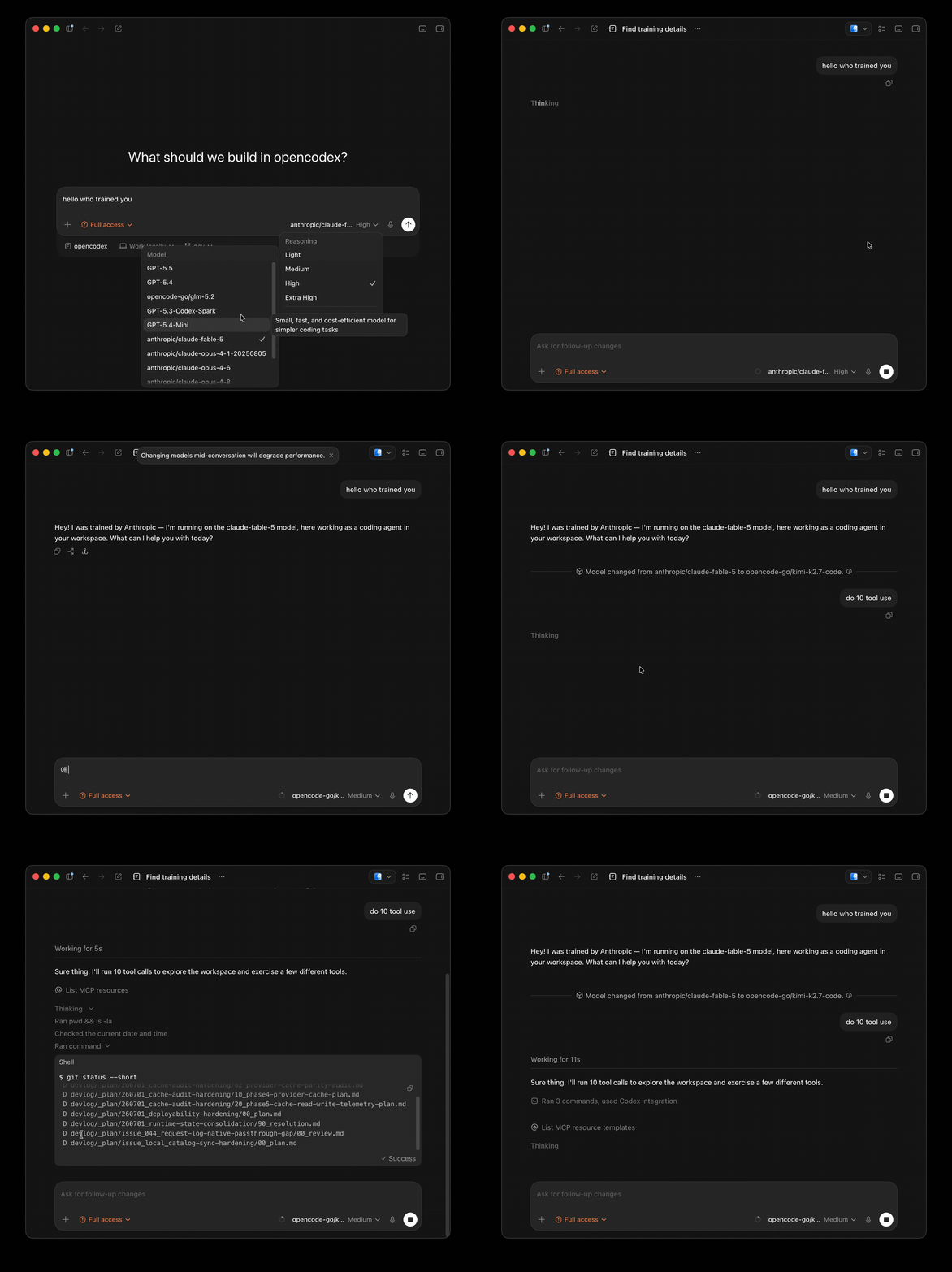
Universal provider proxy for OpenAI Codex & Claude Code — use any LLM (Claude, Gemini, Grok, DeepSeek, Ollama…) with Codex CLI, App, SDK, and Claude Code

Local-first code intelligence graph for MCP and CLI. Builds a persistent map of your codebase so AI coding tools read only what matters, with benchmarked context reductions on reviews and large-repo workflows.

Stop your AI from making things up — it proposes, deterministic tools decide, every claim checked against ground truth with evidence. Grounded facts and context survive resets. Reverse engineering is the proving ground. MCP server + CLI.
20 MB lightweight cross-platform database client for 90+ databases, including MySQL, PostgreSQL, SQLite, Redis, MongoDB, DuckDB, SQL Server, and Dameng. Built-in AI, MCP Server, CLI, desktop and Docker. | 轻量级跨平台数据库管理工具,支持 MySQL、PostgreSQL、SQLite、Redis、MongoDB、达梦等 90+ 数据库,提供桌面端、Docker、CLI、内置 AI 助手和 MCP Server。