
koala73/worldmonitorConnectors
Real-time global intelligence dashboard. AI-powered news aggregation, geopolitical monitoring, and infrastructure tracking in a unified situational awareness interface
86k
Minutes records meetings, calls, and voice memos on-device and saves the result as Markdown with YAML frontmatter. Claude Code, Codex, Cursor, and any MCP client can query the history you choose to share through the local MCP server or the CLI. The repo also ships skills, plugin files, and SDK pieces for working with the same notes from different agents.
Builders who want their agent to search meeting notes, decisions, and action items from local files they own.
You can capture conversations once and ask your agent about past decisions without re-explaining the context.
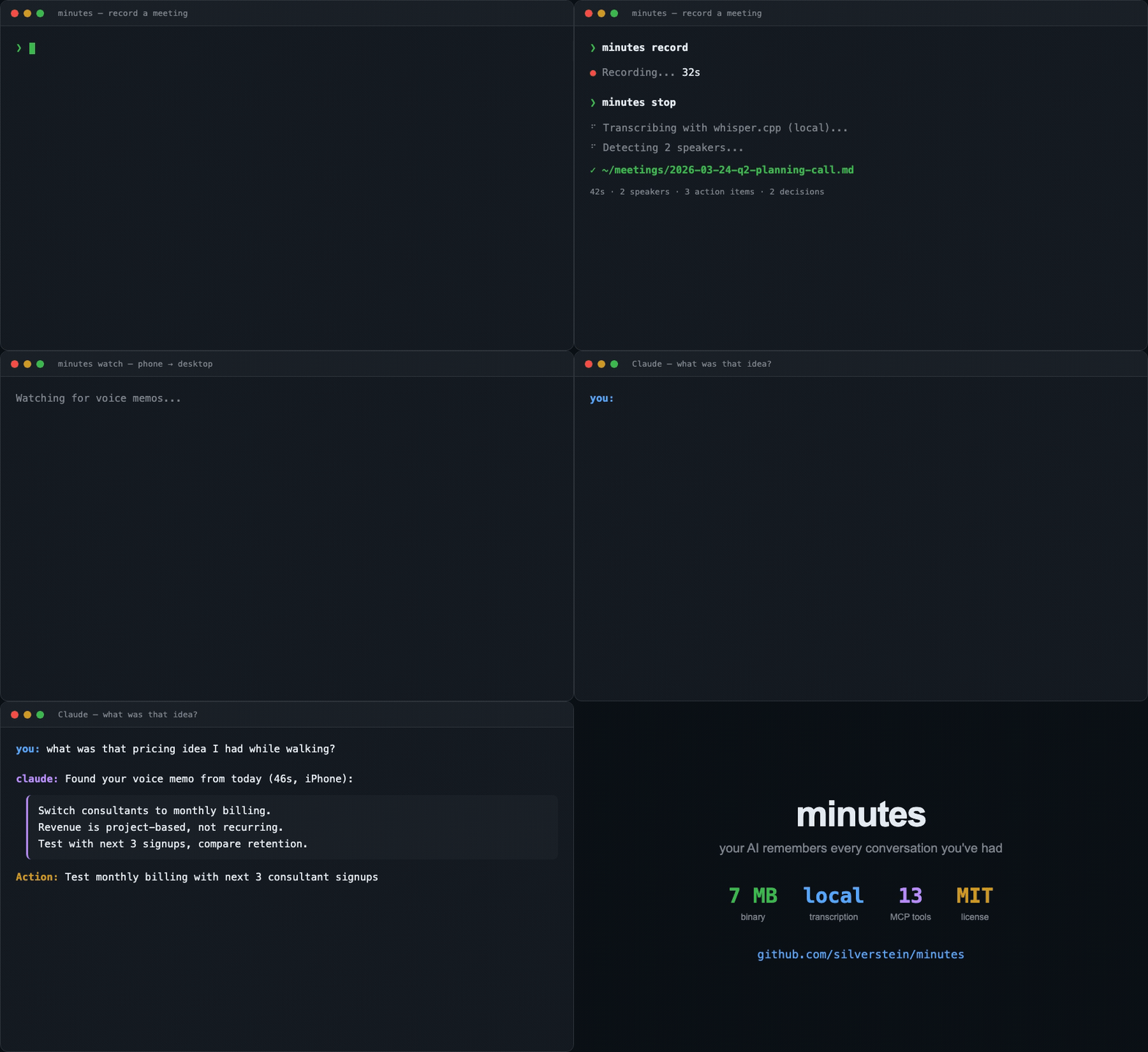
Records and transcribes meetings, calls, voice memos, and dictation on your device, then writes Markdown files in `~/meetings/`.
Exposes local meeting search and retrieval tools for Claude Code, Codex, Cursor, and any MCP client.
Provides local recording, stopping, demo data, import, search, and automation through `minutes` commands.
Includes agent-facing skills and plugin files for prep, capture, live help, debrief, and memory workflows.
Offers a TypeScript SDK for reading meeting files without going through MCP.
Keeps audio and transcription local by default, with consent reminders and restricted handling for sensitive meetings.
brew install --cask silverstein/tap/minutes
brew install silverstein/tap/minutes
cargo install minutes-cli
npx minutes-mcp  # or: claude mcp add minutes -- npx -y minutes-mcp




Minutes is a free, open-source conversation memory app for the AI you already use. Record and transcribe meetings, calls, voice memos, and dictation on your device, then let Claude Code, Codex, Cursor, or another MCP client search the history you choose to share. Your records are Markdown files you own in ~/meetings/.
Capture, transcription, and storage run locally. If you choose a cloud AI assistant or summarizer, the meeting context you authorize is sent to that provider.
Your conversations. Your memory. Ready for the AI you use.
brew install --cask silverstein/tap/minutes
brew install silverstein/tap/minutes
cargo install minutes-cli
npx minutes-mcp  # or: claude mcp add minutes -- npx -y minutes-mcp
If Homebrew reports an untrusted tap, run brew trust silverstein/tap once.
Add Minutes to your agent, seed five sample meetings (no mic needed), then ask about them:
claude mcp add minutes -- npx -y minutes-mcp
minutes demo --full
What did we decide about monthly billing, and did it stick?
The answer spans two meetings a month apart: launched on Feb 28, reversed on Mar 25.
A direct MCP call uses the same local meeting files:
search_meetings({"query":"monthly billing decision"})
Record a real one with minutes record, then minutes stop to transcribe. minutes demo --clean removes the samples.
Setup: Codex, Gemini CLI, and Claude Desktop,
Cursor,
OpenCode,
Pi,
Mistral Vibe, and
Cowork or Dispatch.
Claude Code · Codex · Cursor · OpenCode · Pi · Gemini CLI · Claude Desktop · Mistral Vibe · Cowork · Dispatch · Obsidian · Logseq · any MCP client
| Workflow | Granola | Otter.ai | Anarlog (formerly Hyprnote) | Minutes |
|---|---|---|---|---|
| Product | Hosted meeting notepad | Hosted meeting assistant | Local meeting notepad | Local conversation memory |
| Agent access | Hosted MCP | Hosted integrations | CLI + MCP | Local files, MCP, CLI, SDK |
| Primary storage | Hosted workspace | Hosted workspace | Local SQLite + files | Local Markdown + YAML |
| Local AI | Cloud transcription | Cloud transcription | With local providers | Local transcription; AI provider of your choice |
Reviewed September 5, 2026 against Granola MCP, Otter privacy and security, and the Anarlog repository. Anarlog's community app is MIT; its enterprise components use a commercial license. See the detailed comparison and open-source alternatives for fit and limitations.
Agent-first users treat Minutes as the capture layer of a local second brain. They search meetings through Claude Code, Cursor, Codex, OpenCode, MCP, or the CLI, then fold useful context into a vault or wiki they own.
Desktop notetaker users record and read results in the app. They value reliable setup, clear processing and recovery, Recall, documents, Coach, and summary quality. See the full persona notes.
| Surface | What it provides | Docs |
|---|---|---|
| Desktop app | Menu bar capture, Recall, documents, and Coach. | Install |
| CLI (58 commands) | Local recording, processing, search, import, and automation. | Commands |
| MCP server (34 tools) | Local meeting tools and resources for any MCP client. | MCP reference |
| Claude Code plugin (23 skills) | Prep, capture, live help, debrief, and memory workflows. | Client setup |
| SDK | TypeScript access to meeting files without MCP. | Agent architecture |
Meetings are plain markdown with structured YAML frontmatter:
---
title: Q2 Pricing Discussion with Alex
type: meeting
date: 2026-03-17T14:00:00
duration: 42m
context: Discuss Q2 pricing
action_items:
  - assignee: mat
    task: Send pricing doc
    due: Friday
    status: open
decisions:
  - text: Test monthly billing with 10 advisors
---
See the frontmatter schema. Files work with Obsidian, grep, and any markdown tool.
See the security documentation and consent enforcement design.
See CONTRIBUTING.md. Minutes is MIT licensed and staying that way: no relicensing, no paid tier for anything in this repo.
MIT. Built by Mat Silverstein, founder of X1 Wealth.
Sign in to join the discussion.
No comments yet. Be the first to say what this is good for.
Real-time global intelligence dashboard. AI-powered news aggregation, geopolitical monitoring, and infrastructure tracking in a unified situational awareness interface
High-performance code intelligence MCP server. Indexes codebases into a persistent knowledge graph — average repo in milliseconds. 158 languages, sub-ms queries, 99% fewer tokens. Single static binary, zero dependencies.
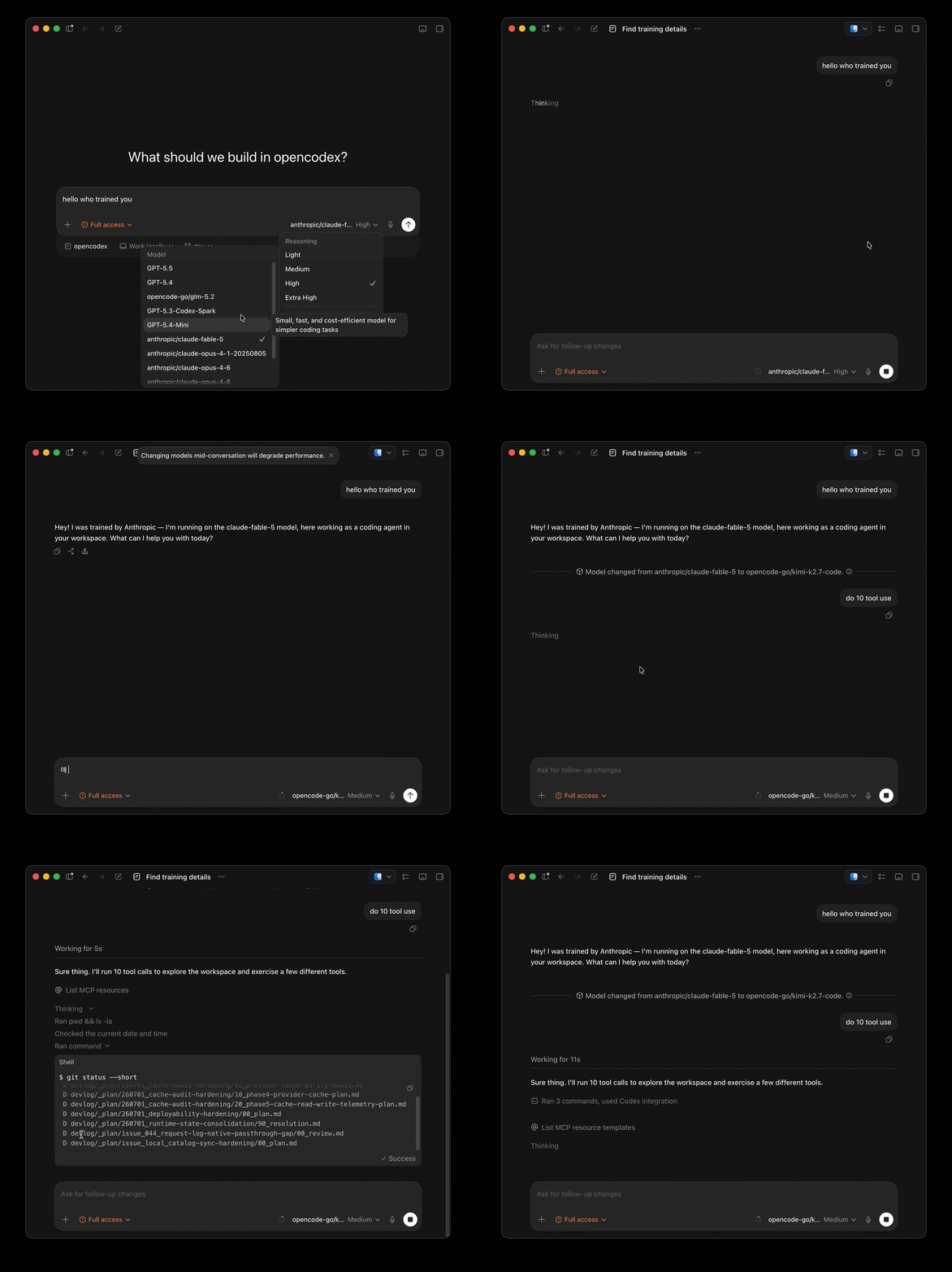
Universal provider proxy for OpenAI Codex & Claude Code — use any LLM (Claude, Gemini, Grok, DeepSeek, Ollama…) with Codex CLI, App, SDK, and Claude Code

Git-native persistent memory for AI coding agents. Implements Google OKF v0.2 with sub-300µs in-memory BM25 search, embedded MCP server, and progressive disclosure. Slashes token bloat by 80% with zero external databases or dependencies. Built in pure Go.

Stop your AI from making things up — it proposes, deterministic tools decide, every claim checked against ground truth with evidence. Grounded facts and context survive resets. Reverse engineering is the proving ground. MCP server + CLI.
x64dbg-MCP Server is a native MCP (Model Context Protocol) plugin for x64dbg that exposes the debugger's full functionality over HTTP. Connect any MCP-compatible AI assistant and control x64dbg programmatically: set breakpoints, step through code, read memory, dump registers, and more. Built with Zig — zero dependencies, single-binary output, cros