
koala73/worldmonitorConnectors
Real-time global intelligence dashboard. AI-powered news aggregation, geopolitical monitoring, and infrastructure tracking in a unified situational awareness interface
86k
x-reader turns a URL into unified content by detecting the platform, fetching text or transcripts, and returning structured output. It can run as a CLI, a Python library, Claude Code skills, or an MCP server with tools like `read_url`, `read_batch`, `list_inbox`, and `detect_platform`.
Builders who use Claude Code or another MCP client and want one reader for posts, pages, videos, and podcasts.
You can hand your agent a link and get back readable, structured content instead of scraping each site by hand.
Detects the platform and fetches content from articles, tweets, video pages, RSS feeds, Telegram, and generic web pages.
Exposes `read_url`, `read_batch`, `list_inbox`, and `detect_platform` through `mcp_server.py`.
Uses subtitles or Whisper-based transcription through the optional `skills/video` layer.
Includes `skills/analyzer` for turning content into a structured report and action items.
Supports saved browser sessions and Playwright fallback for pages that block simple fetches.
git clone https://github.com/runesleo/x-reader.git
cd x-reader
pip install -e ".[all]"
playwright install chromium
# macOS
brew install yt-dlp ffmpeg

# Linux
pip install yt-dlp
apt install ffmpeg
export GROQ_API_KEY=your_key_here


Universal content reader — fetch, transcribe, and digest content from any platform.
Give it a URL (article, video, podcast, tweet), get back structured content. Works as CLI, Python library, MCP server, or Claude Code skills.
简体中文: README.zh.md / README.zh-CN.md
Any URL → Platform Detection → Fetch Content → Unified Output
              ↓                      ↓
         auto-detect           text: Jina Reader
         7+ platforms          video: yt-dlp subtitles
                               audio: Whisper transcription
                               API: Bilibili / RSS / Telegram
The Python layer handles text fetching and YouTube subtitle extraction. The Claude Code skills (optional) add full Whisper transcription for video/podcast and AI-powered content analysis.
x-reader is composable. Use the layers you need:
| Layer | What | Format | Install |
|---|---|---|---|
| Python CLI/Library | Basic content fetching + unified schema | See Install | Required |
| Claude Code Skills | Video transcription + AI analysis | Copy skills/ to your Claude Code skills directory | Optional |
| MCP Server | Expose reading as MCP tools | python mcp_server.py | Optional |
# Fetch any URL
x-reader https://mp.weixin.qq.com/s/abc123

# Fetch a tweet
x-reader https://x.com/elonmusk/status/123456

# Fetch multiple URLs
x-reader https://url1.com https://url2.com

# Login to a platform (one-time, for browser fallback)
x-reader login xhs

# View inbox
x-reader list
Requires cloning the repo (not included in pip install).
For video/podcast transcription and content analysis:
skills/
├── video/       # YouTube/Bilibili/podcast → full transcript via Whisper
└── analyzer/    # Any content → structured analysis report
Install:
export CLAUDE_SKILLS_DIR="/path/to/claude-code-skills"
mkdir -p "$CLAUDE_SKILLS_DIR"
cp -r skills/video "$CLAUDE_SKILLS_DIR/video"
cp -r skills/analyzer "$CLAUDE_SKILLS_DIR/analyzer"
Then in Claude Code, just send a YouTube/Bilibili/podcast link — the video skill auto-triggers and produces a full transcript + summary.
Requires cloning the repo (mcp_server.py is not included in pip install).
git clone https://github.com/runesleo/x-reader.git
cd x-reader
pip install -e ".[mcp]"
python mcp_server.py
The MCP server currently targets FastMCP 1.x. The mcp and all extras pin
mcp<2; moving to MCP 2.x requires a server migration rather than removing the
version cap.
Tools exposed:
read_url(url) — fetch any URLread_batch(urls) — fetch multiple URLs concurrentlylist_inbox() — view previously fetched contentdetect_platform(url) — identify platform from URLClaude Code config (~/.claude/claude_desktop_config.json):
{
    "mcpServers": {
        "x-reader": {
            "command": "python",
            "args": ["/path/to/x-reader/mcp_server.py"]
        }
    }
}
| Platform | Text Fetch | Video/Audio Transcript |
|---|---|---|
| YouTube | ✅ Jina | ✅ yt-dlp subtitles → Groq Whisper fallback |
| Bilibili (B站) | ✅ API | ✅ via Claude Code skill |
| X / Twitter | ✅ oEmbed → FxTwitter → Article/Jina → Playwright | — |
| WeChat (微信公众号) | ✅ Jina → Playwright | — |
| Xiaohongshu (小红书) | ✅ Jina → Playwright* | — |
| Telegram | ✅ Telethon | — |
| RSS | ✅ feedparser | — |
| 小宇宙 (Xiaoyuzhou) | — | ✅ via Claude Code skill |
| Apple Podcasts | — | ✅ via Claude Code skill |
| Any web page | ✅ Jina fallback | — |
*XHS requires a one-time login:
x-reader login xhs(saves session for Playwright fallback)X Articles and login-required X pages can use a saved local browser session:
x-reader login twitterYouTube Whisper transcription requires
GROQ_API_KEY— get a free key from Groq
x-reader uses a lightweight public-first chain for X:
For Articles or gated pages, run:
x-reader login twitter
x-reader "https://x.com/user/status/123"
By default, local X cookies stay local. If you explicitly want to let Jina use your saved X session for gated Articles, set:
export X_READER_ALLOW_EXTERNAL_SESSION_COOKIES=1
# From GitHub (recommended)
pip install git+https://github.com/runesleo/x-reader.git

# With Telegram support
pip install "x-reader[telegram] @ git+https://github.com/runesleo/x-reader.git"

# With browser fallback (Playwright — for XHS/WeChat anti-scraping)
pip install "x-reader[browser] @ git+https://github.com/runesleo/x-reader.git"
playwright install chromium

# With all optional dependencies
pip install "x-reader[all] @ git+https://github.com/runesleo/x-reader.git"
playwright install chromium
Or clone and install locally:
git clone https://github.com/runesleo/x-reader.git
cd x-reader
pip install -e ".[all]"
playwright install chromium
# macOS
brew install yt-dlp ffmpeg

# Linux
pip install yt-dlp
apt install ffmpeg
For Whisper transcription, get a free API key from Groq and set:
export GROQ_API_KEY=your_key_here
import asyncio
from x_reader.reader import UniversalReader

async def main():
    reader = UniversalReader()
    content = await reader.read("https://mp.weixin.qq.com/s/abc123")
    print(content.title)
    print(content.content[:200])

asyncio.run(main())
Copy .env.example to .env:
cp .env.example .env
| Variable | Required | Description |
|---|---|---|
TG_API_ID | Telegram only | From https://my.telegram.org |
TG_API_HASH | Telegram only | From https://my.telegram.org |
GROQ_API_KEY | Whisper only | From https://console.groq.com/keys (free) |
INBOX_FILE | No | Path to inbox JSON (default: ./unified_inbox.json) |
OUTPUT_DIR | No | Directory for Markdown output (default: disabled) |
OBSIDIAN_VAULT | No | Path to Obsidian vault (writes to 01-收集箱/x-reader-inbox.md) |
x-reader/
├── x_reader/              # Python package
│   ├── cli.py             # CLI entry point
│   ├── reader.py          # URL dispatcher (UniversalReader)
│   ├── schema.py          # Unified data model (UnifiedContent + Inbox)
│   ├── login.py           # Browser login manager (saves sessions)
│   ├── fetchers/
│   │   ├── jina.py        # Jina Reader (universal fallback)
│   │   ├── browser.py     # Playwright headless (anti-scraping fallback)
│   │   ├── bilibili.py    # Bilibili API
│   │   ├── youtube.py     # yt-dlp subtitle extraction
│   │   ├── rss.py         # feedparser
│   │   ├── telegram.py    # Telethon
│   │   ├── twitter.py     # oEmbed → FxTwitter → Article/Jina → Playwright
│   │   ├── wechat.py      # Jina → Playwright fallback
│   │   └── xhs.py         # Jina → Playwright + session fallback
│   └── utils/
│       └── storage.py     # JSON + Markdown dual output
├── skills/                # Claude Code skills
│   ├── video/             # Video/podcast → transcript + summary
│   └── analyzer/          # Content → structured analysis
├── mcp_server.py          # MCP server entry point
└── pyproject.toml
User sends URL
    │
    ├─ Text content (article, tweet, WeChat)
    │   └─ Python fetcher → UnifiedContent → inbox
    │
    ├─ Video (YouTube, Bilibili, X video)
    │   ├─ Python fetcher → metadata (title, description)
    │   └─ Video skill → full transcript via subtitles/Whisper
    │
    ├─ Podcast (小宇宙, Apple Podcasts)
    │   └─ Video skill → full transcript via Whisper
    │
    └─ Analysis requested
        └─ Analyzer skill → structured report + action items
Leo (@runes_leo) — AI × Crypto independent builder. Trading on Polymarket, building data and trading systems with Claude Code and Codex.
leolabs.me — writing · community · open-source tools · indie projects · all platforms.
X Subscription — paid content weekly, or just buy me a coffee 😁
Learn in public, Build in public.
MIT
Sign in to join the discussion.
No comments yet. Be the first to say what this is good for.
Real-time global intelligence dashboard. AI-powered news aggregation, geopolitical monitoring, and infrastructure tracking in a unified situational awareness interface
High-performance code intelligence MCP server. Indexes codebases into a persistent knowledge graph — average repo in milliseconds. 158 languages, sub-ms queries, 99% fewer tokens. Single static binary, zero dependencies.
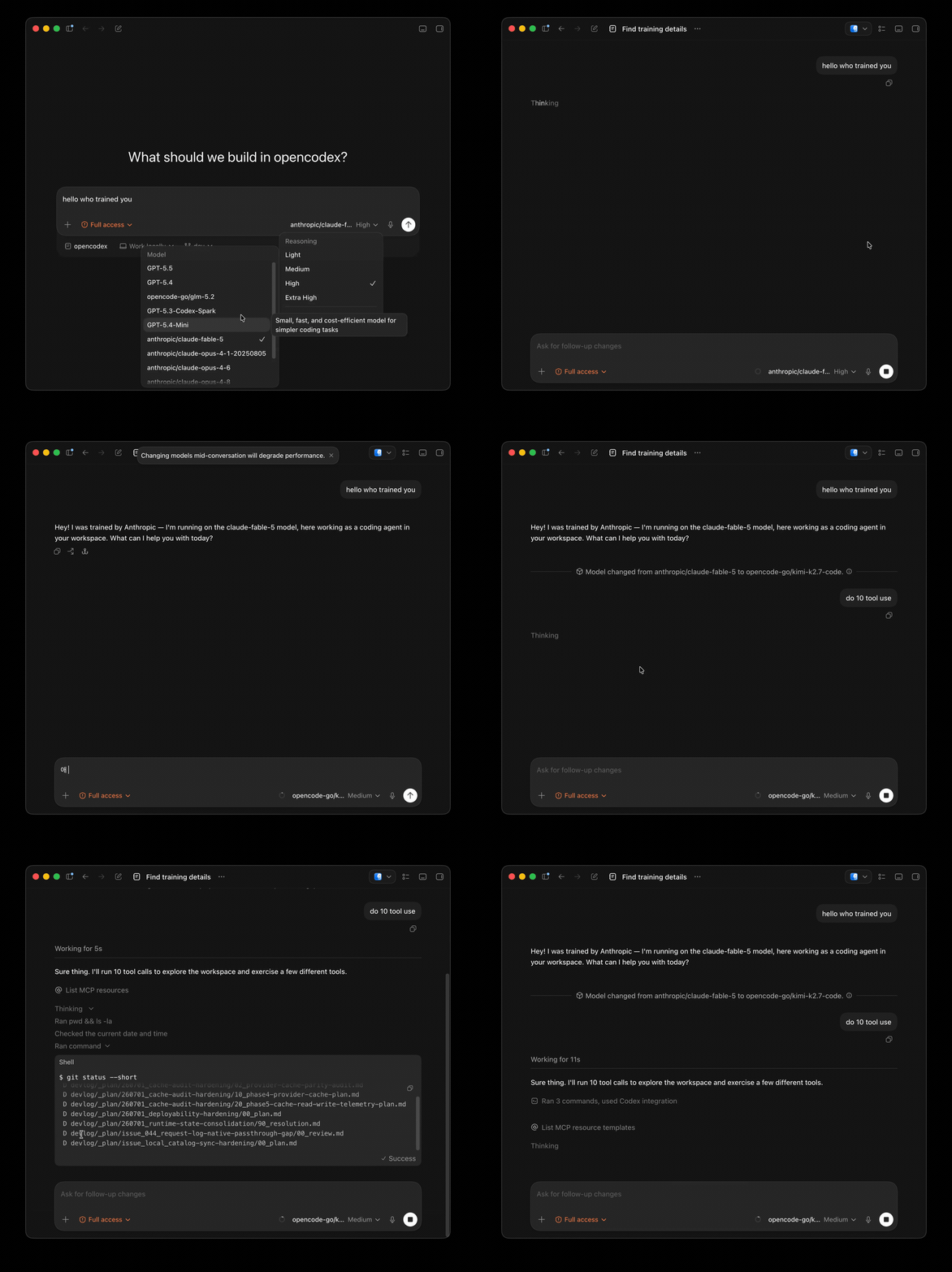
Universal provider proxy for OpenAI Codex & Claude Code — use any LLM (Claude, Gemini, Grok, DeepSeek, Ollama…) with Codex CLI, App, SDK, and Claude Code

Git-native persistent memory for AI coding agents. Implements Google OKF v0.2 with sub-300µs in-memory BM25 search, embedded MCP server, and progressive disclosure. Slashes token bloat by 80% with zero external databases or dependencies. Built in pure Go.

Stop your AI from making things up — it proposes, deterministic tools decide, every claim checked against ground truth with evidence. Grounded facts and context survive resets. Reverse engineering is the proving ground. MCP server + CLI.
x64dbg-MCP Server is a native MCP (Model Context Protocol) plugin for x64dbg that exposes the debugger's full functionality over HTTP. Connect any MCP-compatible AI assistant and control x64dbg programmatically: set breakpoints, step through code, read memory, dump registers, and more. Built with Zig — zero dependencies, single-binary output, cros