
koala73/worldmonitorConnectors
Real-time global intelligence dashboard. AI-powered news aggregation, geopolitical monitoring, and infrastructure tracking in a unified situational awareness interface
86k
This project wraps the dev.to public API in a remote MCP server so compatible agents can query dev.to content directly. It exposes tools for articles, users, tags, comments, and search, and runs over HTTP on port 3000 or `/mcp` in Docker.
Builders who want their agent to pull dev.to articles and metadata through MCP.
You can ask an MCP client to fetch dev.to content without setting up dev.to authentication yourself.
Provides `get_articles` and `get_article` for listing articles or opening one by ID or path.
Provides `get_user` and `get_tags` for author details and popular tags.
Provides `get_comments` for comments on a specific article.
Provides `search_articles` with query, paging, and field filters.
Runs as an HTTP server so any MCP-compatible client can connect to it.
npm install
npm run build
npm start
A remote Model Context Protocol (MCP) server for interacting with the dev.to public API without requiring authentication.
This MCP server provides access to the following dev.to public API endpoints:
If you want to install and build from source using npm:
npm install
npm run build
The server runs as a remote HTTP server on port 3000 (or the PORT environment variable) and can be used with any MCP-compatible client.
npm start
The server will be available at http://localhost:3000 for MCP connections.
# Build the project
npm run build

# Watch mode for development
npm run dev

# Linting
npm run lint
npm run lint:fix

# Formatting
npm run format
npm run format:check
Pull and run the pre-built Docker image:
# Pull the image
docker pull docker.io/nickytonline/dev-to-mcp:latest

# Run it
docker run -d \
  --name dev-to-mcp \
  -e NODE_ENV=production \
  -e PORT=3000 \
  -p 3000:3000 \
  --restart unless-stopped \
  docker.io/nickytonline/dev-to-mcp:latest
Once it's up, check health status via:
curl -fsS http://127.0.0.1:3000/mcp
The server will be available at http://localhost:3000/mcp for MCP connections.
Build and run the MCP server using Docker:
# Build the Docker image
docker build -t dev-to-mcp .

# Run the container
docker run -p 3000:3000 dev-to-mcp
Using the pre-built image with Docker Compose:
services:
  dev-to-mcp:
    image: docker.io/nickytonline/dev-to-mcp:latest
    container_name: dev-to-mcp
    restart: unless-stopped
    environment:
      NODE_ENV: production
      PORT: 3000
    networks:
      - main
    healthcheck:
      # Uses $PORT at runtime; defaults to 3000 if not set
      test:
        [
          "CMD-SHELL",
          "curl -fsS http://127.0.0.1:${PORT:-3000}/mcp >/dev/null || exit 1",
        ]
      interval: 15s
      timeout: 5s
      retries: 5
      start_period: 30s

networks:
  main: {}
For development with a local build, you can also use Docker Compose:
# docker-compose.yml
version: "3.8"
services:
  dev-to-mcp:
    build: .
    ports:
      - "3000:3000"
    environment:
      - PORT=3000
docker-compose up --build
All endpoints use the public dev.to API (https://dev.to/api) and do not require authentication.
Get articles with optional filtering:
username - Filter by author usernametag - Filter by tagtop - Top articles (1, 7, 30, or infinity days)page - Pagination page (default: 1)per_page - Articles per page (default: 30, max: 1000)state - Filter by state (fresh, rising, all)Get a specific article:
id - Article IDpath - Article path (e.g., "username/article-slug")Get user information:
id - User IDusername - UsernameGet popular tags:
page - Pagination page (default: 1)per_page - Tags per page (default: 10, max: 1000)Get comments for an article:
article_id - Article ID (required)Search articles:
q - Search query (required)page - Pagination page (default: 1)per_page - Articles per page (default: 30, max: 1000)search_fields - Fields to search (title, body_text, tag_list)MIT
Sign in to join the discussion.
No comments yet. Be the first to say what this is good for.
Real-time global intelligence dashboard. AI-powered news aggregation, geopolitical monitoring, and infrastructure tracking in a unified situational awareness interface
High-performance code intelligence MCP server. Indexes codebases into a persistent knowledge graph — average repo in milliseconds. 158 languages, sub-ms queries, 99% fewer tokens. Single static binary, zero dependencies.
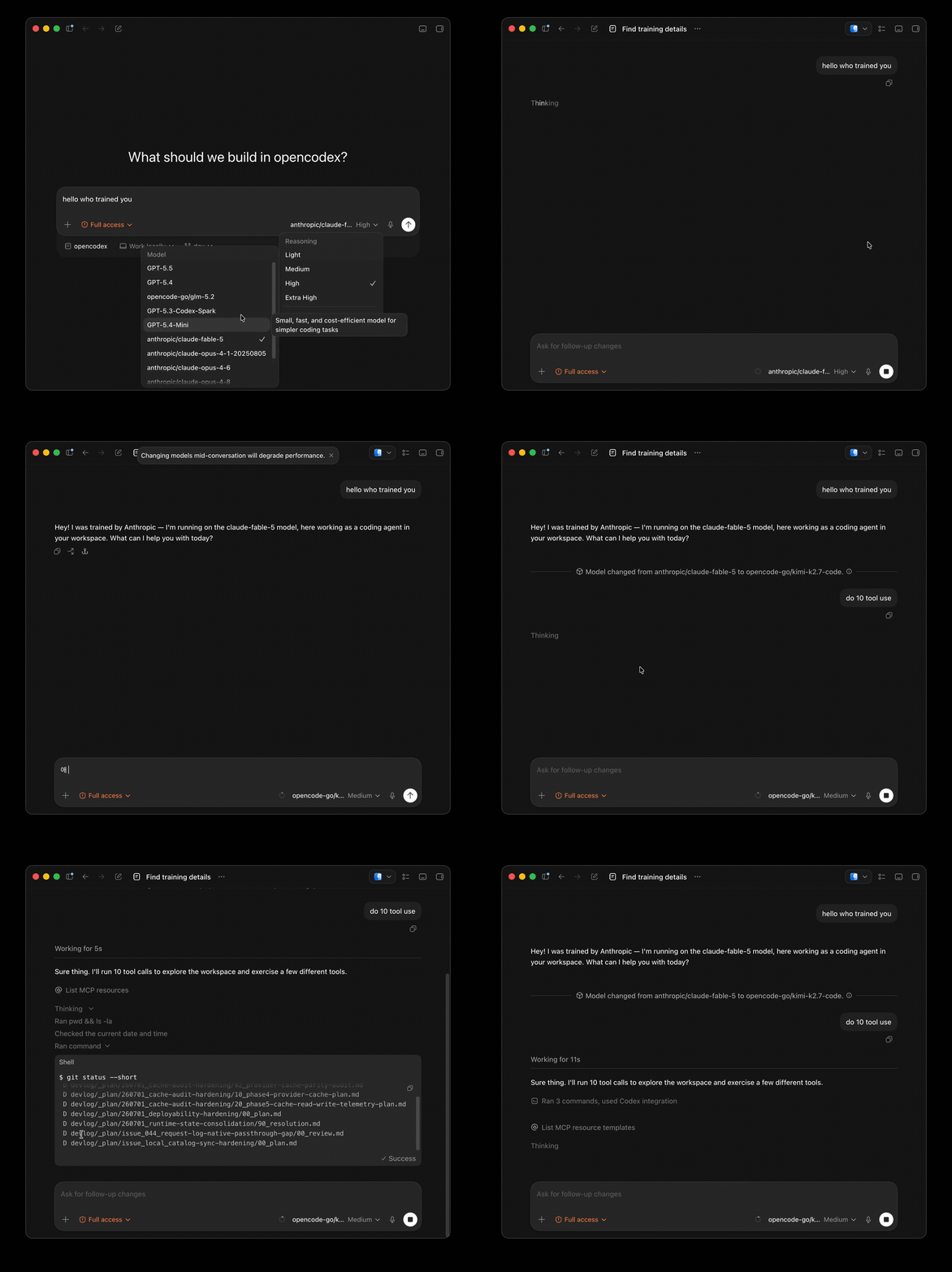
Universal provider proxy for OpenAI Codex & Claude Code — use any LLM (Claude, Gemini, Grok, DeepSeek, Ollama…) with Codex CLI, App, SDK, and Claude Code

Git-native persistent memory for AI coding agents. Implements Google OKF v0.2 with sub-300µs in-memory BM25 search, embedded MCP server, and progressive disclosure. Slashes token bloat by 80% with zero external databases or dependencies. Built in pure Go.

Stop your AI from making things up — it proposes, deterministic tools decide, every claim checked against ground truth with evidence. Grounded facts and context survive resets. Reverse engineering is the proving ground. MCP server + CLI.
x64dbg-MCP Server is a native MCP (Model Context Protocol) plugin for x64dbg that exposes the debugger's full functionality over HTTP. Connect any MCP-compatible AI assistant and control x64dbg programmatically: set breakpoints, step through code, read memory, dump registers, and more. Built with Zig — zero dependencies, single-binary output, cros