

koala73/worldmonitorConnectors
Real-time global intelligence dashboard. AI-powered news aggregation, geopolitical monitoring, and infrastructure tracking in a unified situational awareness interface
86k
This server plugs Zotero into MCP clients so builders can search a library, fetch full metadata, and read full text from items. It works with either a local Zotero desktop API or the Zotero Web API, and it exposes a small set of tools that AI assistants can call in sequence.
Builders who want their agent to use Zotero as a source for research and citations.
You can look up sources and pull article details inside your agent instead of copying them by hand.
`zotero_search_items` finds Zotero items from a text query.
`zotero_item_metadata` returns the full metadata for one Zotero item, grouped into publication details, identifiers, timestamps, and library info.
`zotero_item_fulltext` returns the full text for a Zotero item, including PDF contents when available.
Works against the Zotero desktop local API or the Zotero Web API, depending on configuration.
The server can be used from any MCP client, including the MCP Inspector and Claude Desktop examples in the README.
npx @modelcontextprotocol/inspector uv run zotero-mcp
uv run pytest
docker build . -t zotero-mcp:local
npx @modelcontextprotocol/inspector \
    -e ZOTERO_API_KEY=$ZOTERO_API_KEY \
    -e ZOTERO_LIBRARY_ID=$ZOTERO_LIBRARY_ID \
    docker run --rm -i \
        --env ZOTERO_API_KEY \
        --env ZOTERO_LIBRARY_ID \
        zotero-mcp:local
This project is a python server that implements the Model Context Protocol (MCP) for Zotero, giving you access to your Zotero library within AI assistants. It is intended to implement a small but maximally useful set of interactions with Zotero for use with MCP clients.
This MCP server provides the following tools:
zotero_search_items: Search for items in your Zotero library using a text queryzotero_item_metadata: Get the complete metadata for a specific Zotero item, covering every populated field grouped into publication details, identifiers, timestamps, and library informationzotero_item_fulltext: Get the full text of a specific Zotero item (i.e. PDF contents)These can be discovered and accessed through any MCP client or through the MCP Inspector.
Each tool returns formatted text containing relevant information from your Zotero items, and AI assistants such as Claude can use them sequentially, searching for items then retrieving their metadata or text content.
This server can either run against either a local API offered by the Zotero desktop application) or through the Zotero Web API. The local API can be a bit more responsive, but requires that the Zotero app be running on the same computer with the API enabled. To enable the local API, do the following steps:
To use the Zotero Web API, you'll need to create an API key and find your Library ID (usually your User ID) in your Zotero account settings here: https://www.zotero.org/settings/keys
These are the available configuration options:
ZOTERO_LOCAL=true: Use the local Zotero API (default: false, see note below)ZOTERO_API_KEY: Your Zotero API key (not required for the local API)ZOTERO_LIBRARY_ID: Your Zotero library ID (your user ID for user libraries, not required for the local API)ZOTERO_LIBRARY_TYPE: The type of library (user or group, default: user)uvx with Local Zotero APITo use this with Claude Desktop and a direct python install with uvx, add the following to the mcpServers configuration:
{
  "mcpServers": {
    "zotero": {
      "command": "uvx",
      "args": ["zotero-mcp@latest"],
      "env": {
        "ZOTERO_LOCAL": "true",
        "ZOTERO_API_KEY": "",
        "ZOTERO_LIBRARY_ID": ""
      }
    }
  }
}
The @latest specifier is optional and will pull the latest version when new ones are available. If you don't have uvx installed you can use pipx run instead, or clone this repository locally and use the instructions in Development below.
If you want to run this MCP server in a Docker container, you can use the following configuration, inserting your API key and library ID:
{
  "mcpServers": {
    "zotero": {
      "command": "docker",
      "args": [
        "run",
        "--rm",
        "-i",
        "-e", "ZOTERO_API_KEY=PLACEHOLDER",
        "-e", "ZOTERO_LIBRARY_ID=PLACEHOLDER",
        "ghcr.io/kujenga/zotero-mcp:main"
      ],
    }
  }
}
To update to a newer version, run docker pull ghcr.io/kujenga/zotero-mcp:main. It is also possible to use the docker-based installation to talk to the local Zotero API, but you'll need to modify the above command to ensure that there is network connectivity to the Zotero application's local API interface.
Information on making changes and contributing to the project.
uv sync.env file in the project root with the environment variables aboveStart the MCP Inspector for local development:
npx @modelcontextprotocol/inspector uv run zotero-mcp
To test the local repository against Claude Desktop, run echo $PWD/.venv/bin/zotero-mcp in your shell within this directory, then set the following within your Claude Desktop configuration
{
  "mcpServers": {
    "zotero": {
      "command": "/path/to/zotero-mcp/.venv/bin/zotero-mcp"
      "env": {
        // Whatever configuration is desired.
      }
    }
  }
}
To run the test suite:
uv run pytest
pyproject.toml and server.json (two places: the
server version and the package version).make publish.make publish-mcp, authenticating first with mcp-publisher login github if
needed.Build the container image with this command:
docker build . -t zotero-mcp:local
To test the container with the MCP inspector, run the following command:
npx @modelcontextprotocol/inspector \
    -e ZOTERO_API_KEY=$ZOTERO_API_KEY \
    -e ZOTERO_LIBRARY_ID=$ZOTERO_LIBRARY_ID \
    docker run --rm -i \
        --env ZOTERO_API_KEY \
        --env ZOTERO_LIBRARY_ID \
        zotero-mcp:local
Item metadata is rendered from whatever fields the API returns rather than from a fixed list. Fields it omits are skipped, and fields this server doesn't know about appear under an "Other Fields" heading, so a Zotero upgrade never silently drops metadata.
The two APIs differ in one way worth knowing: the local API's quick search indexes citation keys, while the Web API does not, so searching for one returns nothing over the Web API even though the field is present in the data.
Sign in to join the discussion.
No comments yet. Be the first to say what this is good for.
Real-time global intelligence dashboard. AI-powered news aggregation, geopolitical monitoring, and infrastructure tracking in a unified situational awareness interface
High-performance code intelligence MCP server. Indexes codebases into a persistent knowledge graph — average repo in milliseconds. 158 languages, sub-ms queries, 99% fewer tokens. Single static binary, zero dependencies.
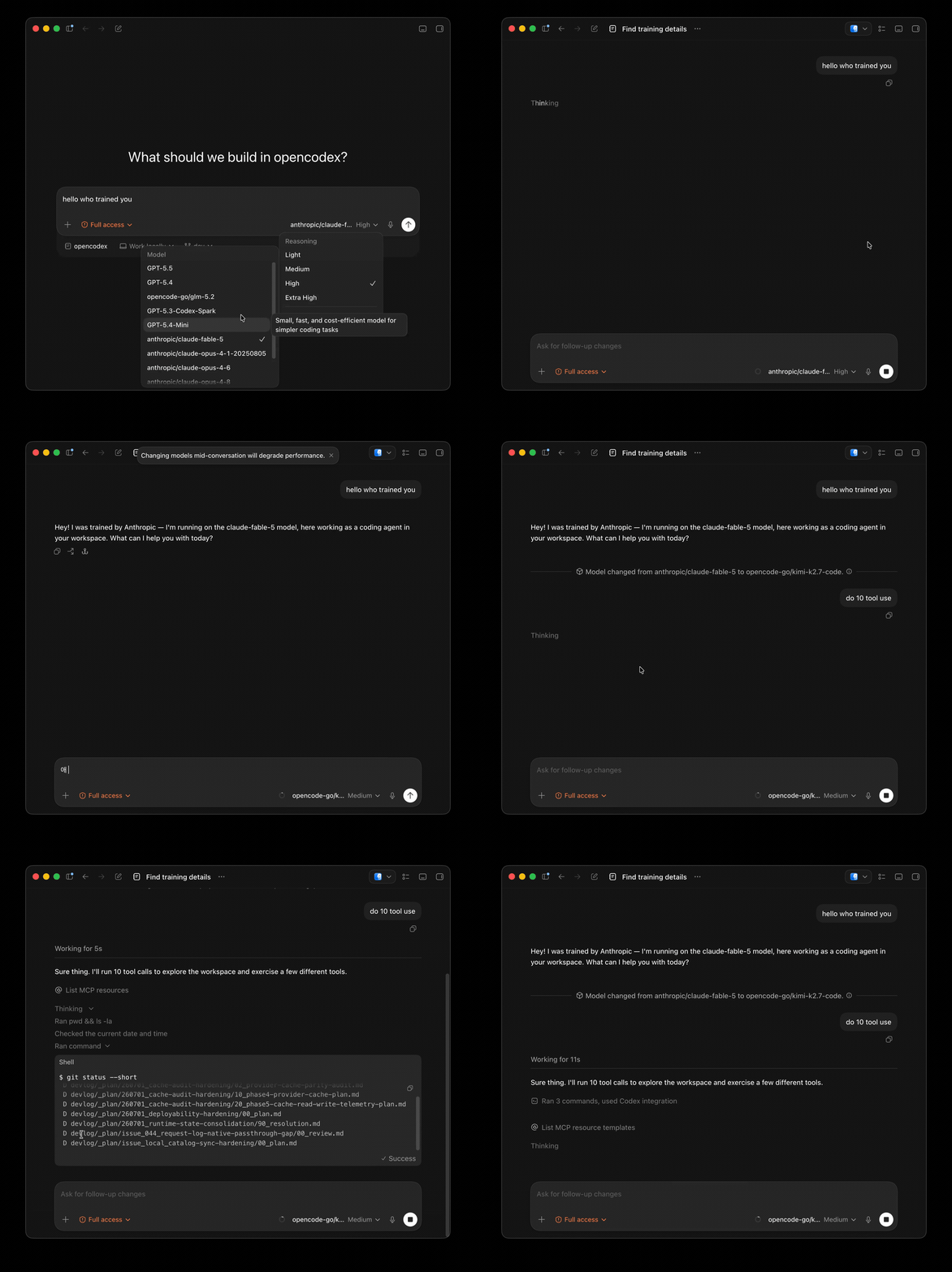
Universal provider proxy for OpenAI Codex & Claude Code — use any LLM (Claude, Gemini, Grok, DeepSeek, Ollama…) with Codex CLI, App, SDK, and Claude Code

Git-native persistent memory for AI coding agents. Implements Google OKF v0.2 with sub-300µs in-memory BM25 search, embedded MCP server, and progressive disclosure. Slashes token bloat by 80% with zero external databases or dependencies. Built in pure Go.

Stop your AI from making things up — it proposes, deterministic tools decide, every claim checked against ground truth with evidence. Grounded facts and context survive resets. Reverse engineering is the proving ground. MCP server + CLI.
x64dbg-MCP Server is a native MCP (Model Context Protocol) plugin for x64dbg that exposes the debugger's full functionality over HTTP. Connect any MCP-compatible AI assistant and control x64dbg programmatically: set breakpoints, step through code, read memory, dump registers, and more. Built with Zig — zero dependencies, single-binary output, cros