

koala73/worldmonitorConnectors
Real-time global intelligence dashboard. AI-powered news aggregation, geopolitical monitoring, and infrastructure tracking in a unified situational awareness interface
86k
This server connects an MCP client to Markmap so you can turn Markdown into an interactive mind map from a prompt or file path. It can return the HTML, a file path, or an exported image, and it keeps the whole flow local.
Builders who use Claude Desktop, Cursor, or other MCP clients to turn notes into mind maps.
You can convert outlines into interactive mind maps or exported images without leaving your agent workflow.
Turns Markdown headings and nested lists into an interactive HTML mind map.
Exports PNG, JPG, or SVG with Playwright so agents can use images directly.
Returns a file path, inline content, or both, depending on startup settings.
Lists generated markmap files in the output directory.
Fetches generated mind maps by path and removes old or all generated files.
Includes `mindmap_from_content` to structure notes as Markdown and then build the map.
# Install from npm
npm install @jinzcdev/markmap-mcp-server -g

# Basic run
npx -y @jinzcdev/markmap-mcp-server

# Specify output directory and auto-open in browser
npx -y @jinzcdev/markmap-mcp-server --output /path/to/output/directory --open always
docker build -t markmap-mcp-server .
docker run --rm -i \
  -v /path/to/output:/data/markmap \
  -e MARKMAP_DIR=/data/markmap \
  markmap-mcp-server
git clone https://github.com/jinzcdev/markmap-mcp-server.git
cd markmap-mcp-server
npm install && npm run build
# Optional: enable server-side image export
npx playwright install chromium
node build/index.js





Markmap MCP Server is based on the Model Context Protocol (MCP). It converts Markdown into interactive mind maps using markmap, and can optionally export PNG / JPG / SVG on the server for Agent-friendly delivery. Generation runs locally — no third-party API keys required.
--offline inlines assets so the page works without CDN accessinputPath, list recent outputs, clean up old filesformat: png|jpg|svg): install Playwright and Chromiumnpm install playwright
npx playwright install chromium
(playwright is an optional dependency of this package.)
# Install from npm
npm install @jinzcdev/markmap-mcp-server -g

# Basic run
npx -y @jinzcdev/markmap-mcp-server

# Specify output directory and auto-open in browser
npx -y @jinzcdev/markmap-mcp-server --output /path/to/output/directory --open always
docker build -t markmap-mcp-server .
docker run --rm -i \
  -v /path/to/output:/data/markmap \
  -e MARKMAP_DIR=/data/markmap \
  markmap-mcp-server
Or clone and run locally:
git clone https://github.com/jinzcdev/markmap-mcp-server.git
cd markmap-mcp-server
npm install && npm run build
# Optional: enable server-side image export
npx playwright install chromium
node build/index.js
Add the following configuration to your MCP client (Cursor / Claude Desktop / etc.):
{
  "mcpServers": {
    "markmap": {
      "type": "stdio",
      "command": "npx",
      "args": ["-y", "@jinzcdev/markmap-mcp-server"],
      "env": {
        "MARKMAP_DIR": "/path/to/output/directory",
        "MARKMAP_OPEN": "never",
        "MARKMAP_RETURN_MODE": "path"
      }
    }
  }
}
These are decided when the server starts — not tool arguments:
| Preference | CLI | Env | Values | Default |
|---|---|---|---|---|
| Output directory | --output / -o | MARKMAP_DIR | any directory path | ~/.markmap-mcp |
| Open in browser | --open [mode] | MARKMAP_OPEN | always | never | agent (bare --open = always) | never |
| Return mode | --return-mode | MARKMAP_RETURN_MODE | path | content | both | path |
| Offline HTML | --offline | MARKMAP_OFFLINE | true | false (CLI: pass --offline to enable) | false |
CLI flags override environment variables. --output overrides MARKMAP_DIR.
--open: bare --open means always. You may also pass --open always|never|agent. An invalid value exits with an error. Without the flag, MARKMAP_OPEN is used (default never).
Return mode:
| Mode | Meaning |
|---|---|
path | Paths JSON only (htmlFilePath + filePath) |
content | Inline content only (raw HTML text, or a base64 image block) — no paths |
both | Paths JSON plus inline content |
Generated HTML always includes the markmap toolbar, English export labels, and fully expanded nodes.
./notes/architecture.md to a mind map.”markdown_to_mindmapConvert Markdown into an interactive mind map (and optionally an image).
| Parameter | Type | Default | Description |
|---|---|---|---|
markdown | string | — | Markdown content (required unless inputPath is set). Wins when both are provided. |
inputPath | string | — | Absolute path to a local .md file |
format | html | png | svg | jpg | html | Output format. Image formats need Playwright |
filename | string | auto | Output base name (sanitized; prefixed with markmap- if needed; reusing overwrites) |
open | boolean | false | Whether to open the result in browser. Only exposed when server open mode is agent (--open agent / MARKMAP_OPEN=agent). |
Return (returnMode=path):
{
  "htmlFilePath": "/path/to/markmap-….html",
  "filePath": "/path/to/markmap-….html"
}
For image formats, filePath is the image path and htmlFilePath is still the HTML source.
Return (returnMode=content): Raw HTML text block, or an MCP image content block (base64) for png/jpg/svg — no paths JSON. Oversized HTML (≥200KB) falls back to paths JSON.
Return (returnMode=both): Paths JSON plus the inline content above.
Note: Interactive zoom/collapse and the in-page “Export PNG/JPG/SVG” buttons are part of the HTML viewer. Server-side
format: png|jpg|svgis what Agents can consume directly without a manual browser click.
list_mindmapsList recent generated files in the output directory (newest first). Only files whose names start with markmap are included.
| Parameter | Type | Default | Description |
|---|---|---|---|
limit | number | 20 | Max files to return (1–200) |
Returns {outputDir, files: [{name, filePath, size, mtimeMs, mtime}]}.
get_mindmapRetrieve a generated mind map file by its absolute path. Path must stay inside the configured output directory (path traversal denied).
| Parameter | Type | Default | Description |
|---|---|---|---|
filePath | string | — | Absolute path to the mind map file (HTML or image) |
Returns JSON {filePath, mimeType, size}. For HTML/SVG under 200KB, also appends a text content block. PNG/JPG return metadata only (no image block) — re-export via markdown_to_mindmap with format=png\|jpg if pixels are needed.
cleanup_mindmapsDelete old (or all) generated mind map files.
| Parameter | Type | Default | Description |
|---|---|---|---|
maxAgeDays | number | 7 | Delete files older than this many days |
all | boolean | false | If true, delete all markmap files |
dryRun | boolean | false | If true, preview without deleting |
mindmap_from_contentHelper prompt that asks the model to structure notes as Markdown, then call markdown_to_mindmap.
| Parameter | Type | Default | Description |
|---|---|---|---|
topic | string | — | Topic or raw notes to organize as a map |
| Project | Description |
|---|---|
| MarkXMind Online | Create XMind mind maps with Markdown online. Try it → |
| Obsidian MarkXMind Plugin | Render XMindMark syntax as XMind mind maps inside Obsidian. |
This project is licensed under the MIT License.
Sign in to join the discussion.
No comments yet. Be the first to say what this is good for.
Real-time global intelligence dashboard. AI-powered news aggregation, geopolitical monitoring, and infrastructure tracking in a unified situational awareness interface
High-performance code intelligence MCP server. Indexes codebases into a persistent knowledge graph — average repo in milliseconds. 158 languages, sub-ms queries, 99% fewer tokens. Single static binary, zero dependencies.
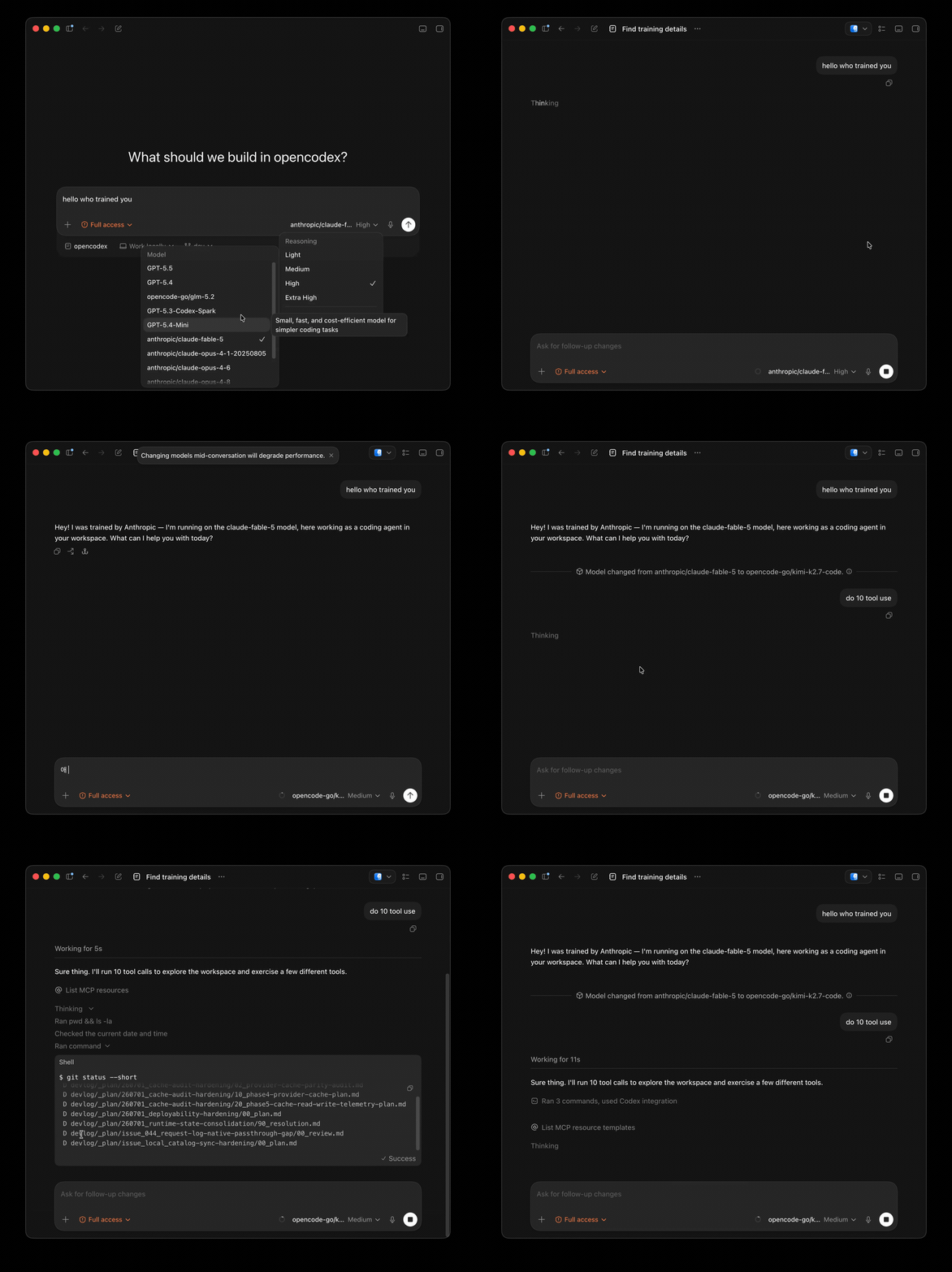
Universal provider proxy for OpenAI Codex & Claude Code — use any LLM (Claude, Gemini, Grok, DeepSeek, Ollama…) with Codex CLI, App, SDK, and Claude Code

Git-native persistent memory for AI coding agents. Implements Google OKF v0.2 with sub-300µs in-memory BM25 search, embedded MCP server, and progressive disclosure. Slashes token bloat by 80% with zero external databases or dependencies. Built in pure Go.

Stop your AI from making things up — it proposes, deterministic tools decide, every claim checked against ground truth with evidence. Grounded facts and context survive resets. Reverse engineering is the proving ground. MCP server + CLI.
x64dbg-MCP Server is a native MCP (Model Context Protocol) plugin for x64dbg that exposes the debugger's full functionality over HTTP. Connect any MCP-compatible AI assistant and control x64dbg programmatically: set breakpoints, step through code, read memory, dump registers, and more. Built with Zig — zero dependencies, single-binary output, cros