
koala73/worldmonitorConnectors
Real-time global intelligence dashboard. AI-powered news aggregation, geopolitical monitoring, and infrastructure tracking in a unified situational awareness interface
86k
This server connects Capacities to an agent through MCP so the agent can inspect your spaces, search notes, read full object content, and save links or daily-note entries. It uses Capacities API endpoints behind a small JavaScript server and exposes the tools through Claude Desktop or any MCP client.
Builders who keep research, references, and daily notes in Capacities and want an agent to work with that content.
You can ask your agent to search, read, and save Capacities content without copying it by hand.
Returns all personal spaces in Capacities.
Shows details for a chosen space, including structures and collections.
Searches across spaces with optional title-only mode and structure filters.
Fetches the full content of a note or other object by object ID, with a search fallback.
Saves a URL into a space with optional title, description, tags, and markdown notes.
Appends markdown content to today's daily note with optional origin and timestamp control.
git clone https://github.com/Im-Hal-9K/capacities-mcp.git
cd capacities-mcp
npm install
# or
bun install
cp .env.example .env
CAPACITIES_API_KEY=your_api_key_here
npm run build
"Show me all my Capacities spaces"
"What spaces do I have in Capacities?"
An enhanced MCP (Model Context Protocol) server for Capacities, providing seamless integration with your knowledge management system.
Note: This is a fork of jemgold/capacities-mcp with additional features and fixes.
| Feature | Original | Plus |
|---|---|---|
| Read Object Content | Not available | Retrieve full note content by object ID |
| fastmcp Version | 1.27.3 | 3.25.4 (fixes MCP SDK compatibility) |
| Windows Support | May have issues | Tested with cmd wrapper |
| npm Package | capacities-mcp | capacities-mcp-plus |
capacities_read_object_contentRetrieve the full content of any Capacities object by its ID:
This MCP server provides access to all current Capacities API endpoints:
Add to your Claude Desktop configuration (~/Library/Application Support/Claude/claude_desktop_config.json):
{
  "mcpServers": {
    "capacities": {
      "command": "npx",
      "args": ["-y", "capacities-mcp-plus"],
      "env": {
        "CAPACITIES_API_KEY": "your_capacities_api_key_here"
      }
    }
  }
}
Windows requires a cmd wrapper. Add to %APPDATA%\Claude\claude_desktop_config.json:
{
  "mcpServers": {
    "capacities": {
      "command": "cmd",
      "args": ["/c", "npx", "-y", "capacities-mcp-plus"],
      "env": {
        "CAPACITIES_API_KEY": "your_capacities_api_key_here"
      }
    }
  }
}
Get your Capacities API key from your Capacities account settings.
That's it! The server will be automatically downloaded and run when Claude Desktop starts.
For local development, you'll need to clone and build the project:
git clone https://github.com/Im-Hal-9K/capacities-mcp.git
cd capacities-mcp
npm install
# or
bun install
cp .env.example .env
.env:CAPACITIES_API_KEY=your_api_key_here
npm run build
Start the development server with interactive mode:
bun run dev
For production use:
npm run start
To inspect the server tools and schema:
bun run inspect
Run the test suite:
bun run test
Check linting and types:
bun run lint
Format code:
bun run format
Get your Capacities API key from your Capacities account settings.
For detailed API documentation, see:
capacities_list_spacesGet a list of all your personal spaces.
capacities_get_space_infoGet detailed information about a specific space, including structures and collections.
capacities_searchSearch for content across your spaces with optional filtering.
capacities_read_object_contentRetrieve the full content of a Capacities object by its ID.
capacities_save_weblinkSave a web link to a space with optional metadata.
capacities_save_to_daily_noteAdd markdown content to today's daily note in a space.
The Capacities API has the following rate limits:
/spaces: 5 requests per 60 seconds/space-info: 5 requests per 60 seconds/search: 120 requests per 60 seconds/save-weblink: 10 requests per 60 seconds/save-to-daily-note: 5 requests per 60 secondsHere are some example prompts you can use with Claude when this MCP server is configured:
"Show me all my Capacities spaces"
"What spaces do I have in Capacities?"
"Get detailed information about my main workspace in Capacities"
"What structures and collections are in my [space name] space?"
"Search for 'project management' across all my Capacities spaces"
"Find all notes mentioning 'machine learning' in my research space"
"Search for 'meeting notes' but only check titles, not full content"
"Read the content of object [object-id] from my research space"
"Get the full note content for [title] in my workspace"
"Save this article to my research space: https://example.com/article"
"Bookmark this GitHub repo in my coding space with tags 'javascript' and 'tools'"
"Save this link with a custom title and description to my resources space"
"Add a summary of today's key insights to my daily note"
"Save these meeting notes to today's daily note in my work space"
"Add this quote to my daily note: [your quote here]"
"Search for 'productivity' in my work and personal spaces, but filter to only show task-related structures"
"Save this research paper to my academic space and add it to today's daily note as well"
"Find all my notes about 'AI tools' and then save the best ones as bookmarks"
MIT - see LICENSE file for details.
Sign in to join the discussion.
No comments yet. Be the first to say what this is good for.
Real-time global intelligence dashboard. AI-powered news aggregation, geopolitical monitoring, and infrastructure tracking in a unified situational awareness interface
High-performance code intelligence MCP server. Indexes codebases into a persistent knowledge graph — average repo in milliseconds. 158 languages, sub-ms queries, 99% fewer tokens. Single static binary, zero dependencies.
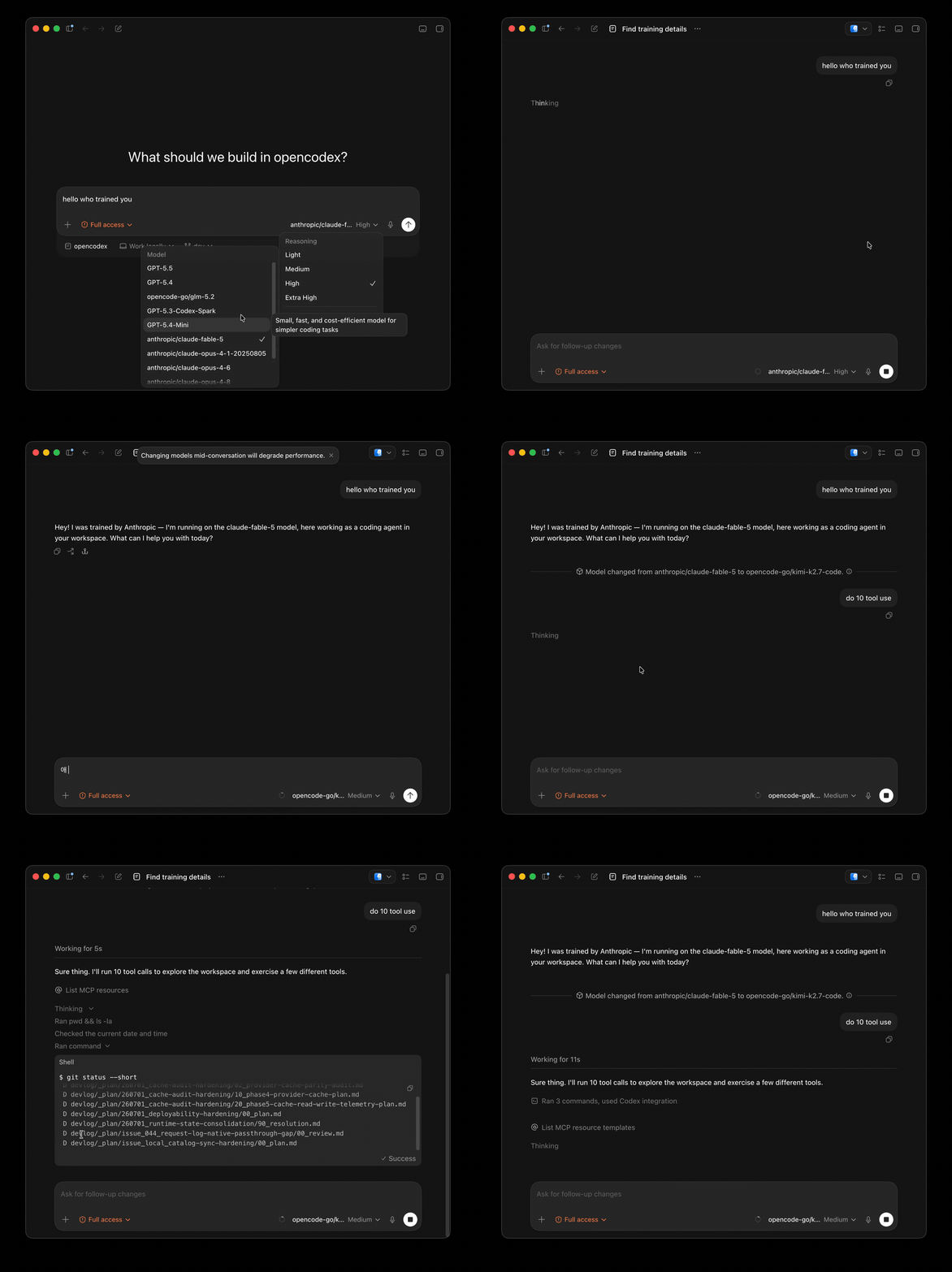
Universal provider proxy for OpenAI Codex & Claude Code — use any LLM (Claude, Gemini, Grok, DeepSeek, Ollama…) with Codex CLI, App, SDK, and Claude Code

Git-native persistent memory for AI coding agents. Implements Google OKF v0.2 with sub-300µs in-memory BM25 search, embedded MCP server, and progressive disclosure. Slashes token bloat by 80% with zero external databases or dependencies. Built in pure Go.

Stop your AI from making things up — it proposes, deterministic tools decide, every claim checked against ground truth with evidence. Grounded facts and context survive resets. Reverse engineering is the proving ground. MCP server + CLI.
x64dbg-MCP Server is a native MCP (Model Context Protocol) plugin for x64dbg that exposes the debugger's full functionality over HTTP. Connect any MCP-compatible AI assistant and control x64dbg programmatically: set breakpoints, step through code, read memory, dump registers, and more. Built with Zig — zero dependencies, single-binary output, cros