

koala73/worldmonitorConnectors
Real-time global intelligence dashboard. AI-powered news aggregation, geopolitical monitoring, and infrastructure tracking in a unified situational awareness interface
86k
This repo packages Kagi search and summarization as MCP tools. An agent can call `kagi_search_fetch` to search the web and `kagi_summarizer` to summarize URLs, videos, or audio using your Kagi session token. It is set up for Claude Desktop and Claude Code, but it works with any MCP-capable agent.
Builders who want their agent to search Kagi or summarize content without using the official Kagi API.
You can give your agent Kagi search and summarization access using your existing Kagi subscription.
`kagi_search_fetch` runs one or more search queries and returns numbered web results.
`kagi_summarizer` summarizes a URL as prose or takeaway bullets, with an optional target language.
It reads `KAGI_SESSION_TOKEN` first, then falls back to `~/.kagi_session_token`.
The README shows Claude Desktop and Claude Code config examples and suggests disabling built-in web search.
It includes input validation, timeout handling, and formatted errors for tool calls.
For web searches, use kagi-ken-mcp MCP server's `kagi_search_fetch` tool.
For summarizing a URL, use the kagi-ken-mcp MCP server's `kagi_summarizer` tool.
claude mcp add kagi-ken-mcp --scope user -- npx -y github:czottmann/kagi-ken-mcp
claude mcp add kagi-ken-mcp \
  --scope user \
  --env KAGI_SESSION_TOKEN="YOUR_SESSION_TOKEN_HERE" -- \
  npx -y github:czottmann/kagi-ken-mcp
git clone <repository-url>
cd kagi-ken-mcp
npm install
A lightweight Node MCP server around the kagi-ken package, providing access to Kagi.com services using Kagi session tokens:
Unlike the official Kagi API which requires API access, this MCP server uses your existing Kagi session to access both search and summarization features.
"Kagi-ken" is a portmanteau of "Kagi" (the service) and "token".
The Kagi API requires a separate API key, which are invite-only at the moment. If you already have a Kagi subscription but no API access, yet want to programmatically access Kagi's services from LLMs or agents like Claude, this MCP server provides an alternative.
The server supports two methods for using your Kagi session token (see Installation), in this order:
KAGI_SESSION_TOKEN environment variable~/.kagi_session_token file containing the token stringIt includes comprehensive error handling:
Node.js 22+ is required.
token value from the link~/.kagi_session_token (recommended), alternatively pass as KAGI_SESSION_TOKEN env variableThe server will automatically try the environment variable first, then fall back to the token file.
[!WARNING] Security Note: Keep your session token private. It provides access to your Kagi account.
Add kagi-ken-mcp to your claude_desktop_config.json which you can open from the Claude Desktop app via Settings → Developer → Local MCP Servers → Edit Config.
{
  "mcpServers": {
    "kagi-ken-mcp": {
      "command": "npx",
      "args": ["-y", "github:czottmann/kagi-ken-mcp"]
    }
  }
}
{
  "mcpServers": {
    "kagi-ken-mcp": {
      "command": "npx",
      "args": ["-y", "github:czottmann/kagi-ken-mcp"],
      "env": {
        "KAGI_SESSION_TOKEN": "YOUR_SESSION_TOKEN_HERE"
      }
    }
  }
}
Disable Claude Desktop's built-in websearch so it'll use this here MCP server. And maybe add this to your "Personal preferences" (i.e., system prompt) in Settings:
For web searches, use kagi-ken-mcp MCP server's `kagi_search_fetch` tool.
For summarizing a URL, use the kagi-ken-mcp MCP server's `kagi_summarizer` tool.
claude mcp add kagi-ken-mcp --scope user -- npx -y github:czottmann/kagi-ken-mcp
claude mcp add kagi-ken-mcp \
  --scope user \
  --env KAGI_SESSION_TOKEN="YOUR_SESSION_TOKEN_HERE" -- \
  npx -y github:czottmann/kagi-ken-mcp
Disable Claude Code's built-in web search (optional) by setting the permission in the relevant .claude/settings*.json file:
{
  "permissions": {
    "deny": [
      "WebSearch"
    ],
    "allow": [
      "mcp__kagi-ken-mcp__kagi_search_fetch",
      "mcp__kagi-ken-mcp__kagi_summarizer"
    ]
  }
}
e.g. "Who was time's 2024 person of the year?" for search, or "summarize this video: https://www.youtube.com/watch?v=sczwaYyaevY" for summarizer.
kagi_search_fetchFetch web results based on one or more queries using the Kagi Search API. Results are numbered continuously for easy reference.
Parameters:
queries (array of strings): One or more search querieskagi_summarizerSummarize content from URLs using the Kagi Summarizer API. Supports various document types including webpages, videos, and audio.
Parameters:
url (string): URL to summarizesummary_type (enum): "summary" for paragraph prose or "takeaway" for bullet points (default: "summary")target_language (string, optional): Language code (e.g., "EN" for English, default: "EN")kagi-ken-mcp/
├── src/
│ ├── index.js # Main server entry point
│ ├── tools/
│ │ ├── search.js # Search tool implementation
│ │ └── summarizer.js # Summarizer tool implementation
│ └── utils/
│ └── formatting.js # Utility functions
├── package.json
└── README.md
Clone the repository:
git clone <repository-url>
cd kagi-ken-mcp
Install dependencies:
npm install
npm run dev
Use the MCP Inspector to debug:
npx @modelcontextprotocol/inspector node ./src/index.js
Then access the inspector at http://localhost:5173. If using environment variables, add your KAGI_SESSION_TOKEN in the environment variables section of the inspector.
Carlo Zottmann, carlo@zottmann.dev, https://c.zottmann.dev, https://github.com/czottmann.
This project is neither affiliated with nor endorsed by Kagi. I'm just a very happy customer.
[!TIP] I make Shortcuts-related macOS & iOS productivity apps like Actions For Obsidian, Browser Actions (which adds Shortcuts support for several major browsers), and BarCuts (a surprisingly useful contextual Shortcuts launcher). Check them out!
Sign in to join the discussion.
No comments yet. Be the first to say what this is good for.
Real-time global intelligence dashboard. AI-powered news aggregation, geopolitical monitoring, and infrastructure tracking in a unified situational awareness interface
High-performance code intelligence MCP server. Indexes codebases into a persistent knowledge graph — average repo in milliseconds. 158 languages, sub-ms queries, 99% fewer tokens. Single static binary, zero dependencies.
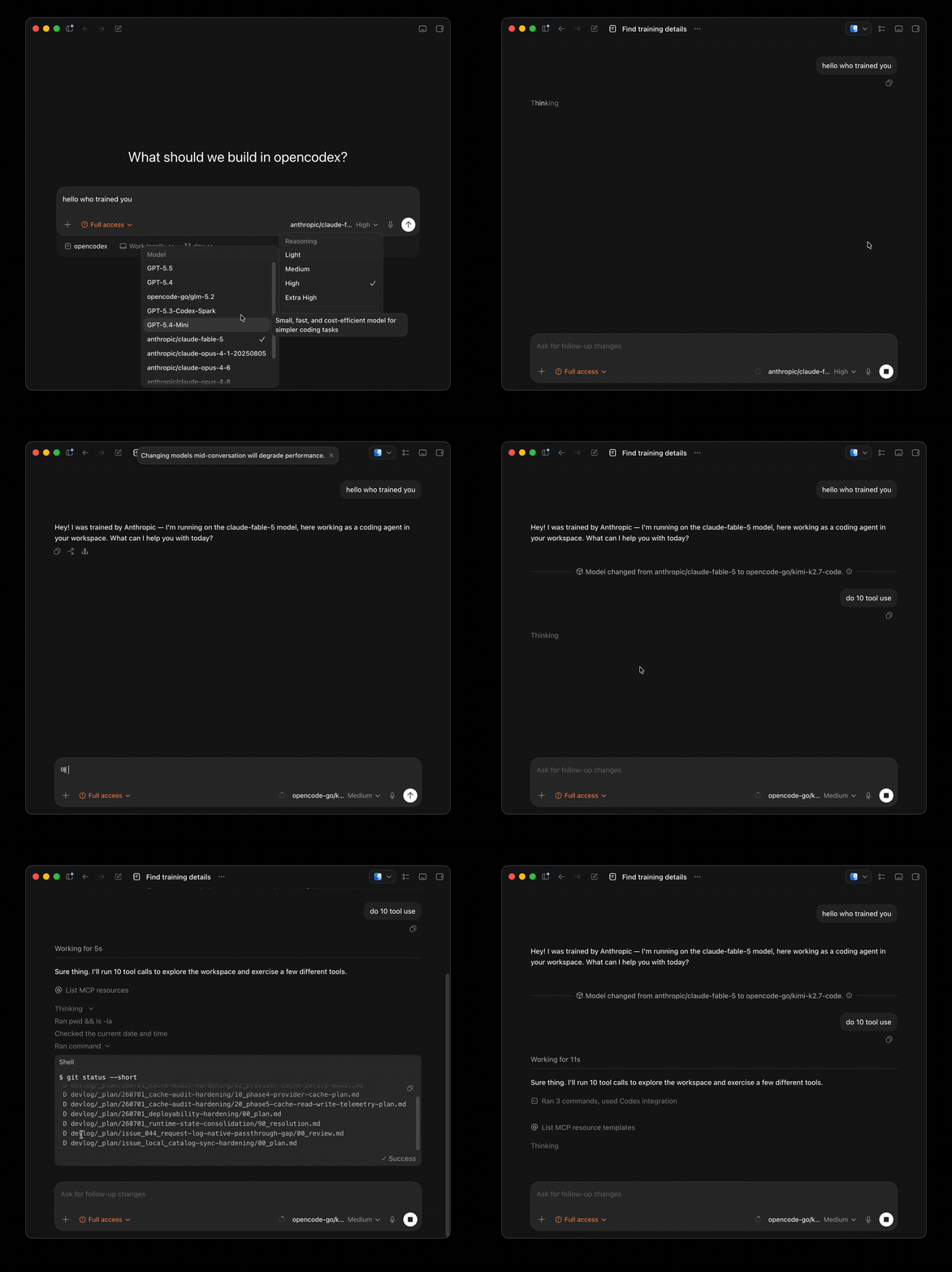
Universal provider proxy for OpenAI Codex & Claude Code — use any LLM (Claude, Gemini, Grok, DeepSeek, Ollama…) with Codex CLI, App, SDK, and Claude Code

Git-native persistent memory for AI coding agents. Implements Google OKF v0.2 with sub-300µs in-memory BM25 search, embedded MCP server, and progressive disclosure. Slashes token bloat by 80% with zero external databases or dependencies. Built in pure Go.

Stop your AI from making things up — it proposes, deterministic tools decide, every claim checked against ground truth with evidence. Grounded facts and context survive resets. Reverse engineering is the proving ground. MCP server + CLI.
x64dbg-MCP Server is a native MCP (Model Context Protocol) plugin for x64dbg that exposes the debugger's full functionality over HTTP. Connect any MCP-compatible AI assistant and control x64dbg programmatically: set breakpoints, step through code, read memory, dump registers, and more. Built with Zig — zero dependencies, single-binary output, cros