
koala73/worldmonitorConnectors
Real-time global intelligence dashboard. AI-powered news aggregation, geopolitical monitoring, and infrastructure tracking in a unified situational awareness interface
86k
This project exposes Telegram actions as MCP tools so an assistant can inspect and manage your chats. It supports account lookup, dialog lists, unread filtering, read markers, message retrieval, and sending draft messages.
Builders who want Claude Desktop, Cursor, or other MCP clients to handle Telegram conversations.
You can review Telegram activity and draft replies without manually copying messages between apps.
Gets the current Telegram account with `tg_me`.
Lists chats and can filter to unread dialogs with `tg_dialogs`.
Marks a dialog as read with `tg_read`.
Fetches messages from a specific dialog with `tg_dialog`.
Sends draft messages to any dialog with `tg_send`.
Provides Claude Desktop and Cursor configuration examples for connecting the server.
# Install
brew install chaindead/tap/telegram-mcp

# Update
brew upgrade chaindead/tap/telegram-mcp
npx -y @chaindead/telegram-mcp
npx -y @chaindead/telegram-mcp auth ...
# For Intel Mac (x86_64)
curl -L -o telegram-mcp.tar.gz https://github.com/chaindead/telegram-mcp/releases/latest/download/telegram-mcp_Darwin_x86_64.tar.gz

# For Apple Silicon (M1/M2)
curl -L -o telegram-mcp.tar.gz https://github.com/chaindead/telegram-mcp/releases/latest/download/telegram-mcp_Darwin_arm64.tar.gz
# Extract the binary
sudo tar xzf telegram-mcp.tar.gz -C /usr/local/bin

# Make it executable
sudo chmod +x /usr/local/bin/telegram-mcp

# Clean up
rm telegram-mcp.tar.gz
# For x86_64 (64-bit)
curl -L -o telegram-mcp.tar.gz https://github.com/chaindead/telegram-mcp/releases/latest/download/telegram-mcp_Linux_x86_64.tar.gz

# For ARM64
curl -L -o telegram-mcp.tar.gz https://github.com/chaindead/telegram-mcp/releases/latest/download/telegram-mcp_Linux_arm64.tar.gz


The server is a bridge between the Telegram API and the AI assistants and is based on the Model Context Protocol.
[!IMPORTANT] Ensure that you have read and understood the Telegram API Terms of Service before using this server. Any misuse of the Telegram API may result in the suspension of your account.
The Model Context Protocol (MCP) is a system that lets AI apps, like Claude Desktop or Cursor, connect to external tools and data sources. It gives a clear and safe way for AI assistants to work with local services and APIs while keeping the user in control.
tool: tg_me)tool: tg_dialogs)tool: tg_read)tool: tg_dialog)tool: tg_send)Here are some example prompts you can use with AI assistants:
You can install a binary release on macOS/Linux using brew:
# Install
brew install chaindead/tap/telegram-mcp

# Update
brew upgrade chaindead/tap/telegram-mcp
You can run the latest version directly using npx (supports macOS, Linux, and Windows):
npx -y @chaindead/telegram-mcp
When using NPX, modify the standard commands and configuration as follows:
npx -y @chaindead/telegram-mcp auth ...
{
  "mcpServers": {
    "telegram": {
      "command": "npx",
      "args": ["-y", "@chaindead/telegram-mcp"],
      "env": {
        "TG_APP_ID": "<your-api-id>",
        "TG_API_HASH": "<your-api-hash>"
      }
    }
  }
}
For complete setup instructions, see Authorization and Client Configuration.
Note: The commands below install to
/usr/local/bin. To install elsewhere, replace/usr/local/binwith your preferred directory in your PATH.
First, download the archive for your architecture:
# For Intel Mac (x86_64)
curl -L -o telegram-mcp.tar.gz https://github.com/chaindead/telegram-mcp/releases/latest/download/telegram-mcp_Darwin_x86_64.tar.gz

# For Apple Silicon (M1/M2)
curl -L -o telegram-mcp.tar.gz https://github.com/chaindead/telegram-mcp/releases/latest/download/telegram-mcp_Darwin_arm64.tar.gz
Then install the binary:
# Extract the binary
sudo tar xzf telegram-mcp.tar.gz -C /usr/local/bin

# Make it executable
sudo chmod +x /usr/local/bin/telegram-mcp

# Clean up
rm telegram-mcp.tar.gz
Note: The commands below install to
/usr/local/bin. To install elsewhere, replace/usr/local/binwith your preferred directory in your PATH.
First, download the archive for your architecture:
# For x86_64 (64-bit)
curl -L -o telegram-mcp.tar.gz https://github.com/chaindead/telegram-mcp/releases/latest/download/telegram-mcp_Linux_x86_64.tar.gz

# For ARM64
curl -L -o telegram-mcp.tar.gz https://github.com/chaindead/telegram-mcp/releases/latest/download/telegram-mcp_Linux_arm64.tar.gz
Then install the binary:
# Extract the binary
sudo tar xzf telegram-mcp.tar.gz -C /usr/local/bin

# Make it executable
sudo chmod +x /usr/local/bin/telegram-mcp

# Clean up
rm telegram-mcp.tar.gz
.zip filetelegram-mcp.exe to a directory in your PATHRequirements:
go install github.com/chaindead/telegram-mcp@latest
Before you can use the server, you need to connect to the Telegram API.
Get the API ID and hash from Telegram API
Run the following command:
Note: If you have 2FA enabled: add --password <2fa_password>
Note: If you want to override existing session: add --new
telegram-mcp auth --app-id <your-api-id> --api-hash <your-api-hash> --phone <your-phone-number>
📩 Enter the code you received from Telegram to connect to the API.
Done! Please give this project a ⭐️ to support its development.
Example of Configuring Claude Desktop to recognize the Telegram MCP server.
Open the Claude Desktop configuration file:
~/Library/Application Support/Claude/claude_desktop_config.json%APPDATA%\Claude\claude_desktop_config.jsonNote: You can also find claude_desktop_config.json inside the settings of Claude Desktop app
Add the server configuration
for Claude desktop:
 {
   "mcpServers": {
     "telegram": {
       "command": "telegram-mcp",
       "env": {
         "TG_APP_ID": "<your-app-id>",
         "TG_API_HASH": "<your-api-hash>",
         "PATH": "<path_to_telegram-mcp_binary_dir>",
         "HOME": "<path_to_your_home_directory"
       }
     }
   }
 }
for Cursor:
{
  "mcpServers": {
    "telegram-mcp": {
      "command": "telegram-mcp",
      "env": {
        "TG_APP_ID": "<your-app-id>",
        "TG_API_HASH": "<your-api-hash>"
      }
    }
  }
}
Some MCP clients (e.g. VS Code) do not support JSON Schema Draft 2020-12 and will reject tools that use it. You can override the JSON Schema version by setting the --schema-version flag or the TG_SCHEMA_VERSION environment variable.
Common values:
| Version | URL |
|---|---|
| Draft-07 (recommended for VS Code) | https://json-schema.org/draft-07/schema# |
| Draft 2020-12 (default) | https://json-schema.org/draft/2020-12/schema |
Sign in to join the discussion.
No comments yet. Be the first to say what this is good for.
Real-time global intelligence dashboard. AI-powered news aggregation, geopolitical monitoring, and infrastructure tracking in a unified situational awareness interface
High-performance code intelligence MCP server. Indexes codebases into a persistent knowledge graph — average repo in milliseconds. 158 languages, sub-ms queries, 99% fewer tokens. Single static binary, zero dependencies.
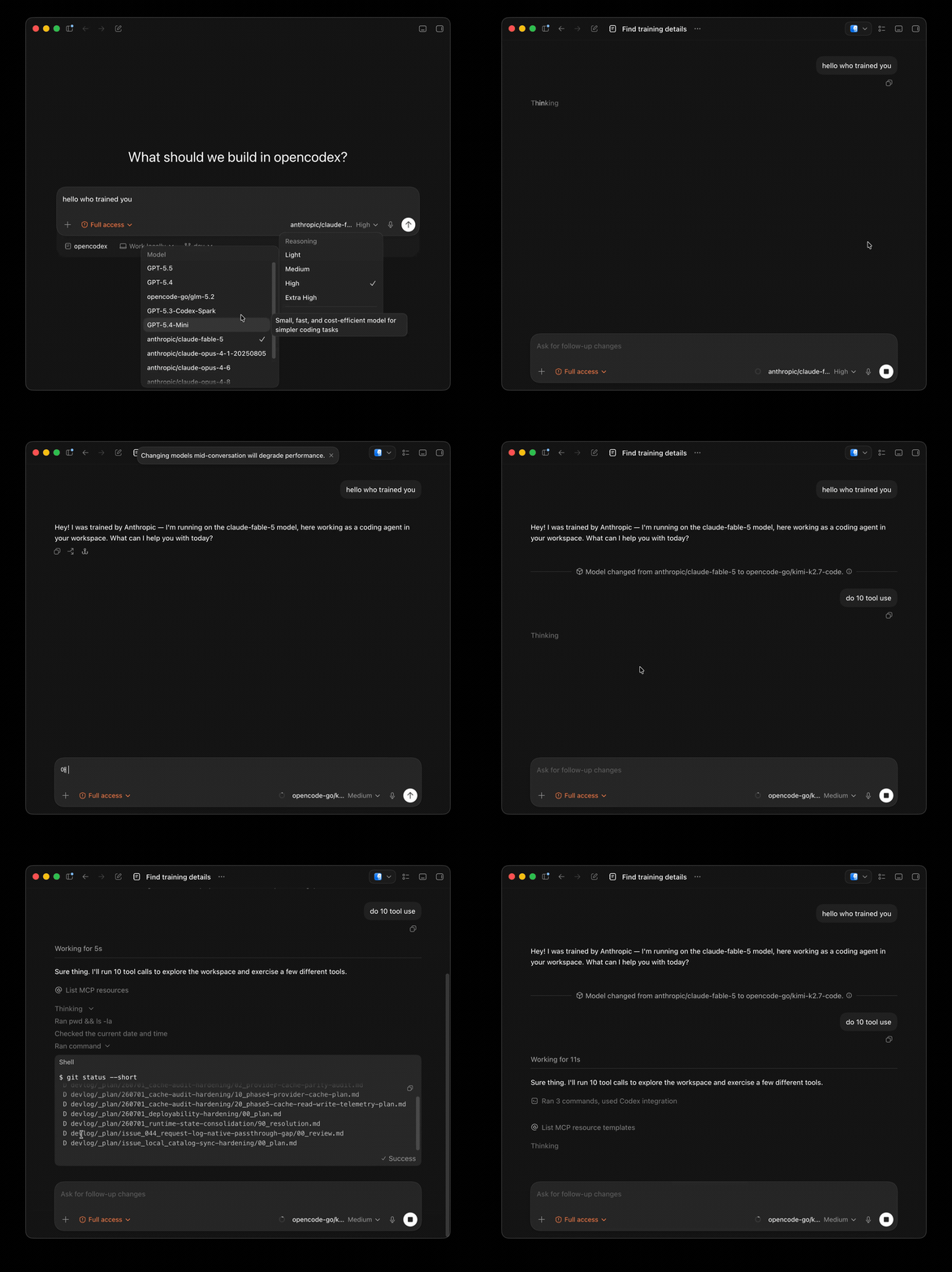
Universal provider proxy for OpenAI Codex & Claude Code — use any LLM (Claude, Gemini, Grok, DeepSeek, Ollama…) with Codex CLI, App, SDK, and Claude Code

Git-native persistent memory for AI coding agents. Implements Google OKF v0.2 with sub-300µs in-memory BM25 search, embedded MCP server, and progressive disclosure. Slashes token bloat by 80% with zero external databases or dependencies. Built in pure Go.

Stop your AI from making things up — it proposes, deterministic tools decide, every claim checked against ground truth with evidence. Grounded facts and context survive resets. Reverse engineering is the proving ground. MCP server + CLI.
x64dbg-MCP Server is a native MCP (Model Context Protocol) plugin for x64dbg that exposes the debugger's full functionality over HTTP. Connect any MCP-compatible AI assistant and control x64dbg programmatically: set breakpoints, step through code, read memory, dump registers, and more. Built with Zig — zero dependencies, single-binary output, cros