
koala73/worldmonitorConnectors
Real-time global intelligence dashboard. AI-powered news aggregation, geopolitical monitoring, and infrastructure tracking in a unified situational awareness interface
86k
OpenZIM MCP connects an agent to local ZIM archives so it can search, browse, read sections, inspect metadata, and follow links without internet access. It supports a simple one-tool mode for natural-language queries and an advanced mode with specialized tools, resources, and subscriptions.
Builders who want their agent to work from offline knowledge archives instead of raw web search.
You can ask an agent to find and summarize information from ZIM files without rehosting the content or re-explaining the source structure.
Exposes `zim_query` as one natural-language entry point that dispatches to the right archive operation.
Provides `zim_search`, `zim_get`, `zim_get_section`, `zim_browse`, `zim_metadata`, `zim_links`, and `zim_health` for finer control.
Reads ZIM format knowledge bases locally, including Wikipedia, Wiktionary, and Stack Exchange archives.
Can answer inbound link queries with `zim_links(direction="inbound")` when a link-graph sidecar is present.
Runs as a local stdio MCP server or as an HTTP service with bearer auth, CORS, and health endpoints.
Publishes `zim://` resources and live change notifications when archives appear, change, or disappear.
Adjusts retrieval behavior for archive types like Wikipedia or Stack Exchange and supports reranking and smart retrieval.
openzim-mcp --help
mkdir -p ~/zim-files
curl -fsSL -o ~/zim-files/wikipedia_en_climate_change_mini_2024-06.zim \
  https://raw.githubusercontent.com/openzim/zim-testing-suite/main/data/withns/wikipedia_en_climate_change_mini_2024-06.zim
npx @smithery/cli mcp add rye/openzim-mcp --client claude
openzim-mcp ~/zim-files

Transform static ZIM archives into dynamic knowledge engines for AI models






✨ Highlights. A lean 8-tool advanced surface (
zim_query,zim_search,zim_get,zim_get_section,zim_browse,zim_metadata,zim_links,zim_health) with a schema small enough for small-model dispatch — or one-tool Simple mode for natural-language queries. Archive-type presets auto-tune retrieval per source (Wikipedia, Stack Exchange, …), inbound link discovery answers "what links here," and native libzim introspection validates and inspects any archive. Available on Smithery and the official MCP Registry. Release notes → Docs →
OpenZIM MCP is a modern, secure, high-performance Model Context Protocol server that gives AI models structured, offline access to ZIM format knowledge archives — Wikipedia, Wiktionary, Stack Exchange, and the rest of the Kiwix Library.
Built for research assistants, knowledge chatbots, and content-analysis systems that need intelligent access to vast knowledge repositories — not just a raw text dump. Smart navigation by namespace (articles, metadata, media), structure-aware retrieval (sections, tables of contents, related articles), full-text search with suggestions and multi-archive search, and link-graph extraction to map content relationships. Cached, paginated operations keep things responsive across massive archives; comprehensive input validation and path-traversal protection keep things safe.
Streamable HTTP transport, per-entry MCP resources with live change notifications, and dual Simple / Advanced modes are all built in.
# uv (recommended — isolated CLI tool)
uv tool install openzim-mcp

# pip
pip install openzim-mcp

# Docker (multi-arch image, ghcr.io) — runs as a local stdio MCP server
docker pull ghcr.io/cameronrye/openzim-mcp
docker run -i --rm -v ~/zim-files:/data ghcr.io/cameronrye/openzim-mcp
The container defaults to stdio transport, so docker run -i speaks MCP over stdin/stdout — wire it into an MCP client the same way as the binary (see Quick start). For the long-running HTTP service (bearer auth, CORS, health endpoints), opt in at runtime with -e OPENZIM_MCP_TRANSPORT=http -e OPENZIM_MCP_HOST=0.0.0.0 -e OPENZIM_MCP_AUTH_TOKEN=… -p 8000:8000; see HTTP & Docker deployment.
Verify the install:
openzim-mcp --help
The server does nothing without an archive to read. Grab a real one — a 13.6 MB extract of English Wikipedia on climate change, from the openZIM project's own testing suite. No account, nothing to install:
mkdir -p ~/zim-files
curl -fsSL -o ~/zim-files/wikipedia_en_climate_change_mini_2024-06.zim \
  https://raw.githubusercontent.com/openzim/zim-testing-suite/main/data/withns/wikipedia_en_climate_change_mini_2024-06.zim
~/zim-files is the directory every example below points the server at — the server expands ~ itself, so it works from a shell and from a client config file alike. For full archives — Wikipedia, Wiktionary, Stack Exchange and the rest, ranging from a few hundred MB to tens of GB — browse browse.library.kiwix.org and save the .zim into the same directory. More detail, including checksums and a Windows PowerShell equivalent: Quick start.
OpenZIM MCP is listed on the Smithery registry and the official MCP Registry (as io.github.cameronrye/openzim-mcp). Add it to your MCP client with the Smithery CLI:
npx @smithery/cli mcp add rye/openzim-mcp --client claude
For a one-click Claude Desktop extension, download the openzim-mcp-<version>.mcpb asset (and its .sha256) from the latest release and double-click it. The bundle launches the version-pinned uvx openzim-mcp@<version> (so the host needs uv) and prompts for your ZIM directory. Maintainer runbook: docs/distribution.md.
Run the server in Simple mode (default — exposes one natural-language tool, zim_query):
openzim-mcp ~/zim-files
Wire it into your MCP client. Example for Claude Desktop's claude_desktop_config.json (any MCP client that speaks stdio works the same way):
{
  "mcpServers": {
    "openzim-mcp": {
      "command": "uvx",
      "args": ["openzim-mcp", "~/zim-files"]
    }
  }
}
Once the client connects, ask your LLM: "summarize the article on Photosynthesis" — zim_query dispatches to the right underlying tool automatically.
For full control, run in Advanced mode to expose all 8 specialized tools:
{
  "mcpServers": {
    "openzim-mcp-advanced": {
      "command": "uvx",
      "args": ["openzim-mcp", "--mode", "advanced", "~/zim-files"]
    }
  }
}
For HTTP transport (long-running service with bearer auth, CORS, and health endpoints) see HTTP & Docker deployment.
zim_query, zim_search, zim_get, zim_get_section, zim_browse, zim_metadata, zim_links, zim_health. Down from 22; advanced-mode schema drops from ~36KB to ~24.1KB, clearing the MCP Tax pain band. API reference →zim://{name}/entry/{path} with native MIME types; clients open a subscriptions/listen stream and get resources/list_changed when a ZIM appears or disappears, resources/updated when one is replaced. Resources, prompts & subscriptions →zim_query — one natural-language tool that dispatches to the right operation, tuned for small-model deployment targets. Quick start →OPENZIM_MCP_PRESETS_OVERRIDE_PATH).zim_health(zim_file_path=...) validates an archive's integrity (Archive.check() + checksum), and zim_metadata reports archive identity, full-text / title index capabilities, and an M/Counter mimetype breakdown. API reference →zim_links(direction="inbound") returns pages that link to an entry, ranked by linker importance. Requires a pre-built sidecar: openzim-mcp build link-graph <archive>.zim (writes <archive>.zim.linkgraph.sqlite next to the archive). API reference →OpenZIM MCP ships two modes; pick one per client.
Simple mode (default) exposes a single intelligent tool, zim_query, that parses natural-language requests and dispatches to the right underlying operation. Built for small-model deployment targets — the wire footprint is minimal and the dispatch happens server-side, not in the LLM context. Start here unless you have a specific reason not to.
Advanced mode exposes all 8 specialized tools (zim_query, zim_search, zim_get, zim_get_section, zim_browse, zim_metadata, zim_links, zim_health) plus 3 MCP prompts (/research, /summarize, /explore) and per-entry resources. Built for larger models that can reliably dispatch over the full schema, and for clients that want fine-grained control over pagination, namespace browsing, and link-graph extraction.
Rule of thumb: models ≤ 13B parameters benefit from Simple mode; larger models (Claude Sonnet/Opus, GPT-4o-class, Llama 70B+) can dispatch Advanced mode directly. See LLM integration patterns for guidance on choosing.
Full documentation lives at https://cameronrye.github.io/openzim-mcp/docs/.
| Group | Pages |
|---|---|
| Get started | Introduction · Installation · Quick start · ZIM concepts · LLM integration patterns · Worked examples |
| Concepts | Smart retrieval · Search reranking · Architecture overview |
| Reference | API reference · Configuration · Resources, prompts & subscriptions · CLI reference |
| Operate | HTTP and Docker deployment · Performance optimization · Security best practices · Troubleshooting · FAQ · Upgrading |
v3.3.2 is the current release (2026-09-09).
v2.0.0 GA shipped 2026-05-27. Per SECURITY.md, the v1.x maintenance window closed when v2.5.0 shipped (2026-06-18); all active development is on the current major line. v3.0.0 is a breaking release for HTTP subscription clients: resources/subscribe/unsubscribe are no longer served — live updates ride subscriptions/listen on the 2026-07-28 protocol revision — and link-graph sidecars built by 2.x must be rebuilt. Tools, resources, and prompts are unchanged, and legacy-handshake clients keep working. Details in CHANGELOG.md, and step-by-step instructions in the upgrade guide.
See CONTRIBUTING.md for development setup, test commands, code style, and the release process.
See SECURITY.md for the vulnerability disclosure policy. No known CVEs.
MIT. See LICENSE.
Made with ❤️ by Cameron Rye
Sign in to join the discussion.
No comments yet. Be the first to say what this is good for.
Real-time global intelligence dashboard. AI-powered news aggregation, geopolitical monitoring, and infrastructure tracking in a unified situational awareness interface
High-performance code intelligence MCP server. Indexes codebases into a persistent knowledge graph — average repo in milliseconds. 158 languages, sub-ms queries, 99% fewer tokens. Single static binary, zero dependencies.
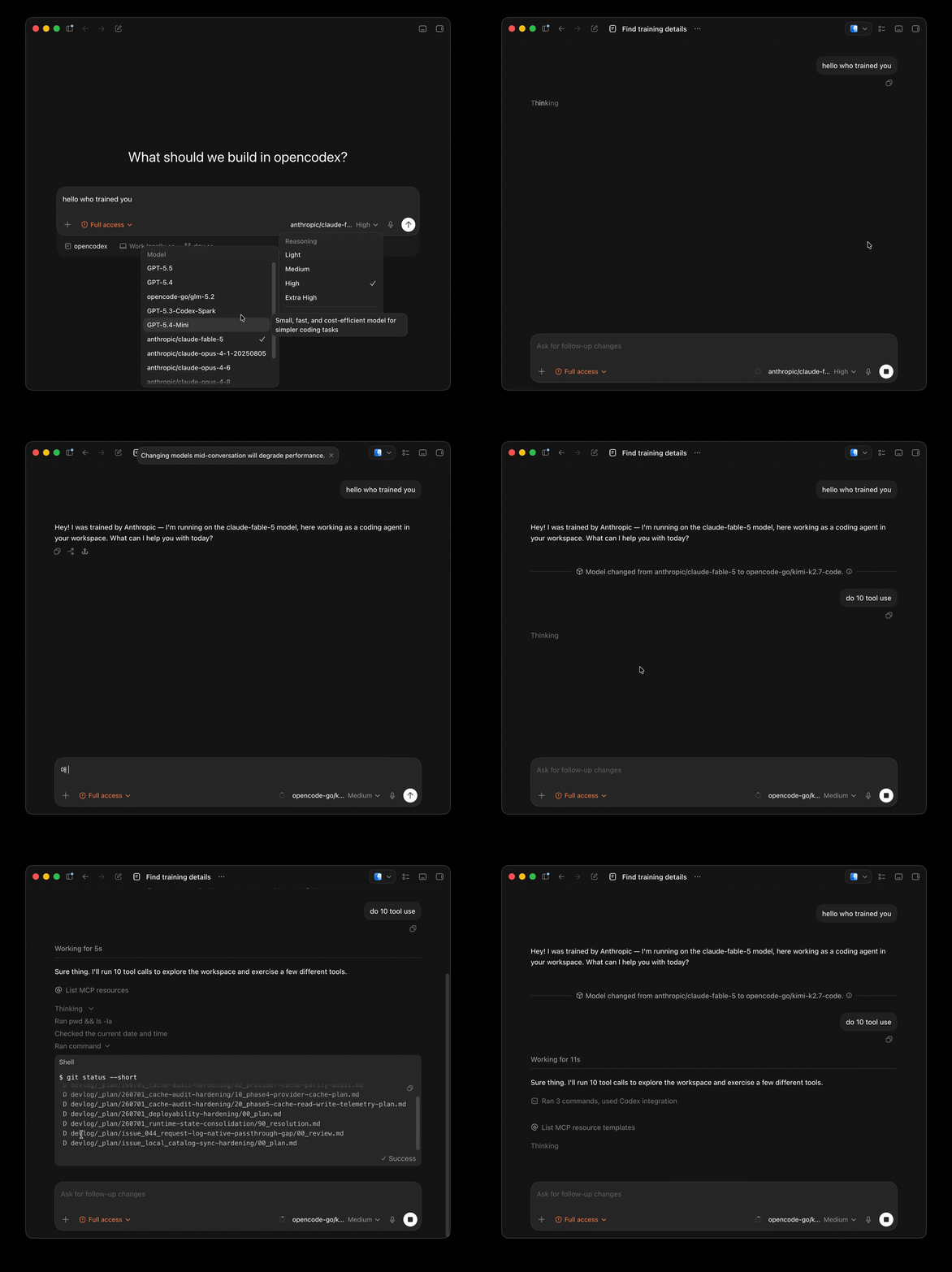
Universal provider proxy for OpenAI Codex & Claude Code — use any LLM (Claude, Gemini, Grok, DeepSeek, Ollama…) with Codex CLI, App, SDK, and Claude Code

Git-native persistent memory for AI coding agents. Implements Google OKF v0.2 with sub-300µs in-memory BM25 search, embedded MCP server, and progressive disclosure. Slashes token bloat by 80% with zero external databases or dependencies. Built in pure Go.

Stop your AI from making things up — it proposes, deterministic tools decide, every claim checked against ground truth with evidence. Grounded facts and context survive resets. Reverse engineering is the proving ground. MCP server + CLI.
x64dbg-MCP Server is a native MCP (Model Context Protocol) plugin for x64dbg that exposes the debugger's full functionality over HTTP. Connect any MCP-compatible AI assistant and control x64dbg programmatically: set breakpoints, step through code, read memory, dump registers, and more. Built with Zig — zero dependencies, single-binary output, cros